Shop Charging for a Branded Bag in Pakistan: What the Law Says
Charged for a shopping bag in Pakistan? A Peshawar court called a Rs 30 logo bag fee unfair. See what each law says and how to refuse or complain at the till.

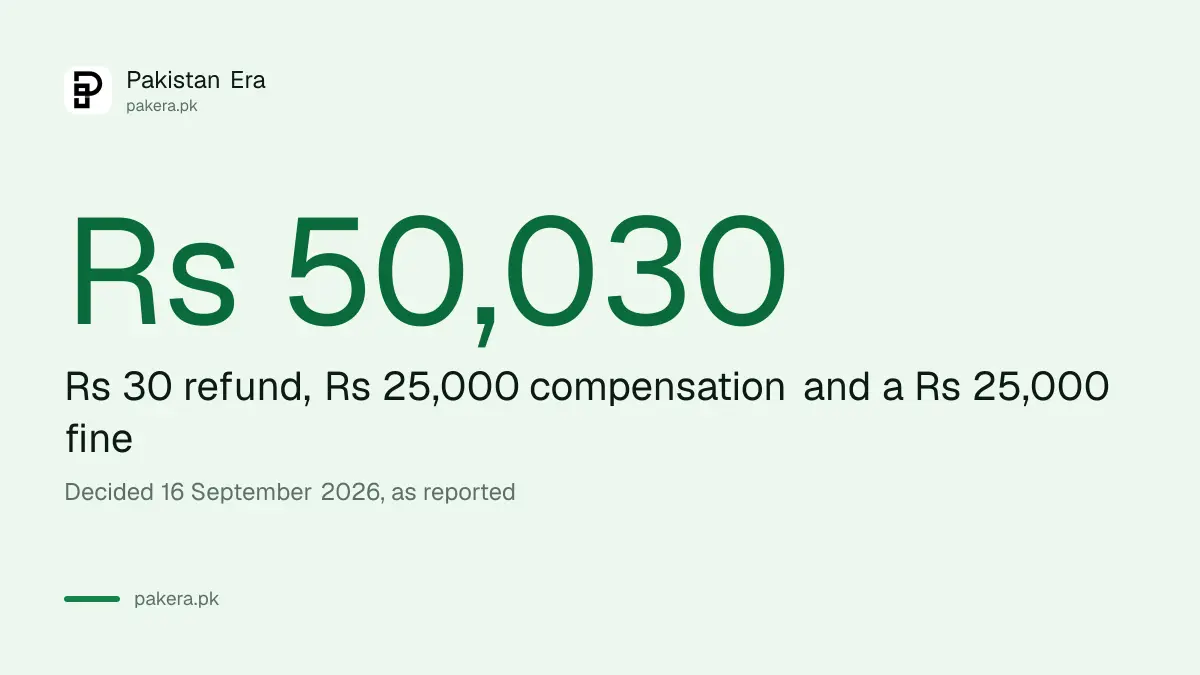
No Pakistani law we read says whether a shop may charge you for a carry bag. But in September 2026 a consumer court in Peshawar ruled that charging Rs 30 for a bag printed with the store's logo was an unfair trade practice. It ordered a refund, Rs 25,000 compensation and a Rs 25,000 fine, as reported.
So the answer depends on where you live and what kind of bag it is. A plain bag with a price shown before you pay is an ordinary sale. A logo bag added to your bill without asking is what one court has called unfair. You can always refuse the bag.
A Peshawar consumer court called the logo bag charge unfair
On 16 September 2026, the Consumer Protection Court in Peshawar decided Consumer Case 84/CC of 2026 against a national clothing brand. It held that charging a customer Rs 30 for a bag carrying the brand's logo was an unfair trade practice, as reported.
A woman bought clothes worth Rs 7,000 at the brand's Peshawar outlet in December 2025, and her receipt showed an extra Rs 30 for the bag.
The brand did not deny the charge. It argued it is not obliged to give free bags and gives them only on request. Judge Nasrullah Khan Gandapur disagreed. He said a logo bag is "obviously provided for promotion of the brand and that too at the cost of the consumers". The court ordered three things:
- Refund the Rs 30 to the customer.
- Pay her Rs 25,000 as compensation.
- Deposit a Rs 25,000 fine with the government.
We could not find the judgment on any court website, so these details are as reported. The ruling settles one case and does not bind other courts.
The KP consumer law bans hidden charges presented as free
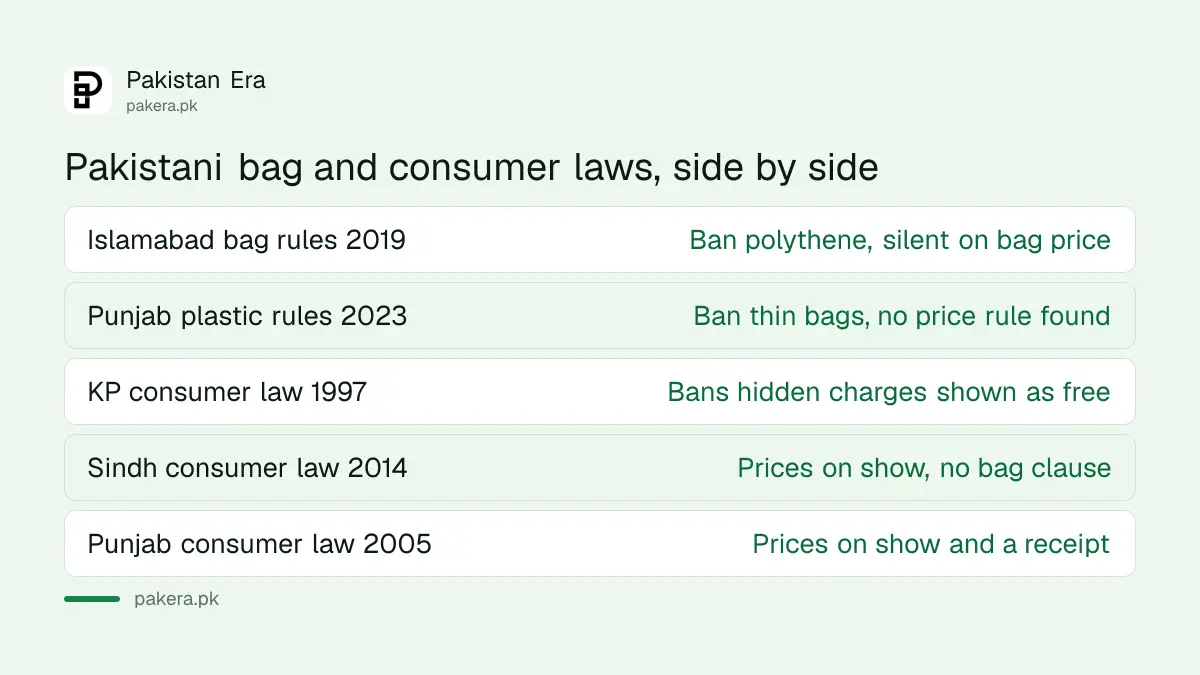
The Khyber Pakhtunkhwa Consumers Protection Act 1997 defines unfair trade practices in section 2(o) and bans them in section 7C. The court relied on clauses (xii) and (xiii), which cover false bargain offers and charges hidden behind something shown as free.
We read the Act on the KP Code website. Clause (xiii) covers "creating the impression that something is being given or offered free of charge when it is fully or partly covered by the amount charged in the transaction".
Two other sections help a shopper. Section 5 says traders must display the price of all goods for sale. Section 6 says they must give a receipt on demand, showing the goods and the price. In Peshawar, that receipt was the key evidence. Section 16 sets a minimum fine of Rs 10,000 for a breach.
Islamabad and Punjab plastic rules ban thin bags but say nothing on price
The plastic bag bans tell shops which bags they may use. They do not say whether shops may charge for them. We found no clause requiring or allowing a bag fee in the Islamabad rules or in the Punjab material we read.
Islamabad's rule is S.R.O. 92(KE)/2019, printed in the Gazette of Pakistan on 25 July 2019. It banned the sale and use of polythene bags in Islamabad from 14 August 2019. It defines a "permitted bag" as one made of jute, paper, cloth, papyrus or fully degradable material. Its fines fall on sellers, not shoppers:
| Who breaks the Islamabad bag rules | First time | Second time | More than twice |
|---|---|---|---|
| Shopkeeper, hawker or stall holder | Rs 10,000 | Rs 20,000 | Rs 50,000 |
| Manufacturer, importer or wholesaler | Rs 100,000 | Rs 200,000 | Rs 500,000 |
| Any other person involved | Rs 5,000 each time | ||
In Punjab, the Production and Consumption of Single Use Plastic Product Regulations 2023 ban shopping bags thinner than 75 microns from 5 June 2024, according to the polythene policy on the Attock district website. We could not open the regulation text itself.
Punjab and Sindh consumer laws require shown prices and a receipt
Neither the Punjab nor the Sindh consumer law mentions carry bags. Both require a shop to display the price of what it sells and to give a receipt. A bag the shop sells is one of those items, so its price should be on show before you pay.
We read the Sindh Consumer Protection Act 2014 on the Provincial Assembly of Sindh website. Section 18 says traders must "display prominently" the price of every item for sale. Section 19 requires a receipt.
The Punjab Consumer Protection Council's FAQ lists the same duties under the Punjab Consumer Protection Act 2005: section 18 on displayed prices and section 19 on receipts. These are the price display and receipt rules in Punjab.
This part is our reading, not a ruling: a bag fee added at the till, never shown on a notice, sits badly with section 18. No Punjab or Sindh court has ruled on bag charges, as far as we could find.
Courts in India have ruled against stores charging for branded bags. That is Indian law and does not bind Pakistani courts.
What to do at the till before you pay for a bag
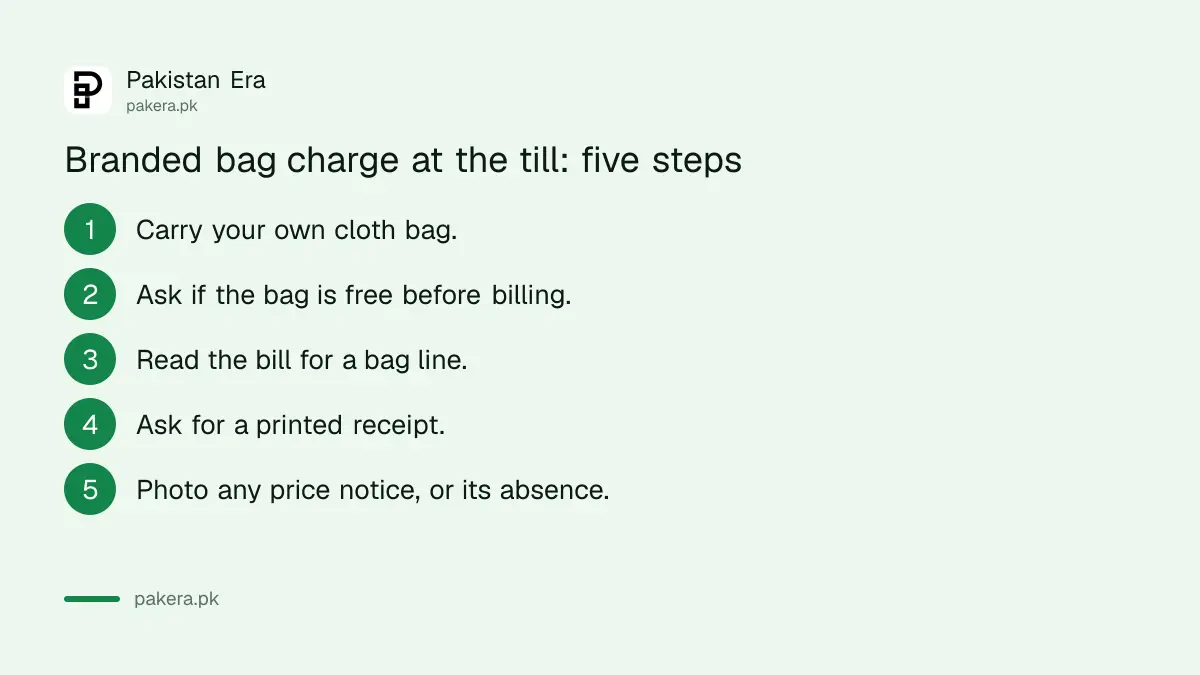
Ask before the cashier rings up your items. Say you do not want a bag, or ask what it costs. If a bag fee appears anyway, ask for it to be removed before you pay. Keep the receipt, because it is your evidence later.
- Carry your own bag. A folded cloth bag ends the question before it starts.
- Ask the price first. "Is the bag free?" takes three seconds. If it is not, you can say no.
- Read the bill before paying. Look for a line such as "carry bag" or "shopper", and ask to cancel it if you never agreed.
- Ask for a printed receipt. The law in Punjab, Sindh and KP gives you a right to one.
- Note the price notice. Photograph it, or note that there was none.
How to complain about a bag charge in Punjab, Sindh or KP
In Punjab and Sindh, a failure to display prices or give a receipt can go to the Authority on plain paper, with a fine of up to Rs 50,000. For a refund and compensation, go to the district consumer court after a written notice to the shop.
In Punjab, the Authority is the Deputy Commissioner, and no legal notice is needed for that route. Punjab also runs an online Complaint Registration Portal at consumerservice.punjab.gov.pk.
For the consumer court in Punjab, first serve a 15-day legal notice on plain paper, ideally by registered post. If the shop does not settle, file the claim within the next 15 days. The overall limit is 30 days from the problem. No court fee is charged.
In Sindh, the Authority is the Supply and Prices Department. Section 29 requires a written notice first, gives the shop 15 days to reply, and sets a 30-day limit for the claim. In KP, section 13 lets you file directly in the district consumer court, as the Peshawar shopper did.
A bag fee is not a price control case. Reporting overcharging on 0800-02345 is for essential goods such as flour, milk and vegetables, not for a Rs 30 bag.
Common questions
Is it illegal for a shop in Pakistan to charge for a carry bag?
No law we read bans it outright. One KP consumer court ruled in September 2026 that charging for a logo bag was an unfair trade practice, as reported.
Does it matter if the bag has the store's logo?
Yes, in the Peshawar case it was central. The judge said the logo bag promoted the brand at the customer's cost.
Did the polythene ban make shops charge for bags?
No. The Islamabad 2019 rules ban polythene bags and fine shops that use them. They say nothing about charging for paper or cloth bags.
Can I refuse to pay for a bag?
Yes. Say no before the bill is made and use your own bag.
Does the Peshawar ruling apply in Lahore or Karachi?
Not directly. It decided one KP case. Punjab and Sindh have their own consumer laws, and their courts are not bound by it.
How we verified this
What we checked, where we read it, and what we could not confirm.
Last checked on 1 October 2026. We read the KP Consumers Protection Act 1997 on kpcode.kp.gov.pk, the Sindh Consumer Protection Act 2014 on pas.gov.pk, the Punjab Consumer Protection Council's FAQ and filing guideline, S.R.O. 92(KE)/2019 in the Gazette of Pakistan via environment.gov.pk, and the Attock district polythene policy. The Peshawar ruling is reported only, because we could not find the judgment online. Islamabad's Consumers Protection Act 1995 is online only as a scanned image, and we did not rely on it.
About the author

Public Services and Education Journalist
Fajr Riaz is a journalist and content writer at Pakistan Era, based in Lahore. She covers the questions people meet in everyday life in Pakistan: how a public service works, what a change in the rules means, and where to find a reliable answer.