Khyber Pakhtunkhwa Property Tax: Get 30% Off Arrears by 31 December 2026
Khyber Pakhtunkhwa gives 30% off residential property tax arrears paid in one lump sum by 31 December 2026. Who qualifies, 2026-27 rates and how to pay.
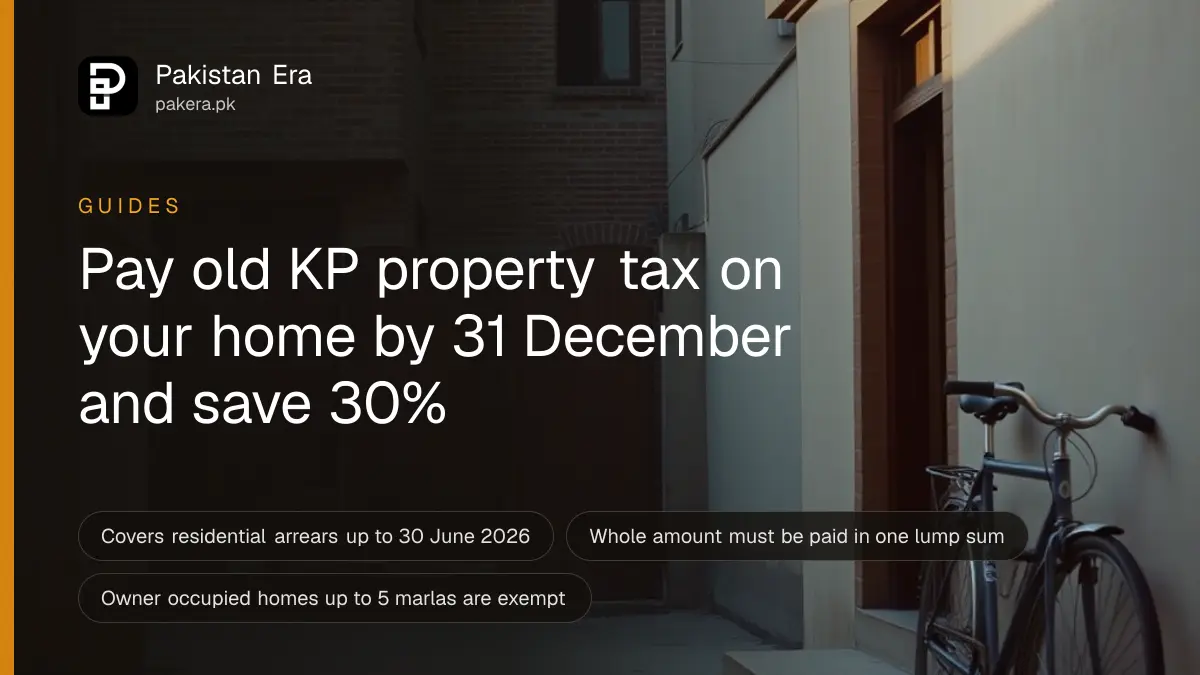
Khyber Pakhtunkhwa is cutting 30% off old property tax arrears on homes, if you pay the whole amount in one go by 31 December 2026. The rebate covers arrears up to 30 June 2026 on all residential properties. Miss the date and you pay the full arrears plus a penalty.
The rebate is law, not a promise. We read it in section 2 of the Khyber Pakhtunkhwa Finance Act, 2026, printed in the provincial Gazette on 2 July 2026 and in force from 1 July. It adds a new clause to section 4 of the West Pakistan Urban Immovable Property Tax Act, 1958, the law behind property tax in KP's towns and cities.
The same Act also gives the Excise, Taxation and Narcotics Control Department two new ways to recover unpaid tax: sealing a property and freezing bank accounts. So for anyone with an old bill, this is the cheapest moment to clear it.
Who gets the 30% property tax rebate in KP
Owners of residential property in KP's rating areas who owe property tax for any period up to 30 June 2026. The rebate applies only when you clear all outstanding arrears in one lump sum on or before 31 December 2026. Commercial property is not covered.
| Point | What the Finance Act, 2026 says |
|---|---|
| Rebate | 30% of outstanding arrears |
| Property type | All residential properties |
| Arrears covered | Accrued up to 30 June 2026 |
| How to pay | Lump sum, the whole amount at once |
| Last date | 31 December 2026 |
| After the date | Original amount plus penalty under section 15 |
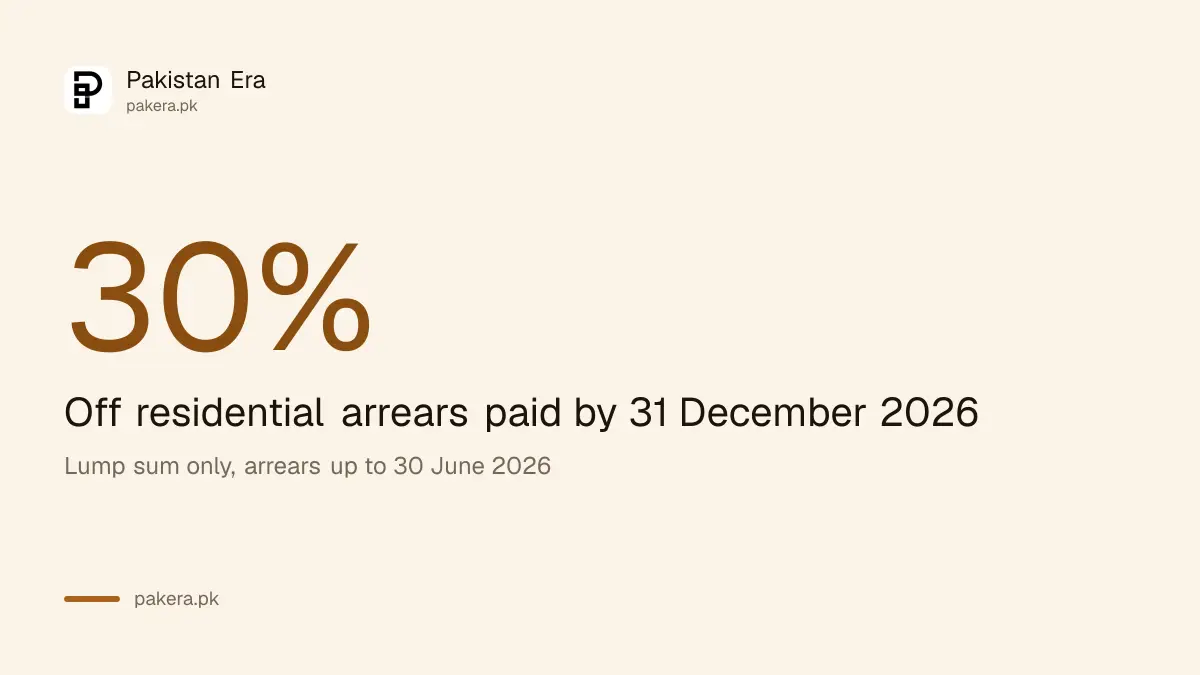
The maths is simple. Arrears of Rs 30,000 become Rs 21,000. Arrears of Rs 100,000 become Rs 70,000. The rebate is on old arrears, not on this year's tax for 2026-27, which you still owe in full.
Part payment does not count. The clause says "lumpsum payment of outstanding arrears", so paying half now and half in January loses the rebate on both halves.
Homes that pay no property tax at all
A house of up to 5 marlas that the owner lives in is exempt everywhere in KP. The Finance Act, 2026 also raised the old limit from 4.99 to 5 marlas. If your home is exempt, you should have no arrears to clear.
- Up to 5 marlas, self occupied: exempt in every rating area, under the new Schedule-I. The department's copy of the Act asks for an affidavit that you own no other house in the same rating area.
- Widows: the Act exempts one residential building owned and occupied by a widow in each rating area.
- Up to 5 marlas, rented out: not exempt. Schedule-I charges it Rs 1,200 to Rs 2,000 a year outside Peshawar.
Fraud is costly here. The Act sets a penalty of five times the tax for anyone who wrongly claims the 5 marla exemption.
Property tax rates for homes in KP for 2026-27
Yearly residential rates now run from Rs 1,200 for a small rented house in a district town to Rs 40,000 for a house over 40 marlas in a divisional headquarters township. In Peshawar the tax is charged per marla: Rs 1,000, Rs 800 or Rs 500 by area category.
| House size | Divisional HQ, township | District HQ, township | Other districts, outside townships |
|---|---|---|---|
| Up to 5 marlas, owner lives there | Exempt | Exempt | Exempt |
| Up to 5 marlas, not self occupied | Rs 2,000 | Rs 1,600 | Rs 1,200 |
| 5 to 10 marlas | Rs 3,000 | Rs 2,000 | Rs 1,500 |
| 10 to 15 marlas | Rs 3,500 | Rs 3,000 | Rs 2,000 |
| 15 to 18 marlas | Rs 4,700 | Rs 3,500 | Rs 2,500 |
| 18 to 20 marlas | Rs 15,000 | Rs 7,000 | Rs 5,000 |
| 20 to 30 marlas | Rs 25,000 | Rs 10,000 | Rs 6,000 |
| 30 to 40 marlas | Rs 30,000 | Rs 20,000 | Rs 10,000 |
| Over 40 marlas | Rs 40,000 | Rs 25,000 | Rs 15,000 |
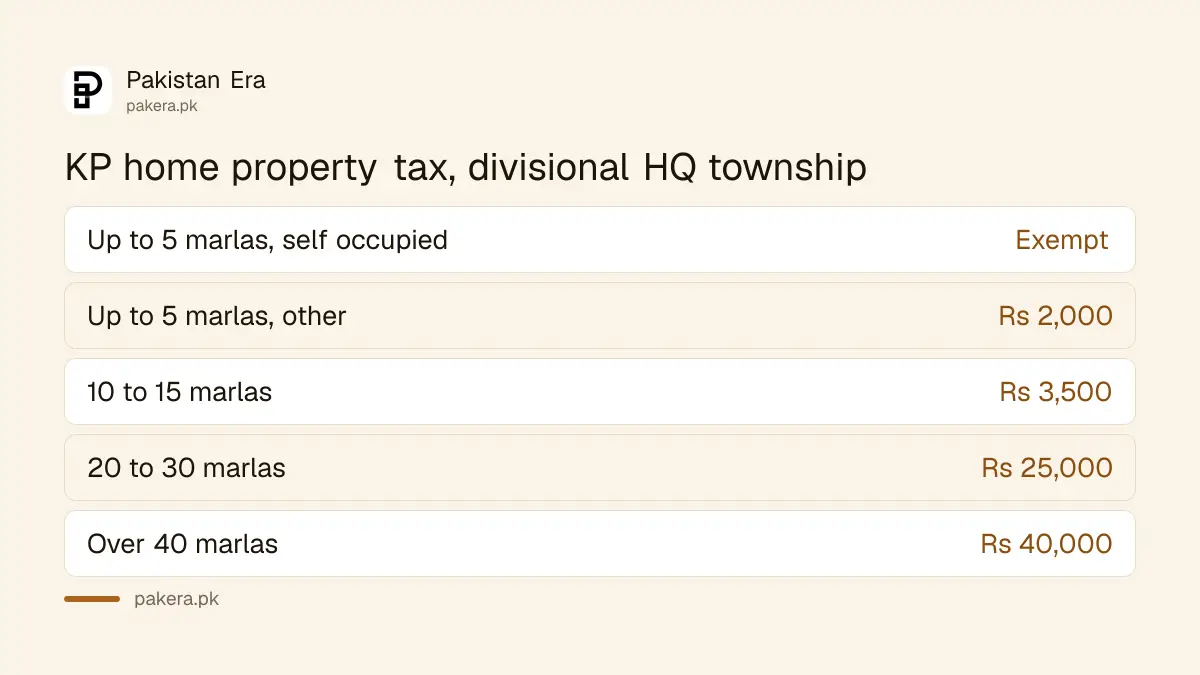
Schedule-I has more columns than we can fit here: outside townships at divisional headquarters, suburban areas of divisional headquarters, and townships in other districts. For Peshawar, the provincial headquarters, houses above the exempt band pay per marla, with the government deciding which areas fall in category A, B or C.
Renting out changes the bill. Part-B of Schedule-I says a home let on rent or lease, and not used by its registered owner, pays double these rates. That is separate from the federal tax on rental income, which FBR collects.
How to clear your property tax arrears with the rebate
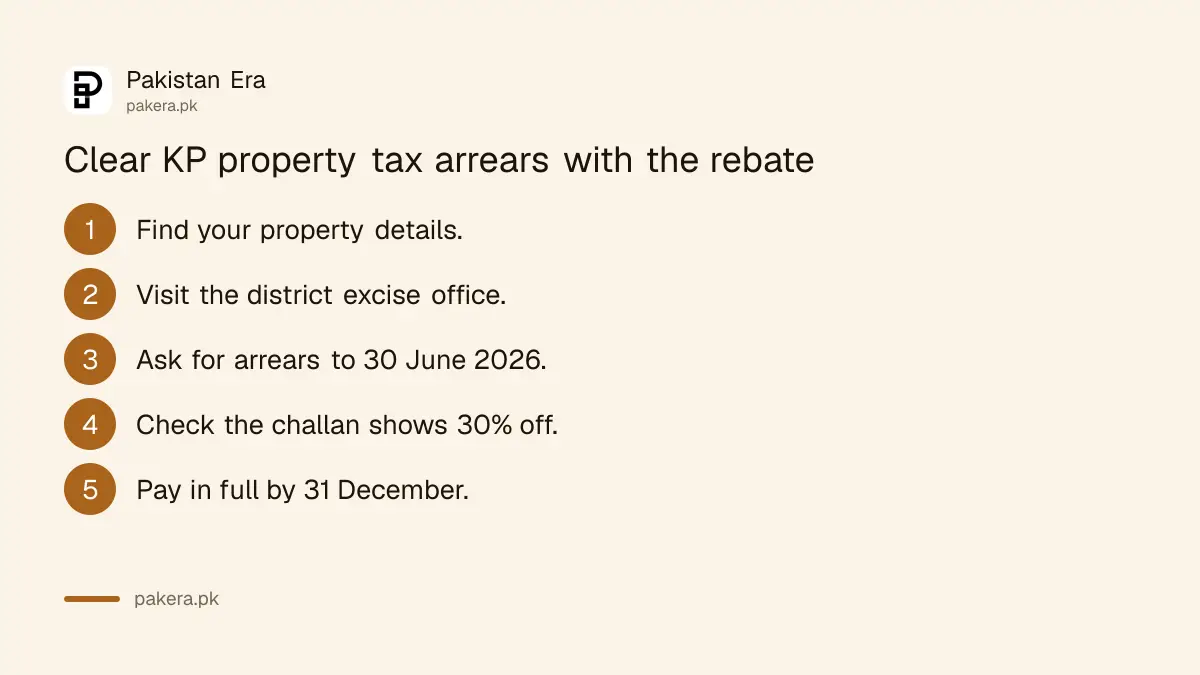
Ask your district excise and taxation office for a statement of arrears up to 30 June 2026. Get a challan with the 30% rebate applied. Pay the whole amount at a treasury or authorised bank branch before 31 December, and keep the stamped receipt.
- Find your property's details: owner name, address and the property number on any old demand notice.
- Visit the District Excise and Taxation Officer for your area. Under the 1958 rules, this officer is the assessing authority for property tax.
- Ask for the total arrears up to 30 June 2026, and a separate figure for 2026-27.
- Ask for the challan to show the 30% rebate on arrears. Check the figure before you pay.
- Pay at a treasury or a bank branch authorised to accept government money. Keep the stamped copy safe.
We could not find an online payment option for property tax on the department's website. Its homepage links to an apps site, apps.kpexcise.gov.pk, which did not load for us on 3 October 2026. That may be a local block rather than an outage, so try it, but plan for a visit.
Living in a cantonment is different. Property in Peshawar Cantonment and other cantonments is taxed by the cantonment board, not the province, so pay through the cantonment board property tax system instead. Before you pay, confirm the land is in your name with a KP land record check.
What happens if you miss 31 December
You lose the 30% rebate and owe the full arrears plus the penalty in section 15 of the 1958 Act. The 2026 amendments also let the department seal your property or attach bank accounts to recover unpaid tax.
- Penalty: section 15 lets the assessing authority add a penalty of up to the unpaid tax, after a notice, if it finds the default was wilful.
- Recovery: unpaid tax and penalty can be recovered by warrant, by sale of movable property and as arrears of land revenue.
- New from 1 July 2026: sealing the immovable property, or attaching the bank accounts of the owner, tenant or leaseholder.
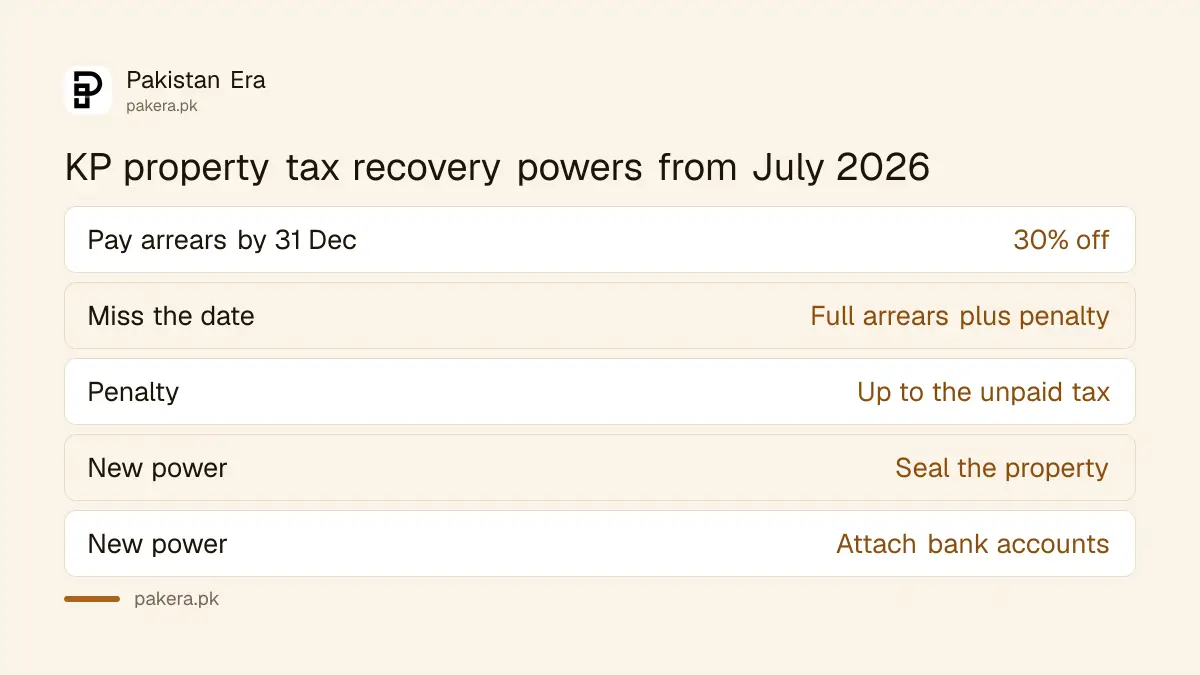
Tenants should note that last point. The new clause names the tenant's bank account as well as the owner's. If you rent, ask your landlord whether the tax is paid. Sindh and Punjab run their own systems, with Sindh property tax paid to Sindh's excise department.
Common questions
What is the last date for the KP property tax rebate?
31 December 2026. The full arrears must be paid in one lump sum by then to get 30% off.
Does the 30% rebate apply to commercial property in KP?
No. The Finance Act, 2026 limits it to residential properties. Hotels have a separate 20% rebate on arrears under the hotel tax, also until 31 December 2026.
Is a 5 marla house exempt from property tax in KP?
Yes, if the owner lives in it. A 5 marla house that the owner does not live in pays tax.
Does the rebate cover this year's property tax?
No. It covers arrears up to 30 June 2026 only. Tax for 2026-27 is due in full.
Can I pay KP property tax online?
We could not confirm an online channel. Pay at a treasury or authorised bank branch with a challan from your district excise and taxation office.
Can the government seal my house for unpaid property tax?
Yes. From 1 July 2026 the law allows sealing the property or attaching bank accounts to recover unpaid property tax.
How we verified this
What we checked, where we read it, and what we could not confirm.
Last checked on 3 October 2026. The 30% rebate, its 31 December 2026 deadline, the 30 June 2026 cut off, the change from 4.99 to 5 marlas, the sealing and bank attachment powers, the hotel arrears rebate and the 2026-27 residential rates in Schedule-I are read in the Khyber Pakhtunkhwa Finance Act, 2026, Khyber Pakhtunkhwa Government Gazette, Extraordinary, 2 July 2026, published on the KP Finance Department website. The exemptions, the five times penalty for false claims, section 15 and section 16 are read in the Urban Immovable Property Tax Act, 1958 as published by the KP Excise, Taxation and Narcotics Control Department, and the assessing authority and challan steps in the department's copy of the 1958 rules. We did not pay a bill ourselves.
About the author

Tax, Bills and Technology Writer
Ali Akhtar is a young and curious voice here at Pakistan Era. He is currently pursuing his A-Levels and has a growing interest in Pakistan’s changing industrial landscape and educational trends. Ali likes to write in a way that helps him explain and explore the world around him. His writing reflects the perspective of the new generation navigating the evolving trends of Pakistan where technology, youth innovation, and shifting opportunities are reshaping the country’s future.