LESCO Bill Estimator: Calculate Your Electricity Bill by Units Online, With Our Results for 100 to 700 Units
We tested LESCO's free bill estimator: 100 units came to Rs 3,780 and 200 units Rs 8,520 by due date. How to use it, what each line means and when it is wrong.
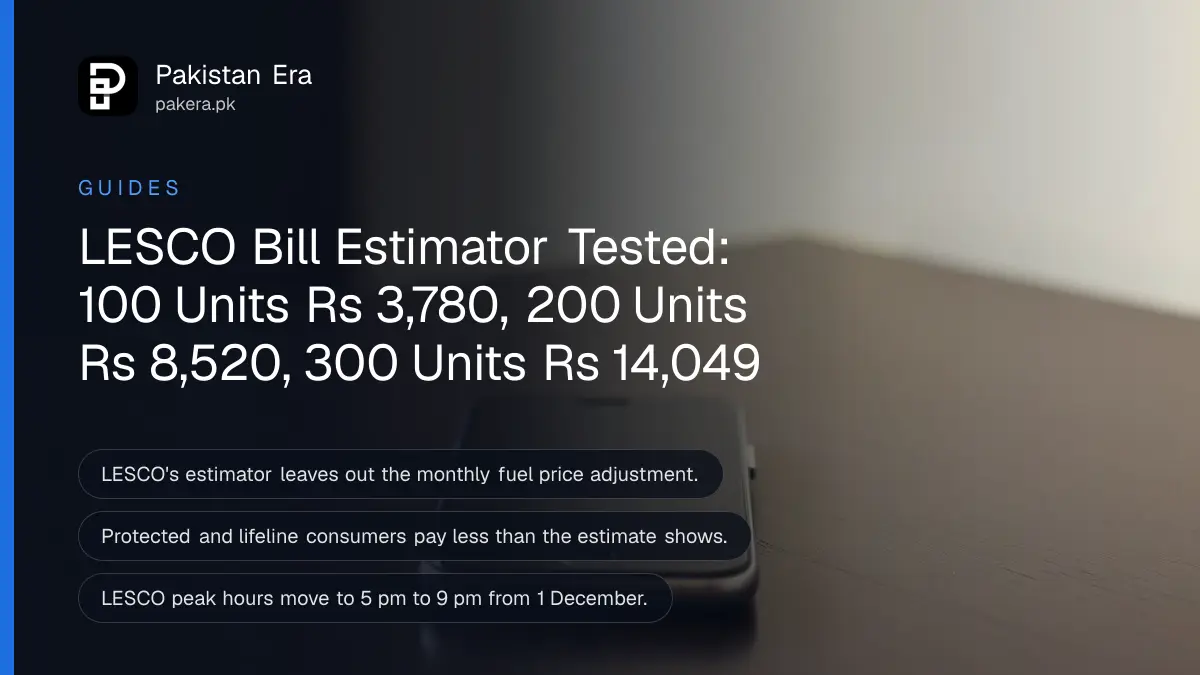
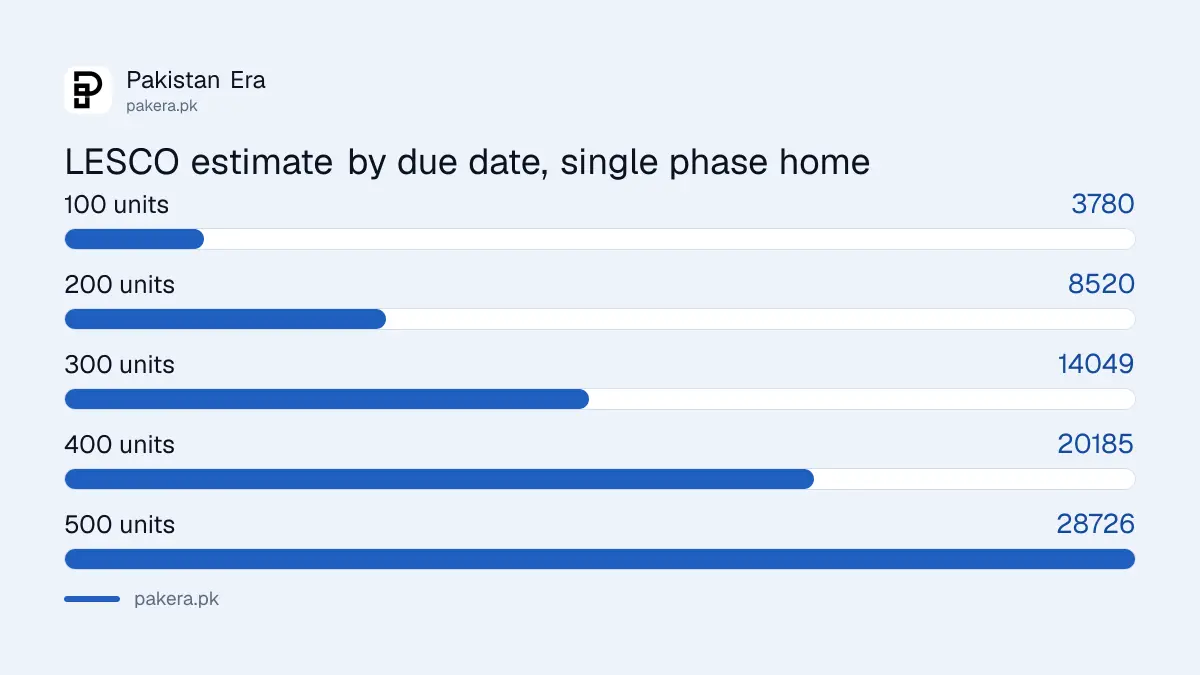
LESCO's own bill estimator works out your electricity bill from the units you used, free, on lesco.gov.pk. We tested it on 5 November 2026 for a single-phase home on the non-protected tariff. It put 100 units at Rs 3,780, 200 units at Rs 8,520 and 300 units at Rs 14,049 if paid by the due date. It leaves out the monthly fuel price adjustment, so your real bill can be higher or lower.
Below: how to open the estimator, what to fill in each box, our results from 100 to 700 units, what each line of the result means, and the three cases where the estimate will not match your bill.
Open LESCO's estimator and fill in five boxes
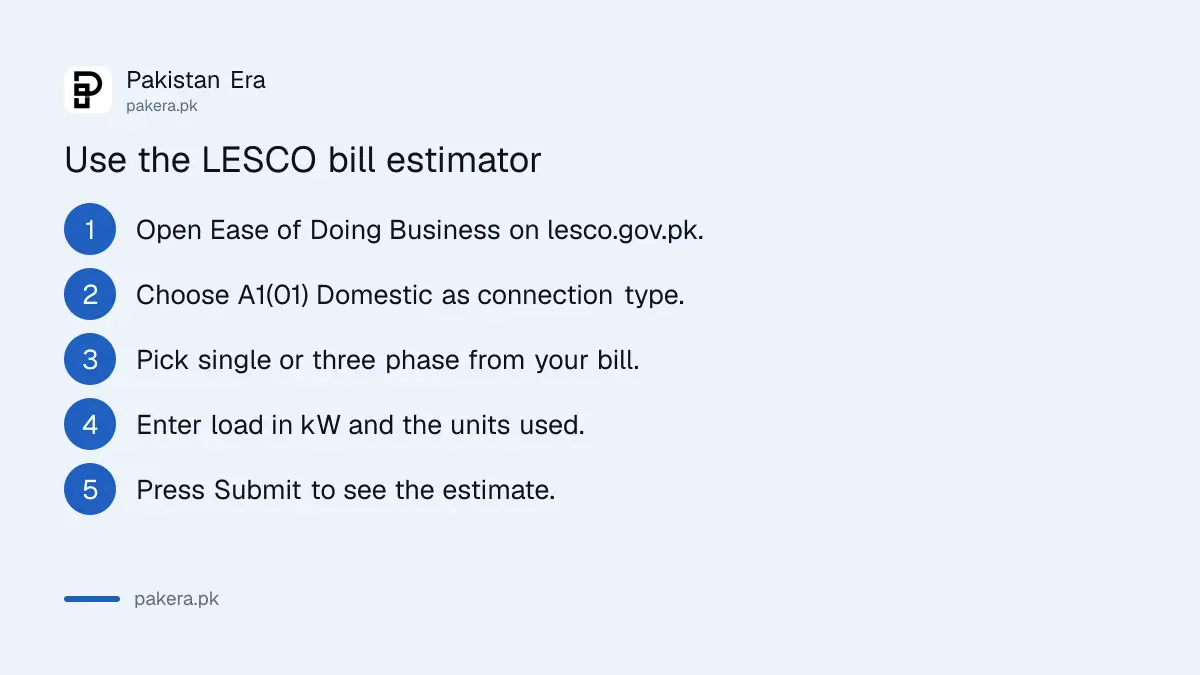
The estimator sits under "Ease of Doing Business" on the LESCO website, as "Bill estimator". It opens a form with a connection type, phase, load and units. For a normal home you only need five fields.
- Go to lesco.gov.pk, open "Ease of Doing Business" and click "Bill estimator".
- Under connection type, choose A1(01) Domestic for an ordinary house.
- Choose Single Phase or Three Phase, as printed on your bill.
- Enter your sanctioned load in kW, from the bill, and the units used in the off-peak box.
- Leave arrears and instalment at 0 unless you have them, then press Submit.
The result appears on a new page. It shows the cost of electricity, each tax, fixed charges, the total payable by the due date and the total after the due date.
Our test results from 100 to 700 units
We ran the estimator six times for a single-phase domestic connection with a 2 kW load, no arrears and no TV set. The table shows what it returned. Late payment adds about 8 per cent.
| Units in the month | Bill by due date | Bill after due date |
|---|---|---|
| 100 | Rs 3,780 | Rs 4,097 |
| 200 | Rs 8,520 | Rs 9,233 |
| 300 | Rs 14,049 | Rs 15,224 |
| 400 | Rs 20,185 | Rs 21,873 |
| 500 | Rs 28,726 | Rs 30,961 |
| 700 | Rs 42,767 | Rs 46,094 |
The jump is steep. Going from 200 to 300 units adds about Rs 5,500, and from 400 to 500 adds about Rs 8,500. That is because each slab above 200 units has a higher rate per unit, as our list of electricity slab rates for 2026 shows.
What each line of the estimate means
For 200 units, the estimator split the Rs 8,520 like this. The same lines appear on a real LESCO bill.
| Line on the estimate | 200 units | What it is |
|---|---|---|
| Total cost of electricity | Rs 5,782 | Units times the slab rate |
| Fixed charges | Rs 600 | A monthly charge set by tariff |
| FC surcharge | Rs 646 | Financing cost surcharge per unit |
| General sales tax | Rs 1,300 | Federal sales tax on the bill |
| AQTA (Q-Trf-Adj) | Rs 103.88 | Quarterly tariff adjustment |
| Electricity duty | Rs 88.29 | Provincial duty |
Lines such as PTV fee, advance income tax and instalment showed blank in our test because we chose no TV and no instalment. If your bill shows a PTV fee, set the number of TV sets in the form.
Three cases where your bill will not match the estimate
The estimator is a fair guide, but it is not your bill. LESCO's own note under the result names two gaps, and there is a third.
- Fuel price adjustment is not included. The note says "Bill Estimator does not include FPA". This charge per unit changes every month. Our list of the FCA in every 2026 bill gives the current rate.
- Protected and lifeline consumers get lower rates. The note says values "will be different" for them. If you used 200 units or less in each of the last six months, read our guide to the protected consumer rule.
- A long billing month changes the slab. If your reading was taken after more than 30 days, units are split pro rata. Our guide to 33-day bills and pro rata explains it.
Peak and off-peak boxes are for time-of-use meters
The estimator has separate boxes for peak and off-peak units. These matter only if you have a time-of-use meter, which is usual for three-phase homes and businesses. A single-phase home enters all units as off-peak.
LESCO's tariff page sets peak hours by season. From September to November they are 6 pm to 10 pm. From December to February they move to 5 pm to 9 pm. All other hours are off-peak. So from 1 December, a three-phase home should move heavy use, such as an electric heater or washing machine, out of the 5 pm to 9 pm window.
| Season | Peak hours on LESCO's tariff page |
|---|---|
| December to February | 5 pm to 9 pm |
| March to May | 6 pm to 10 pm |
| June to August | 7 pm to 11 pm |
| September to November | 6 pm to 10 pm |
Our guide to electricity peak hours in Pakistan covers the other companies.
Common questions
Where is the LESCO bill estimator?
On lesco.gov.pk under Ease of Doing Business, as "Bill estimator". It is free and needs no login.
How much is a LESCO bill for 200 units?
The estimator gave Rs 8,520 by the due date for a non-protected single-phase home on 5 November 2026, before the fuel adjustment.
Does the LESCO estimator include FPA?
No. LESCO's note says the estimator does not include the fuel price adjustment, so add the month's rate yourself.
Is the estimate right for protected consumers?
No. LESCO says values will be different for lifeline and protected consumers, whose rates are lower.
What are LESCO peak hours in November 2026?
6 pm to 10 pm, per LESCO's tariff page. They change to 5 pm to 9 pm from December to February.
How do I check my real bill?
Enter your 14-digit reference number on LESCO's bill page; see our guide to checking a LESCO bill online.
How we verified this
What we checked, where we read it, and what we could not confirm.
Last checked 5 November 2026. We ran the LESCO bill estimator six times, for A1(01) domestic, single phase, 2 kW load, 100, 200, 300, 400, 500 and 700 off-peak units, no arrears, no TV. Peak hours are from the LESCO electricity tariffs page. LESCO can change the estimator's rates without notice, so run it yourself before you rely on a figure.
About the author

Tax, Bills and Technology Writer
Ali Akhtar is a young and curious voice here at Pakistan Era. He is currently pursuing his A-Levels and has a growing interest in Pakistan’s changing industrial landscape and educational trends. Ali likes to write in a way that helps him explain and explore the world around him. His writing reflects the perspective of the new generation navigating the evolving trends of Pakistan where technology, youth innovation, and shifting opportunities are reshaping the country’s future.