Mpox Symptoms in Pakistan: Spot the Rash, Isolate and Get a PCR Test
Mpox symptoms in Pakistan: fever, swollen glands and a rash that blisters then crusts. What to do at home, who is at high risk and how to get a PCR test.
Mpox usually starts with fever, headache, body aches and swollen glands, followed by a rash that turns from flat sores into blisters and then crusts. Symptoms begin within about a week of contact, but can take up to 21 days, and last 2 to 4 weeks. If you have this rash, stay in your own room, cover the sores, and see a doctor for a PCR swab test taken from the rash.
That is the World Health Organization's guidance, and it is what matters if you are worried right now. Sindh has reportedly recorded 93 confirmed mpox cases and 11 deaths so far in 2026, most of them in Karachi, Khairpur and Sukkur. We could not find those figures on the Sindh Health Department's own website, so treat them as reported, not official.
Below are the signs to look for, the steps to take at home, and who is at higher risk.
Mpox symptoms: the rash comes with fever and swollen glands
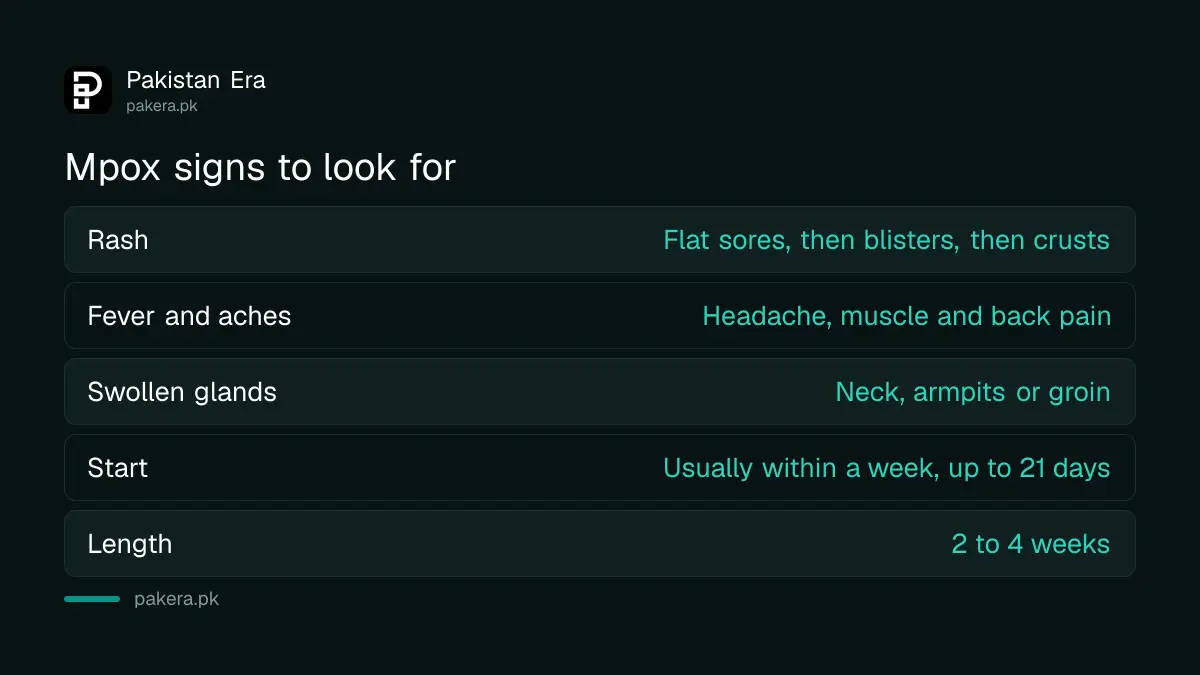
The rash is the sign most people notice. According to WHO, it starts as a flat sore, becomes a blister filled with liquid that can itch or hurt, and then dries up, crusts and falls off. The other common symptoms are fever, sore throat, headache, muscle aches, back pain, low energy and swollen lymph nodes.
Swollen lymph nodes are lumps under the jaw, in the neck, armpits or groin. Not everyone gets every symptom. Some people have only a few sores.
| Stage | What you see | When |
|---|---|---|
| After contact | Nothing yet | Usually up to a week, can be 1 to 21 days |
| Early illness | Fever, headache, body and back aches, low energy, swollen glands | Around the time the rash starts |
| Rash | Flat sores that turn into fluid-filled blisters | Over the following days |
| Healing | Blisters dry, crust over and fall off | Illness lasts 2 to 4 weeks in total |
| Safe to mix again | All scabs gone, new skin underneath | End of illness |
Mpox spreads through close contact, not across a room
Mpox passes mainly through close contact with someone who has it, including people in the same household. WHO lists skin-to-skin contact, touching, sex, kissing and face-to-face contact. It can also spread through contaminated clothing or bedsheets, and through needle injuries in health care or tattoo shops.
That makes the home the main risk. A family member who shares a bed, towels or clothes with a sick person is far more exposed than a colleague in the same office. Pregnant women can also pass the virus to the baby.
What to do if you think you have mpox
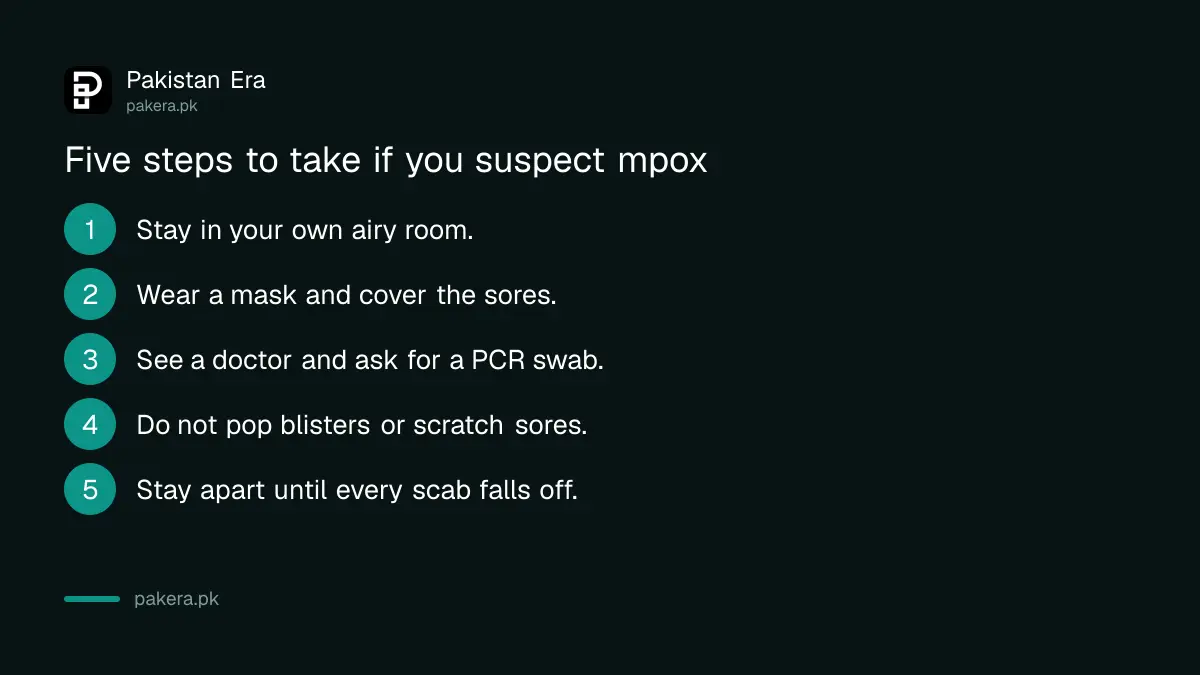
Act early, and keep others away from your sores until a doctor has seen you. These steps follow WHO's advice for people with mpox:
- Stay in your own room, with a window open if possible. Use separate towels, plates and bedding.
- Wear a mask and cover the sores with clothing or a bandage when anyone else is near.
- See a doctor at a government hospital or your clinic. Call ahead if you can, and tell them about the rash before you arrive.
- Get a PCR test. The best sample is a swab taken from the rash itself, from the skin, fluid or crust.
- Do not pop blisters or scratch the sores. That slows healing and can cause infection.
- Use saltwater rinses for sores in the mouth, and paracetamol for pain if it suits you.
- Stay apart until every scab has fallen off and fresh skin has formed. That is when you stop being infectious.
Wash clothes and bedsheets used by the sick person separately, and wash your hands after handling them. Clean the room the patient uses.
Children, pregnant women and people with weak immunity face more risk
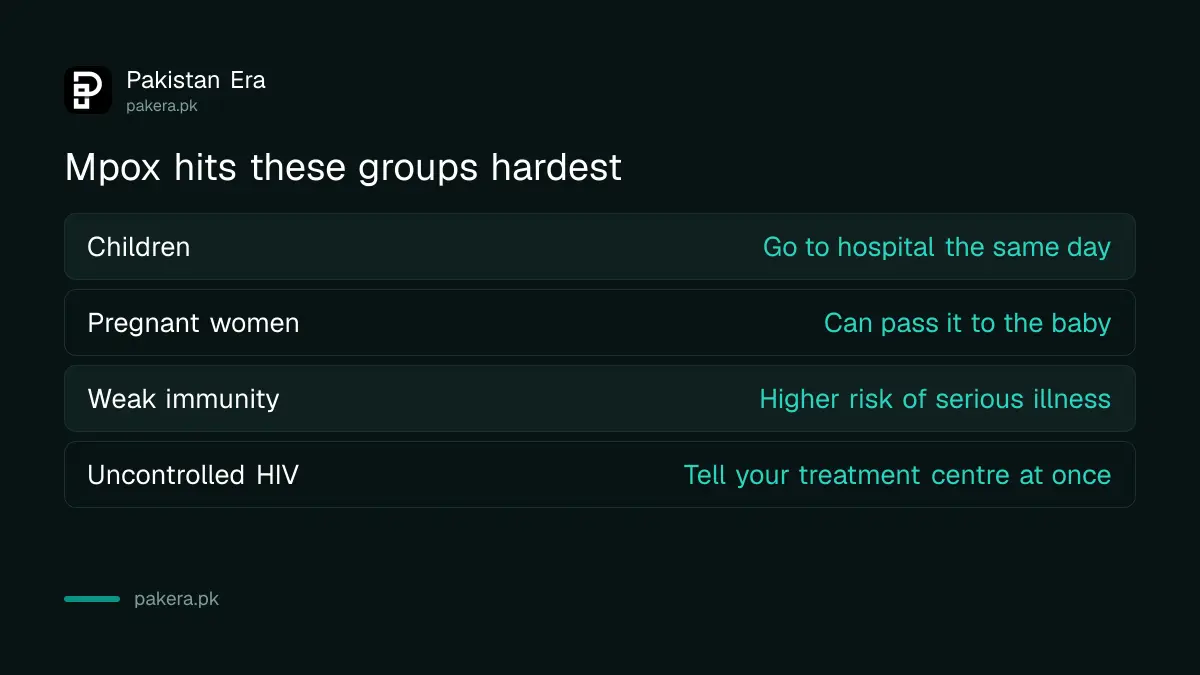
WHO says children, pregnant women and people with weak immune systems, including people with HIV that is not under control, are at higher risk of serious illness or death. For them, do not wait to see whether the rash settles. Go to a hospital the same day.
Karachi has had earlier HIV clusters, including the HIV outbreak traced to a hospital in Valika and Landhi. Anyone with HIV who develops a new rash should tell their treatment centre straight away.
As general care advice, get urgent help if a patient has trouble breathing, confusion, sores in or near the eyes, cannot eat or drink, or if a baby or young child has the rash with a fever.
Testing, treatment and vaccines in Pakistan
Mpox is confirmed by a PCR test, which detects the virus's genetic material. A rash on sight alone is not enough. Chickenpox, scabies and some other conditions can look similar. Fever with a rash and painful joints can also point to chikungunya, which is often confused with dengue.
There is no proven antiviral for most patients, according to WHO. Treatment is supportive: care for the skin, pain relief, fluids and watching for complications. Most people recover in 2 to 4 weeks.
WHO recommends vaccination for people at high risk, especially during an outbreak, and says a vaccine given within 4 days of contact can help. We found no official notice of a public mpox vaccination drive in Pakistan. Do not pay anyone offering an "mpox vaccine" privately without a doctor's advice.
The National Institute of Health in Islamabad lists an mpox advisory among its public health advisories, and reports provincial disease data in its weekly surveillance bulletins. The latest bulletin we opened, for week 38 of 2026, did not include mpox figures.
Common questions
What are the first symptoms of mpox?
Often fever, headache, muscle and back aches, low energy and swollen glands, then a rash. WHO says symptoms usually start within a week of contact.
How long does mpox last?
Usually 2 to 4 weeks. You stay infectious until all scabs have fallen off and new skin has formed.
How is mpox tested in Pakistan?
With a PCR test on a swab taken from the rash. A doctor at a government hospital can arrange the sample.
Is there an mpox vaccine in Pakistan?
We found no official notice of public mpox vaccination in Pakistan. WHO recommends vaccines for high-risk people during outbreaks.
How many mpox cases does Sindh have?
Sindh has reportedly recorded 93 confirmed cases and 11 deaths in 2026. We could not confirm these figures on an official page.
Can mpox spread through the air?
It spreads mainly through close contact, including face-to-face contact, touching, kissing and shared clothes or bedding.
How we verified this
What we checked, where we read it, and what we could not confirm.
Last checked on 10 October 2026. Symptoms, timings, spread, testing, home care and risk groups are from the World Health Organization's mpox fact sheet. We also checked the National Institute of Health's advisories page and its week 38 bulletin on nih.org.pk. The Sindh case and death figures are reported in the press and are not on the Sindh Health Department's website, so we mark them as reported. This page is general health information, not a diagnosis. See a doctor if you have symptoms.
About the author

Senior Writer, Public Services and Technology
Shahid joined us in 2024 as an author. He is a senior contributor to Pakistan's leading technology websites. He writes detailed articles, mostly covering his expertise in the latest tech, mobiles, apps, gadgets, and step-by-step guides. His ideology is to help people understand the latest trends and explain complex methods through very easy-to-understand guides.