Pakistan's Emigration Policy 2026 Plans Rs 2 Million Insurance for Workers Abroad
We read Pakistan's 76-page National Emigration and Welfare Policy 2026. Rs 2 million insurance, a call centre and age 25 for maids are planned, not rules yet.
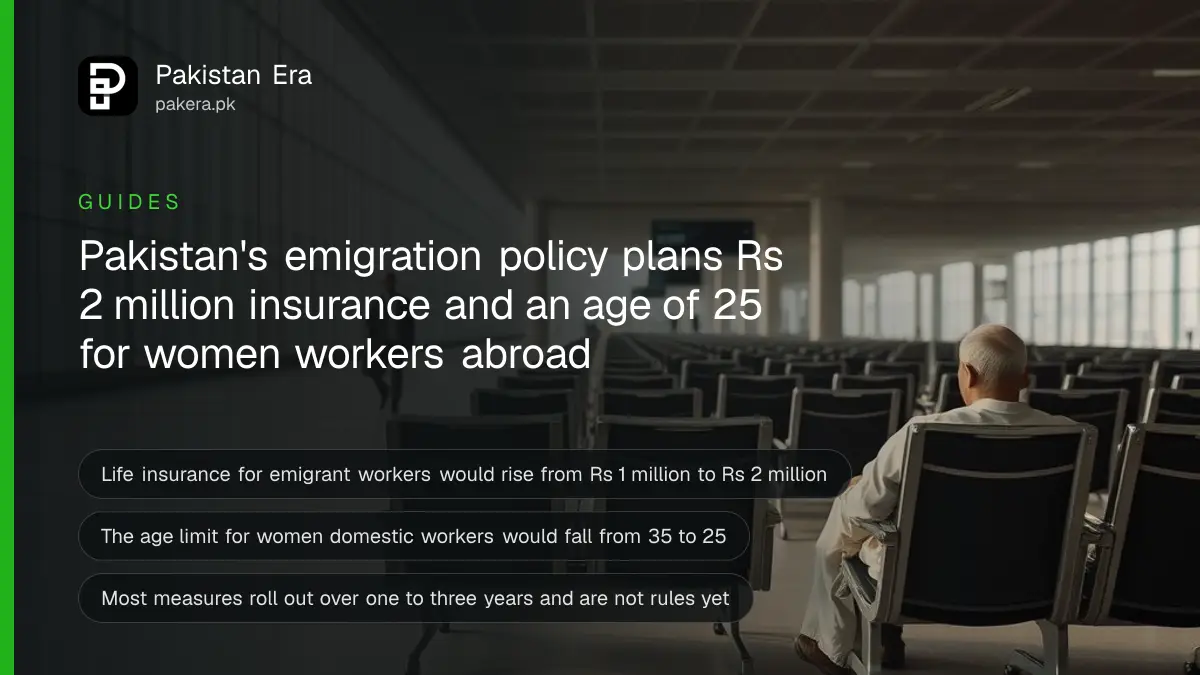
Pakistan's first National Emigration and Welfare Policy plans to double the life insurance cover for workers abroad to Rs 2 million, set up an international call centre for complaints, launch one mobile app for every step of going abroad, and lower the minimum age for women domestic workers from 35 to 25. Most of these are plans, not rules yet. The policy itself says each one will be rolled out over one to three years.
The Ministry of Overseas Pakistanis and Human Resource Development has published the approved 76-page policy on its website. We read it in full on 9 October 2026. Here is what it promises a worker who is planning to go abroad, what it promises the family at home, and what has actually changed so far.
The scale matters. The policy says about 14.38 million Pakistanis registered to go abroad for work between 1971 and June 2025, and 95.5% of them went to the Gulf states. It also records US$38.3 billion in remittances in 2024-25.
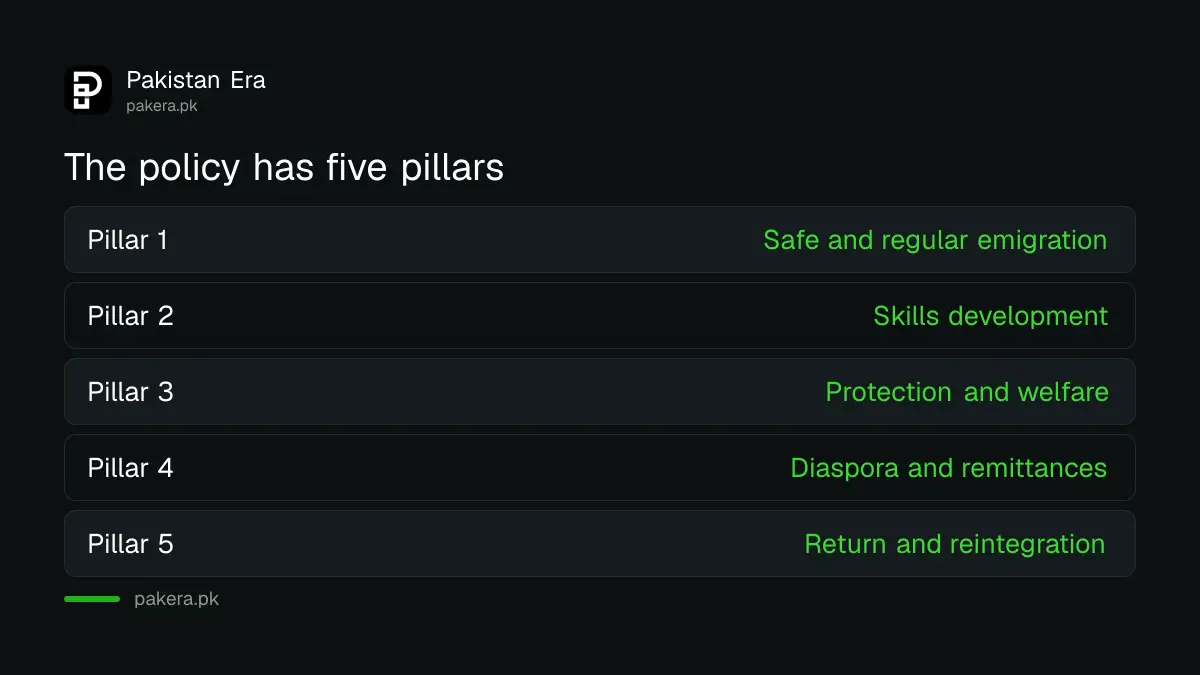
The policy has five parts, from leaving to coming home
The policy is built on five pillars that follow a worker's whole journey, from getting a job abroad safely to settling back in Pakistan at the end.
- Safe, orderly and regular emigration. Finding real jobs abroad, cutting fraud by recruiting agents, and making the process faster.
- Skills development. Training workers to the standards foreign employers want, including languages.
- Protection and welfare. Complaints, legal help, insurance and support in a crisis, plus welfare for families in Pakistan.
- Diaspora and remittances. More money sent home through banks and more investment by overseas Pakistanis.
- Reintegration. Helping workers who return find work or start a business.
The first person a worker usually meets is still the Protector of Emigrants, whose stamp is required before a work visa can be used.
Workers abroad would get Rs 2 million insurance and a call centre
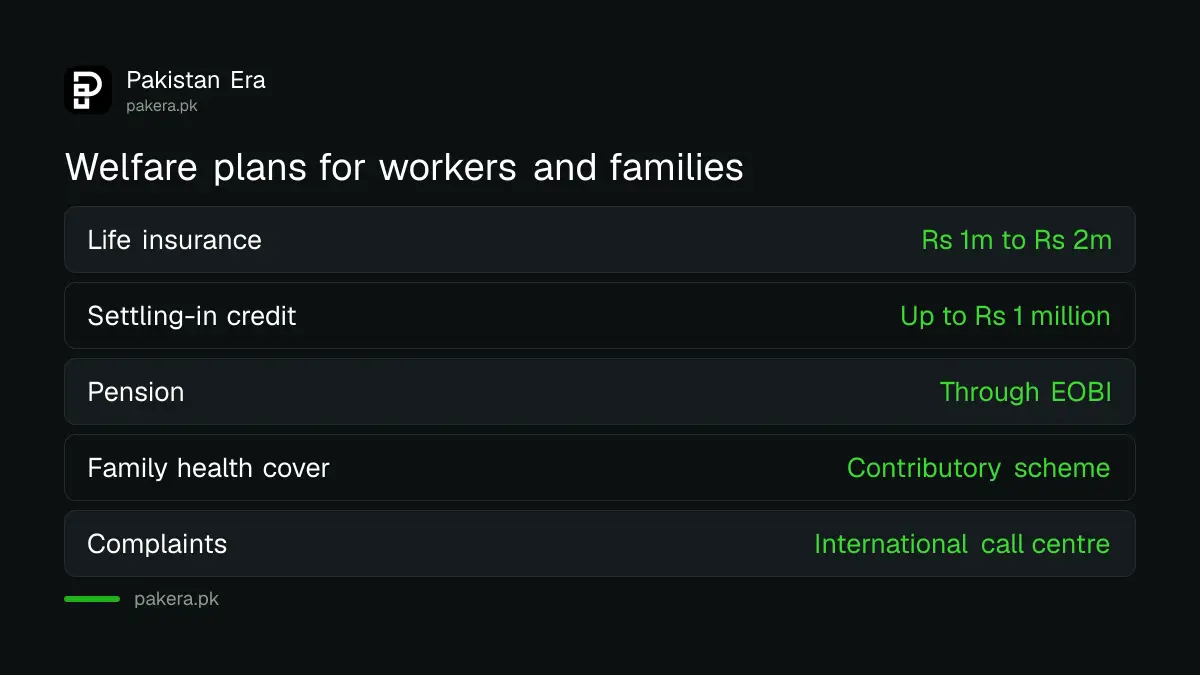
The welfare pillar has the measures most workers will notice. Life insurance for emigrant workers would rise from Rs 1 million to Rs 2 million, and an International Call Centre would take complaints from anywhere in the world.
The policy says the current State Life insurance cover for an emigrant worker is Rs 1,000,000 for death or disability. It proposes raising that to Rs 2,000,000. It does not give a start date or say whether the fee paid at the Protector office will change.
Other welfare plans in the document:
- A credit facility of up to Rs 1 million for new emigrants to settle in abroad.
- A pension scheme for migrant workers through EOBI, the Employees' Old-Age Benefits Institution.
- Families of emigrant workers added to contributory health insurance.
- Special courts to decide court cases of overseas Pakistanis faster.
- An Overseas Pakistanis Commission in every province, on the Punjab pattern.
- Reserved seats and more scholarships for children of overseas Pakistanis.
Some help already exists. A family can still claim OPF financial aid after a worker's death or disability under the current rules, and a family in Punjab can take a property or police problem to the Punjab Overseas Pakistanis Commission.
The minimum age for women domestic workers would fall to 25
Pakistan's Emigration Rules, 1979 set 35 as the minimum age for a woman to go abroad as a housemaid, nanny or governess. The policy proposes 25, and lists the change as under process, which means it is not yet law.
The policy compares Pakistan with its neighbours. It says Bangladesh and Nepal use 25, the Philippines 24, and Sri Lanka 21 for most countries and 25 for Saudi Arabia.
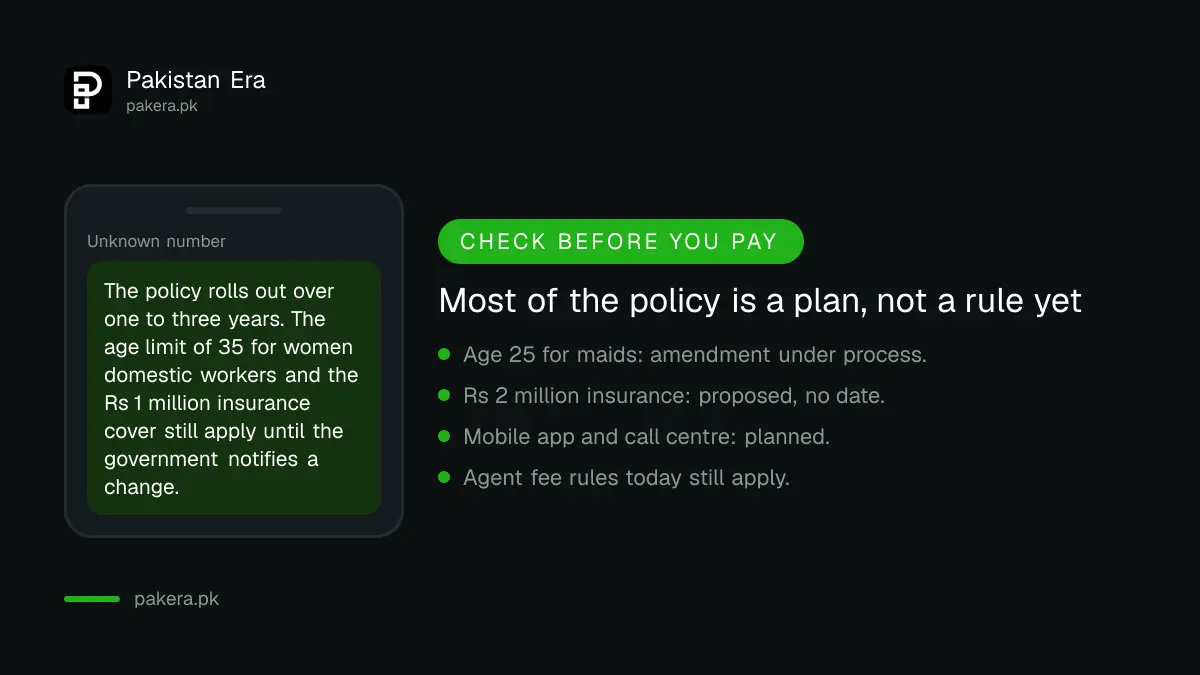
The Ministry expects about 10,000 women a year to go abroad as domestic workers for the first three years after the change, and twice that in the fourth year. Until Rule 25 is amended and notified, the age limit of 35 still applies at the Protector office. A woman aged 25 to 34 who is offered a housemaid job today should not pay anyone on the promise that the rule has changed.
One app and one database are planned to cut delays and fraud
Three digital systems are planned: a central emigrant database, a mobile app that covers every step before and after departure, and an online matching platform between foreign employers and Pakistani workers.
| Planned system | What it is for | Status in the policy |
|---|---|---|
| Pakistan Emigrant Management Framework | One central database shared by every agency, to cut processing time and cost | Planned |
| Mobile app | Pre-departure steps, job abroad, complaints and welfare services in one place | Planned |
| e-Informed Migration Framework | Talent and job search engines to match employers with workers | Planned |
| International Call Centre | Complaints from workers abroad | Planned |
| Life insurance cover | Rs 2 million instead of Rs 1 million | Proposed |
| Women domestic workers' age | 25 instead of 35 | Amendment under process |
The policy also promises to tighten the rules for licensed recruiting agents, called Overseas Employment Promoters. It wants an employer-paid model, where the foreign employer and not the worker pays the cost of hiring. Today an agent can legally charge a worker only a fixed fee, and the Rs 15,000 agent fee limit is the number to remember when an agent asks for more.
New markets are Europe, Japan, Korea and care work
The policy wants fewer workers going only to the Gulf and more going to Europe, Japan, Korea, the UK, Australia, Canada and the USA. It names caregivers, nurses and health workers as the main openings.
To get there, it plans training institutions for caregivers and nurses, recognition of Pakistani certificates abroad, new labour agreements, and language and soft skills courses with Korea and Japan.
Two routes to East Asia are already open. Workers can apply through the Korea EPS-TOPIK system, which runs through the Overseas Employment Corporation, or prepare for the Japan SSW skills tests. Neither needs a private agent.
What a worker should do now, before the plans arrive
Follow the rules that are in force today. The policy is a roadmap for one to three years, so the current Protector process, fees and age limits still apply until the government notifies a change.
- Get your job offer and visa only through a licensed agent or the Overseas Employment Corporation.
- Check the agency's licence on the Bureau of Emigration's own list before you pay.
- Pay only the official fees and take a receipt for each one.
- Complete the Protector registration, insurance and OPF membership before you fly.
- Keep a copy of your contract, called the Foreign Service Agreement, with your family in Pakistan.
Our view: the policy is detailed and honest about the problems, including fraud, high costs and weak protection abroad. But a policy is not a notification. Watch for the Emigration Rules amendment and the insurance change, because those two will change real costs and real rights.
Common questions
Is the National Emigration and Welfare Policy 2026 in force?
The policy is approved and published by the Ministry. Most measures in it are plans that will be rolled out over one to three years, and some need changes to the Emigration Rules first.
Has the minimum age for women housemaids changed to 25?
Not yet. The policy lists the change to Rule 25 of the Emigration Rules, 1979 as under process. Until it is notified, the limit of 35 applies.
Is the emigrant worker insurance now Rs 2 million?
No. The policy proposes raising it from Rs 1 million to Rs 2 million but gives no start date. The current cover is Rs 1 million.
Is there a new app for workers going abroad?
The policy plans one mobile app for pre-departure steps, complaints and welfare services. It does not name a launch date, so be careful of any unofficial app using the policy's name.
Who runs the policy?
The Ministry of Overseas Pakistanis and Human Resource Development leads it. The Bureau of Emigration, the Overseas Employment Corporation and the Overseas Pakistanis Foundation carry out most measures.
How we verified this
What we checked, where we read it, and what we could not confirm.
Last checked on 9 October 2026. We read the full approved National Emigration and Welfare Policy 2026 on the Ministry of Overseas Pakistanis and Human Resource Development website. All figures, including the insurance amounts, the age limits, the 14.38 million emigrants and the phased timeline, come from that document. We could not confirm a notification date for any single measure, so each one is described as planned, proposed or under process, in the policy's own words.
About the author

Global Affairs & Political Economy Writer
Muhammad Hatim is a book lover who started writing because he enjoys it. At Pakistan Era he writes about international relations, geopolitics and the global economy, with a particular interest in South Asia and the forces behind current events.