NEPRA Fines CPPA-G Rs 10 Million for Not Charging WAPDA About Rs 77 Billion in Penalties
NEPRA fined CPPA-G Rs 10 million for not charging WAPDA about Rs 77 billion in outage penalties, and closed the WAPDA and Orient Power cases. Read the orders.
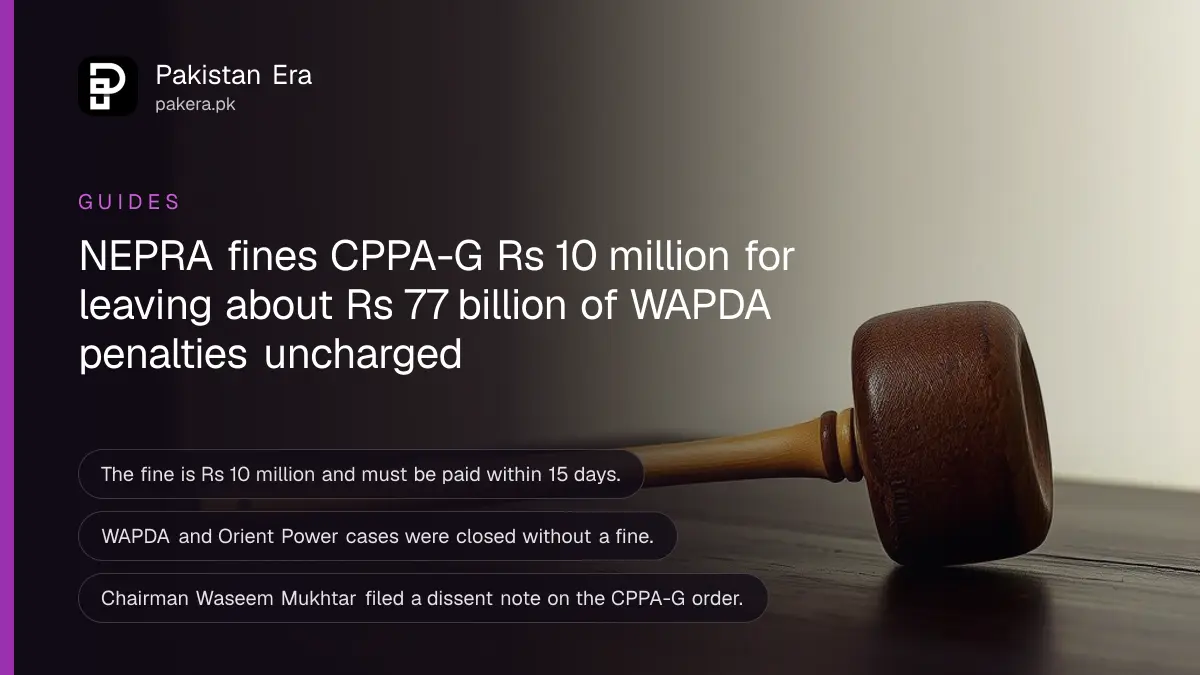
Short answer: NEPRA has fined the Central Power Purchasing Agency (Guarantee) Limited, CPPA-G, Rs 10 million for not charging WAPDA about Rs 77 billion in penalties for hydropower outages. In two other orders of 16 September 2026 it closed the cases against WAPDA and Orient Power without a fine.
The three orders came out together and have gone almost unread. They show how a regulator settles a fight between two state bodies, and why a bill that never reaches you can still end up inside the circular debt.
We downloaded all three orders from NEPRA's website and read them in full. This page sticks to what the orders say. Where a number is one side's claim, we say so.
CPPA-G was fined for a penalty it never charged
NEPRA found that CPPA-G broke its market rules, its commercial code and the power purchase agreement with WAPDA. It had not imposed liquidated damages, a contract penalty, on WAPDA for hydel plants that took more outage hours than the agreement allows. The fine is Rs 10 million, payable in 15 days.
The power purchase agreement was signed on 24 January 2011. Article 9 sets the penalty, and the agency's commercial code requires it to deduct the exact amount from WAPDA's invoice each billing period. NEPRA says the agency was asked again and again, from 2020, to do so.
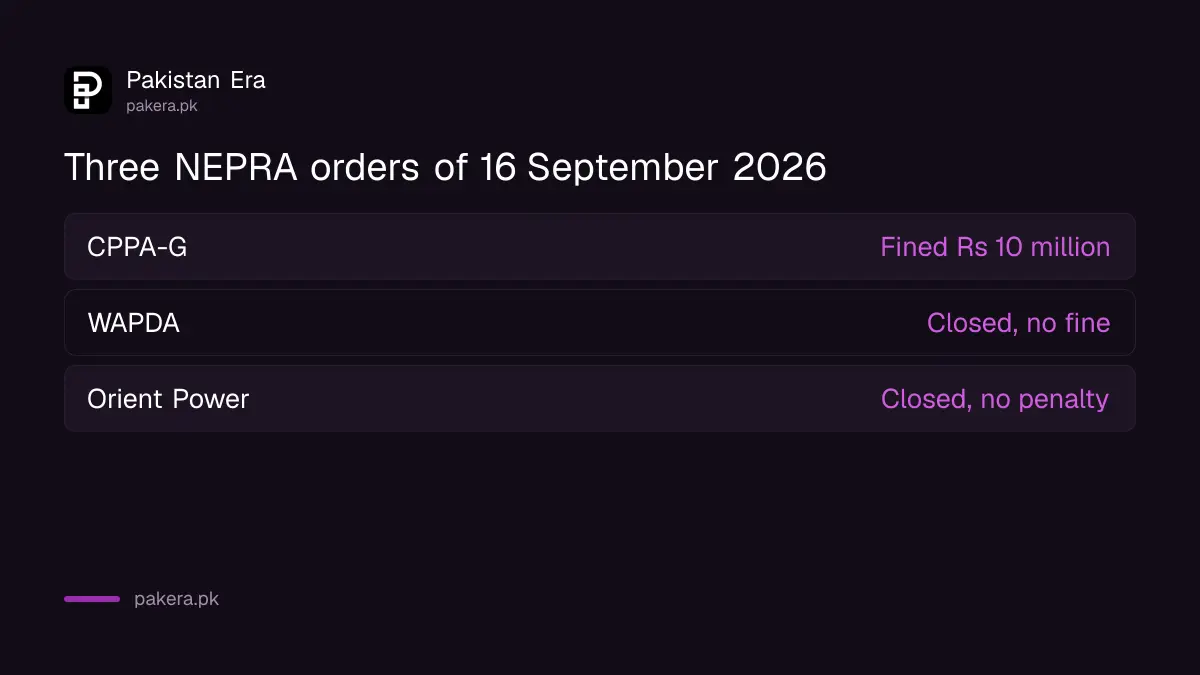
| Order of 16 September 2026 | Who | Result |
|---|---|---|
| Show cause notice on penalties not charged | CPPA-G | Fined Rs 10 million, 15 days to pay |
| Show cause notice on outage hours | WAPDA | Proceedings closed, no fine |
| Show cause notice on slow restart after the 2023 blackout | Orient Power | Response accepted, no penalty |
The unimposed penalties come to about Rs 77 billion
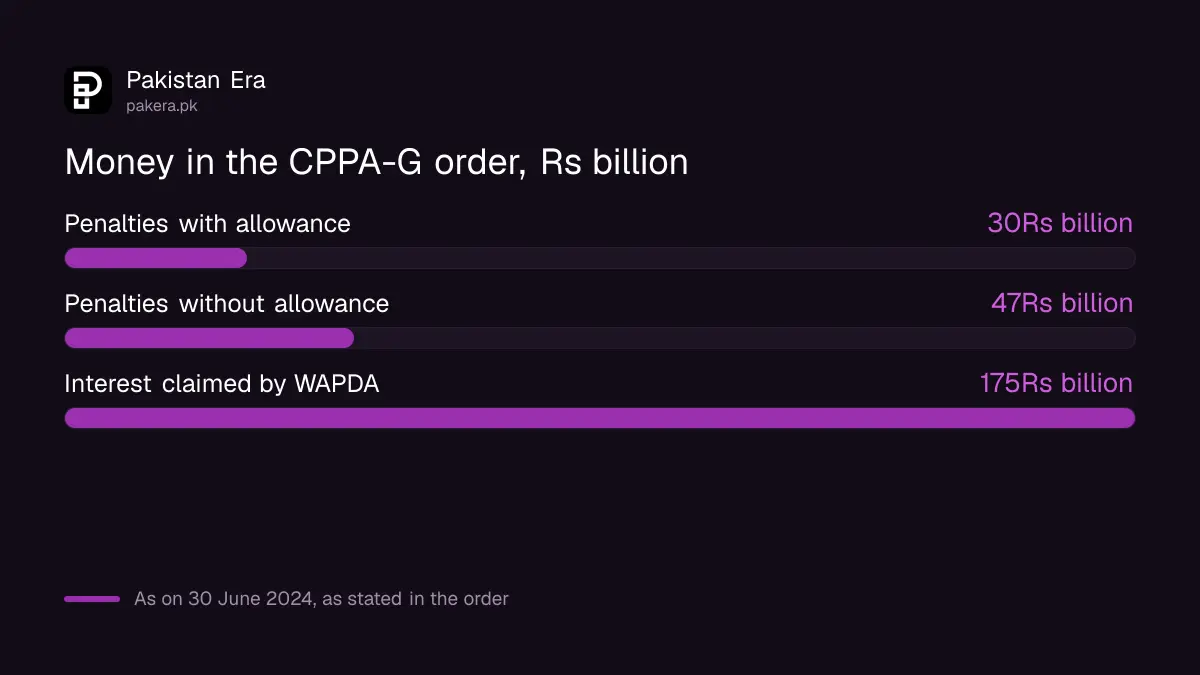
NEPRA says CPPA-G's own submissions show about Rs 77 billion of penalties on ten major plants remain unimposed. The agency gave two figures, as on 30 June 2024: about Rs 30 billion for five stations with an outage allowance, and about Rs 47 billion for five stations with none.
The five stations with an allowance are Ghazi Barotha, Mangla, Tarbela, Warsak and Chashma, with a total of 6,355 MW. The other five are Tarbela 4th Extension, Duber Khwar, Allai Khwar, Khan Khwar and Jinnah, with 1,829 MW between them.
NEPRA called the agency's reply unsatisfactory and legally unsustainable. It wrote that charging the penalty is a mandatory duty owed to the power sector and, in the end, to the consumer.
CPPA-G argued that the penalty would cost more than it recovers
The agency's case was simple. WAPDA is owed late payment interest because distribution companies pay their bills late. CPPA-G said that charging penalties would start a bigger claim for that interest, which it put at about Rs 175 billion as on 30 June 2024.
NEPRA's order rejected that argument. The Chairman, Waseem Mukhtar, filed a dissent note. He wrote that the interest claims exceed the penalties, that imposing penalties would likely trigger a larger claim, and that the net burden would end up in circular debt.
Circular debt is the pile of unpaid bills between power plants, distribution companies and the government. Our report on Pakistan's plan to cut gas circular debt covers the gas side of that problem.
WAPDA's case was closed, but Chashma stays open
NEPRA accepted WAPDA's explanation for every hydel station except Chashma. It found that Chashma took more outage hours than the agreement allows, and rejected both of WAPDA's defences.
First, WAPDA said extra output from Tarbela and Mangla made up the loss: 1,018 million extra units against a shortfall of 716 million units at Chashma. NEPRA said outage limits are set station by station, so one station cannot make up for another. Second, WAPDA called the faults force majeure, an event outside its control. NEPRA found no evidence that WAPDA had invoked that clause with CPPA-G.
The proceedings under the fine rules were still closed. The Chashma shortfall stays open to be dealt with under the power purchase agreement. WAPDA also told NEPRA that about Rs 247 billion is still pending from CPPA-G. That is WAPDA's statement, not a finding of the regulator.
Orient Power's case came from the January 2023 blackout
The third order goes back to 23 January 2023, when the whole grid collapsed at 7:34 am and took about 20 hours to restore. NEPRA's show cause notice said Orient Power's units were synchronised late: 20 minutes for one unit, 2 hours 37 minutes for another and 36 minutes for the steam unit.
Orient Power argued, among other points, that its duty to follow dispatch instructions sits in its power purchase agreement and not in the Act or the Grid Code. NEPRA accepted the company's response and closed the matter. It wrote that the issues were adequately explained and need no further intervention.
What the orders mean for your bill
Nothing changes on your bill because of these orders. A penalty charged to WAPDA would lower the capacity payments in the tariff, as CPPA-G itself noted. A penalty not charged leaves those payments where they are, and the late payment interest keeps growing in the background.
Your own bill is shaped by monthly fuel charges, quarterly adjustments and the slab you fall in. The October fuel charge is covered in our note on the October electricity bill fuel charge. The orders above affect the system behind those lines, not the lines themselves.
- Check your bill lines for the fuel charge and quarterly adjustment.
- Compare your units with your previous month and the same month last year.
- If a line looks wrong, complain to your distribution company in writing first.
- If it does not answer, take the complaint to NEPRA with your bill copy.
Common questions
Why was CPPA-G fined by NEPRA?
NEPRA found that CPPA-G failed to impose liquidated damages on WAPDA for excess outage hours at its hydel stations, as its power purchase agreement and commercial code require.
How much is the fine and when must it be paid?
The fine is Rs 10 million. CPPA-G must pay it within 15 days of the order and send NEPRA a copy of the payment.
Was WAPDA fined as well?
No. NEPRA closed the proceedings against WAPDA under its fine regulations. The Chashma shortfall remains open under the power purchase agreement.
What are liquidated damages?
They are a penalty written into a contract. Here, the agreement lets the buyer deduct an amount from a power plant's invoice when the plant is out of service for longer than allowed.
Did the Chairman agree with the order?
No. Chairman Waseem Mukhtar filed a dissent note, arguing that imposing the penalties would trigger a larger interest claim from WAPDA.
How we verified this
What we checked, where we read it, and what we could not confirm.
We read the three orders of 16 September 2026 on NEPRA's news page on 12 October 2026. The orders' own signature lines carry no date, so we use the date on the covering letters. Some figures in the orders are as on 30 June 2024 and have since moved.
About the author

Global Affairs & Political Economy Writer
Muhammad Hatim is a book lover who started writing because he enjoys it. At Pakistan Era he writes about international relations, geopolitics and the global economy, with a particular interest in South Asia and the forces behind current events.