NEPRA to Hear 3 Punjab Hydropower Tariff Petitions on 20 October 2026
NEPRA holds a hearing on 20 October 2026 on tariff changes for Marala, Chianwali and PakPattan hydropower plants. See what is asked and how to file comments.
Short answer: NEPRA will hold a public hearing on 20 October 2026 at 2 pm on three petitions from Punjab Power Development Company to change the tariffs of the Marala, PakPattan and Chianwali hydropower plants. The three plants total 15.84 MW. NEPRA has not decided anything yet.
Update, 11 October 2026: NEPRA also had Suki Kinari and Sapphire Wind tariff petitions before it.
The Punjab Power Development Company Limited wants NEPRA to rewrite parts of the tariff for three small hydropower plants in Punjab. NEPRA admitted the petitions and listed the notices on its website on 9 October 2026. A hearing is set for Tuesday 20 October.
We read all three notices on NEPRA's website. This story covers what is asked, what it could mean for electricity bills and how the public can take part.
The three plants and what they are paid today
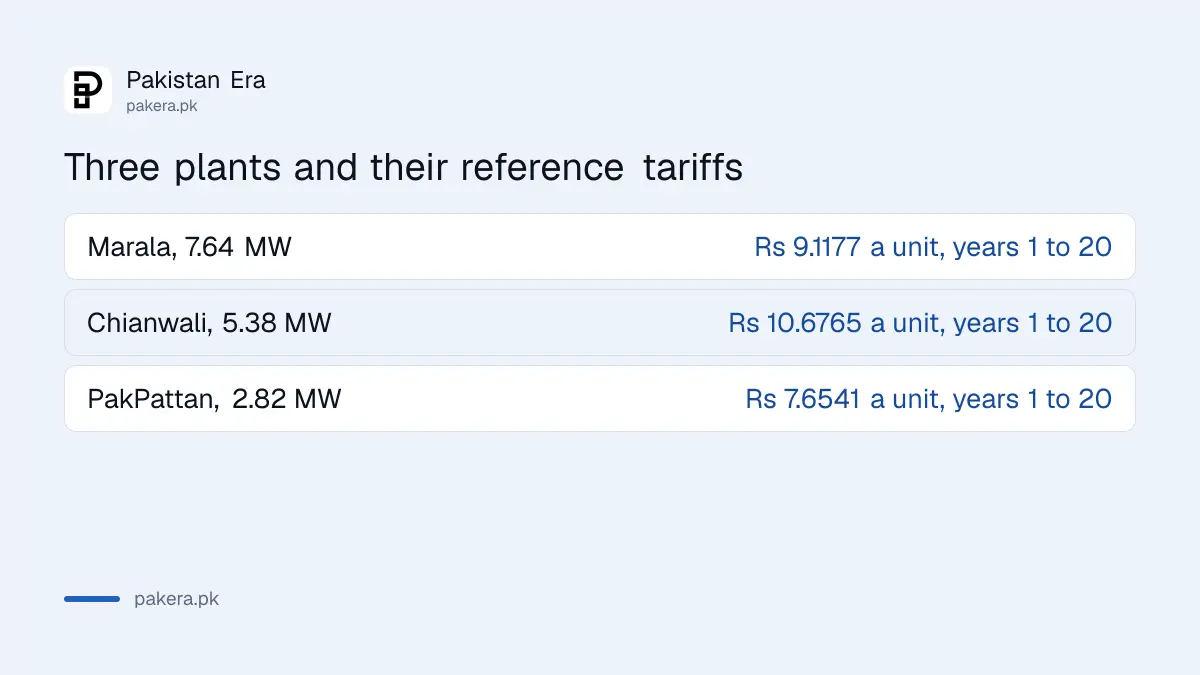
The petitions cover Marala at 7.64 MW, Chianwali at 5.38 MW and PakPattan at 2.82 MW. Each notice prints a reference tariff for years 1 to 20 and a lower one for years 21 to 30, per kilowatt hour. A kilowatt hour is one unit on your bill.
| Plant | Capacity | Annual energy now | Tariff, years 1 to 20 | Tariff, years 21 to 30 |
|---|---|---|---|---|
| Marala | 7.64 MW | 49.995 GWh | Rs 9.1177 | Rs 5.8358 |
| Chianwali | 5.38 MW | 28.532 GWh | Rs 10.6765 | Rs 6.5241 |
| PakPattan | 2.82 MW | 21.671 GWh | Rs 7.6541 | Rs 4.8815 |
A GWh is a million units. One note on a mismatch: NEPRA's news list gives Chianwali as 2.82 MW, but the Chianwali notice itself says 5.38 MW. We use the notice, which is the legal document.
The company wants a third less energy in the benchmark
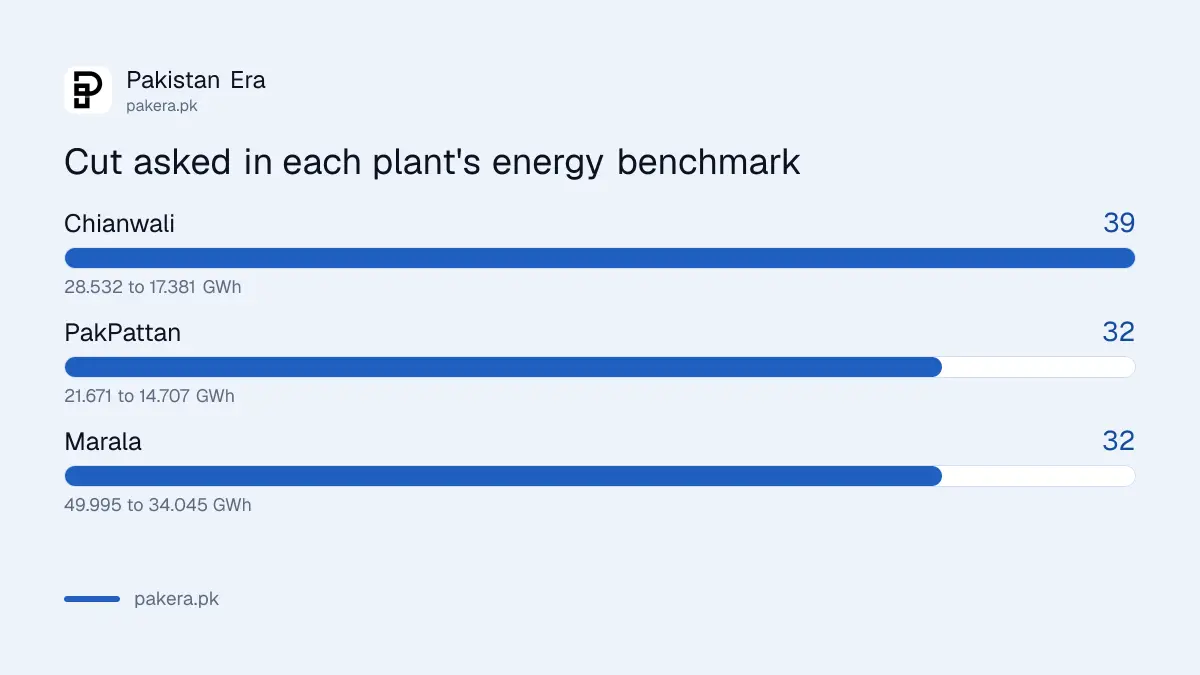
All three petitions ask NEPRA to cut the annual energy benchmark by roughly a third. Marala would fall from 49.995 to 34.045 GWh, PakPattan from 21.671 to 14.707 GWh, and Chianwali from 28.532 to 17.381 GWh.
The benchmark is the yearly amount of electricity the plant is expected to deliver. In our arithmetic the cuts are about 32 per cent for Marala, 32 per cent for PakPattan and 39 per cent for Chianwali.
A lower benchmark is a bet that the water will not deliver what was once assumed. For a hydropower plant the river sets the output. The notice does not say why the company is asking, and we have not seen the petition.
Other changes in the Marala and PakPattan petitions
The Marala and PakPattan notices list nine requests. The big ones are to move from a take-or-pay structure to take-and-pay, to stop upward dollar indexation of return from 1 January 2026, and to pass insurance, taxes and duties on electricity sales through to the buyer.
- Extend an expiry date, printed in the notice only as "GL", to match the 30-year power purchase term.
- Take-and-pay with must-run, with hydrological risk staying with the seller and excess generation paid at 10 per cent of the tariff.
- Index all fixed and variable operating costs only with the national consumer price index.
- Stop dollar indexation of return on equity from 1 January 2026 and fix the exchange rate at Rs 280.55 a dollar.
- Cut the operational insurance cap from 1.35 per cent to 0.8 per cent of the construction cost.
- Exclude the 7.5 per cent dividend withholding tax and the Punjab water use charge from the tariff.
Chianwali's list is shorter. It asks for the benchmark cut, insurance and tax pass-through, operating costs indexed to the consumer price index only, and the Punjab water use charge excluded from the tariff.
Take-or-pay means the buyer pays for a set amount whether or not it takes the power. Take-and-pay means it pays only for what is delivered. Which way helps the consumer depends on the final terms, and NEPRA must still decide.
What this could mean for electricity bills
The notices do not state a bill impact. These are three small plants totalling 15.84 MW, so any effect on a national average is tiny. NEPRA decides after the hearing, and any change in cost reaches consumers through the power purchase price, not as a separate line.
Power purchase price is the average cost of power that distribution companies pass on in tariffs. Our guide to the lines on an electricity bill shows where those costs land. Monthly fuel changes are separate, as in the October fuel charge decision. Hydropower has no fuel cost, so it would not show up in that charge.
Other recent NEPRA matters are in the review of the incremental consumption package and the 2027 tariff hearings of ten power companies.
How to take part in the 20 October hearing
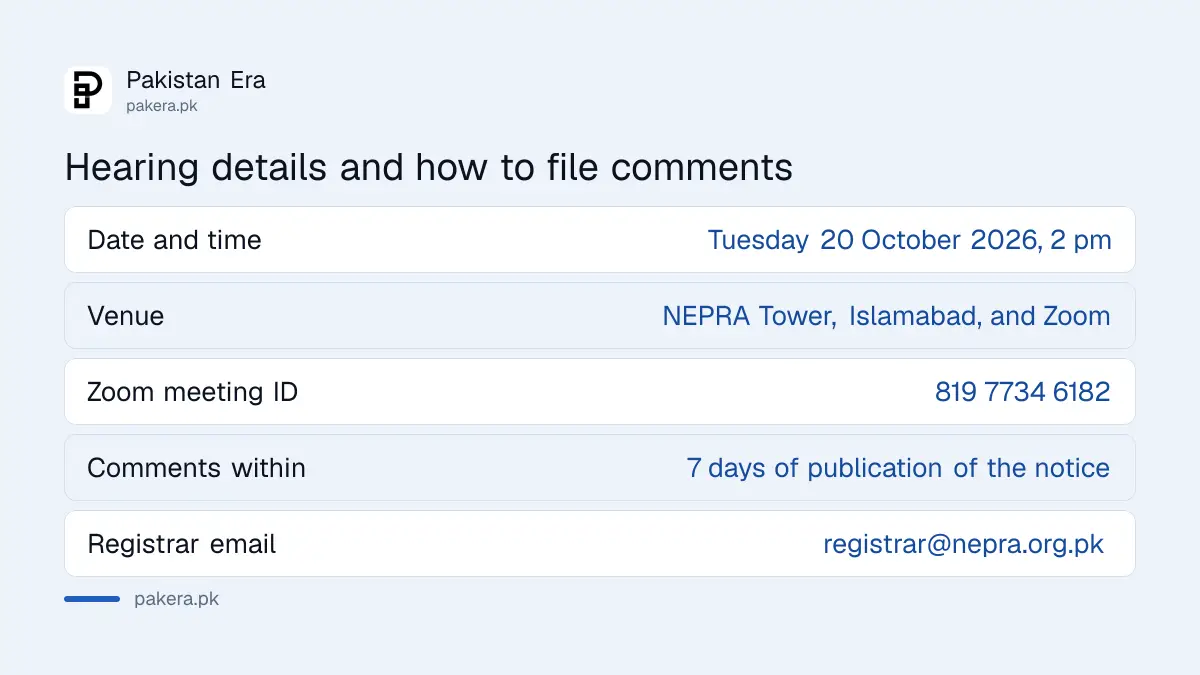
NEPRA invites interested persons to file an intervention request or comments within seven days of the notice's publication. The hearing is at 2 pm at NEPRA Tower, Islamabad, and on Zoom, meeting ID 819 7734 6182. The Registrar's email is registrar@nepra.org.pk.
- Download the petition and the list of issues from NEPRA's website.
- Write your name and address, your objection and how you are affected.
- Send it to the Registrar by email or post within seven days of the notice's publication.
- Join the hearing in person or on Zoom at 2 pm on 20 October.
The notices appeared on NEPRA's site on 9 October. If the seven days count from then, the deadline falls around 16 October, but the clock runs from the date of publication in newspapers, which we have not seen. File early. The full method is in how to take part in a NEPRA public hearing.
Common questions
When is the NEPRA hearing on the Punjab hydropower tariffs?
It is on Tuesday 20 October 2026 at 2 pm at NEPRA Tower in Islamabad, with a Zoom link, meeting ID 819 7734 6182.
Which plants are involved?
The Marala (7.64 MW), Chianwali (5.38 MW) and PakPattan (2.82 MW) hydropower projects of Punjab Power Development Company Limited.
Has NEPRA approved the changes?
No. NEPRA has only admitted the petitions and set a hearing. It will decide after hearing the company and any interested persons.
Will my electricity bill go up?
The notices do not say. The three plants total 15.84 MW and NEPRA has not decided, so any effect on a national average would be very small.
Can an ordinary consumer comment?
Yes. The notice invites any interested person to file an intervention request or comments within seven days of publication, by email to registrar@nepra.org.pk.
How we verified this
What we checked, where we read it, and what we could not confirm.
Last checked on Sunday 11 October 2026. We read the three NEPRA notices of admission and hearing for the Marala, PakPattan and Chianwali petitions on the NEPRA news page. We have not read the petitions themselves or NEPRA's list of issues. Percentages are our own arithmetic from the figures printed in the notices.
About the author

Global Affairs & Political Economy Writer
Muhammad Hatim is a book lover who started writing because he enjoys it. At Pakistan Era he writes about international relations, geopolitics and the global economy, with a particular interest in South Asia and the forces behind current events.