New Provinces Referendum in Pakistan: Tarar Says It Is Constitutional, Joint Sitting Needed First
Information Minister Tarar said on 17 November 2026 a referendum on new provinces is constitutional. Article 48(6) needs a joint sitting of Parliament first.
یہ صفحہ اردو میں پڑھیں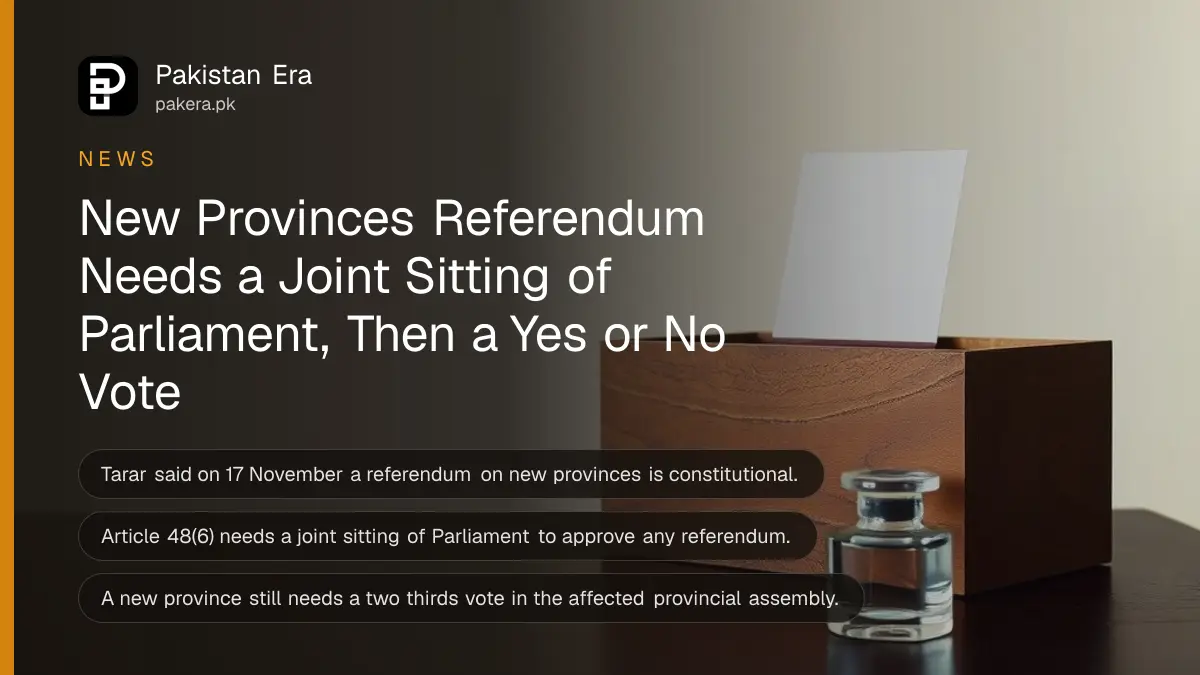
Short answer: Federal Information Minister Attaullah Tarar said on Tuesday 17 November 2026 that a referendum is a constitutional and legal way to find out whether people want new provinces, and that there is "no harm in holding one". No referendum has been called. Under Article 48(6) of the Constitution, the Prime Minister would first need a joint sitting of Parliament to approve it.
Even a yes vote would not create a province by itself. Changing a province's borders still needs a constitutional amendment under Article 239, and the assembly of that province must pass it by two thirds.
Tarar said a referendum on new provinces is constitutional
On 17 November 2026, Information Minister Attaullah Tarar said the people should decide whether they want new provinces, and that a referendum is a constitutional way to ask them. He was replying to a statement by PPP Chairman Bilawal Bhutto Zardari the same day.
Tarar made the remarks in a television conversation, as carried by Radio Pakistan, the state broadcaster. His main points were these:
- Public opinion should come first in decisions on administrative reforms.
- The debate on new provinces and better governance is part of the democratic process and should not be discouraged.
- No political party should object to asking the public.
- Personal opinions should not be imposed on the people of Sindh, Punjab, Khyber Pakhtunkhwa and Balochistan without asking them first.
- Smaller administrative units should be seen constructively, not as a source of controversy.
The same day, Radio Pakistan carried views from people in Khyber Pakhtunkhwa who said smaller provinces would mean they no longer had to travel to Peshawar to get their problems solved.
The referendum idea began with the Interior Minister on 12 November
Interior Minister Mohsin Naqvi proposed a public referendum on new provinces on 12 November 2026. Tarar spoke in support of a referendum five days later. No bill, resolution or official notice has been issued.
The PPP has opposed dividing Sindh. In late October, Bilawal Bhutto Zardari said the Sindh Assembly had already given its verdict on the question and that the debate should end. In August he said the party would accept only a decision backed by public consensus.
| Date | What happened | Status |
|---|---|---|
| 10 September 2026 | The government said Parliament would debate new provinces in October | No bill was introduced |
| Late October 2026 | Bilawal said the Sindh Assembly had already decided, and the debate should end | Party position |
| 30 October 2026 | The National Assembly session was prorogued | No new session called yet |
| 12 November 2026 | Interior Minister Mohsin Naqvi proposed a referendum | Proposal only |
| 17 November 2026 | Information Minister Tarar said a referendum is constitutional | Statement only |
Some reports say the government wants a decision before the Senate election due in March 2027, and that plans of 10 to 12 provinces are being discussed. No minister has confirmed a number or a date. For the background, see the new provinces debate in Parliament from September.
Article 48(6) needs a joint sitting of Parliament first
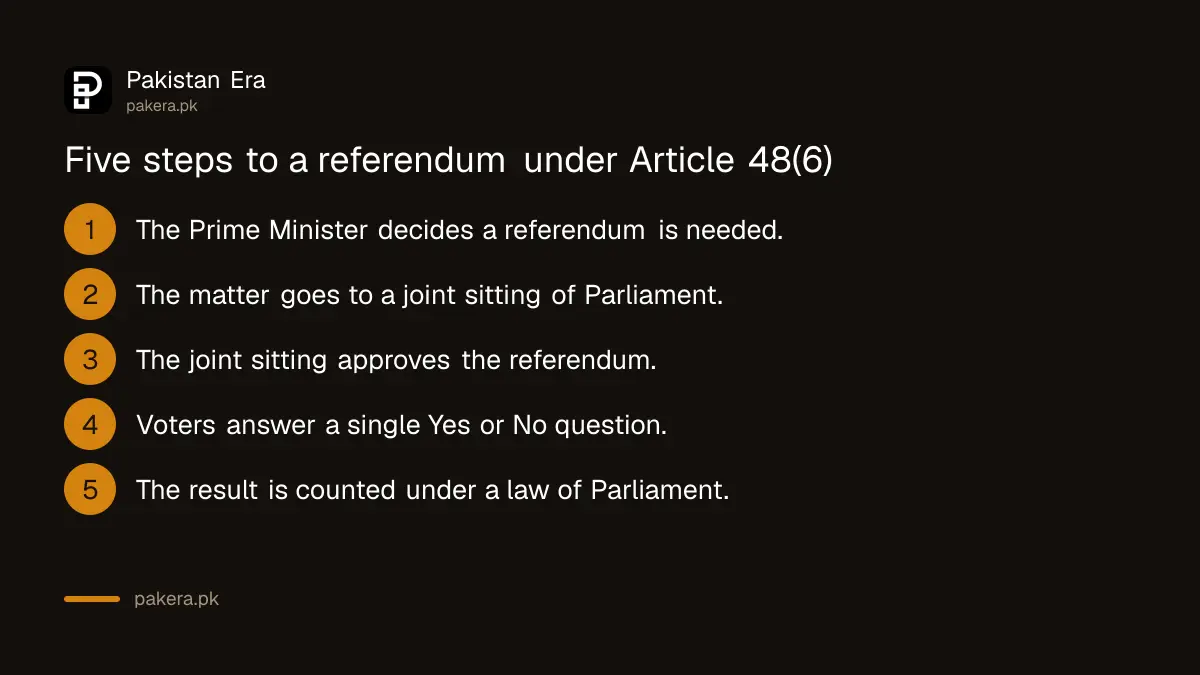
Article 48(6) lets the Prime Minister hold a referendum on "any matter of national importance", but only after referring it to a joint sitting of the National Assembly and the Senate and getting its approval. The question must be one that can be answered Yes or No.
The clause, read on the Constitution published on Pakistan Code, works in this order:
- The Prime Minister decides a referendum is needed on a matter of national importance.
- The Prime Minister refers the matter to a joint sitting of Parliament. The President summons a joint sitting under Article 54.
- The joint sitting approves the referendum.
- The Prime Minister puts the matter to voters as a single Yes or No question.
- The result is compiled and announced under the procedure Parliament has laid down by law.
Article 48(7) says an Act of Parliament may lay down how a referendum is held and how its result is counted and combined. Article 219, which lists the Election Commission's duties, names general elections, Senate elections and local government elections, and lets Parliament add other duties by an Act. Referendums are not on that list by name.
A yes vote would not create a province on its own
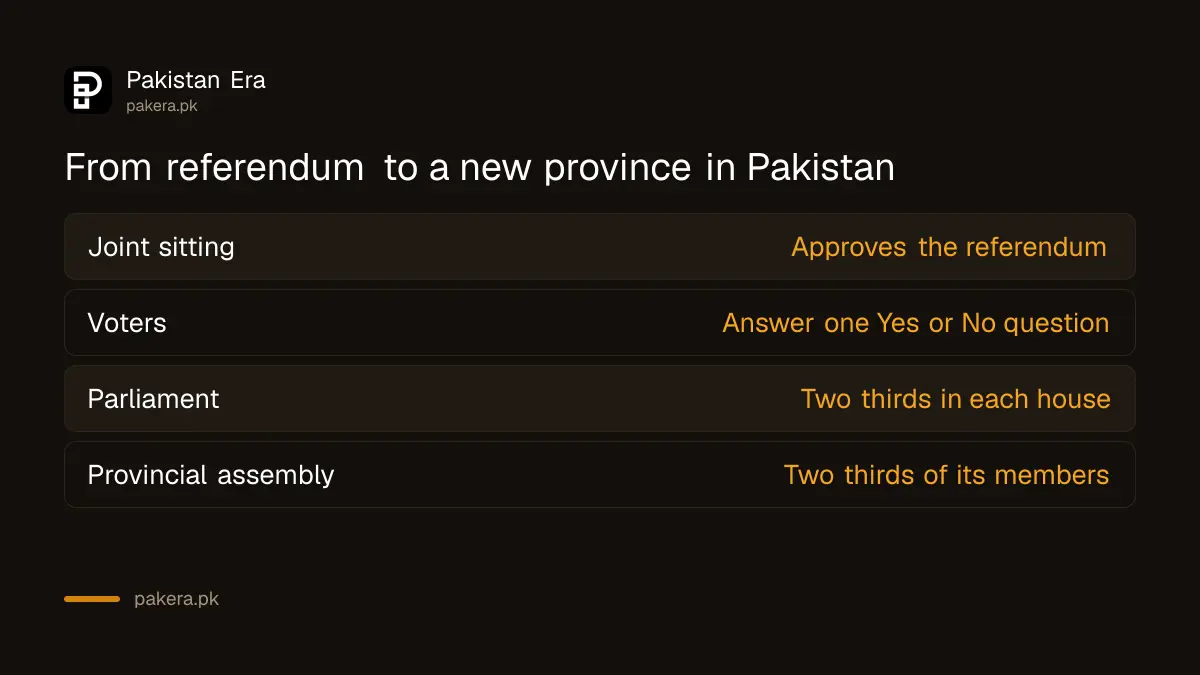
A referendum can show what voters want, but Article 48(6) does not change the Constitution. Creating a province changes the limits of an existing one. That needs a constitutional amendment passed under Article 239, including a two thirds vote in the affected province's own assembly.
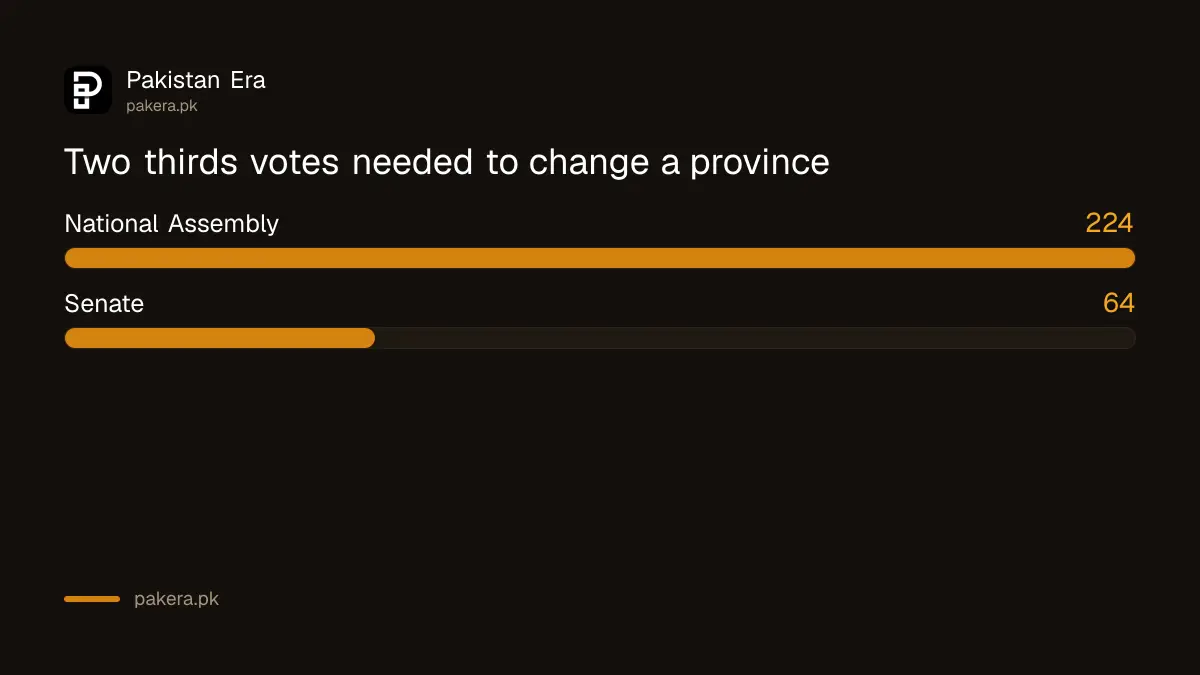
Article 239 sets three separate two thirds votes, each counted against the total membership of the house, not just the members present:
| House | Vote needed under Article 239 | Total seats | Two thirds |
|---|---|---|---|
| National Assembly | Two thirds of total membership | 336 | 224 |
| Senate | Two thirds of total membership | 96 | 64 |
| Assembly of the province being divided | Two thirds of total membership | Varies by province | Two thirds of its seats |
Article 239(4) says a bill that changes a province's limits "shall not be presented to the President for assent" until that province's assembly has passed it. In practice, the province being divided holds a veto. The full process is set out in how a new province is created in Pakistan, and the vote counts in the constitutional amendment rules.
Pakistan has held two national referendums before
Pakistan held national referendums in December 1984 and April 2002. Both were held under military rule and asked voters to back the head of state. The 1984 vote was held under the Referendum Order 1984, which Article 270A of the Constitution still lists among the laws it affirmed.
Neither vote was on provinces. The present wording of Article 48(6), which requires a joint sitting of Parliament, was added by the Eighteenth Amendment in 2010, so a vote on new provinces would be the first held under it. Parliament would also have to settle who runs the vote and how results are counted, as Article 48(7) allows.
Nothing changes for voters or residents yet
Nothing changes for voters today. There is no referendum date, no question, and no schedule from the Election Commission of Pakistan. Domiciles, CNIC addresses, district boundaries and provincial services all stay exactly as they are.
Watch for these steps, in this order, before anything becomes real:
- A session of Parliament being summoned, and a joint sitting called under Article 54.
- A motion from the Prime Minister referring the question to that joint sitting.
- A law, or an amendment to the election laws, setting out how a referendum is run.
- A schedule and a Yes or No question published by whoever runs the vote.
If you want to follow what Parliament does next, the Senate election 2027 timetable explains the March vote that reports link to this plan.
Common questions
Has a referendum on new provinces been announced in Pakistan?
No. Two federal ministers have spoken in favour of the idea, Mohsin Naqvi on 12 November and Attaullah Tarar on 17 November 2026. No date, question or official notice has been issued, and Parliament has not voted on it.
Who can call a referendum under the Constitution?
The Prime Minister, under Article 48(6). The Prime Minister must first refer the matter to a joint sitting of the National Assembly and the Senate, and the joint sitting must approve it.
Would a yes vote create new provinces?
No. Changing a province's limits needs a constitutional amendment under Article 239, passed by two thirds of each house of Parliament and by two thirds of the affected province's assembly.
Who would run the vote?
The Constitution does not say directly. Article 48(7) lets Parliament pass an Act on how a referendum is held, and Article 219 lets Parliament give the Election Commission extra duties by law.
What kind of question would voters answer?
A single question that can be answered Yes or No, as Article 48(6) requires. The wording would be fixed before the vote.
Does this affect my domicile or CNIC address?
No. Nothing has changed. Your domicile, CNIC, district and province stay the same unless a constitutional amendment is passed and comes into force.
How we verified this
What we checked and where we read it.
We checked this on Wednesday 18 November 2026 at about 13:30 PKT. Article 48(6) and (7), Article 54, Article 219, Article 239(4) and Article 270A are quoted from the Constitution of Pakistan on Pakistan Code, the edition with footnotes up to the Twenty-seventh Amendment, and we compared the same clauses with the 2012 edition published by the National Assembly; the wording of 48(6) and 239(4) is the same in both. Tarar's remarks and the views from Khyber Pakhtunkhwa are from Radio Pakistan, 17 November 2026. The prorogation date is from the National Assembly home page. Naqvi's proposal, Bilawal Bhutto Zardari's October and August remarks, and the March timing are as reported by national media. Seat totals are from Articles 51 and 59; the two thirds figures are our arithmetic.
About the author

Global Affairs & Political Economy Writer
Muhammad Hatim is a book lover who started writing because he enjoys it. At Pakistan Era he writes about international relations, geopolitics and the global economy, with a particular interest in South Asia and the forces behind current events.