Do You Need Your Own SIM for JazzCash or Easypaisa?
JazzCash terms require the number registered in your own name on your CNIC. Using a relative's SIM risks the account being blocked or closed.
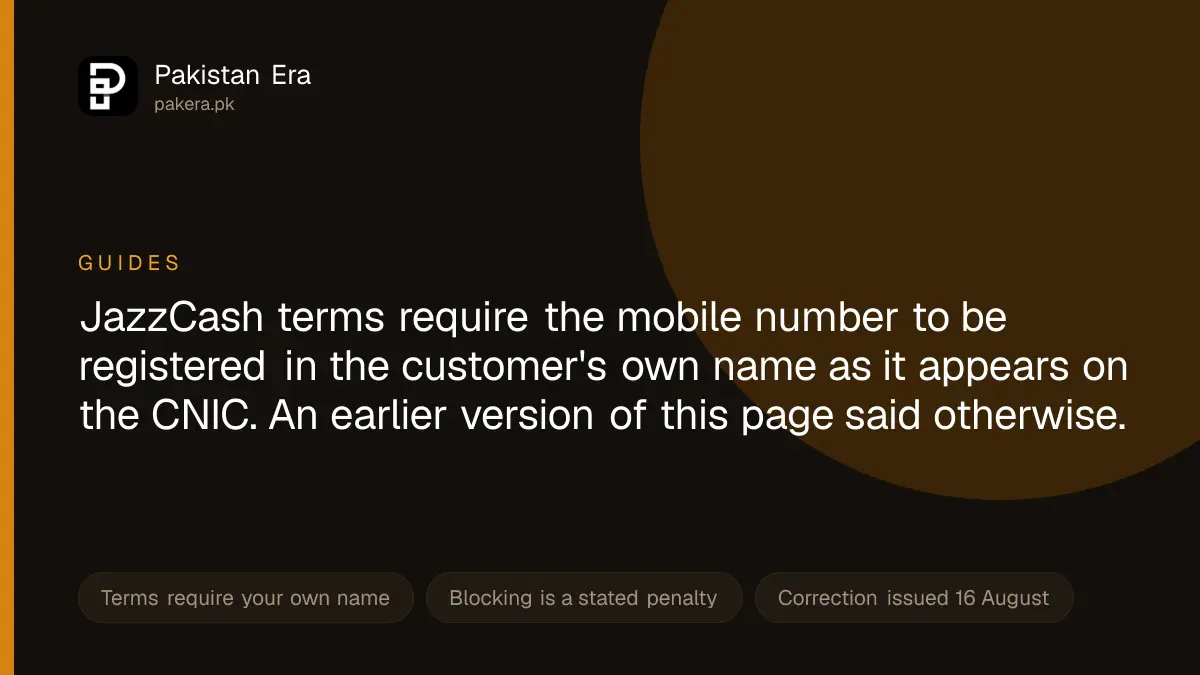
Correction, 16 August 2026. An earlier version of this page told readers they could open a mobile wallet on a SIM registered to a parent or sibling, as long as they could receive the verification code. That was wrong, and we have replaced it.
The short answer is no. The number has to be registered in your own name.
What the terms actually say
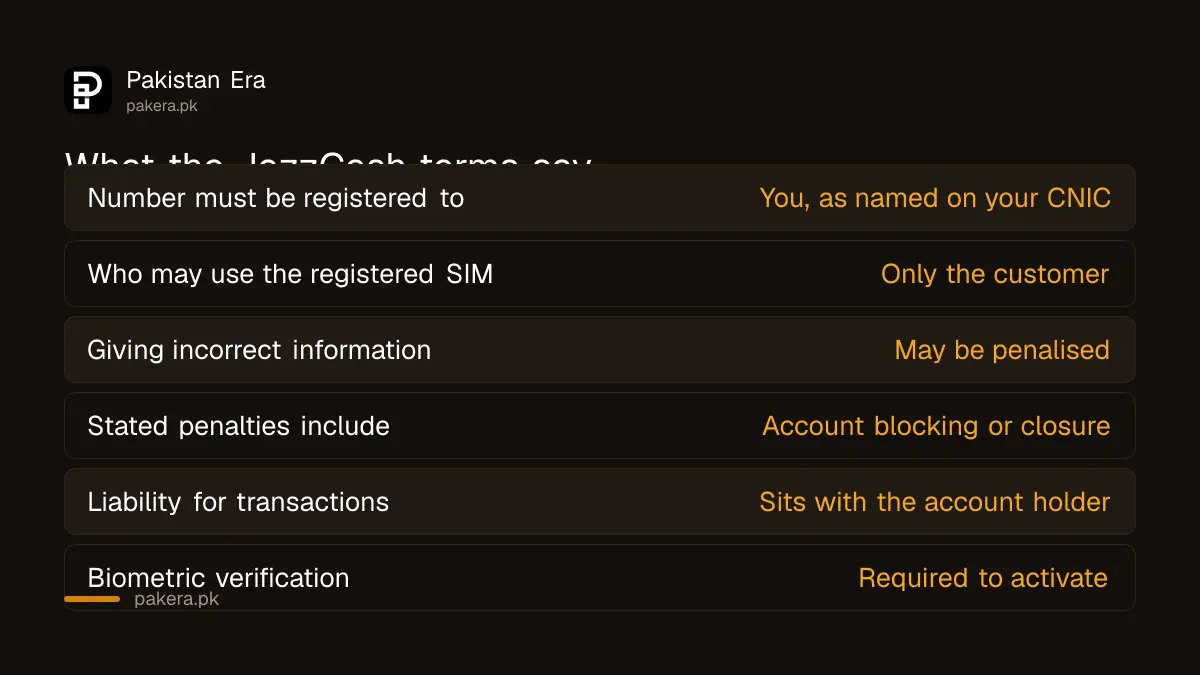
We read JazzCash's own terms and conditions on 16 August 2026. They are not ambiguous.
| Point | What the terms state |
|---|---|
| Whose name the number must be in | The customer's, as it appears on the CNIC |
| Who may use the registered SIM | Only the customer |
| If incorrect information is given | The bank may penalise the customer |
| Penalties named | Account blocking or closure |
The wording on the number is direct: it must be registered in the customer's name appearing on the CNIC. For fund transfer services the terms repeat the requirement.
So this is not a grey area or an unenforced technicality. It is a stated condition with a stated penalty.
Why this matters beyond the rulebook
Even setting the terms aside, a wallet opened on somebody else's number is a bad position to be in, for reasons that only become obvious when something goes wrong.
The liability is yours. The account holder carries responsibility for every transaction made through the registered number, whoever actually made it.
Your access depends on their SIM. If that person stops using the number, loses it, or lets it lapse, it eventually returns to the pool and is reissued. Whoever receives it next gets your verification codes. We set out how quickly that happens in reactivating an expired SIM.
You cannot prove it is yours. In a dispute, a recovery request or a fraud investigation, the record shows another person's identity against the connection.
None of that is theoretical. It is the ordinary way these arrangements fail.
What to do instead
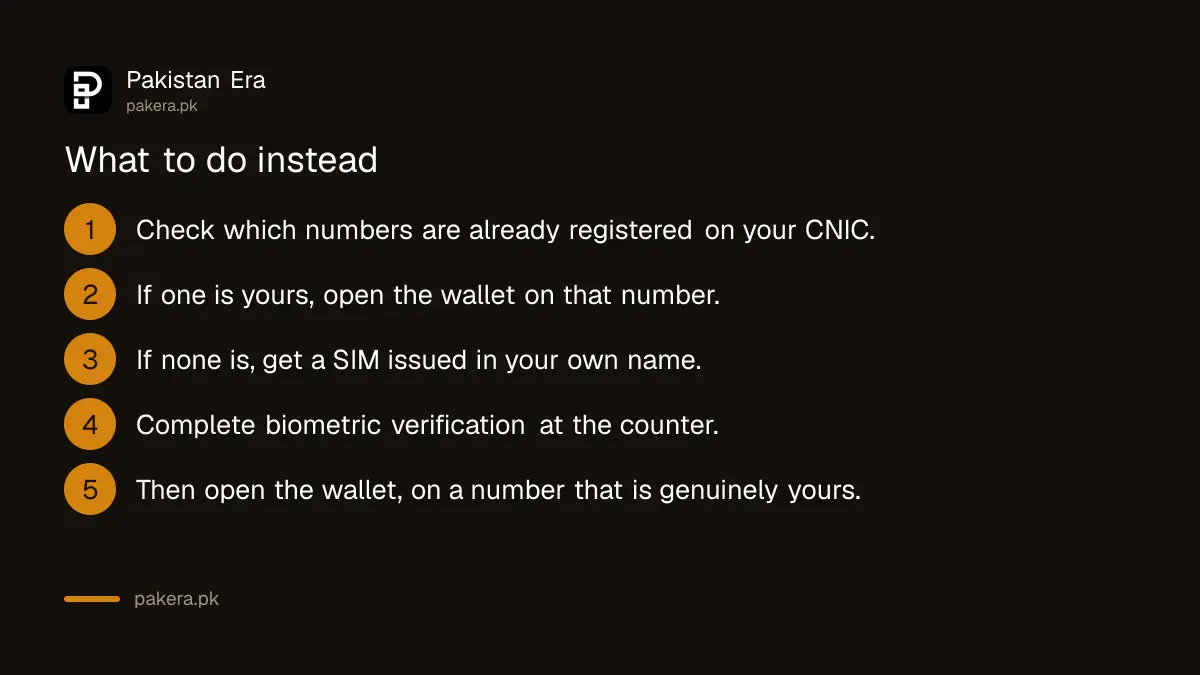
- Check what is already registered to you. Many people have a connection in their own name and do not realise it.
- If you have one, use that number for the wallet.
- If you do not, get a SIM issued in your own name. This needs your original CNIC and biometric verification at a franchise or service centre.
- Complete the wallet's own verification. Biometric verification is reported to be required before activation, with no exceptions by document type.
- Then open the account on a number that is genuinely yours.
The free check on what is registered against your identity card takes about a minute and is covered in checking which SIMs are on your CNIC. It is worth running before you conclude you have no number of your own.
What we verified and what we did not
We read JazzCash's terms directly. That is the source for everything stated above.
We did not read Easypaisa's, SadaPay's or NayaPay's terms at source, and the earlier version of this page named all four as though the same answer applied. We are not repeating that. If you are opening an account with a different provider, read that provider's own terms rather than assuming.
The general direction is consistent across the sector. Wallets are tied to a CNIC, biometric verification is reported to be required before activation, and identity is the point of the whole arrangement. But consistent direction is not the same as a verified clause, and we are separating the two.
How we got this wrong
Worth explaining, because it is instructive.
The original claim was plausible. The verification code does arrive on whatever phone you hold, so in a purely practical sense a sign-up can be completed that way. The page mistook what is technically possible for what is permitted.
There was a second trap. When we went to check the underlying rule, a search returned this very page as a source. An unverified claim, published once, comes back as evidence for itself. That is how a wrong answer hardens into an accepted one across an entire topic.
The fix in both cases is the same and it is the rule we apply everywhere: go to the responsible party's own document. Our approach to this is set out in our corrections policy and editorial standards.
If you already opened one this way
We are not going to tell you to panic, and we are not able to tell you what any particular provider will do.
What we can say is that the position is not stable. The stated penalty for incorrect information is blocking or closure, and your access depends on a SIM you do not control.
The orderly fix is to get a connection in your own name and move to a wallet on that number, rather than waiting to find out. Moving money out of an account you may lose access to is easier done calmly than urgently.
If the wallet is on a number you can no longer reach at all, the recovery route runs through the provider's own support with identity verification, and the MPIN reset process is in resetting a forgotten JazzCash MPIN.
Questions readers are asking
Can I open JazzCash on someone else's SIM?
No. The terms require the mobile number to be registered in your own name as it appears on your CNIC.
What happens if I do it anyway?
The terms state the bank may penalise the customer, including blocking or closing the account, for providing incorrect information.
But the code arrives on any phone. Does that not mean it works?
Receiving the code is technically possible. That is not the same as being permitted, and it was the mistake in our earlier version.
Does the same rule apply to Easypaisa?
We did not read Easypaisa's terms at source, so we are not stating their position. Check your provider's own terms.
I do not have a SIM in my name. What now?
Get one issued in your own name with your original CNIC and biometric verification, then open the wallet on that number.
I already have an account on a relative's number.
Move to a number registered to you rather than waiting. Your access depends on a SIM you do not control, and the liability is yours either way.
Why did this page say the opposite before?
Because it confused what is technically possible with what the terms allow. We have corrected it and left this explanation on the page rather than amending it quietly.
About the author

Senior Writer, Public Services and Technology
Shahid joined us in 2024 as an author. He is a senior contributor to Pakistan's leading technology websites. He writes detailed articles, mostly covering his expertise in the latest tech, mobiles, apps, gadgets, and step-by-step guides. His ideology is to help people understand the latest trends and explain complex methods through very easy-to-understand guides.