How to Open a Special Savings Account in Pakistan From Rs 500: 11.60% Paid Every Six Months
Open a National Savings Special Savings Account in Pakistan from Rs 500: papers, 11.60% profit paid every six months, 15% or 30% tax and how to withdraw.
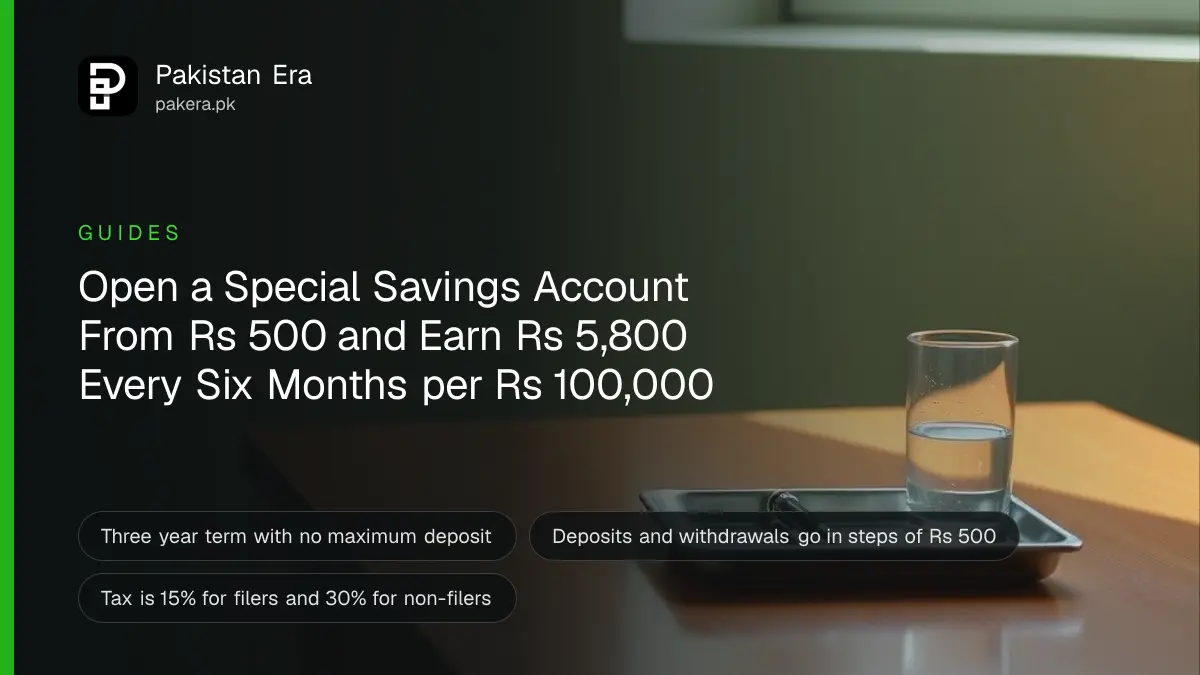
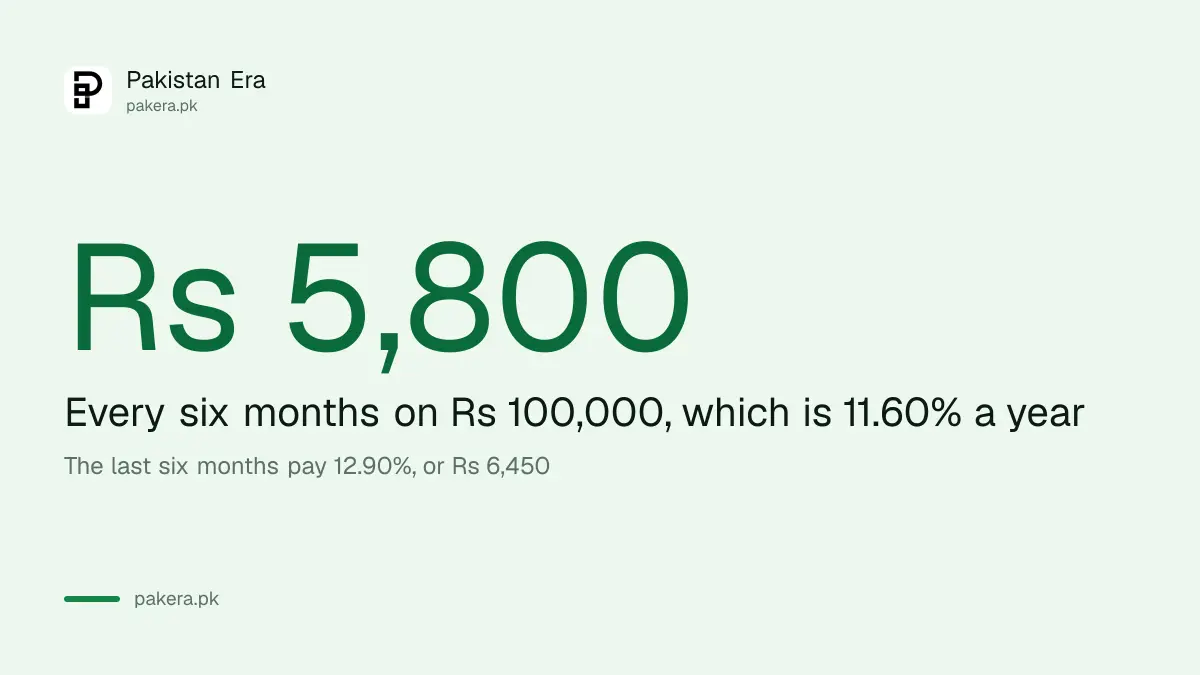
A National Savings Special Savings Account opens with just Rs 500 and pays 11.60% a year in six monthly payments, which is Rs 5,800 every six months for each Rs 100,000. The term is three years, there is no maximum deposit, and you can withdraw at any time, though money taken out before six months earns no profit.
Most savings accounts at banks have a low profit rate and a high minimum balance. The Special Savings Account (SSA) is the opposite. It takes small amounts, pays twice a year and lets you add or withdraw in steps of Rs 500. This guide shows who can open one, the papers, the profit, the tax and the withdrawal rules.
Check who can open a Special Savings Account
Pakistani nationals and overseas Pakistanis can open the account in their own name. A minor can hold one through a guardian, and two people can hold one jointly. There is no maximum investment, and deposits go in multiples of Rs 500.
The scheme started in February 1990 and runs on a three year maturity. If you have never used National Savings, this is one of the gentlest starts. Compare it with the guide to opening a minor's bank account if the account is for a child and you also want a bank option.
Seniors and pensioners have other schemes with higher monthly rates. The guide to the Pensioners' Benefit Account is one. The SSA is open to everyone, so it is the fallback when you do not qualify for those.
Bring a CNIC and fill in form DA-1
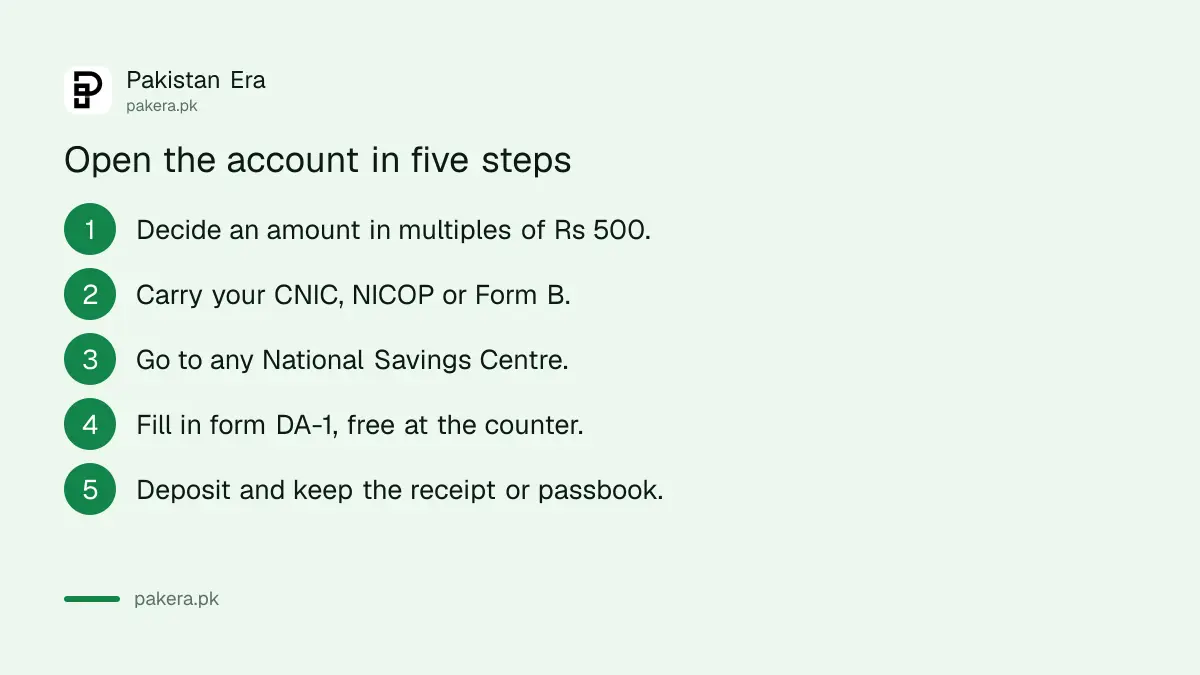
Adult Pakistanis bring a CNIC copy. Overseas Pakistanis bring a NICOP or Pakistan Origin Card copy. A minor needs Form B or a Child Registration Certificate. You fill in form DA-1, which the centre gives out free of cost.
Take your original documents as well as copies. Account opening is at any National Savings Centre, so choose the one nearest to your home or office. If you are overseas, the guide to applying for a NICOP online shows how to get the document first.
Read how the profit is paid
The account pays profit at the end of each six month period, or at the end of three years. The National Savings rate sheets from 1 October 2026 show 11.60% for each of the first five periods and 12.90% for the last one.
| Period | Rate a year | Profit per Rs 100,000 for the period |
|---|---|---|
| Periods 1 to 5, each six months | 11.60% | Rs 5,800 |
| Period 6, the last six months | 12.90% | Rs 6,450 |
| All three years together | Mixed | Rs 35,450 |
The first two rows are from the National Savings rate sheet. The third row is our own addition: five payments of Rs 5,800 plus one of Rs 6,450. Rates change, and the sheet has moved several times this year, as our story on National Savings rates from 1 October 2026 shows.
Every holder pays withholding tax on the profit: 15% for filers on the active taxpayer list and 30% for non-filers, according to the scheme page. The page also says zakat is collected at source when you withdraw. The guide to the tax on savings profit explains the difference.
Know the withdrawal rules
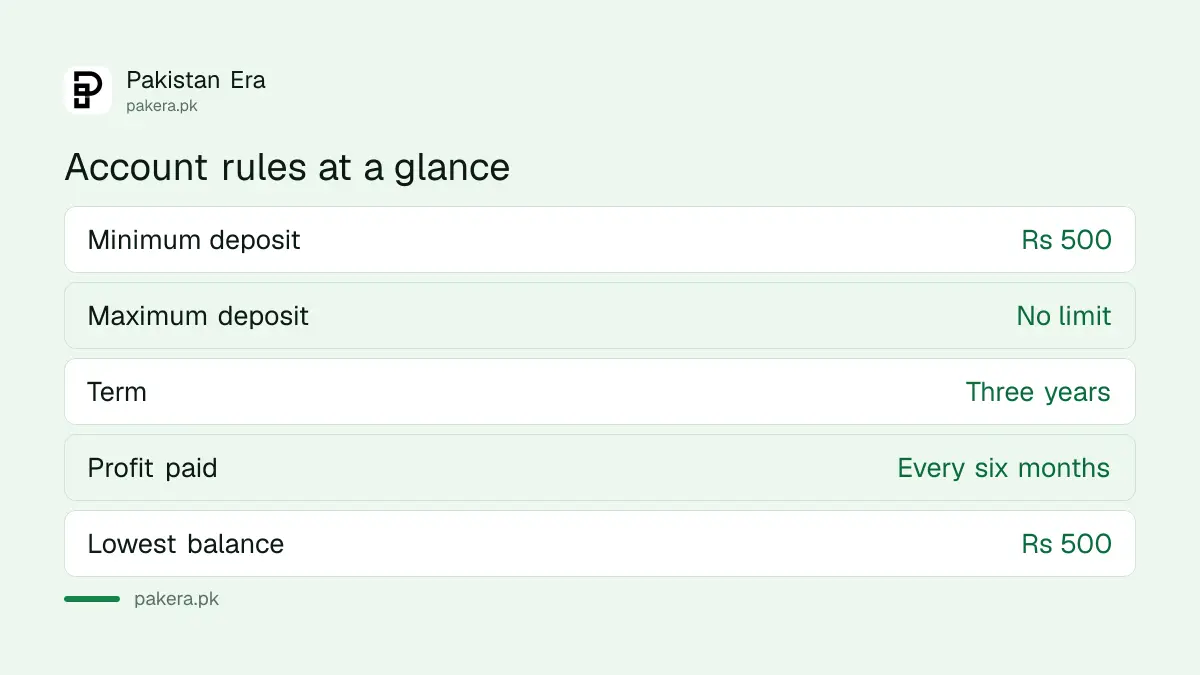
You can withdraw at any time after the date of deposit. If you withdraw before six months are complete, no profit is paid on that money. Withdrawals go in multiples of Rs 500, and the balance cannot fall below Rs 500.
| Rule | What the scheme page says |
|---|---|
| Minimum deposit | Rs 500 |
| Deposit and withdrawal steps | Multiples of Rs 500 |
| Lowest balance allowed | Rs 500 |
| Withdrawal before 6 months | No profit on that money |
| Reinvestment | Restrictions apply after 1 July 2017 |
The page gives no detail on what the reinvestment restriction means in practice, so ask the counter what happens at the end of three years. If you lose your passbook or paper, the guide to a duplicate National Savings certificate explains the usual route. And if the holder dies, the family follows the steps to claim a deceased person's National Savings.
Open the account in six steps
Opening takes one visit. Start with the amount you can leave alone for at least six months, since early money earns nothing.
- Decide your amount in multiples of Rs 500.
- Collect your CNIC, NICOP or the child's Form B, with copies.
- Go to any National Savings Centre.
- Ask for form DA-1 and fill it in. It is free.
- Make the deposit and keep the receipt or passbook.
- Note the date, so you know when each six month payment is due.
Common questions about the Special Savings Account
What is the minimum to open a Special Savings Account?
Rs 500. All deposits and withdrawals must be in multiples of Rs 500, and the balance cannot fall below Rs 500.
How often is profit paid?
Every six months, or on completion of three years, according to the scheme page. That is two payments a year.
Is there a maximum I can deposit?
No. The scheme page says there are no maximum investment limits.
Can a child have a Special Savings Account?
Yes, through a guardian. The child needs Form B or a Child Registration Certificate.
Is tax taken from the profit?
Yes. The scheme page lists 15% withholding tax for filers and 30% for non-filers, and zakat collected at source on withdrawal.
How we verified this
What we checked, where we read it, and what we could not confirm.
Last checked 8 October 2026. Eligibility, the Rs 500 rules, the three year term, six monthly profit, documents, withdrawal rules, tax and the zakat wording come from the Special Savings Account page on the National Savings website, which we read on 8 October 2026. The summary page on the same site dates its rates from 1 October 2026. The 11.60% and 12.90% figures come from the rate sheet we read on 3 October 2026. We did not visit a centre.
About the author

Tax, Bills and Technology Writer
Ali Akhtar is a young and curious voice here at Pakistan Era. He is currently pursuing his A-Levels and has a growing interest in Pakistan’s changing industrial landscape and educational trends. Ali likes to write in a way that helps him explain and explore the world around him. His writing reflects the perspective of the new generation navigating the evolving trends of Pakistan where technology, youth innovation, and shifting opportunities are reshaping the country’s future.