How Pakistan's Homes Get Light and Cook: Electricity, Solar, Sui Gas and Wood (Census 2023)
84% of Pakistan homes use grid electricity for light and 7.7% solar, the 2023 census shows. 52.7% cook on wood, 37.8% on sui gas. See every province here.
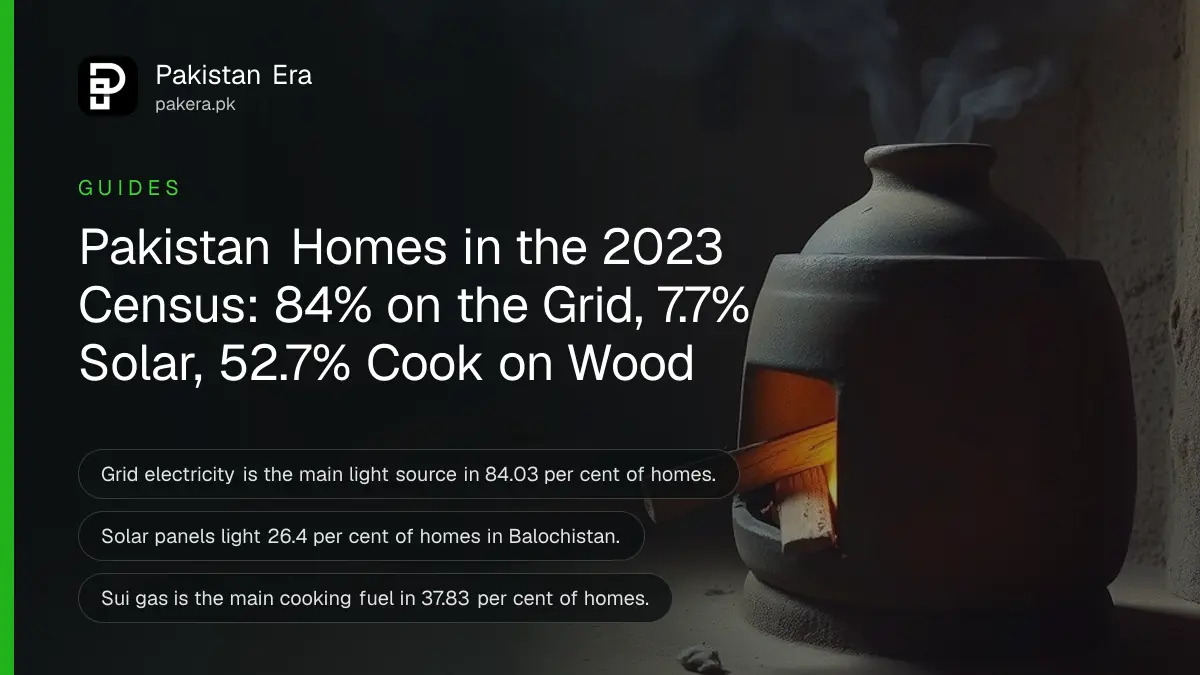
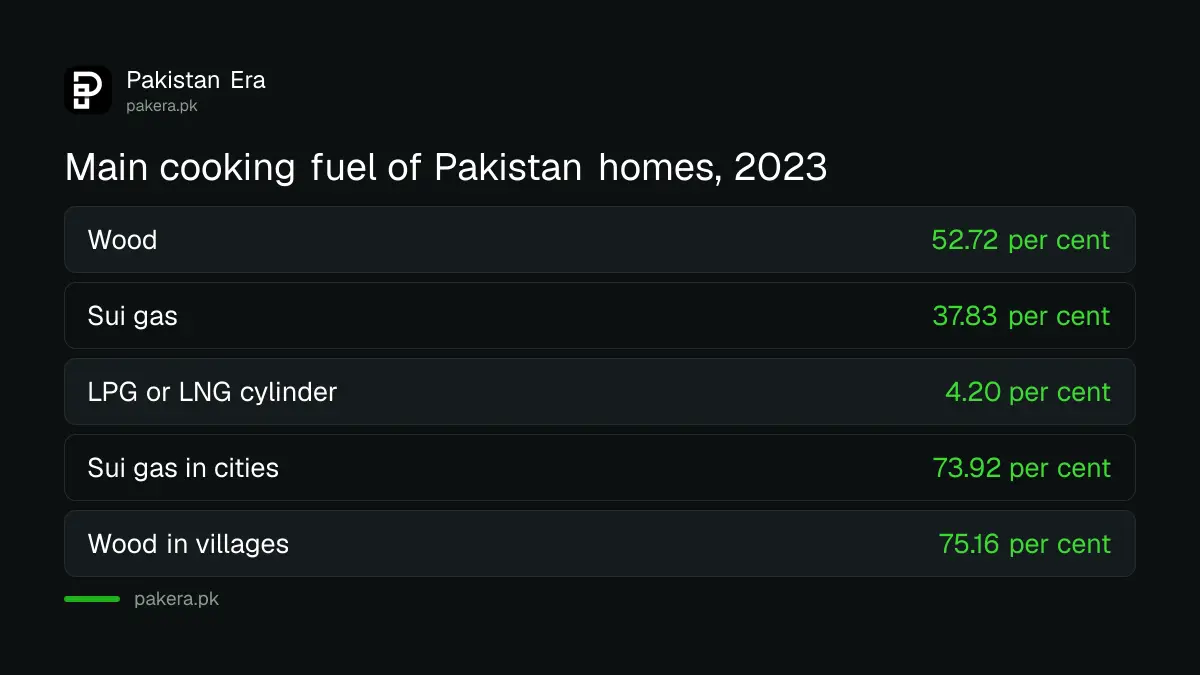
84 per cent of Pakistan's homes use grid electricity for light and 7.7 per cent rely on solar panels, according to the 2023 census by the Pakistan Bureau of Statistics (PBS). For cooking, 52.7 per cent still burn wood, 37.8 per cent use sui gas and 4.2 per cent use LPG cylinders.
The census asked every household two energy questions: what is your main source of light, and what is your main cooking fuel. We took the answers from the PBS National Census Report 2023 for all 38.3 million households and set out the national, urban, rural and provincial picture below.
| Main source | All homes | Rural | Urban |
|---|---|---|---|
| Light: grid electricity | 84.03% | 76.69% | 95.41% |
| Light: solar panel | 7.74% | 11.19% | 2.38% |
| Cooking: wood | 52.72% | 75.16% | 17.97% |
| Cooking: sui gas | 37.83% | 14.53% | 73.92% |
| Cooking: LPG or LNG cylinder | 4.20% | 2.91% | 6.21% |
84 per cent of homes light up with grid electricity
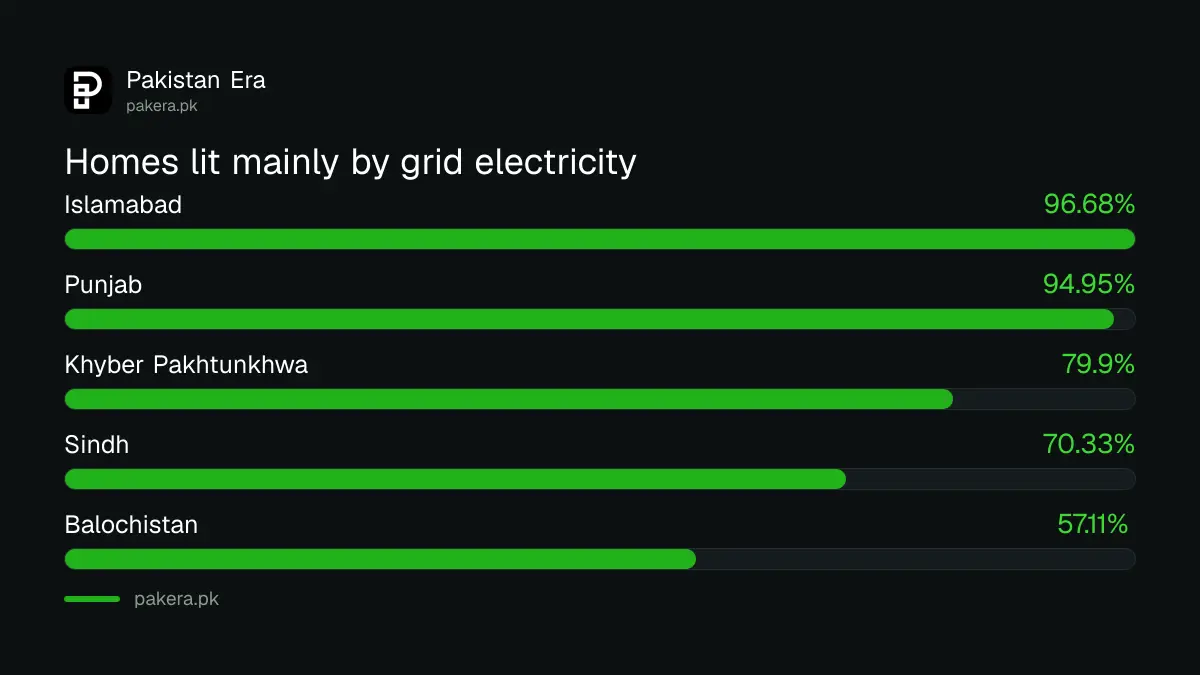
The census counted 32.18 million homes, 84.03 per cent, whose main light source is grid electricity. In cities the figure is 95.41 per cent. In villages it is 76.69 per cent, so about one rural home in four depends on something else.
The 2017 census put grid electricity at 87.87 per cent. The 2023 census added solar panels as a separate answer for the first time, which explains much of the drop. Kerosene lamps fell from 3.67 to 1.23 per cent of homes in the same six years.
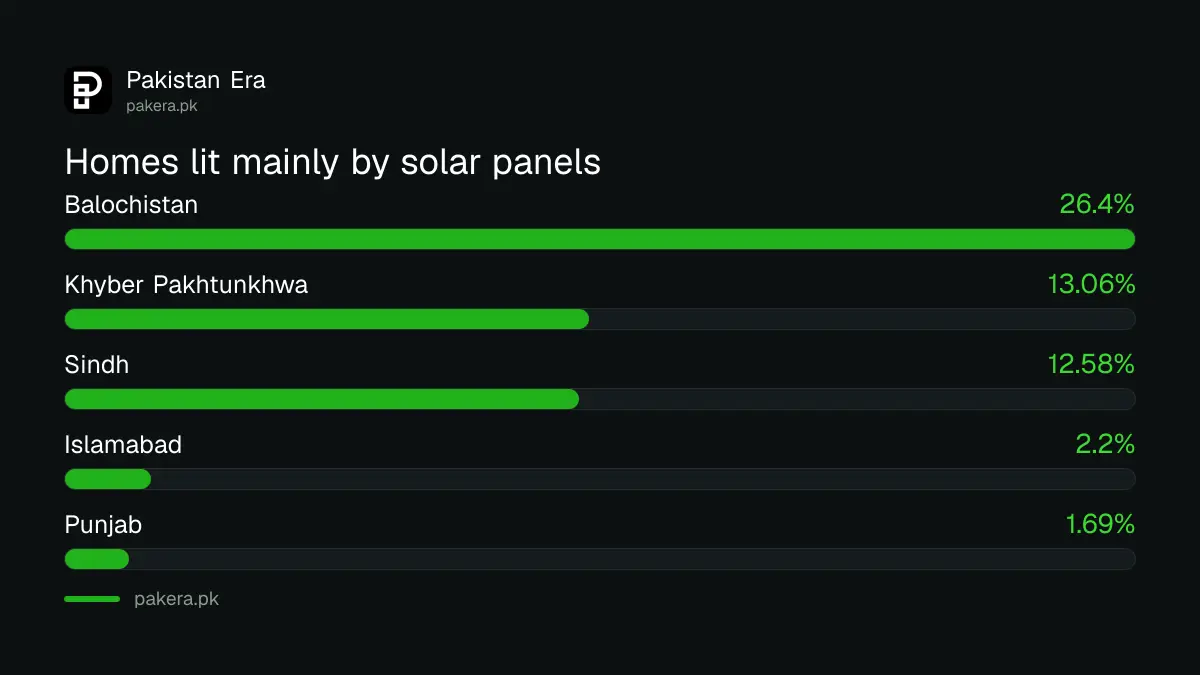
One home in four in Balochistan runs on solar
Solar panels are the main light source for 2.96 million Pakistani homes, 7.74 per cent of the total. In Balochistan the share is 26.4 per cent, against 57.11 per cent on the grid. Punjab and Islamabad homes barely use solar as a main source, at about 2 per cent.
| Area | Grid electricity | Solar panel |
|---|---|---|
| Islamabad | 96.68% | 2.20% |
| Punjab | 94.95% | 1.69% |
| Khyber Pakhtunkhwa | 79.90% | 13.06% |
| Sindh | 70.33% | 12.58% |
| Balochistan | 57.11% | 26.40% |
Note what this measures: the main source of light. A city home with rooftop solar and a grid connection is likely to answer grid electricity. So these figures show off-grid solar homes, mostly in villages, not the full count of solar panels in the country.
More than half of homes still cook on wood
Wood is the main cooking fuel in 20.19 million homes, 52.72 per cent of the country. That is down from 58.44 per cent in 2017. In rural areas three homes in four cook on wood. In cities fewer than one in five do.
Khyber Pakhtunkhwa (71.38 per cent) and Balochistan (70.06) rely on wood the most. Punjab is at 49.94 and Sindh 44.8. Islamabad is lowest at 13.16 per cent.
| Area | Wood | Sui gas | LPG cylinder |
|---|---|---|---|
| Islamabad | 13.16% | 61.54% | 24.31% |
| Sindh | 44.80% | 47.37% | 1.94% |
| Punjab | 49.94% | 39.43% | 5.40% |
| Balochistan | 70.06% | 17.86% | 3.27% |
| Khyber Pakhtunkhwa | 71.38% | 22.56% | 2.90% |
Sui gas reaches 37.8 per cent of homes, and the share has not grown
Sui gas is the main cooking fuel in 14.49 million homes, 37.83 per cent. In 2017 it was 37.86 per cent, so the share has stayed flat while the number of homes grew. In cities 73.92 per cent of homes use it; in villages only 14.53 per cent.
LPG and LNG cylinders fill part of the gap. The census counted 1.61 million homes, 4.20 per cent, that cook mainly on a cylinder. In Islamabad nearly one home in four does, the highest share in the country.
For a household, this matters because the two fuels are priced very differently. Piped gas rates are set by OGRA in slabs, while cylinder prices change every month. The cost per meal is compared in piped gas against LPG, and this month's official cylinder price is in the LPG price for November 2026.
What these numbers mean for your home
If your home is one of the 16 per cent not lit mainly by the grid, or one of the 62 per cent not cooking on sui gas, there are steps you can take. Pick the one that fits.
- Already on the grid with rooftop solar? Ask your power company about net metering, so you are credited for surplus units. The process is in the net metering application guide.
- Off the grid? Have solar batteries and wiring checked by a trained electrician once a year, and keep batteries in a ventilated spot.
- Want sui gas? New connections depend on a gas main near your street and on the company's current policy. Ask SNGPL or SSGC in writing before paying anyone.
- Cooking on a cylinder? Buy from an authorised dealer, check the seal and weight, and keep the cylinder outside the kitchen where possible.
- Cooking on wood indoors? Open a window or use a chimney, because smoke in a closed room is a health risk for children and older people.
Gas bills in winter are covered in the sui gas slab rates guide.
Common questions
How many homes in Pakistan have electricity?
The 2023 census found 84.03 per cent of homes use grid electricity as their main light source, and 7.74 per cent use solar panels.
How many Pakistani homes have sui gas?
37.83 per cent of homes, 14.49 million, cook mainly on sui gas. In cities the figure is 73.92 per cent.
Which province uses the most solar?
Balochistan, where 26.4 per cent of homes use solar panels as the main light source.
What is the most common cooking fuel in Pakistan?
Wood, used by 52.72 per cent of homes. In rural areas the figure is 75.16 per cent.
How many homes use LPG cylinders?
1.61 million homes, 4.20 per cent, cook mainly on LPG or LNG cylinders. Islamabad has the highest share at 24.31 per cent.
Does the census count every solar panel?
No. It records the main source of light only. Homes with both grid and solar are likely to report grid electricity.
How we verified this
What we checked and where we read it.
We checked these figures on 25 November 2026 in the PBS National Census Report 2023, linked from the PBS census page: section 5.1.2 on facilities in housing units, Table 5.15 (source of lighting, 2017 and 2023), Table 5.16 (lighting by province), Table 5.17 (cooking fuel, 2017 and 2023) and Table 5.18 (cooking fuel by province). The household total is from Table 5.4.
The report's text under Table 5.18 describes the 47.37, 39.43 and 22.56 per cent figures as natural gas, LPG and LNG together, while the table places them in the sui gas row with LPG listed separately. We follow the table. The safety steps are general practice, not census findings.
Free on WhatsApp
Get last dates and rule changes on WhatsApp
We post new last dates, fee changes and fixes for common problems, a few short posts a day.
Follow Pakera on WhatsAppOther followers cannot see your number.
Pakera Solves It
Which online process wasted your time this week?
A portal that will not load, a form nobody explains, a complaint that went nowhere. Tell us. Every week we pick one, solve it step by step and publish the answer.
About the author

Tax, Bills and Technology Writer
Ali Akhtar is a young and curious voice here at Pakistan Era. He is currently pursuing his A-Levels and has a growing interest in Pakistan’s changing industrial landscape and educational trends. Ali likes to write in a way that helps him explain and explore the world around him. His writing reflects the perspective of the new generation navigating the evolving trends of Pakistan where technology, youth innovation, and shifting opportunities are reshaping the country’s future.