Pay a Utility Bill at a Bank Branch in Pakistan: 9 to 5, and an Extra Counter After 15 in Line
SBP says bank branches must take utility bills from 9 am to 5 pm, add a counter when 15 people queue and keep a cheque drop box. See what to do if refused.
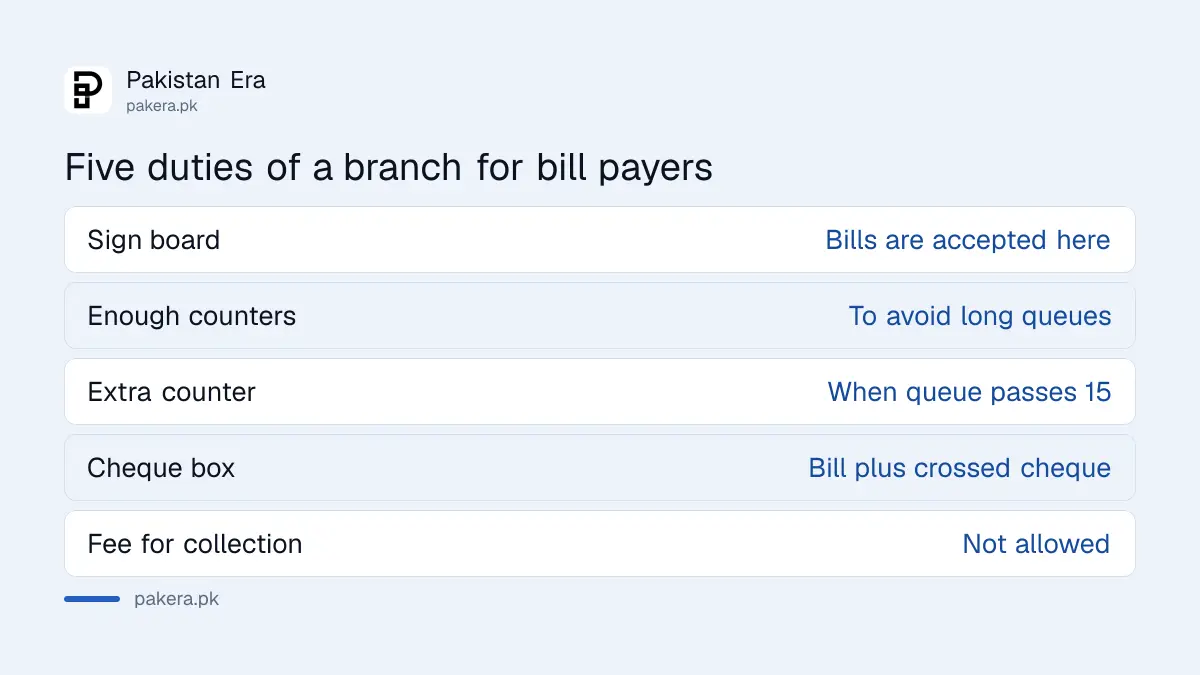
SBP's public awareness message says every bank branch must collect utility bills from 9 am to 5 pm, apart from lunch and prayer breaks. The branch must show a sign, open an extra counter once the queue passes fifteen people, keep a drop box for bills paid by crossed cheque, and charge you no fee for collecting the bill.
You arrive at a branch with a gas bill, and the line runs out of the door. The cashier says the counter is closing. That is a common story, and SBP has a written answer to it. We read the awareness message on SBP's consumer protection page on 14 October 2026, and checked the fee rule in SBP's Business Conduct and Fair Treatment of Consumers Regulatory Framework.
Branches must take utility bills from 9 am to 5 pm
The awareness message says that, under instructions SBP has issued from time to time, all bank branches, local and foreign commercial banks alike, are bound to collect utility bills from 9 am to 5 pm. Lunch and prayer breaks are excluded from that window.
The message does not say the rule applies on Saturdays or any other special day. For the usual banking hours in your city, see the guide on bank timings in Pakistan. Note that the message is an older notice that SBP still publishes on its consumer page, so the date SBP last revised the instruction is not shown.
What every branch must arrange for bill payers
SBP lists several duties for the bank. Some are about the counter, some about dignity and some about complaints. The table puts the main ones side by side.
| Duty | What SBP's message says |
|---|---|
| Sign board | Display "utility bills are accepted here" |
| Counters | Enough counters to avoid long queues |
| Extra counter | Open one when the queue goes beyond fifteen consumers |
| Cheque box | A box in a prominent place for the bill and a crossed cheque |
| Acknowledgement | You may collect it later after dropping the cheque |
| Queue shelter | Water and shelter from heat and rain if people queue outside |
| Senior citizens | Proper respect and treatment |
A crossed cheque in the drop box saves you the queue
SBP says each branch shall arrange a box in a prominent place so a consumer can drop the utility bill with a crossed cheque for the billed amount. The consumer can collect the acknowledgement afterwards. So if you hold an account at that bank, you do not have to stand in the line.
Practical tip, not an SBP rule: write your account number and phone number on the back of the cheque and keep the bill's copy. Then you can show what you dropped and when. For paying without a branch at all, the guide on paying utility bills with Easypaisa or JazzCash lists the app route.
The bank cannot charge you for collecting the bill
The Business Conduct and Fair Treatment of Consumers Regulatory Framework, part of BPRD Circular No. 04 of 2025, lists among unfair practices that banks shall not "charge any fee for collecting utility bill payments from customers". If a cashier asks for an extra amount, that is a complaint.
The framework's wider list of charges banks cannot take is in the guide on bank fees you can refuse. A late payment surcharge from the utility company itself is a different matter and is not covered by this rule.
What to do when a branch refuses your bill
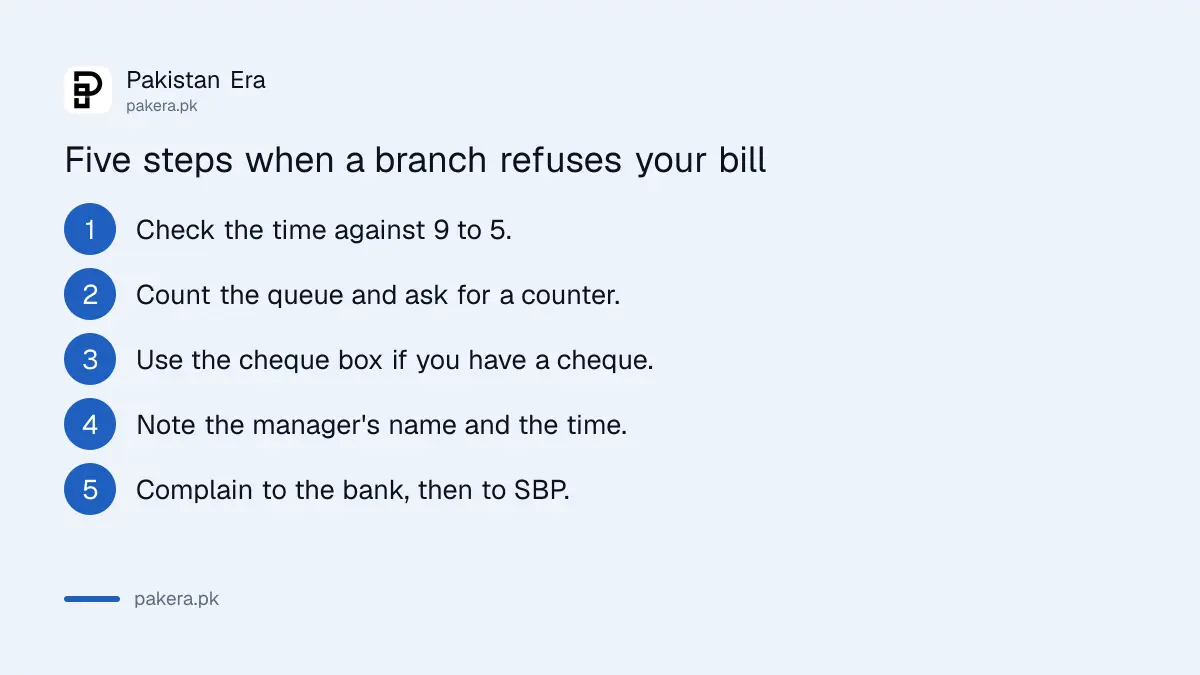
- Check the time. If it is between 9 am and 5 pm and not a lunch or prayer break, ask why the counter is closed.
- Count the queue. If more than fifteen people are waiting, ask for an extra counter.
- Ask for the cheque box if you have a crossed cheque.
- Ask the branch manager for the refusal in writing, or note the manager's name and the time.
- Complain to the bank's complaint unit, then to SBP if there is no fix.
SBP's message says consumers can complain by post to the Director, Banking Conduct and Consumer Protection Department, State Bank of Pakistan, 5th floor, I.I. Chundrigar Road, Karachi, or through its help desk. SBP's consumer page also lists utility bill payment among complaints the Banking Mohtasib can take, once the bank has had 45 days to reply. The Banking Mohtasib complaint guide shows the form.
Common questions about paying utility bills at a bank in Pakistan
Until what time must a bank take my utility bill?
Until 5 pm, according to SBP's awareness message. Lunch and prayer breaks are excluded, and the message does not mention any special counter time.
How long can the queue be before an extra counter opens?
SBP says the bank must arrange an extra counter when the queue exceeds fifteen consumers.
Can I pay by cheque without waiting?
Yes, if you hold a crossed cheque for the billed amount. The branch must keep a box for this and give you the acknowledgement afterwards.
Can the bank charge a fee to take my bill?
No. SBP's 2025 framework lists a fee for collecting utility bill payments among practices banks must avoid.
Where do I complain if the branch refuses?
The bank's complaint unit first. SBP's message gives its Karachi address and help desk, and its consumer page lists the Banking Mohtasib for bill payment complaints.
How we verified this
What we checked, where we read it, and what we could not confirm.
Last checked 14 October 2026. The hours, counter, queue and cheque box duties come from SBP's public awareness message on utility bill collection by banks, linked from its consumer protection page as a PDF. The fee rule is in SBP's Business Conduct and Fair Treatment of Consumers Regulatory Framework. We have not visited any branch to test these rules. The awareness message is undated, so confirm the hours with your branch.
About the author

Senior Writer, Public Services and Technology
Shahid joined us in 2024 as an author. He is a senior contributor to Pakistan's leading technology websites. He writes detailed articles, mostly covering his expertise in the latest tech, mobiles, apps, gadgets, and step-by-step guides. His ideology is to help people understand the latest trends and explain complex methods through very easy-to-understand guides.