PCB Domestic T20 and One-Day Rules 2026-27: Powerplay, Super Over and Illegal Player Penalties
Read the PCB 2026-27 domestic T20 and one-day rules in plain English: overs, Powerplay, Super Over, DLS, over-rate limits and the penalty for an illegal player.
Short answer: The PCB's 2026-27 domestic playing conditions set a T20 at 20 overs a side, with 4 overs a bowler, and a one-day match at 50 overs, with 10 a bowler. A tied match goes to a Super Over. A team that fields an illegal player loses the points even if it wins, and its captain is banned for 2 matches.
Domestic cricket is where Pakistan's next players are found, and its rules are not the same as the ones on television. Many fans have never read them.
The Pakistan Cricket Board (PCB) lists its domestic playing conditions on its documents page. We downloaded the men's T20 and the men's one-day editions for 2026-27 on 12 October 2026, and read them in full. This page sets out the rules fans ask about most.
A T20 match is 20 overs a side and 4 overs a bowler
Each side bats for up to 20 overs, and no bowler may bowl more than 4 overs. If overs are cut, a bowler may bowl one-fifth of the innings. Each team names 11 players and up to 4 substitute fielders before the toss.
The one-day match is 50 overs a side, with 10 overs for each bowler. The same 11 players and 4 substitute fielders apply.
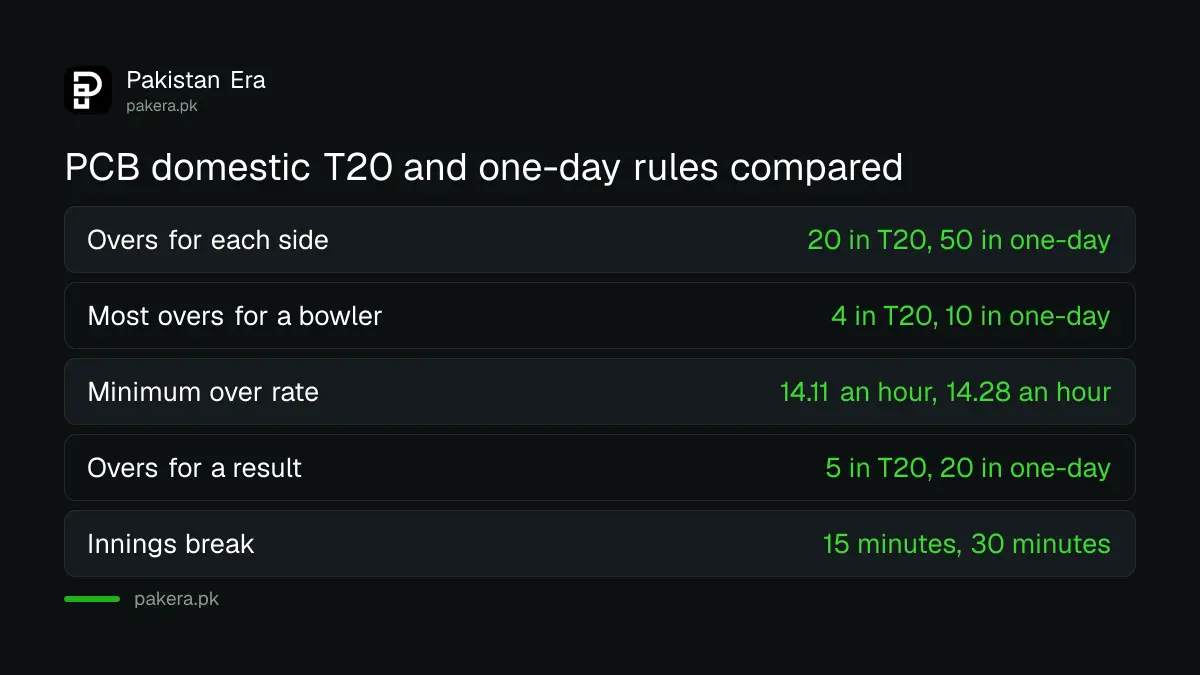
| Rule | T20 | One-day |
|---|---|---|
| Overs for each side | 20 | 50 |
| Most overs for one bowler | 4 | 10 |
| Minimum over rate | 14.11 overs an hour | 14.28 overs an hour |
| Minimum overs for a result, second innings | 5 | 20 |
| Innings break | 15 minutes | 30 minutes |
These limits also shape the youth game, where the format splits into a cup and a championship, as set out for the National U19 Cup and Championship.
The one-day match has two sessions of 3.5 hours with a 30 minute break. The T20 has two sessions of 1 hour 25 minutes with a 15 minute break.
The first 6 overs of a T20 limit the fielders
In the T20 Powerplay, the first 6 overs of each innings, only 2 fielders may stand outside a 30-yard circle. After the Powerplay, up to 5 fielders may stand outside it. A no ball is a free hit for the next delivery.
If an innings is shortened by rain, the number of Powerplay overs is reduced too. The conditions include a table of how many overs apply for each reduced innings.
A tie goes to a Super Over, and two wickets end it
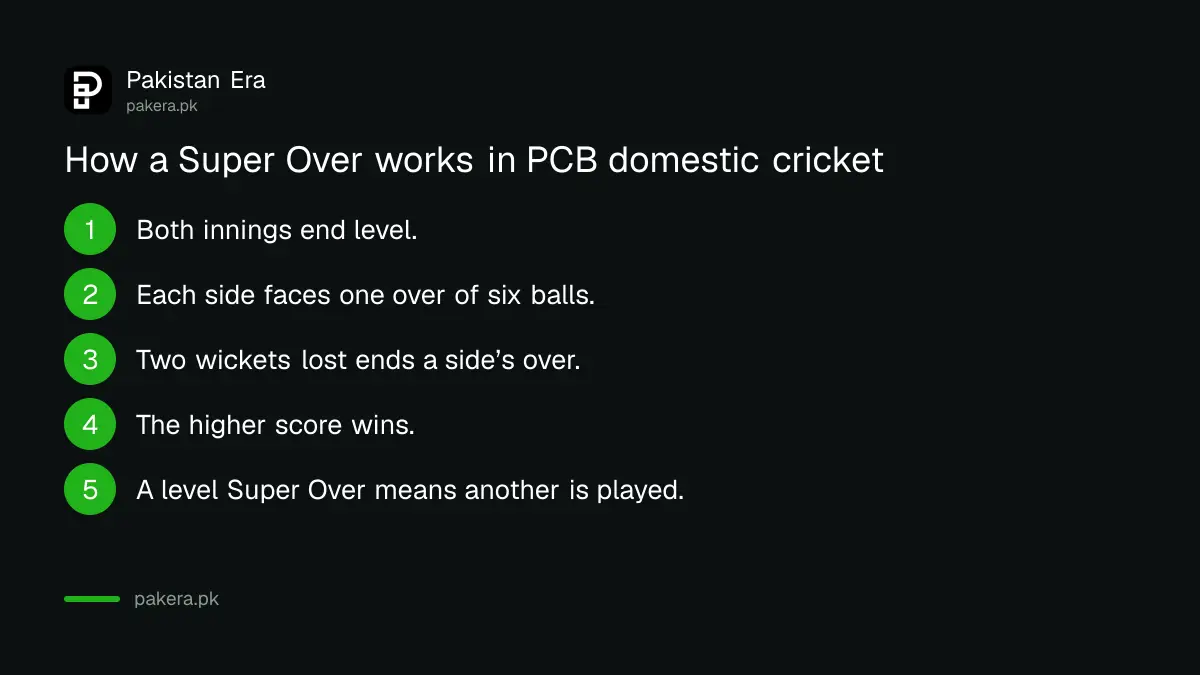
If the scores are level after both innings, the match goes to a Super Over. Each side faces one over of six balls, and the loss of two wickets ends that side's turn. If the Super Over is tied, another is played until there is a winner.
If weather stops the Super Over from being finished, the match is a tie. A tied semi-final is settled by a Super Over to decide who reaches the final. If the weather also stops that, the team that finished higher in the preliminary round goes through.
- Both innings end level.
- Each side faces one over of six balls.
- Two wickets lost ends a side's over.
- The higher score wins, whatever the wickets.
- A level Super Over means another one is played.
Rain turns to the Duckworth-Lewis-Stern method
When rain cuts the match, the PCB uses the Duckworth-Lewis-Stern method (DLS) to set a new target. DLS is a formula that compares the runs a side could still score with the overs and wickets it has left. A target is always a whole number, and one run short is a tie.
To make a match, the side batting second must face at least 5 overs in a T20 and 20 overs in a one-day game. If there are fewer, the match is a no result. If the second innings is stopped after that point, the result is by comparison with the DLS par score.
Illegal players cost a team all its points
A team that plays someone who was not nominated before the toss loses all its points from the match, even if it wins. The captain is banned for the next 2 matches, and the coach and the manager are each fined at least Rs 50,000.
The PCB also allows a concussion replacement. A team doctor must diagnose the concussion and the team must send a request to the match referee on a standard form.
One-day points are 2 for a win and 1 for a tie
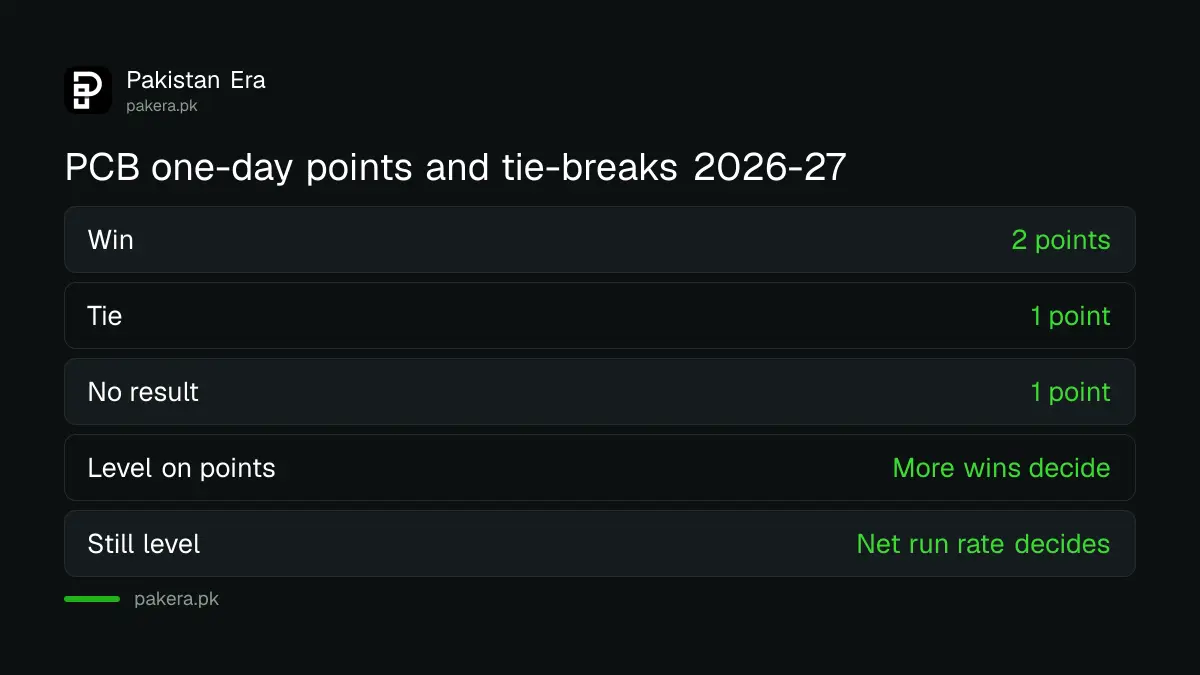
In one-day preliminary matches, a win earns 2 points, and a tie or a no result earns 1. If teams finish level, the team with more wins goes through. If wins are also level, the better net run rate decides. Net run rate counts only matches with a result.
The one-day document also prints a bonus point table for batting and bowling. It is headed with the 2024 President's Cup, so we do not treat it as the current table for 2026-27 competitions.
| One-day result | Points |
|---|---|
| Win | 2 |
| Tie | 1 |
| No result | 1 |
| Level on points | More wins, then net run rate |
Four-day matches, such as the Quaid-e-Azam Trophy, have their own multi-day document. The women's game has two documents of its own, which cover events like the National Women's T20 Tournament. We read only the men's T20 and one-day editions.
Common questions
How many overs are in a PCB domestic T20?
Twenty overs a side. Each bowler may bowl up to 4.
How many overs are in a domestic one-day match?
Fifty overs a side, with up to 10 overs for each bowler.
What happens if a T20 is tied?
A Super Over is played, and more are played until there is a winner.
How many overs make a match when it rains?
At least 5 overs for the side batting second in a T20, and 20 in a one-day match.
What is the penalty for an illegal player?
The team gets no points from the match, the captain is banned for 2 matches, and the coach and manager are fined at least Rs 50,000.
Where can I read the rules myself?
On the PCB's important documents page, under Men's Playing Conditions.
How we verified this
What we checked, where we read it, and what we could not confirm.
Checked on 12 October 2026. Sources: the PCB "Men's Domestic T20 Match Playing Conditions 2026-27" and "Men's Domestic One Day Match Playing Conditions 2026-27", both PDFs on the PCB important documents page. We did not read the multi-day or the women's editions. The PCB may amend its conditions for a particular event.
About the author

Public Services and Education Journalist
Fajr Riaz is a journalist and content writer at Pakistan Era, based in Lahore. She covers the questions people meet in everyday life in Pakistan: how a public service works, what a change in the rules means, and where to find a reliable answer.