PEC Engineering Practice Examination: How a Registered Engineer Becomes a Professional Engineer in Pakistan
PEC holds the 27th Engineering Practice Examination on 8 November 2026. You need 5 years of experience, 17 CPD points and 60% in each part. Fee Rs 5,000.
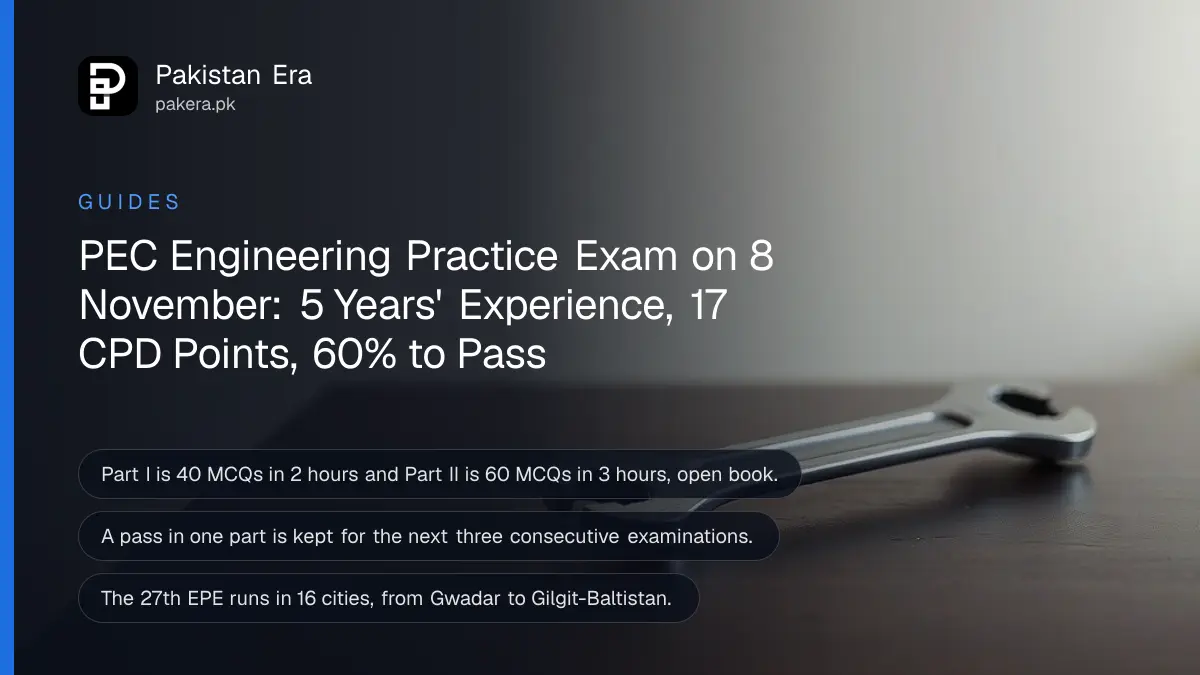
The Pakistan Engineering Council holds its 27th Engineering Practice Examination on Sunday 8 November 2026, the exam a Registered Engineer must pass to become a Professional Engineer. Applications closed on 10 October 2026 after a final extension. Candidates need five years of experience since registration, 17 CPD points and a fee of Rs 5,000 plus bank charges. The pass mark is 60% in each of two parts on the same day. We read the PEC advertisements and the EPE guidebook on pec.org.pk on 19 October 2026.
If you missed the October deadline, the next cycle is the one to prepare for. PEC says it normally announces the exam twice a year, and the 27th cycle's original closing date was 15 August, so the spring 2027 round should open early in the year. Here is what the exam asks and how to qualify for it.
The PE title gives privileges a Registered Engineer does not have
Under the PEC Act 1976 a Professional Engineer, or PE, holds technical sanction authority and can certify designs and processes, where a Registered Engineer, or RE, cannot. PEC's advertisement also lists preference for higher posts and a path towards international practice. The EPE is the only route from RE to PE.
A fresh graduate from an accredited programme registers as an RE first. The steps and fee for that are in how to register as an engineer with PEC, and whether a degree qualifies is a matter of checking the programme's PEC accreditation. The EPE comes at least five years later.
You need five years since registration and 17 CPD points
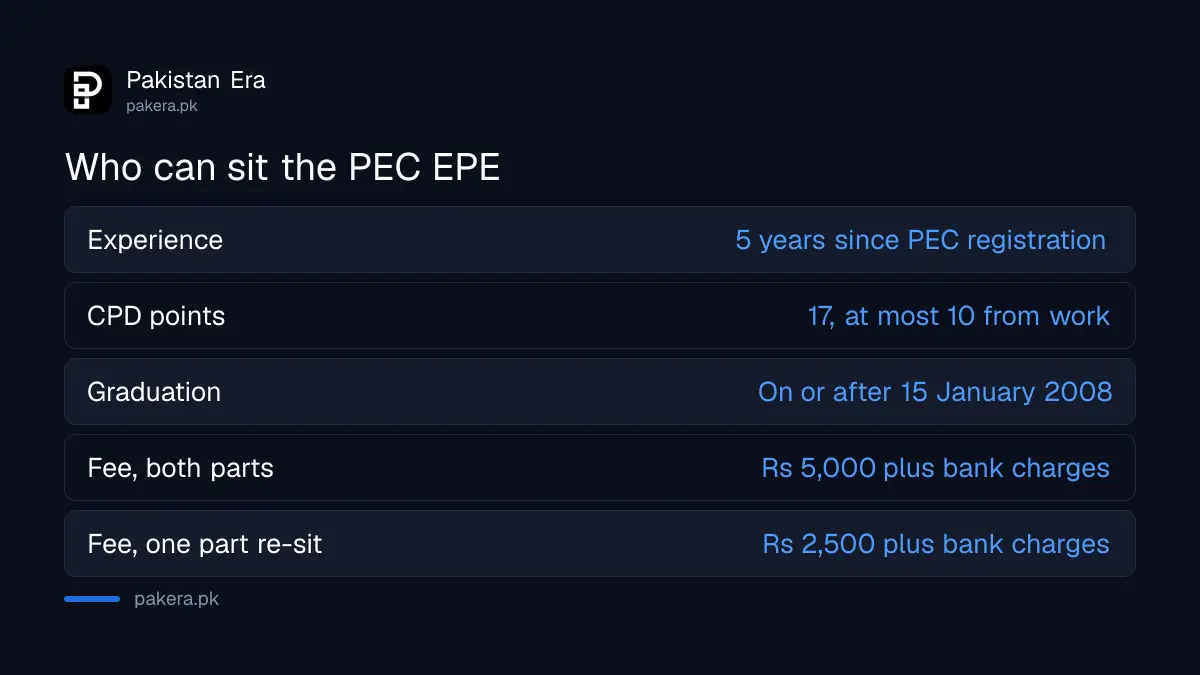
PEC's 27th EPE advertisement sets three conditions: graduation on or after 15 January 2008, five years of practical experience in a relevant field of engineering counted from PEC registration to the closing date, and 17 CPD points, of which at most 10 may come from work experience and at least 7 from other categories such as courses, conferences, publications or teaching.
The guidebook explains how the five years are counted. Start from the RE registration date and add full-time, relevant engineering roles up to the announcement's closing date. Part-time work, unrelated jobs and gaps of unemployment do not count. CPD points count from 10 July 2010 or your registration date, whichever is later, under the PDE Byelaws 2008 as amended to 15 February 2024.
Evidence matters. The application asks for employer letters with from and to dates, designation and duties, plus attested proof for every CPD item. PEC says misstated hours or unrecognised bodies can disqualify a candidate even after the exam.
Two MCQ papers on one day, 60% in each, Part II open book
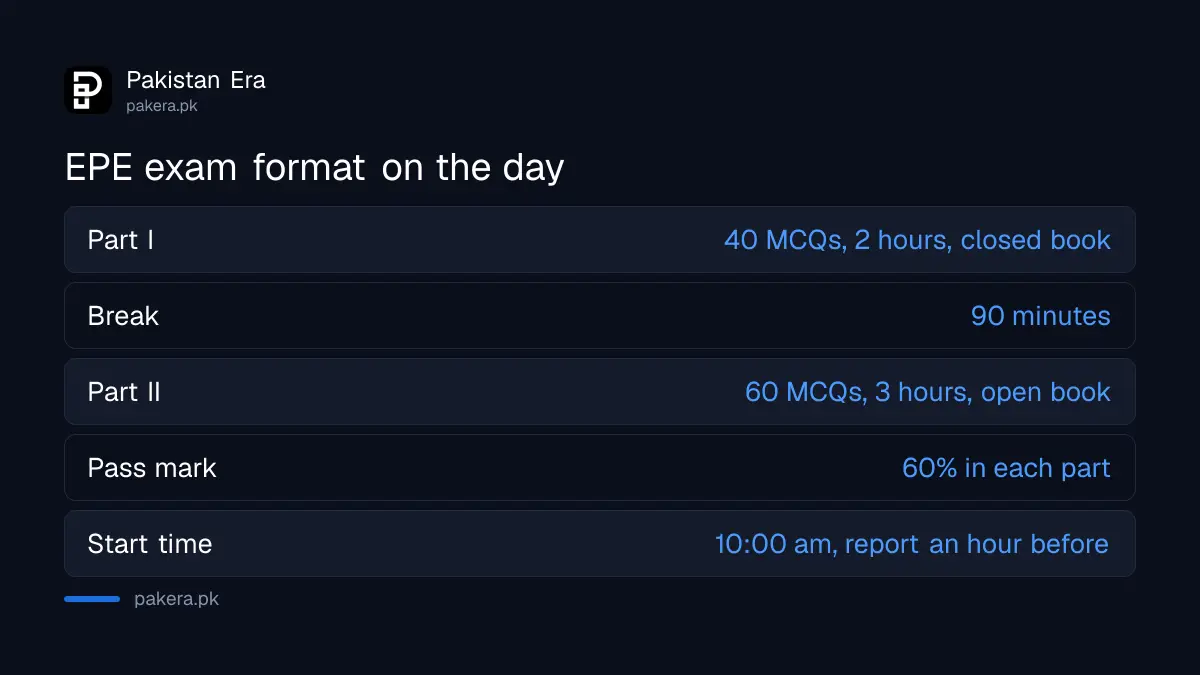
Part I is a two hour paper of 40 multiple choice questions common to every discipline. After a 90 minute break, Part II is a three hour paper of 60 discipline-specific questions: 25 on breadth, which follows the undergraduate curriculum, and 35 on the depth area you choose. Part II is open book for bound books and standards, but not loose notes.
| Item | Part I | Part II |
|---|---|---|
| Duration | 2 hours | 3 hours |
| Questions | 40 MCQs, common to all disciplines | 60 MCQs: 25 breadth, 35 depth |
| Books allowed | No | Yes, bound books and standards only |
| Pass mark | 60% | 60% |
| Fee if re-appearing in this part only | Rs 2,500 plus bank charges | Rs 2,500 plus bank charges |
Part I is split evenly across five areas, 20% each: management covering quality, finance and procurement; communication skills; ethics and social issues; environmental issues and policy; and hazards and risk management. The exam starts at 10:00 am and candidates report an hour earlier. A simple calculator is allowed; phones, smart watches and programmable devices are not. Bring your original CNIC, PEC registration card and roll number slip.
Each part is passed on its own, with three more attempts to clear the other
A candidate who passes one part but not the other keeps the pass and may re-sit the failed part in any of the next three consecutive examinations, paying Rs 2,500 each time. A candidate who does not clear it within those three is declared not qualified and must sit both parts again as a new candidate at Rs 5,000.
The 27th EPE advertisement says the same thing in plainer words: anyone who appeared in the 24th, 25th or 26th EPE and failed one part may apply for that part only. Three cycles at two exams a year is about eighteen months, so a failed part does not have to be rushed into the very next sitting, but it cannot be left for two years either.
The exam is computer based in 16 cities, from Gwadar to Gilgit
The 27th EPE runs at the same time in Islamabad, Rawalpindi, Lahore, Multan, Faisalabad, Peshawar, Swat, Dera Ismail Khan, Karachi, Hyderabad or Jamshoro, Sukkur, Nawabshah, Quetta, Gwadar, Gilgit-Baltistan and Muzaffarabad. Centres are mainly public sector universities with secure computer labs, and you choose a centre preference on the application.
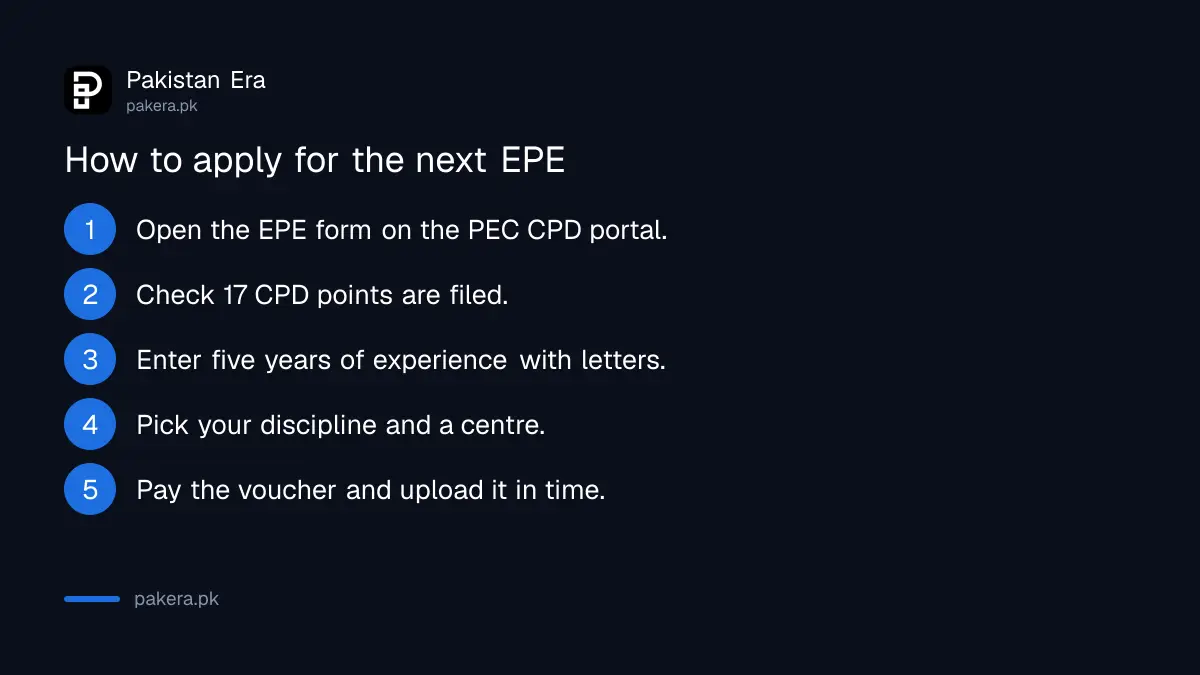
- Log in to the PEC CPD portal and open the EPE application at cpd.pec.org.pk/EPECustom.
- Check that your RE registration is active and that the portal shows at least 17 CPD points filed.
- Enter your experience with employer letters covering five full years since registration.
- Choose your discipline for Part II and a centre preference.
- Select new candidate or re-appearing in one part, generate the fee voucher and pay Rs 5,000 or Rs 2,500 plus bank charges.
- Upload the paid voucher before the closing date and wait for the roll number slip, which also confirms the centre.
PEC's guidebook adds one rule on the fee: a candidate who cannot appear must inform PEC at least 15 days before the exam, or the whole fee is treated as consumed. Syllabi for every discipline, the CPD points calculator and the guidebook are under the CPD section of pec.org.pk.
Common questions
When is the 27th PEC Engineering Practice Examination?
Sunday 8 November 2026, in 16 cities at the same time. Applications closed on 10 October 2026 after a final extension from 15 August.
Who can sit the EPE?
A Registered Engineer who graduated on or after 15 January 2008, has five years of relevant experience since PEC registration and holds 17 CPD points, with at most 10 from work experience.
What is the EPE fee?
Rs 5,000 plus bank charges for both parts, or Rs 2,500 plus bank charges to re-appear in one part.
What is the pass mark?
60% in Part I and 60% in Part II, each judged on its own. A pass in one part is kept for the next three consecutive exams.
Is the EPE open book?
Part II is open book for bound books and standards. Part I is closed book. Loose notes and electronic devices are not allowed in either.
When is the next EPE after November 2026?
PEC says it normally holds the exam twice a year. No date for the 28th EPE had been announced when we checked on 19 October 2026.
How we verified this
What we checked, where we read it, and what we could not confirm.
Last checked 19 October 2026. We read the PEC advertisement for the 27th Engineering Practice Examination (Fall 2026), which lists the 8 November date, the 16 cities, the eligibility conditions, the fee and the original 15 August closing date, and the final extension notice moving the closing date to 10 October 2026, both linked from the home page of pec.org.pk. The exam format, Part I syllabus areas, five year and CPD counting rules, retake window, timings and fee forfeiture rule come from the EPE Guidebook version 4, dated October 2025, on the same site, and the fee line on PEC's EPE page. We did not verify the number of candidates registered or any centre-level arrangements.
About the author

Public Services and Education Journalist
Fajr Riaz is a journalist and content writer at Pakistan Era, based in Lahore. She covers the questions people meet in everyday life in Pakistan: how a public service works, what a change in the rules means, and where to find a reliable answer.