The Petrol Dealer Margin Rise Costs Consumers Rs 26 Billion a Year
The strike ended with a Rs 1.34 margin rise from 1 September. It goes on the pump price, not government revenue, and adds over Rs 26bn a year.
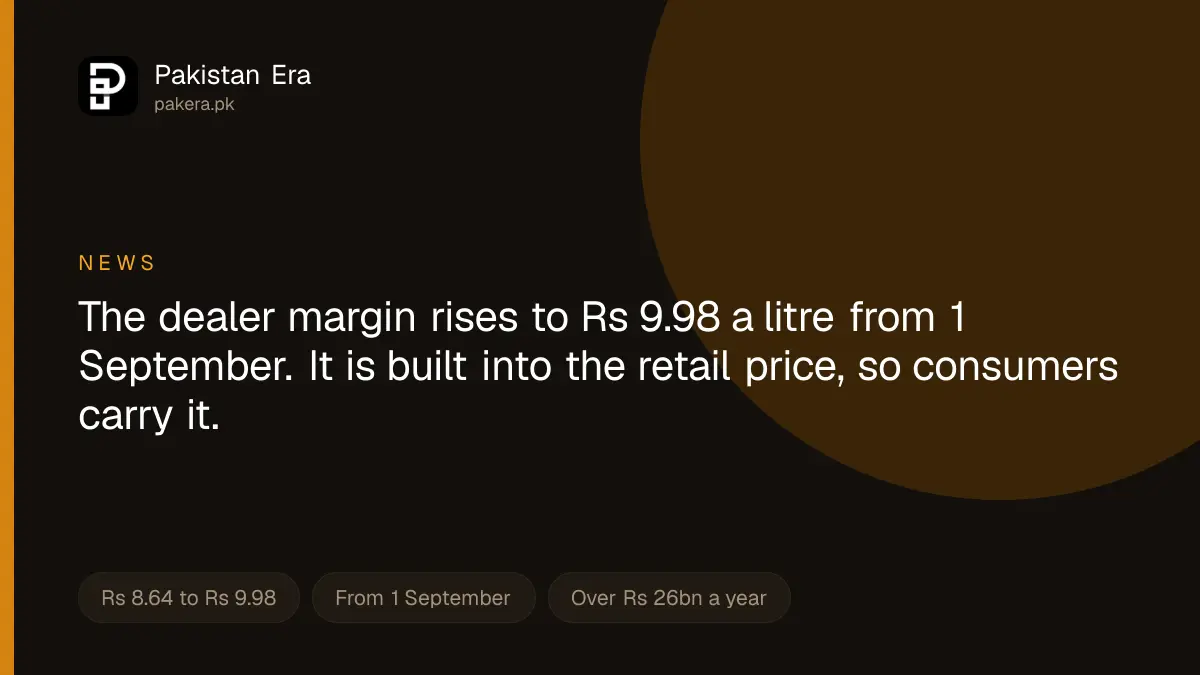
The petrol pump strike ended before it began. Dealers got an extra Rs 1.34 a litre, and from 1 September you pay it.
Not the government. You, at the pump, built into the price on the board.
What was settled
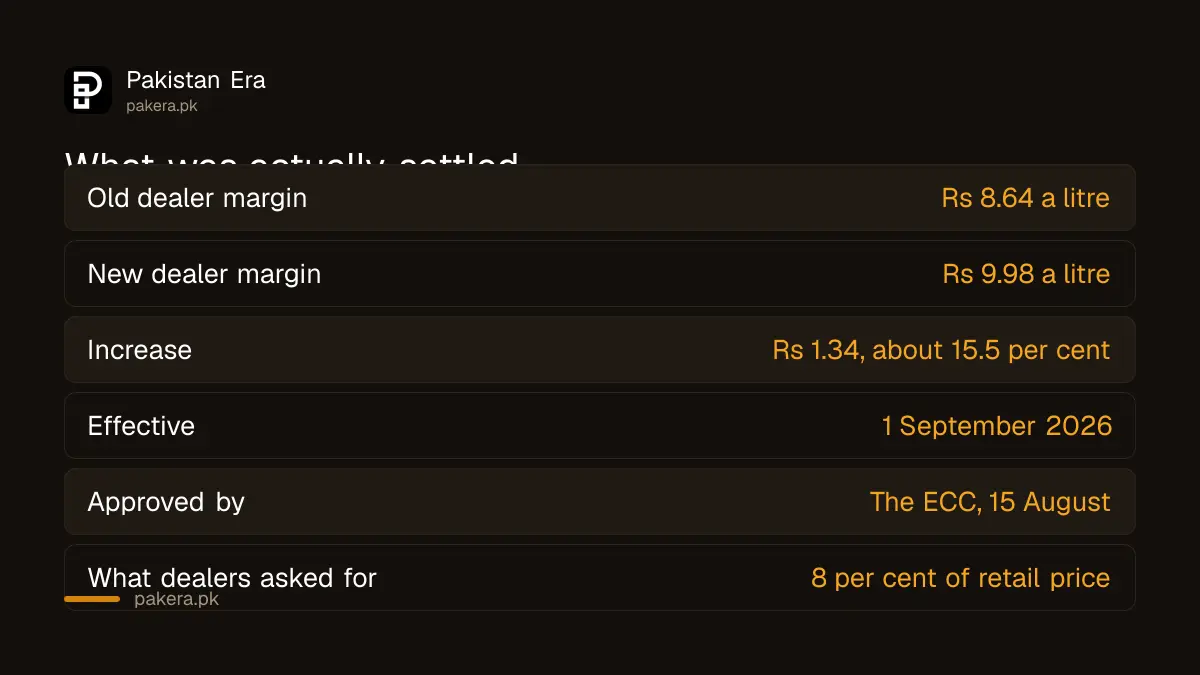
| Item | Detail |
|---|---|
| Old dealer margin | Rs 8.64 a litre |
| New dealer margin | Rs 9.98 a litre |
| Increase | Rs 1.34, about 15.5 per cent |
| Effective from | 1 September 2026 |
| Approved by | The ECC, on 15 August |
The Economic Coordination Committee approved it in a virtual meeting chaired by Finance Minister Muhammad Aurangzeb. The Pakistan Petroleum Dealers Association suspended the shutdown the same day.
Oil marketing company margins were left alone at Rs 7.87 a litre, with any future rise tied to completing digitisation.
What it adds up to
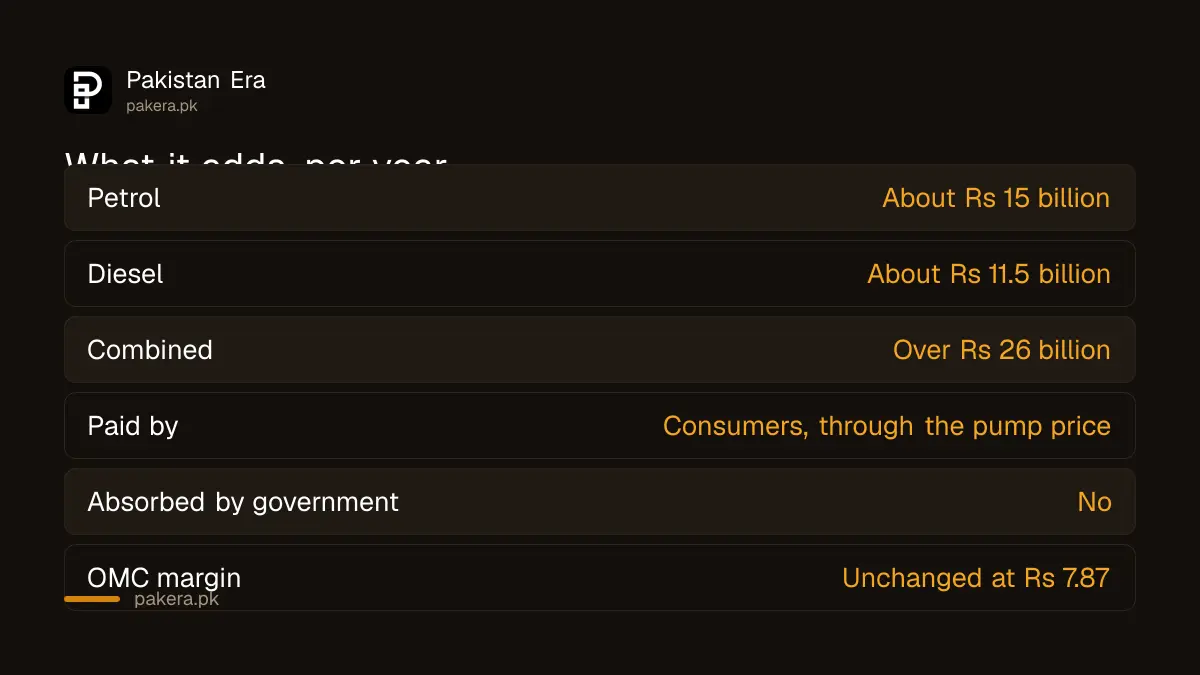
Rs 1.34 sounds small. Multiplied by national consumption it is not.
On petrol, against monthly consumption of about 926.64 million litres, the increase works out at roughly Rs 15 billion a year. On diesel, against about 714 million litres a month, roughly Rs 11.5 billion.
Over Rs 26 billion a year, combined. Those figures come from Dawn's analysis rather than from our own calculation.
Diesel matters more than the smaller number suggests. Freight, farming and public transport run on it, so a diesel increase reaches people who never buy a litre themselves, through the cost of moving goods.
The government did not absorb it
This is the part worth being precise about, because there were two ways it could have gone.
A margin increase can be funded by taking it out of the price, meaning the state collects less levy per litre and the pump price stays flat. Or it can be added to the price, meaning the consumer pays and government revenue is untouched.
It was added to the price. The increase is built into the retail rate, and the government's own take is unaffected.
That is a choice rather than an inevitability, and it is worth seeing clearly alongside what the same pump already collects. Petroleum levy receipts reached Rs 1.567 trillion in FY26, up 29 per cent and above both the original and revised targets. We set both facts down and leave the arithmetic to you.
Dealers did not get what they asked for
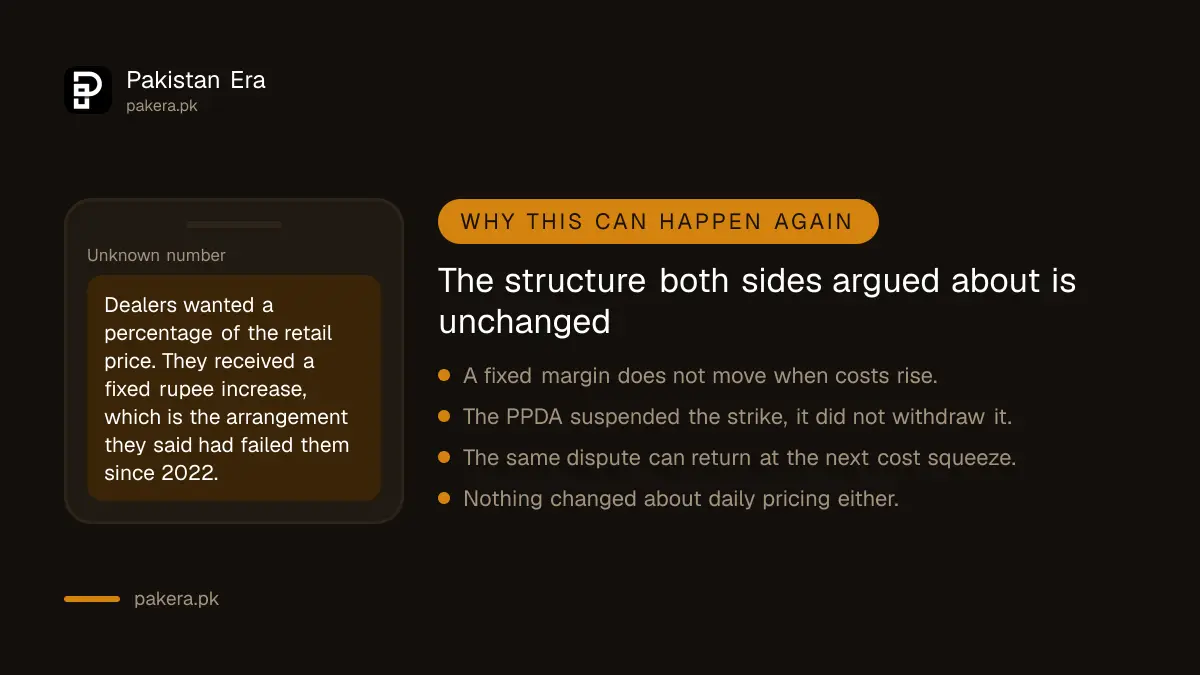
Read the settlement against the demand and it looks different.
Dealers wanted a margin of 8 per cent of the retail price. At current prices that is roughly Rs 26 a litre on petrol and Rs 30 on diesel. They received Rs 9.98.
More importantly, they wanted a percentage rather than a fixed amount. That was the whole argument. A fixed cut does not move when their costs rise, which is why they said a margin frozen since 2022 had stopped covering anything.
They took a fixed increase. So the structure they objected to is still in place, one rupee thirty-four higher. When costs rise again, the same dispute is available, and the PPDA suspended its strike rather than withdrawing it.
Nothing changed on daily pricing either, which was their second demand. Prices still move every 24 hours. Why that matters to a pump holding stock is in our margin explainer, written while the dispute was live.
What it means at the pump
From 1 September, the per litre price carries Rs 1.34 more than it otherwise would. That is the whole of the direct effect on a driver.
It will be invisible in practice, because prices now change every 24 hours on a seven day average of international rates, and daily movements are frequently larger than Rs 1.34 in either direction. You will not see a step change on 1 September. The increase is real, but it arrives inside ordinary noise.
Today's actual rates, and where the official figure is published, are on our daily petrol price page.
What we are not saying
We are not saying the increase is unjustified. Dealers put their pre-expense margin at Rs 8.64 and said about Rs 2.20 survived costs, and we have no way to audit that. A business whose regulated income has not moved since 2022 has a real case.
We are not saying the government should have absorbed it. That would mean less levy revenue against a fiscal position we are not qualified to redesign in a news article.
What we are doing is naming who pays, because the settlement was widely reported as a strike being averted, and the part that reached the reader's wallet was not the headline.
Questions readers are asking
Did the petrol pump strike happen?
No. It was called off on 14 August after the government approved the margin increase, and pumps opened normally on 15 August.
What is the new dealer margin?
Rs 9.98 a litre, up from Rs 8.64, an increase of Rs 1.34 effective 1 September 2026.
Who pays for it?
Consumers. It is built into the retail price rather than absorbed from government revenue.
How much does it cost in total?
Over Rs 26 billion a year, roughly Rs 15 billion on petrol and Rs 11.5 billion on diesel, per Dawn's analysis.
Will I notice it on 1 September?
Probably not. Prices change daily and ordinary moves are often larger than Rs 1.34, so it arrives inside normal fluctuation.
Did dealers get the 8 per cent they wanted?
No. Eight per cent of retail would be roughly Rs 26 a litre on petrol. They received a fixed Rs 1.34 increase instead.
Could there be another strike?
The association suspended rather than withdrew its action, and the fixed margin structure it objected to is unchanged, so the same dispute remains available.
About the author

Tax, Bills and Technology Writer
Ali Akhtar is a young and curious voice here at Pakistan Era. He is currently pursuing his A-Levels and has a growing interest in Pakistan’s changing industrial landscape and educational trends. Ali likes to write in a way that helps him explain and explore the world around him. His writing reflects the perspective of the new generation navigating the evolving trends of Pakistan where technology, youth innovation, and shifting opportunities are reshaping the country’s future.