Why Petrol Pumps Are Striking While Petrol Gets Cheaper
Petrol is down Rs 7.58 since 6 August, yet dealers shut tomorrow. They are arguing about a different number, and the daily price rule is why.
Resolved, and the shape of it is what this article predicted. The strike was called off on 14 August. The Economic Coordination Committee approved raising the dealer margin from Rs 8.64 to Rs 9.98 a litre, effective 1 September 2026.
The important part is what did not change. Dealers wanted a margin of 8 per cent of the retail price, roughly Rs 26 a litre on petrol at current prices. They received a fixed Rs 1.34 instead. As set out below, the argument was never really about the size of the number, it was about whether the number should be a fixed amount or a percentage. The fixed structure survived intact, so the same dispute can recur the next time costs rise.
The cost lands on consumers rather than the government, which we cover in who pays for the margin increase. The explainer as originally published follows.
Petrol pumps are due to shut nationwide from 6am tomorrow. In the same week, petrol has got cheaper.
Both of those are true, and people are reading them as a contradiction. They are not. There are two different numbers here, and almost nobody is separating them.
The price and the margin are not the same thing
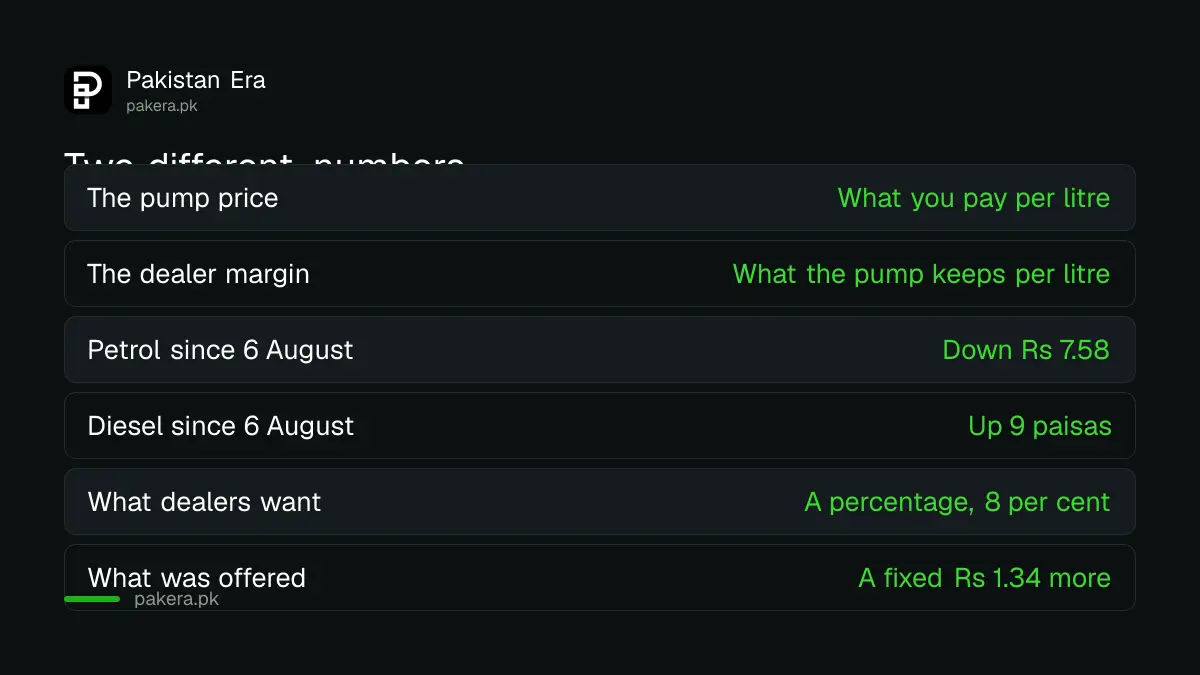
| Number | What it is |
|---|---|
| The pump price | What you pay per litre |
| The dealer margin | What the pump keeps per litre |
| Petrol since 6 August | Down Rs 7.58 |
| Diesel since 6 August | Up 9 paisas |
Petrol was Rs 333.01 on 6 August. Today it is Rs 325.43. Diesel has gone almost nowhere, from Rs 383.86 to Rs 383.95.
None of that touches the dispute. The dealers' argument is about the second number, the slice of each litre that stays with the pump, and it is set by a different rule.
The real disagreement is about the shape, not the size
This is the part that explains why five hours of talks on Wednesday produced nothing.
Dealers are asking for a margin of 8 per cent. That is a percentage of the price. The government offered an increase of Rs 1.34. That is a fixed number of rupees.
The two sides are not haggling over a figure. They are arguing about what kind of number it should be.
Under a fixed cut, a dealer earns the same on a litre whether petrol costs Rs 250 or Rs 400. Under a percentage, their income moves with the price. Dealers say the fixed amount has not changed since 2022, while everything they pay for has, which is the whole of their case.
Update, later on 14 August. The figures are now on the record. PPDA chairman Malik Khuda Bakhsh puts the current margin at Rs 8.64 a litre, falling to about Rs 2.20 once expenses are taken out. That is the number the argument is actually about.
Two more details landed with it. The Rs 1.34 increase has been pending for two years and now sits with the Economic Coordination Committee awaiting federal cabinet approval. And the government has formally rejected the dealers' request to move from daily to monthly pricing, with Petroleum Minister Ali Pervaiz Malik saying the daily mechanism continues.
That also explains why a falling pump price does not calm this down. If your cut is a fixed amount, a cheaper litre does nothing for you. If your cut were a percentage, a cheaper litre would actually pay you less.
Why the daily price rule is the trigger
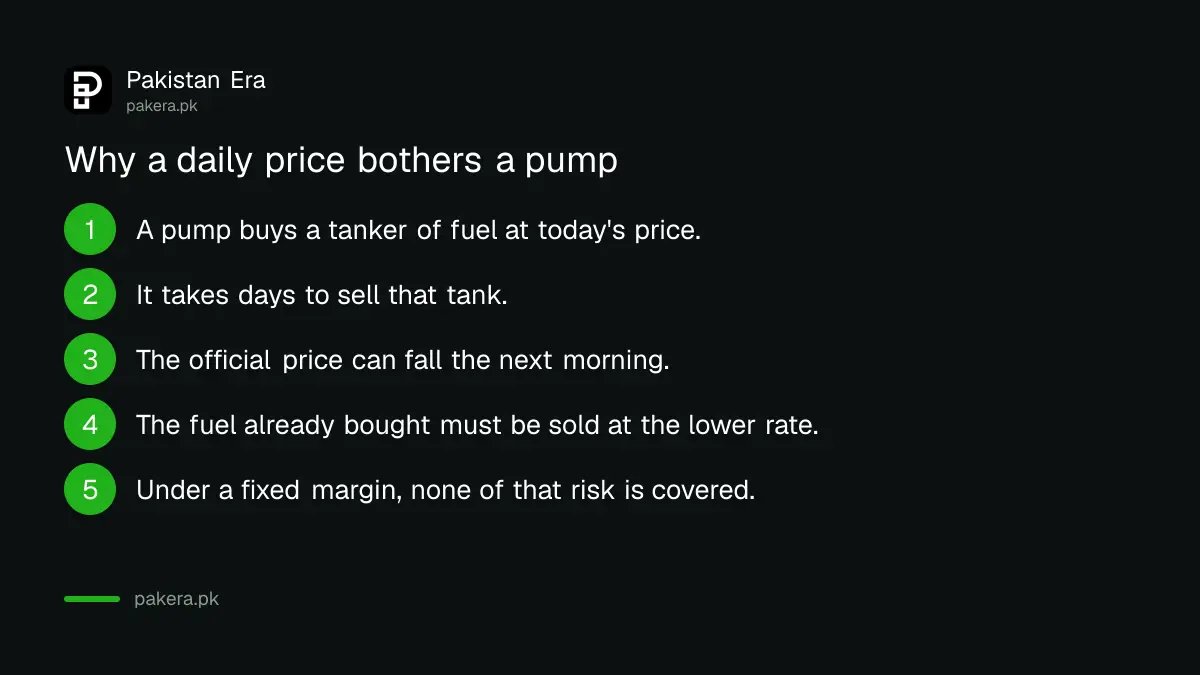
The dealers' second demand is to review the daily pricing mechanism. Since 17 July, OGRA has revised prices every 24 hours, on a seven day average of international rates.
Here is why that matters to somebody running a pump, in the order it happens.
- The pump buys a tanker of fuel at the price in force that day.
- That tank takes several days to sell.
- The official price can fall the next morning, and under a daily rule it often does.
- The fuel already paid for must then be sold at the lower price, because the pump cannot charge yesterday's rate.
- A fixed cut does not cover that swing, which is the objection dealers have put on the record.
Before 17 July, prices moved on a fortnightly cycle. A pump had a known window. Now the number can move under them overnight, which is a genuine change in how the business works, whatever you think of the remedy being demanded.
We set out how the daily mechanism works, and where OGRA publishes the official rate, in our daily petrol price page.
What this means for you tomorrow
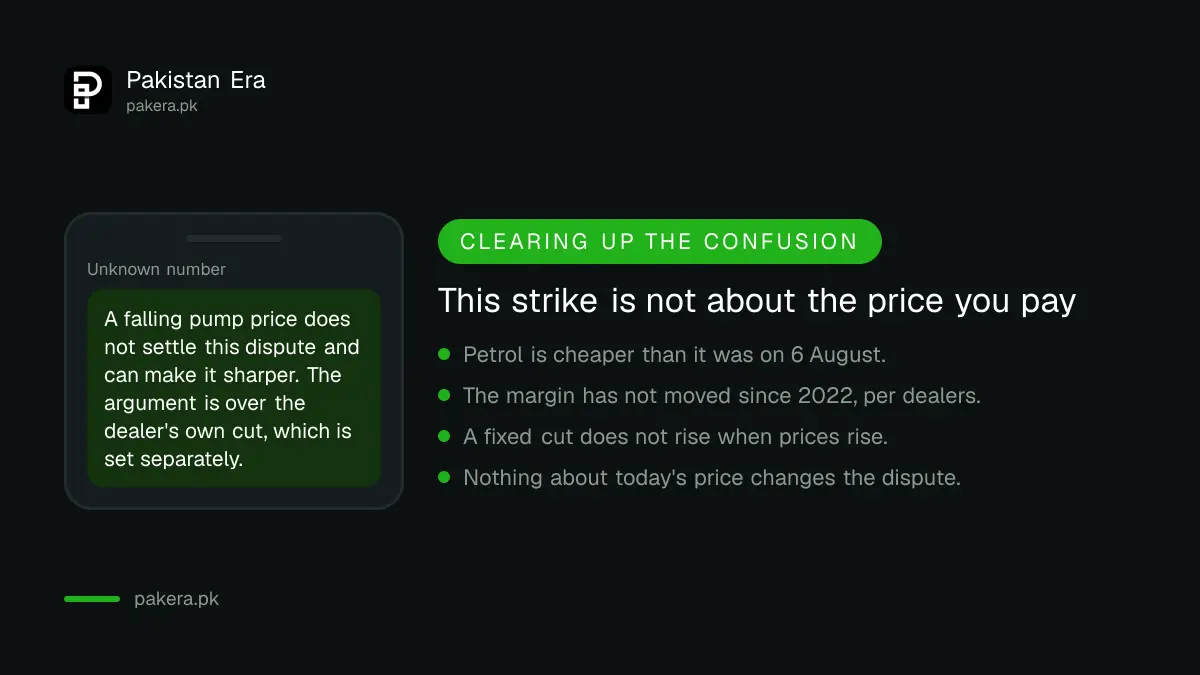
Practically, nothing about today's price changes your position.
The strike is still announced for 6am tomorrow and has not been withdrawn. Our full guidance, including what happened in July when the same shutdown was announced and fell apart, is in the strike article.
Fill up today during normal hours if you need fuel. Not at midnight, not in a queue.
Do not expect a price cut to end this. If you have been waiting for the government to drop the pump price and make the strike go away, that is not the lever. The two numbers are separate, and the one in dispute is not the one you pay.
What we are not saying
We are not taking a view on whether 8 per cent is a fair margin. We do not have pump accounts, nobody has published them, and a number that size deserves evidence rather than an opinion from us.
We are not publishing dealer profit figures. Several are circulating and we did not read any of them at source.
We are not alleging that dealers are profiteering or that the government is acting in bad faith. Dealers say their cut has been frozen since 2022. The government says it has offered an increase that needs cabinet approval. Both are positions on the record and we have set them out without deciding between them.
And we are not predicting whether the pumps actually shut. That has been announced before and not happened.
The wider picture
Fuel pricing in Pakistan carries more than the cost of fuel. Levies and taxes make up a large part of what you hand over, which is why the pump price does not track the international market the way people expect.
We explained that gap in why petrol prices do not fall when oil does, and the fiscal pressure behind the daily mechanism in the flexible fuel levy.
There is also a second stoppage already running. The goods transport strike has not been resolved, so freight is already affected before any of this starts.
Questions readers are asking
If petrol is cheaper, why are pumps striking?
Because the dispute is over the dealer's margin, not the pump price. Those are separate numbers set by separate rules, and a cheaper litre does not raise a fixed margin.
What is a dealer margin?
The amount a petrol pump keeps from each litre it sells. It is set by regulation rather than by the pump itself.
What are dealers asking for?
A margin of 8 per cent, a review of the daily pricing mechanism, and implementation of earlier commitments from the Petroleum Ministry.
What did the government offer?
An increase of Rs 1.34, subject to federal cabinet approval, and it refused to change the daily pricing system.
What is the petrol price today?
Rs 325.43 a litre and high speed diesel Rs 383.95, effective 14 August 2026. Prices now change every 24 hours.
Why does daily pricing bother pump owners?
They buy fuel at one day's price and sell it over several days, during which the notified price can fall. A fixed per litre cut does not cover that movement.
Will a price cut stop the strike?
There is no reason to think so. The pump price is not the number being argued about.
About the author

Tax, Bills and Technology Writer
Ali Akhtar is a young and curious voice here at Pakistan Era. He is currently pursuing his A-Levels and has a growing interest in Pakistan’s changing industrial landscape and educational trends. Ali likes to write in a way that helps him explain and explore the world around him. His writing reflects the perspective of the new generation navigating the evolving trends of Pakistan where technology, youth innovation, and shifting opportunities are reshaping the country’s future.