Petrol Up Rs 2.29 to Rs 346.16 From Today
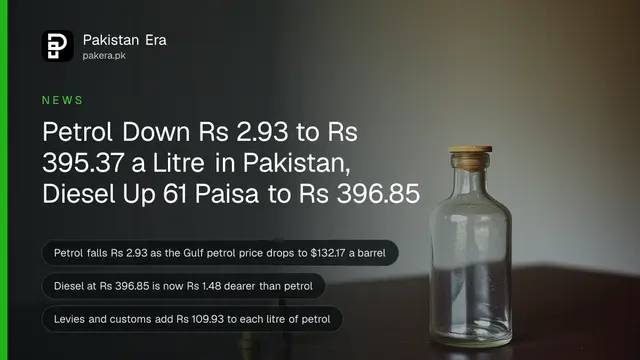
Petrol is Rs 346.16 and diesel Rs 372.03 from 3 September. Two rises in two days add Rs 3.37 to petrol and Rs 1.62 to diesel.
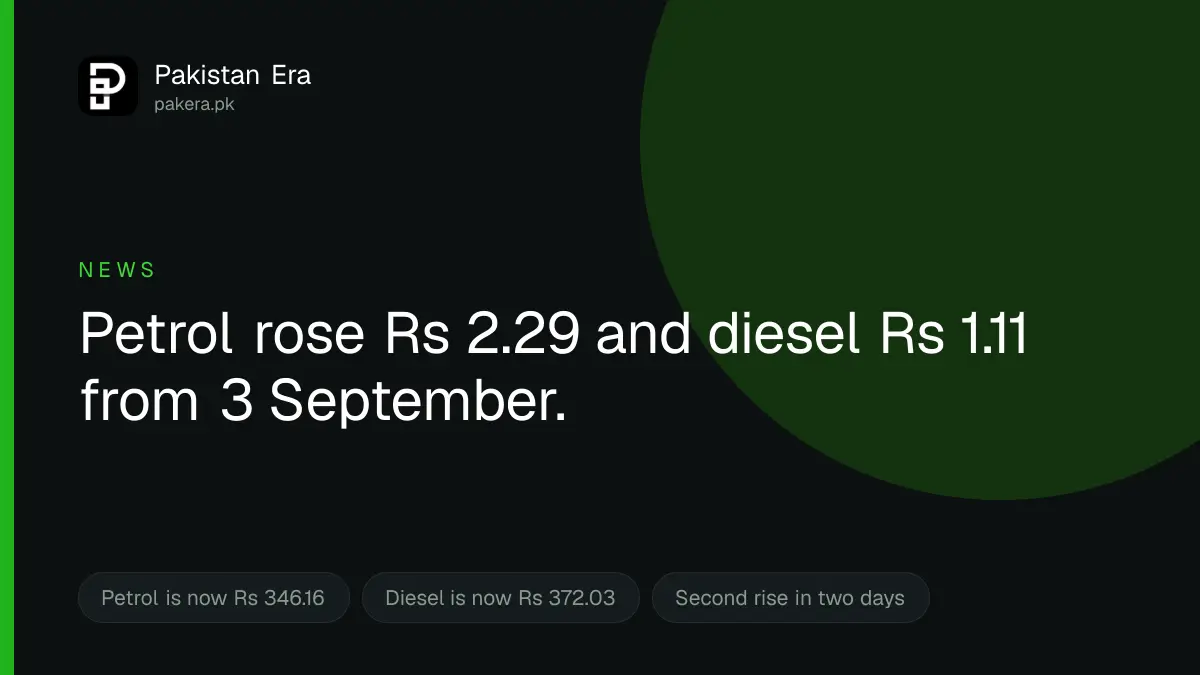
Petrol went up Rs 2.29 a litre and diesel Rs 1.11 from 3 September. Petrol is now Rs 346.16 and high speed diesel Rs 372.03.
It is the second rise in two days, and the larger of the two by some distance.
What changed
| Fuel | Was | Now | Change |
|---|---|---|---|
| Petrol | Rs 343.87 | Rs 346.16 | Up Rs 2.29 |
| High speed diesel | Rs 370.92 | Rs 372.03 | Up Rs 1.11 |
The notification is reported to have come from the Ministry of Energy, Petroleum Division, with OGRA revising ex-depot prices under the government's pricing mechanism.
Two rises in two days
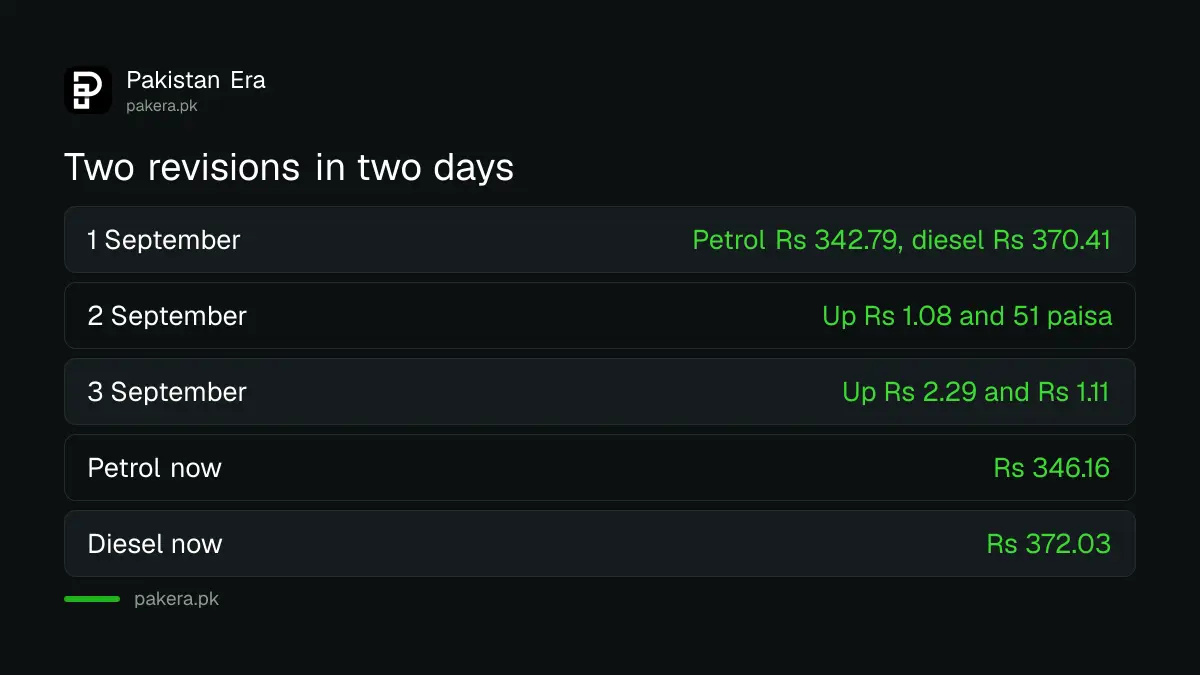
This did not arrive on its own. There was a smaller increase the day before.
- On 1 September petrol was Rs 342.79 and diesel Rs 370.41.
- On 2 September petrol rose Rs 1.08 and diesel 51 paisa.
- That took them to Rs 343.87 and Rs 370.92.
- On 3 September petrol rose Rs 2.29 and diesel Rs 1.11.
- The two days together add Rs 3.37 to petrol and Rs 1.62 to diesel.
We check these figures by chaining them rather than accepting a single reported number. The arithmetic reconciles exactly across both revisions, which is not proof but is better than repeating a figure that does not add up.
Why the diesel number matters more
Petrol moved further, but diesel is the one that reaches everybody.
Diesel moves freight and farm machinery, so its price feeds into what food costs by the time it reaches a shop. A household that owns no vehicle at all still pays for a diesel increase, a few weeks later and without seeing the connection.
Petrol is the more visible number and the one that gets the headline. Diesel is the one worth watching if you are trying to work out where prices are going.
The Rs 32.63 diesel cut keeps eroding
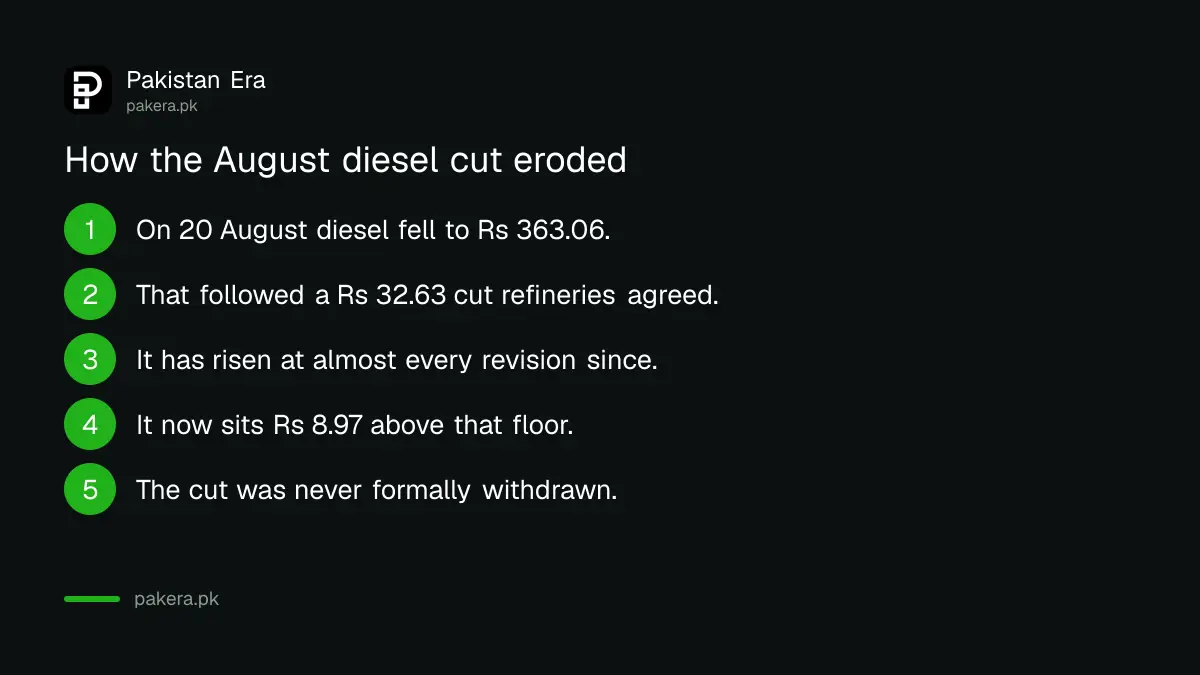
On 20 August diesel fell to Rs 363.06 after refineries agreed to a cut of Rs 32.63. It has risen at almost every revision since.
At Rs 372.03 it now sits Rs 8.97 above that floor. The cut has not been withdrawn or cancelled. It is being taken back a rupee or two at a time by the ordinary mechanism, which arrives at the same place far more quietly than an announcement would.
Our report on the Rs 32.63 diesel cut and who paid for it covers how that cut was arranged.
What you actually pay in tax
Roughly Rs 114 of every litre of petrol is tax and duty, and about Rs 100 on diesel. Against a pump price of Rs 346.16 that is around a third of what you hand over at the counter.
That is why the pump price moves even when the international figure barely does. Our guide to the daily petrol price and how it is set explains the mechanism, the levy, and why there is no announcement schedule you can plan around.
What a rise like this costs a household
The arithmetic is worth doing once, because the number on the sign does not tell you much on its own.
A motorcycle tank holding around ten litres costs roughly Rs 23 more to fill after these two days. A small car taking forty litres costs about Rs 135 more each time. Somebody filling weekly is paying a few hundred rupees a month more than they were at the end of August, before anything else in the household changes.
For a rickshaw driver or a delivery rider buying fuel daily, the same movement is a direct cut in what they take home, because fares and delivery rates do not move on the day a notification is issued.
Where to check the current figure
Prices are revised frequently and any article ages within days, including this one.
OGRA publishes at ogra.org.pk and the Finance Division issues the notification. For the current figure, go to one of those rather than to a page that may have been written before the last revision.
If you drive between cities, our guides to motorway toll rates and getting an M-Tag cover the other running costs of a journey.
Common questions
What is the petrol price in Pakistan today?
Rs 346.16 a litre from 3 September 2026, up Rs 2.29.
What is the diesel price?
High speed diesel is Rs 372.03, up Rs 1.11.
How long do these prices last?
There is no fixed schedule. Revisions have been arriving every day or two, so treat any figure as current only until the next notification.
Why did it rise twice in two days?
Both revisions came under the same pricing mechanism. The first was smaller, at Rs 1.08 on petrol and 51 paisa on diesel.
Is diesel still cheaper than in August?
It is above the Rs 363.06 floor reached on 20 August, by Rs 8.97.
Where is the official price published?
OGRA at ogra.org.pk, following the notification from the Petroleum Division.
How we verified this
What we checked, where we read it, and what we could not confirm.
Last checked 3 September 2026. The figures on this page are reported rather than read on an OGRA page. We went to ogra.org.pk and the notified petroleum price pages we could open carry RLNG and gas decisions, with the retail petrol and diesel figures not exposed as readable text on any page we could reach. The increase of Rs 2.29 on petrol to Rs 346.16 and Rs 1.11 on high speed diesel to Rs 372.03 effective 3 September 2026, and the attribution of the notification to the Ministry of Energy Petroleum Division with OGRA revising ex-depot prices, are taken from consistent coverage in Pakistani outlets. One check we can offer: taking the 1 September figures of Rs 342.79 and Rs 370.41, adding the reported rises of Rs 1.08 and 51 paisa for 2 September and then Rs 2.29 and Rs 1.11 for 3 September, gives exactly Rs 346.16 and Rs 372.03. The tax and duty figures of roughly Rs 114 on petrol and Rs 100 on diesel are reported and were not recalculated for this revision. Prices change frequently, so confirm the current figure with OGRA before relying on it.
About the author

Tax, Bills and Technology Writer
Ali Akhtar is a young and curious voice here at Pakistan Era. He is currently pursuing his A-Levels and has a growing interest in Pakistan’s changing industrial landscape and educational trends. Ali likes to write in a way that helps him explain and explore the world around him. His writing reflects the perspective of the new generation navigating the evolving trends of Pakistan where technology, youth innovation, and shifting opportunities are reshaping the country’s future.