PMT Score Limits for Welfare Schemes in Pakistan: BISP, Punjab and KP Compared
PMT score limits side by side: Kafaalat 32 or 37, Humqadam 30, Ration Card under 35, Himmat and Minority Card 45, Apni Chhat 60, Jwandun 26. How to get yours.
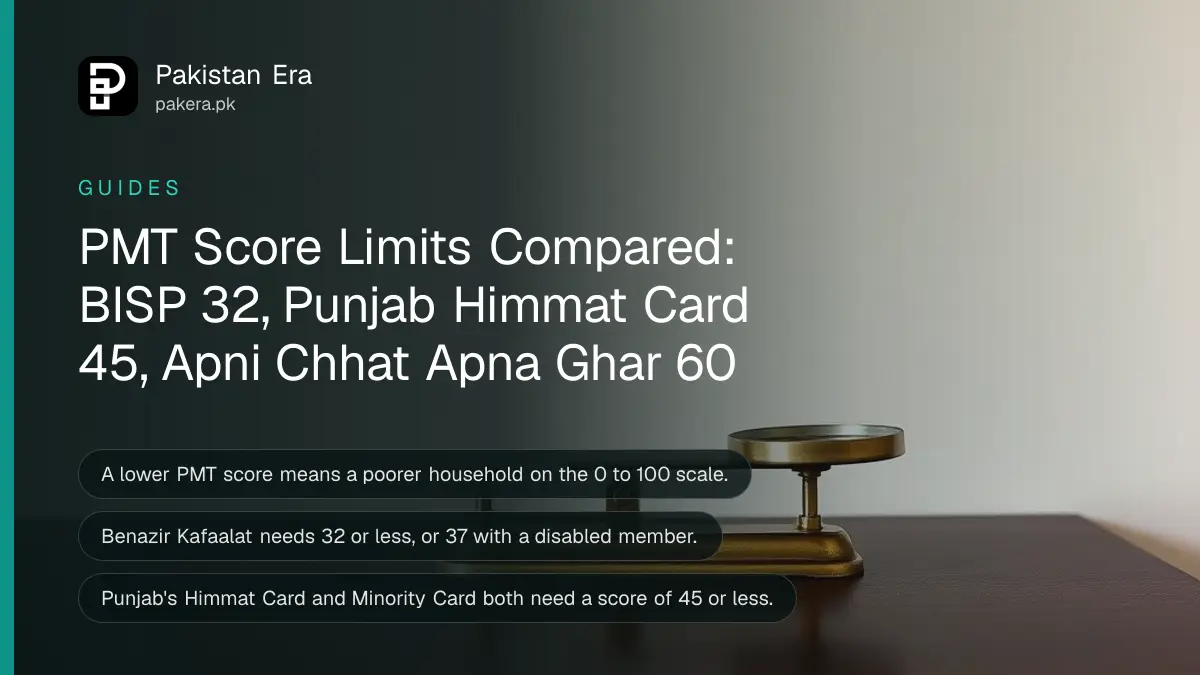
Your PMT score decides most welfare schemes in Pakistan, and a lower score means a poorer household. BISP's Benazir Kafaalat needs 32 or less (37 with a disabled member). Punjab's Himmat Card and Minority Card need 45 or less, Apni Chhat Apna Ghar 60 or less, and KP's Jwandun Card 26 or less. To get your score, visit a BISP tehsil office or NSER centre with your CNIC.
PMT stands for Proxy Means Test. It is a number from 0 to 100 that estimates how poor a household is from what it owns and how it lives, rather than from what it says it earns. BISP calculates it from its national survey, and Punjab uses it from its own registry too. The same score can open one scheme and close another, so the table below puts the limits side by side.
Each scheme sets its own PMT cut-off
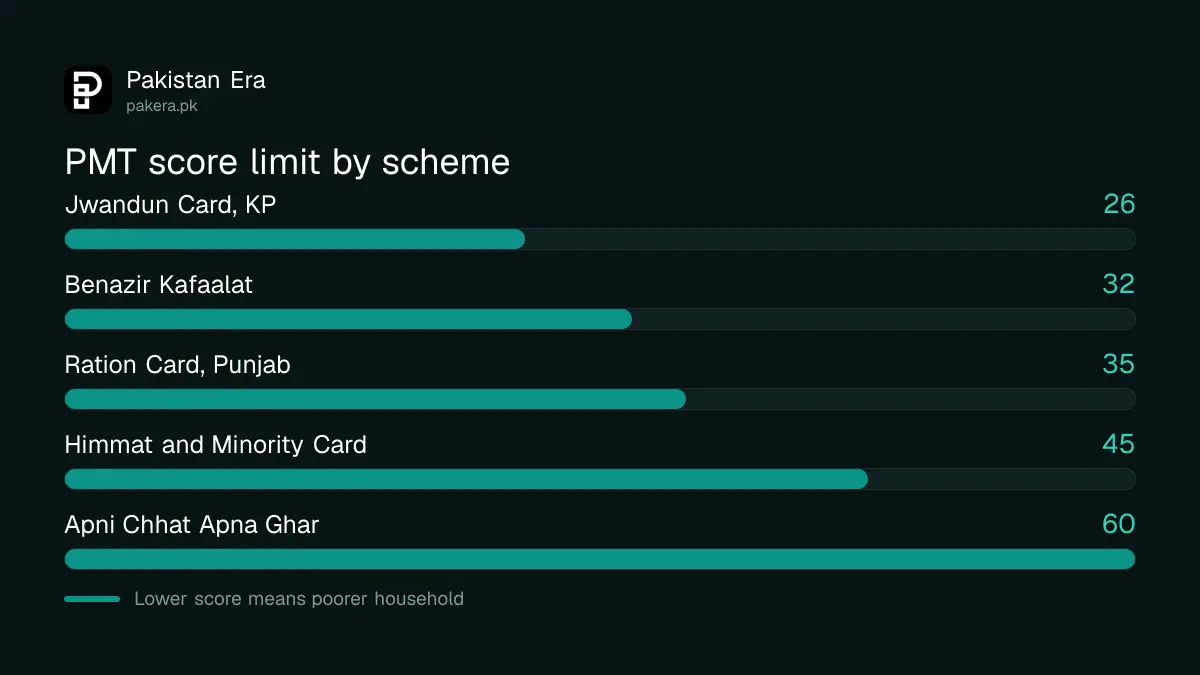
A household qualifies when its score is at or below a scheme's limit. The limits range from 26 for KP's Jwandun Card to 60 for Punjab's housing loan. BISP says its Board sets the Kafaalat cut-off according to the money available, so a limit can change by decision.
| Scheme | Run by | PMT limit | Score taken from |
|---|---|---|---|
| Jwandun Card (free OPD) | Khyber Pakhtunkhwa | 26 or less | BISP and NADRA records |
| Humqadam (disabled persons) | Punjab, PSPA | 30 or less | NSER, as calculated by BISP |
| Benazir Kafaalat | Federal, BISP | 32 or less, 37 with a disabled member | NSER |
| CM Punjab Ration Card (households) | Punjab | Under 35 | PSER |
| CM Himmat Card | Punjab Social Welfare | 45 or less | BISP survey |
| CM Punjab Minority Card | Punjab Human Rights and Minorities | 45 or less | BISP or NSER centre |
| Apni Chhat Apna Ghar | Punjab Housing | 60 or less | NSER or PSER |
A lower score means more help, not less
The scale runs from 0 to 100, and a poorer household gets a lower number. So a score of 20 qualifies for every scheme above, while a score of 50 qualifies only for the housing loan. Families sometimes read the number the wrong way round and think a high score is good.
The score is not a measure of need you can argue at a desk. It comes from the survey answers: the house, its walls and roof, the toilet and water, land, livestock, vehicles, the number of earners and the family size. Change those facts, through a new survey, and the score can change too.
| Example score | Schemes it meets on PMT alone |
|---|---|
| 24 | All seven schemes in the table |
| 31 | Kafaalat, Ration Card, Himmat, Minority Card, housing loan |
| 36 | Kafaalat only with a disabled member, plus Himmat, Minority Card, housing loan |
| 44 | Himmat, Minority Card, housing loan |
| 55 | Housing loan only |
PMT is only one rule. Each scheme adds others, such as a disability certificate for Himmat, a minority faith for the Minority Card, or land up to 5 marla for the housing loan.
Get your PMT score at a BISP office or NSER centre
Punjab's own Minority Card page tells applicants to get their PMT score from the nearest BISP or NSER service centre. Take your original CNIC. In KP, the Jwandun Card check by SMS to 9930 returns your score directly. A household that was never surveyed has no score at all.
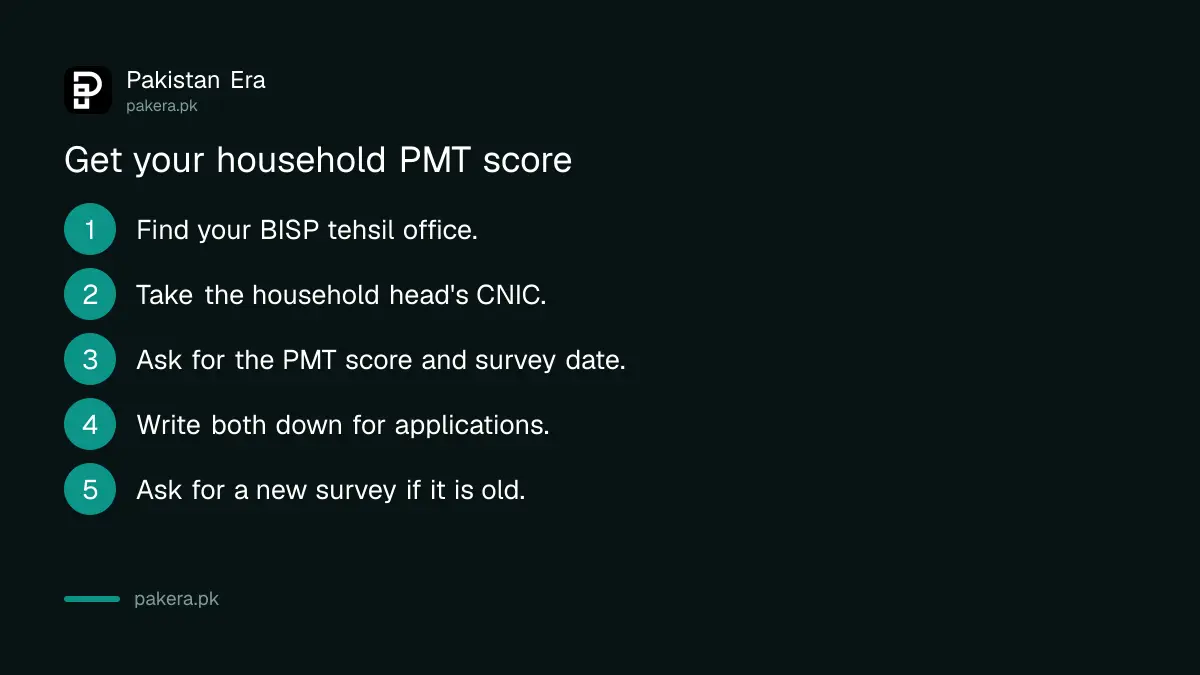
- Find your nearest BISP tehsil office, which also runs the NSER registration desk.
- Take the original CNIC of the household head, and of yourself if different.
- Ask staff for the household's PMT score and the date of the last survey.
- Write both down. Schemes check the latest score on record.
- If the survey is old or wrong, ask for a new survey at the same desk.
The BISP office addresses are listed province by province, for example the BISP offices in Lahore and central Punjab. For KP's OPD card, the Jwandun Card check on 9930 shows the score and the clinics.
Update an old survey when your score is wrong
If your household's situation has worsened since the survey, or a member died or was born, ask for a fresh survey at the BISP registration desk. For Punjab schemes that use PSER, the PSPA helpline 1221 handles survey and correction requests. Answer honestly, because assets are checked against other records.
BISP's own steps for a new survey are in the guide to updating your NSER survey after a not-eligible reply. Punjab's registry works the same way through its own teams, and the guide to checking your PSER record covers the 1221 route.
| Registry | Who runs it | Where to update |
|---|---|---|
| NSER | BISP, federal | BISP tehsil office registration desk |
| PSER | PSPA, Punjab | PSER survey team, helpline 1221 |
Nobody can sell you a lower score
The score is calculated by BISP or PSPA from survey data and checked against NADRA and departmental records. An agent who promises a lower score for money is lying, and false survey answers can get a household removed. Surveys at BISP offices are free.
Report anyone who asks for money to BISP's helpline 0800-26477, or in Punjab to the anti-corruption line 1350. Never hand your CNIC or thumbprint to someone outside an official office.
Common questions
What PMT score do I need for BISP?
32 or less for Benazir Kafaalat, or 37 or less if the family has a person with a disability. BISP relaxes the cut-off for transgender persons.
Is a high PMT score good?
No. A lower score means a poorer household and more schemes you can join.
How can I find my PMT score?
Visit a BISP tehsil office or NSER centre with your CNIC and ask. In KP, the Jwandun Card SMS on 9930 shows the score.
What PMT score is needed for the Punjab Himmat Card?
45 or less, from BISP's survey, together with a Social Welfare disability certificate.
Can my PMT score change?
Yes. A new survey records your current situation, and the score is worked out again.
Is the PSER score the same as the BISP score?
Both are PMT scores, but they come from different surveys. Each scheme names the registry it uses.
How we verified this
What we checked and where we read it.
Last checked 24 November 2026. The Kafaalat cut-off of 32, the 37 for families with a disabled person, the 0 to 100 scale, the Board's role and the relaxed rule for transgender persons come from BISP's Benazir Kafaalat page on bisp.gov.pk, which says the 32 cut-off was approved at the Board's 52nd meeting on 23 September 2021. Humqadam's limit of 30 comes from the PSPA Humqadam programme page.
The Himmat Card, Minority Card and Ration Card limits come from the scheme pages on the Government of Punjab flagship projects list, and the Himmat limit also from the Social Welfare Department's DPMIS FAQ. The housing loan limit comes from the Apni Chhat Apna Ghar eligibility page. The Jwandun Card limit of 26 comes from the Social Health Protection Initiative's OPD card page. The example score table is our own reading of these limits.
About the author
Public Services and Education Journalist
Fajr Riaz is a journalist and content writer at Pakistan Era, based in Lahore. She covers the questions people meet in everyday life in Pakistan: how a public service works, what a change in the rules means, and where to find a reliable answer.