How Legal Heirs Settle a Deceased Person's Income Tax With FBR
Under section 87, a deceased taxpayer's legal representative settles the tax, but only from the estate. See the rules, the steps and why inheriting is tax free.
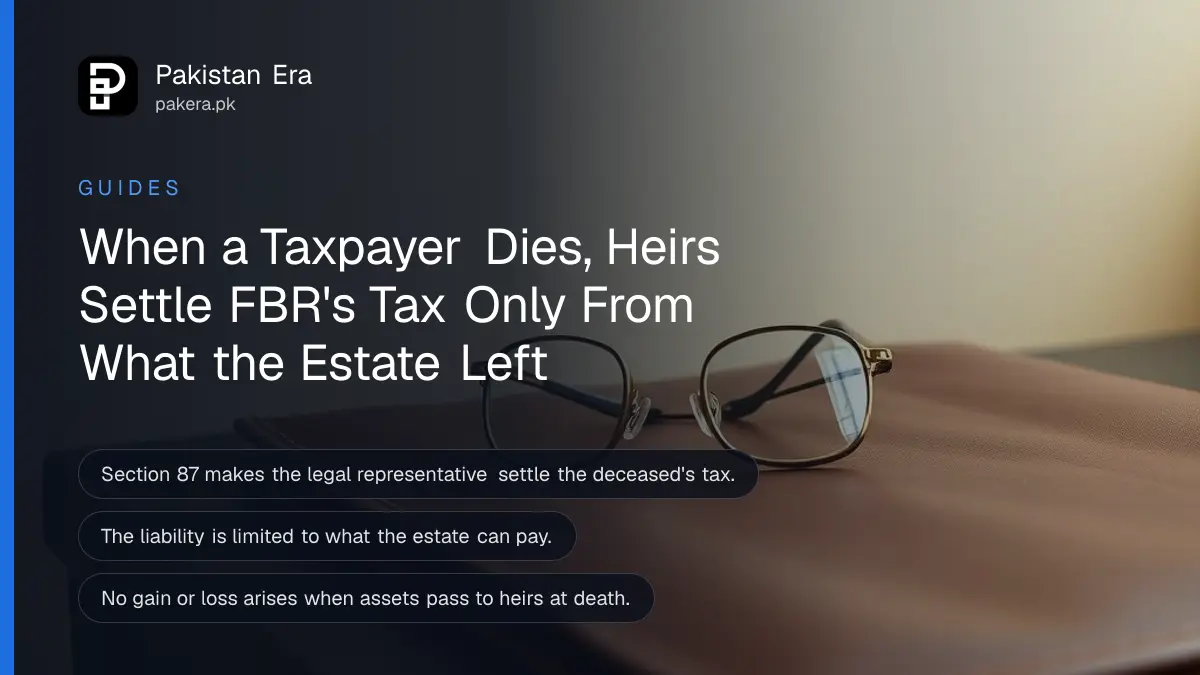
When a taxpayer dies in Pakistan, the tax does not die with them. Under section 87 of the Income Tax Ordinance, 2001, the legal representative must settle any tax the person owed and any tax on income of the estate. But the liability is limited to what the estate can pay. Heirs never pay a dead relative's tax from their own pocket.
Families usually find this out months later, when a notice addressed to the late father arrives, or a bank refuses to release an account. Knowing the rules early saves stress. Here is who counts as the legal representative, what they owe, what they do not owe, and the steps to close the file.
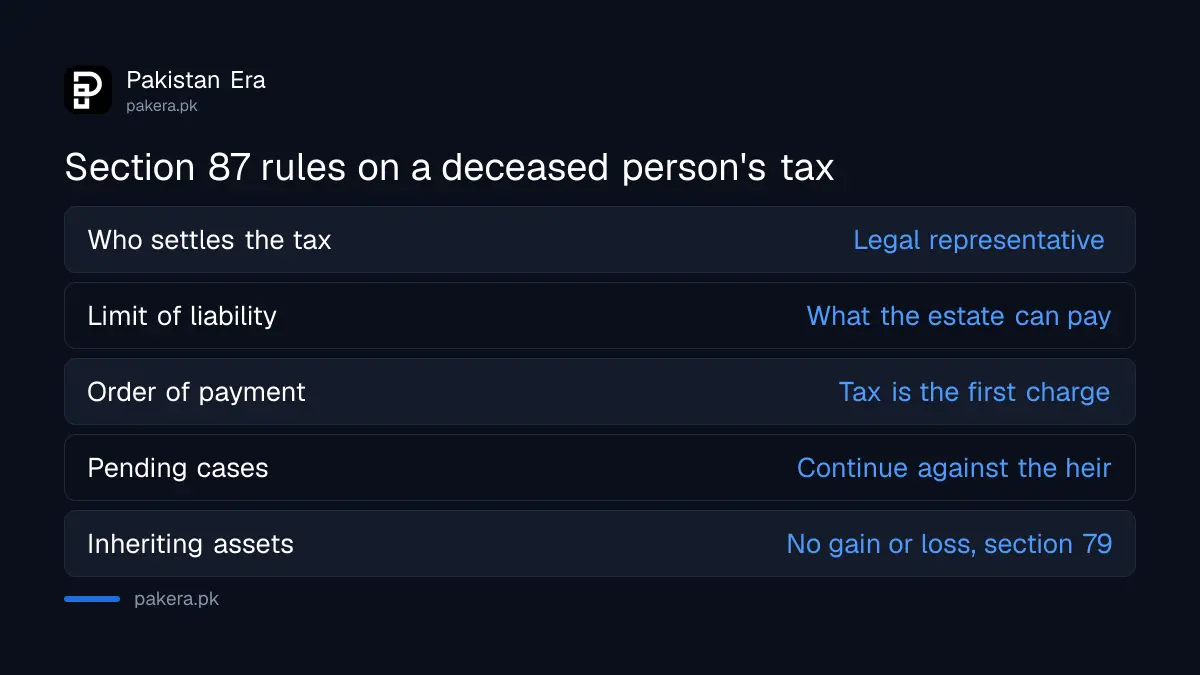
| Question | Answer under the Income Tax Ordinance |
|---|---|
| Who settles a deceased person's tax? | The legal representative, section 87(1) |
| Up to what amount? | Only as far as the estate can pay, section 87(2) |
| Is tax paid before heirs share the estate? | Yes, it is the first charge on the estate, section 87(2A) |
| Do old cases and notices continue? | Yes, against the legal representative, section 87(3) |
| Is inheriting property a taxable gain? | No gain or loss arises on transmission at death, section 79 |
The legal representative settles the dead person's tax
Section 87 makes the legal representative liable for two things: any tax the person would have owed had they lived, and any tax on the income of the estate. That covers an unpaid return, an assessment, a pending notice, and income such as rent received after death.
The law defines a legal representative widely. It is the person who in law represents the estate. It also includes anyone who "intermeddles" with the estate, which means anyone who takes charge of the property or money, even without a court order. In most families, that is the eldest son, the widow, or whoever collects the rent and runs the accounts.
Heirs pay only from the estate, never from their own money
Section 87(2) limits the legal representative's liability to the extent the estate can meet it. So if the late taxpayer owed Rs 500,000 but left assets worth Rs 300,000, FBR can recover only from those assets. The heirs' own salaries, houses and bank accounts are not on the hook.
There is a catch. Since 2010, section 87(2A) has made tax the first charge on the deceased's estate. That means FBR's claim comes before the heirs divide the estate. If the family shares out the money first and a tax demand arrives later, the person who took charge of the estate can be asked to account for it.
So the safe order is simple. Settle the tax position first, then divide the estate. The shares each heir gets under Islamic law are in the guide to inheritance shares in Pakistan.
Notices and cases against the deceased carry on against the heir
Any tax proceeding started before the death is treated as taken against the legal representative and continues from the stage it reached. Any proceeding FBR could have started had the person lived can still be started against the legal representative. A death does not close an audit or a demand.
This is why a notice in a late parent's name should never be ignored. Reply in writing, say the taxpayer has died, give the date of death, and name yourself as the legal representative. Attach the death certificate and your CNIC. The deadlines in the notice still apply.
The common notices and how to answer them are covered in the guides to a section 114(4) notice to file a return and an FBR audit notice under section 177.
Close the deceased person's tax file in six steps
Collect the papers, check what returns are pending, file or settle them for the period up to death, and tell FBR about the death. Then deal with the estate's income separately. Work through the steps in this order and keep a copy of everything you send.
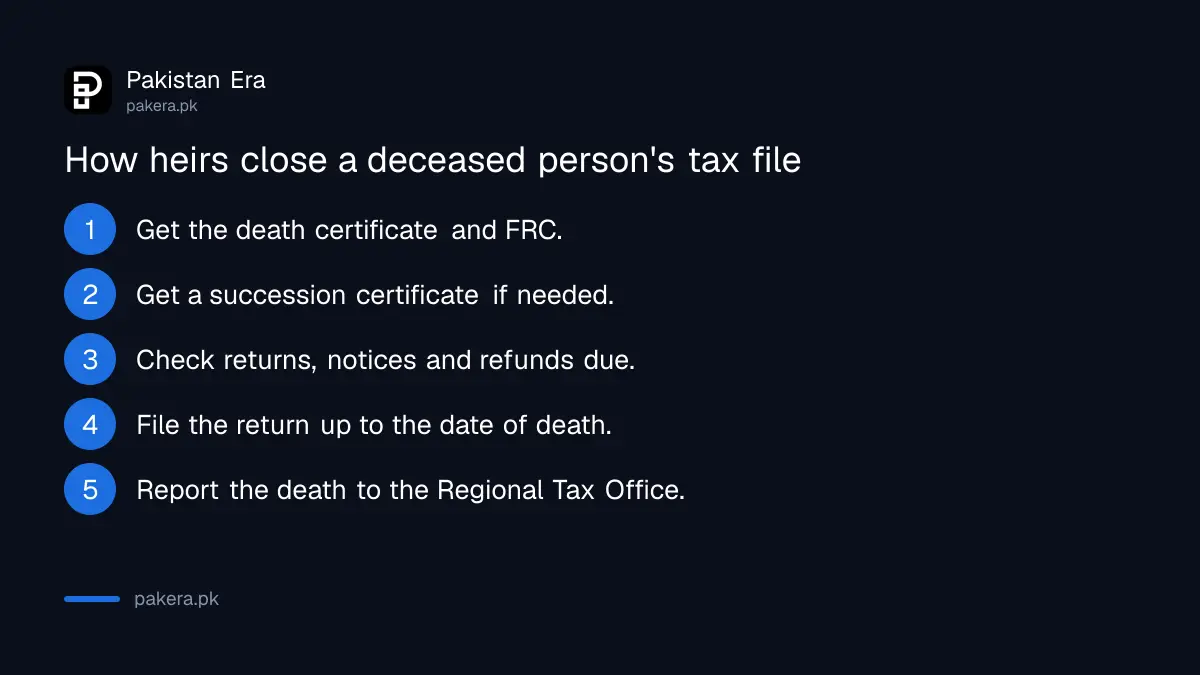
- Get the NADRA death certificate and a family registration certificate showing the heirs.
- Get a succession certificate or letters of administration if banks or the court need one. This also fixes who the legal representative is.
- Check the deceased's tax position: last return filed, any notice or demand, any refund due. For an individual, the CNIC is the NTN.
- File any return still due for the tax year in which the person died, covering income up to the date of death.
- Write to the Commissioner at the Regional Tax Office where the deceased was registered, report the death, attach the death certificate and your CNIC, and give your contact details as legal representative.
- If the estate earns income after death, such as rent or profit, keep separate records, because tax on the estate's income is also the legal representative's duty under section 87(1)(b).
The succession certificate route is explained in the guide to a succession certificate through NADRA. FBR's helpline and tax office contacts are listed under FBR helpline and tax offices.
Inheriting property does not create a capital gains tax bill
Section 79 says no gain or loss arises when an asset passes to an executor or beneficiary on a person's death. The Finance Act, 2026 added that a family settlement among the family after the death counts too. So the heirs pay no tax just for receiving the house, plot or shares.
| Event | Tax position |
|---|---|
| House passes to heirs at death | No gain or loss, section 79(1)(b) |
| Family settlement after the death | Also covered, explanation added in 2026 |
| Heir later sells the inherited house | Normal sale rules apply to the heir |
| Rent from the house after death | Income of the estate or of the heirs |
| Tax the deceased owed before death | Paid from the estate first |
A later sale by an heir is a separate matter, with its own advance tax and gain rules. Those are set out in the guide to tax on inherited property. Once the property is in an heir's name, it goes into that heir's own wealth statement.
Common questions
Do children have to pay their dead father's income tax?
Only from what he left behind. Section 87(2) limits the legal representative's liability to the extent the estate can meet it. Heirs do not pay from their own income.
Who is the legal representative for tax purposes?
The person who in law represents the estate, and anyone who takes charge of the estate's property or money. In most families, it is whoever manages the late person's assets.
Does FBR stop a pending case when the taxpayer dies?
No. Section 87(3) continues the case against the legal representative from the stage it had reached on the date of death.
Is there inheritance tax in Pakistan?
No separate inheritance tax applies. Section 79 also says no gain or loss arises when assets pass on death, so receiving the inheritance is not a taxable gain.
Should we file a tax return for the year of death?
If the deceased had to file, yes. The return covers income up to the date of death, and the legal representative files it.
Can heirs claim a tax refund that was due to the deceased?
A refund due to the deceased is part of the estate, so the legal representative deals with it. Write to the Regional Tax Office with the death certificate, the succession papers and your CNIC.
How we verified this
What we checked and where we read it.
We read sections 79, 87 and 172 of the Income Tax Ordinance, 2001 in FBR's consolidated text "Amended upto 30.06.2026", downloaded from FBR's Income Tax Ordinance page on 24 November 2026. Section 87(2A) was added by the Finance Act, 2010, and the family settlement explanation in section 79 by the Finance Act, 2026. FBR's registration page confirms an individual's CNIC is used as the NTN. FBR does not publish a separate IRIS form for reporting a taxpayer's death, so the steps above use a written letter to the Regional Tax Office.
About the author

Tax, Bills and Technology Writer
Ali Akhtar is a young and curious voice here at Pakistan Era. He is currently pursuing his A-Levels and has a growing interest in Pakistan’s changing industrial landscape and educational trends. Ali likes to write in a way that helps him explain and explore the world around him. His writing reflects the perspective of the new generation navigating the evolving trends of Pakistan where technology, youth innovation, and shifting opportunities are reshaping the country’s future.