How to Reply to an FBR Section 177 Audit Notice: Records, Reasons and the 6 Year Limit
FBR audit notice under section 177? Written reasons are required and records older than six years cannot be called for. See how to reply and what to send.
Short answer: A section 177 audit notice asks you to hand over your records so FBR can check your income tax affairs. The Commissioner must record the reasons in writing and tell you those reasons. The Commissioner cannot call for records of a tax year after six years from its end. Send complete records on time, because missing ones let FBR use benchmark ratios to set your income.
An audit notice feels like an accusation. It is not one. It is a request for papers, and what you send in the first reply shapes everything that follows.
We read section 177 of the Income Tax Ordinance, 2001, as amended up to 30 June 2026, on FBR's own website on 12 October 2026. One sub-section, (6B), was added by the Finance Act, 2026, so older summaries of this section are now incomplete.
A section 177 notice calls for your books and records
Section 177 lets the Commissioner call for any record or document, including books of account, to audit your income tax affairs. If records are kept on a computer, you must allow the officer access to the machine and software and to attested hard copies of the data.
The notice can be about you or about another person's affairs. It can be sent to a salaried person, a business or a company. Read it for three things: the tax years, the documents asked for and the date by which they are due.
The Commissioner must give written reasons and stay inside six years
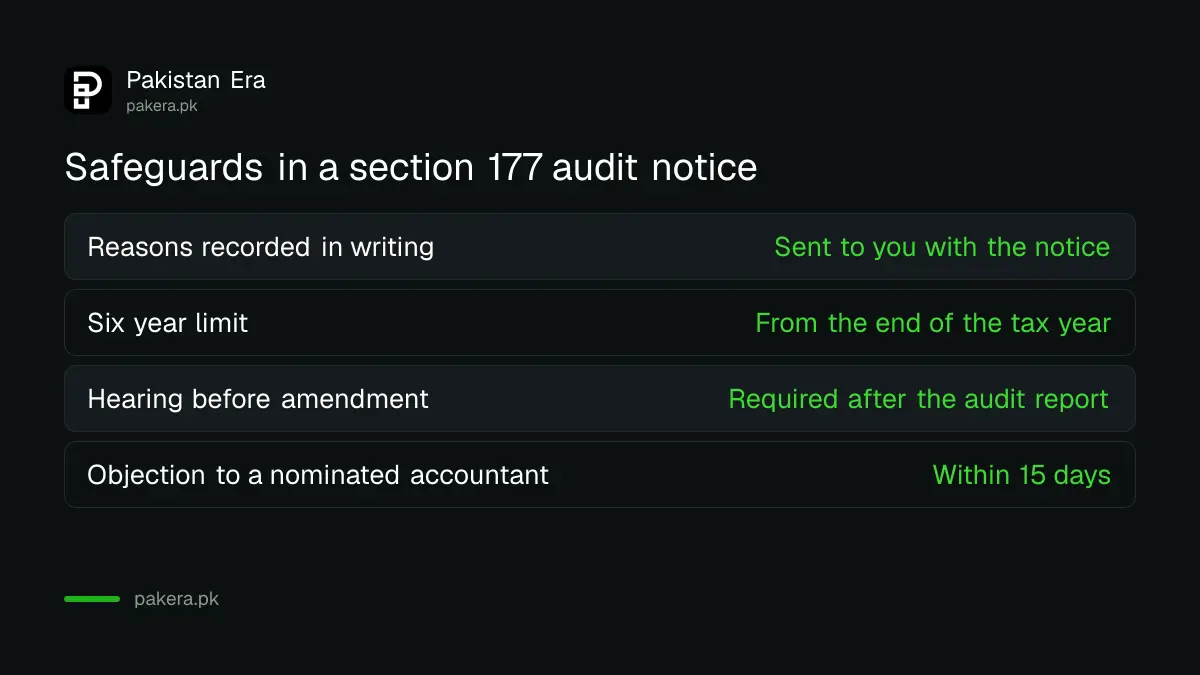
Two rules protect you. The Commissioner must record the reasons in writing before calling for your record, and those reasons must be communicated to you. And records cannot be called for after six years from the end of the tax year they relate to.
| Rule in section 177 | What you can check |
|---|---|
| Reasons recorded in writing | Does the notice or a covering letter state why you were picked? |
| Reasons communicated to the taxpayer | Did you receive them with the notice? |
| Six year limit from the end of the tax year | Is the tax year named inside the limit? |
| Same person can be audited again | An earlier audit does not bar a new one where there are reasonable grounds |
If the notice has no reasons, write to the Commissioner and ask for them. Do this politely and in writing, and still meet the date. A missed date creates a bigger problem than a missing letter.
Incomplete records let FBR use sector benchmark ratios
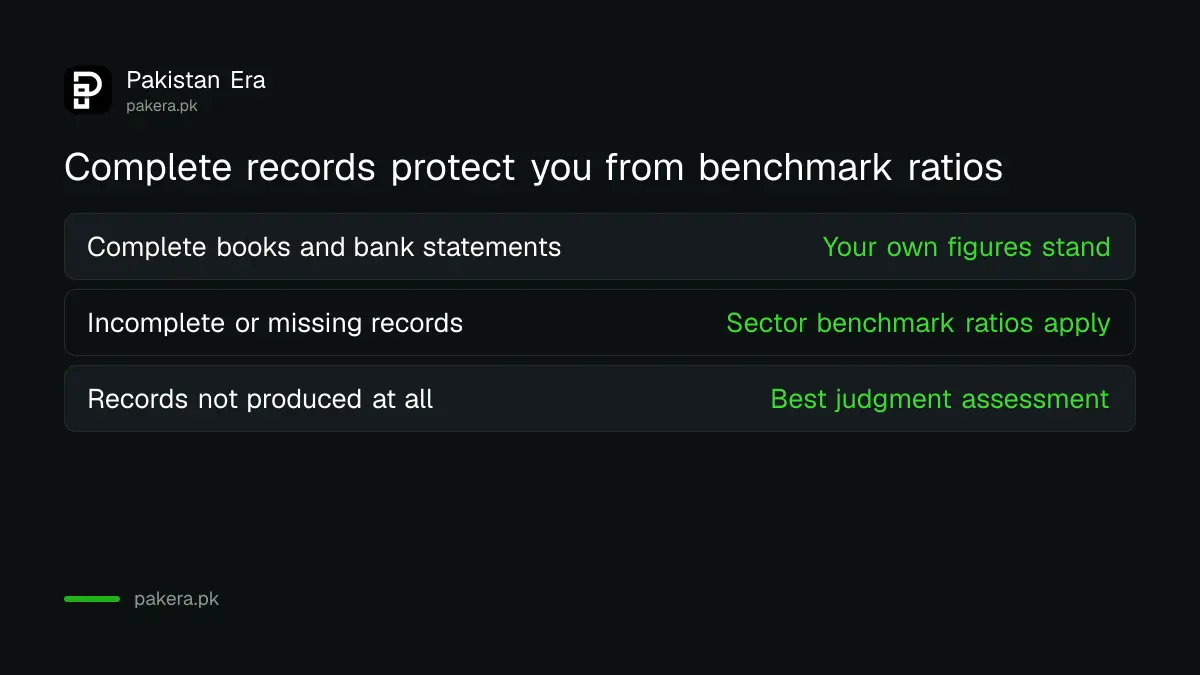
If you do not furnish records, furnish incomplete records or cannot explain defects in them, section 177(2AA) treats your income as incorrectly declared. The Commissioner then sets taxable income using sectoral benchmark ratios fixed by FBR.
These are standard ratios for a business sector, such as gross profit, net profit and wastage. They are built from comparable cases, not from your own books. They are usually less kind than a well kept ledger. Complete records are your defence.
The same warning applies to failing to produce documents at all. Sub-sections (10) and (14) let the Commissioner make a best judgment assessment under section 121 if you do not produce what is asked for. That route is explained in how to reply to a section 114(4) notice for a missing return.
How an audit moves from notice to report to amended assessment
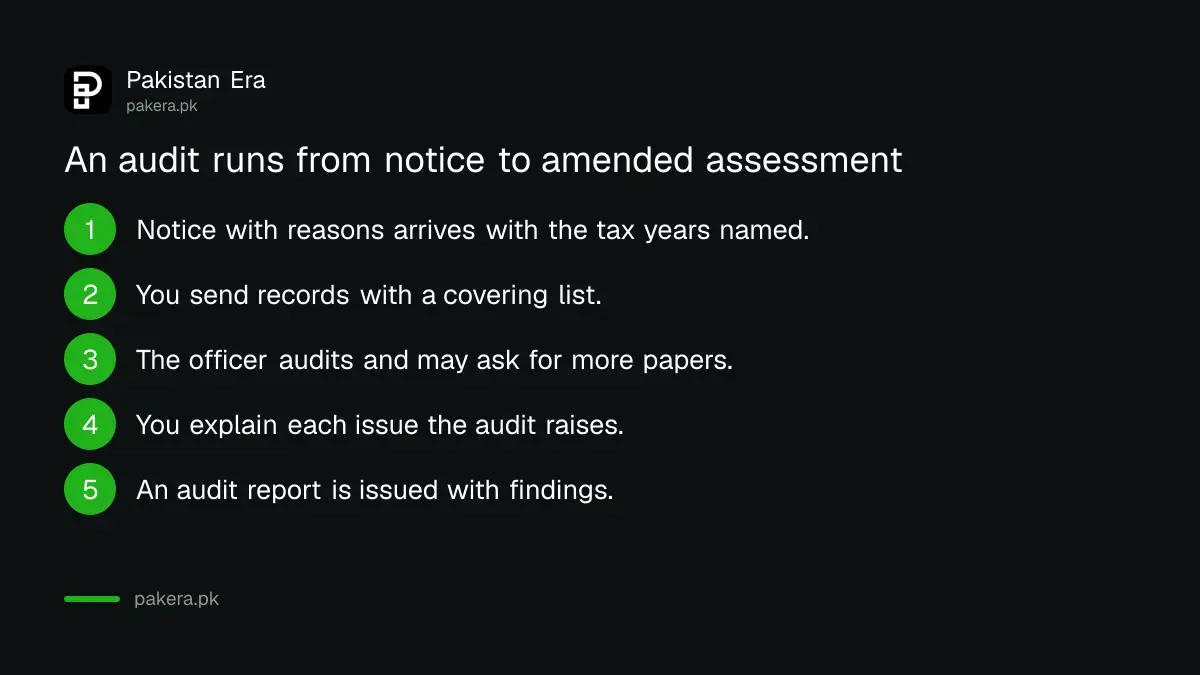
After the Commissioner obtains your record, an audit of your income tax affairs is conducted, including accounts, expenditure, assets and liabilities. The Commissioner may call for more documents. Audit can be done by video link.
When the audit is compiled, the Commissioner must get your explanation on all issues raised and then issue an audit report with observations and findings. Only after the report can the assessment be amended, and only after you are given a hearing.
- Notice with reasons arrives, and you note the date and the tax years.
- You send the records asked for, with a covering letter listing every document.
- The officer audits, and may ask for more papers or an online session.
- You are asked to explain each issue raised in the audit.
- The Commissioner issues an audit report with observations and findings.
- If the assessment is to be amended, you are heard first.
The amendment step is where a formal notice follows, and the reply is set out in how to reply to an FBR section 122 notice to amend your assessment. FBR has also announced faceless audit handling, described in the National Faceless Centre for tax audits.
A new power: re-audit of accounts by a panel accountant
The Finance Act, 2026 added sub-section (6B). With the previous approval of the Chief Commissioner, and after giving you a reasonable chance to be heard, the Commissioner can direct you to get accounts re-audited, inventory re-valued or actuarial values checked.
The professional is nominated by the Commissioner from a panel fixed by FBR. You may object to the nominated accountant or cost accountant within fifteen days of the nomination. If the Commissioner agrees with your objection, another professional can be named.
This applies where the accounts are complex, large, doubtful, full of transactions or highly specialised. Ask which of those reasons the Commissioner is relying on.
Keep a clean record from the first day
The simplest defence is paper that matches your return. Keep bank statements, invoices, utility bills, rent agreements and a cash book in one place, and keep them for at least six years. What banks send to FBR on their own is listed in what your bank already reports to FBR. Match your records against it before the officer does.
Common questions
Can FBR audit me without giving a reason?
No. Under section 177 the Commissioner must record reasons in writing and communicate them to you when calling for your records.
How far back can an audit notice go?
The Commissioner cannot call for your record after six years from the end of the tax year it relates to.
Can I be audited every year?
Yes. Being audited in one year does not stop another audit in the next years if there are reasonable grounds.
What if I do not have all the records?
Send what you have and explain the gaps in writing. Incomplete records let the Commissioner set income by sector benchmark ratios.
Can the audit be done online?
Yes. Section 177(2A) allows the Commissioner to conduct audit proceedings through video links or another facility the Board prescribes.
Does an audit mean I will owe more tax?
No. The audit ends in a report. The assessment can be amended only after your explanation and a hearing, and only if the Commissioner finds a reason.
How we verified this
What we checked, where we read it, and what we could not confirm.
We read section 177 of the Income Tax Ordinance, 2001, amended up to 30 June 2026, published by the Federal Board of Revenue, on 12 October 2026. The notice you receive and the official text decide your case. This page is general information, not tax advice.
About the author

Global Affairs & Political Economy Writer
Muhammad Hatim is a book lover who started writing because he enjoys it. At Pakistan Era he writes about international relations, geopolitics and the global economy, with a particular interest in South Asia and the forces behind current events.