Tax on Inherited Property in Pakistan: What the Finance Act 2026 Changed for Heirs
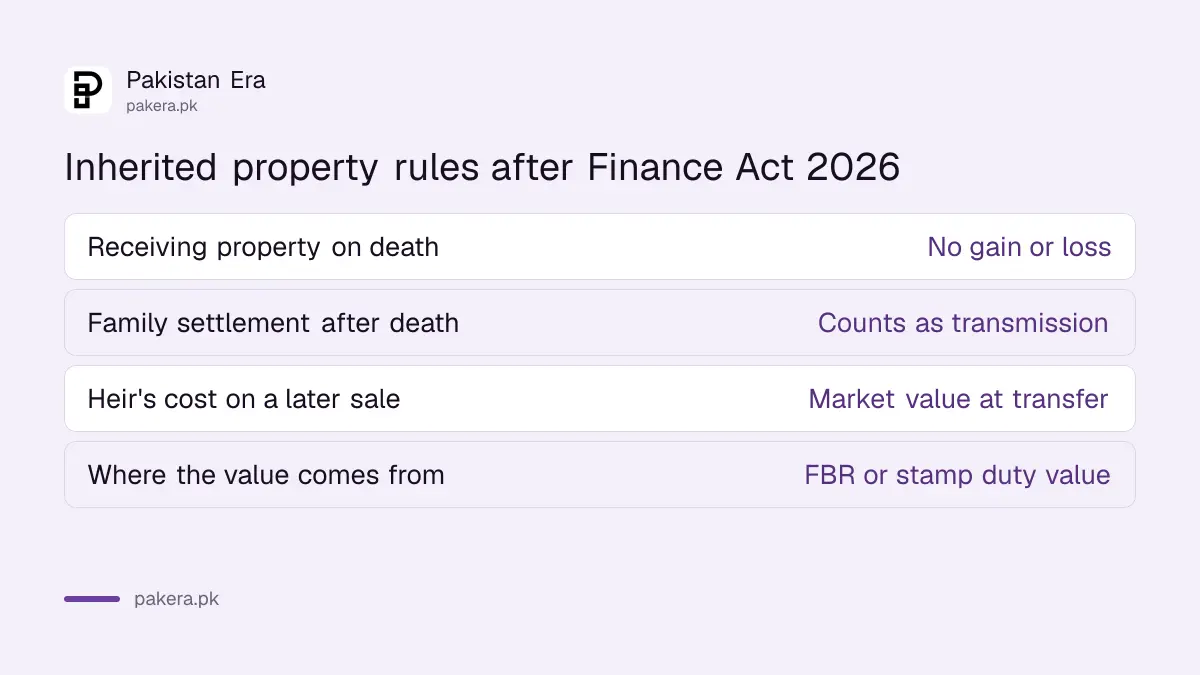
Receiving inherited property triggers no gain in Pakistan. Finance Act 2026 sets the heir's cost at market value and treats a family settlement as inheritance.

Receiving inherited property triggers no income tax gain in Pakistan, and the Finance Act 2026 made two points clearer. When an heir later sells, the cost of the property is its fair market value on the day it was transferred to the heir. A family settlement made after a death counts as inheritance, not a sale.
A father dies and four children inherit a house. Months later they agree that one child takes the house and the others take cash and a plot. Before this year, that second step left room for argument about who had sold what. We read the Finance Act 2026 in the Gazette of 26 June 2026 and the Income Tax Ordinance, 2001 on FBR's site on 15 October 2026.
No gain or loss arises when property passes to an heir on death
Section 79(1)(b) of the Ordinance says no gain or loss is taken to arise when an asset is transmitted to an executor or beneficiary on the death of a person. So an heir who receives a share of a house does not pay capital gains tax for receiving it.
This rule is old. What changed in 2026 is what happens at the next step, when the heir sells, and how a family settlement is treated. Both changes came through the Finance Act 2026, which the Gazette published on 26 June 2026 as Act XLIII of 2026.
A family settlement after a death now counts as transmission
The Finance Act 2026 added an explanation to section 79(1)(b). It says transmission of immovable property to a beneficiary on death includes transmission of assets by reason of a family settlement among family members that follows the death.
In plain words, if heirs agree among themselves how to divide the property, the law does not treat that as a sale between them. The Gazette calls it "for the removal of doubt". It is a statutory clarification, so it does not depend on one officer's view.
The wording ties the settlement to the death. A deal made years later between relatives, with no link to the inheritance, may not qualify. We did not find a time limit in the text. Ask an adviser before you sign a settlement deed.
The cost of inherited property is its market value on transfer
The Finance Act 2026 inserted a new sub-section (8A) in the cost rules. When an individual gets immovable property by inheritance, the cost in their hands is the fair market value on transfer to them, as section 68(5) provides for it.
This matters when you sell. The Ordinance now names the starting figure. It is the market value at transfer, so the taxable gain on a later sale is the difference between the sale price and that value.
| Step | Value |
|---|---|
| Fair market value when the property is transferred to you | Rs 10 million (example) |
| Your cost for tax | Rs 10 million |
| Sale price years later | Rs 14 million (example) |
| Gain measured on | Rs 4 million, then the Ordinance's holding period and rates apply |
The figures are our own example, not an FBR one. For the tax rates on a later sale, see the guide to capital gains tax on property.
Section 68(5) says which value the law will accept
Section 68(5) says that where FBR has not notified a fair market value for an area, the value is the one fixed by the District Officer (Revenue), or by a provincial or other authority, for stamp duty. FBR may also notify values for an area under section 68(4).
So the practical starting point is the official valuation of your property. The guide to checking the DC valuation of property shows where to find it, and the FBR property valuation check shows FBR's own figure for an area.
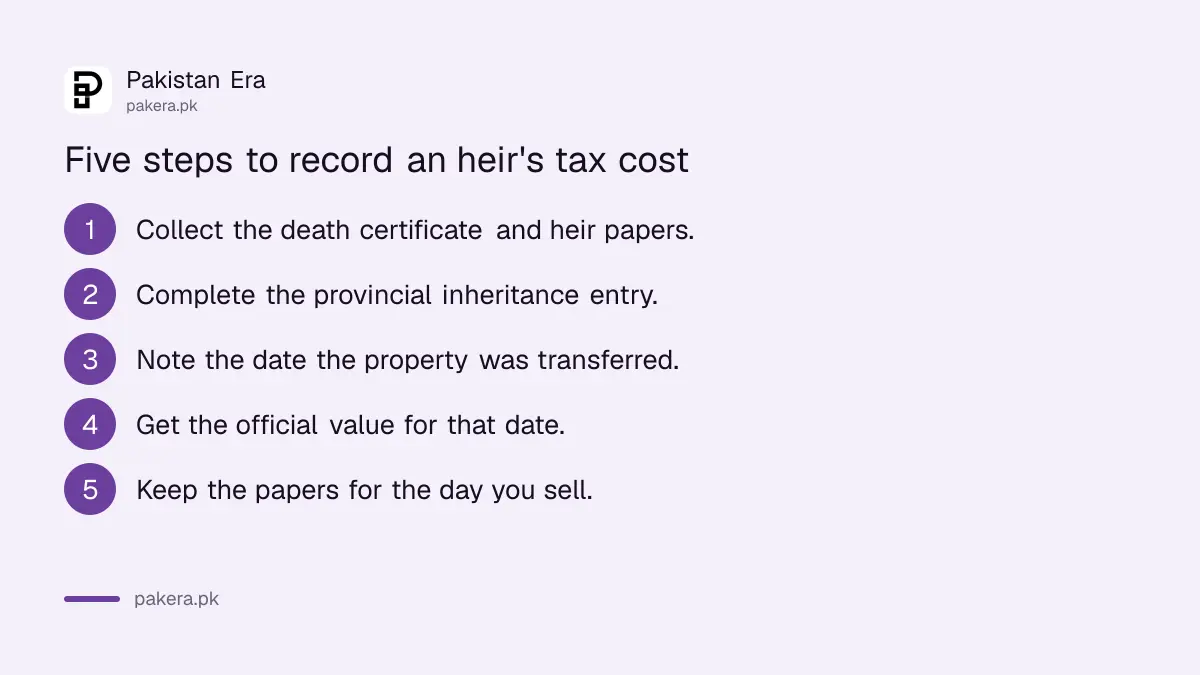
- Collect the death certificate and the heirs' papers.
- Complete the provincial inheritance entry. The steps for Punjab are in inheritance mutation in Punjab.
- Write down the date the property was transferred to you.
- Get the official valuation for that date from the DC or FBR page.
- Keep the valuation and the transfer papers for the day you sell.
Check these gaps before you sell or settle
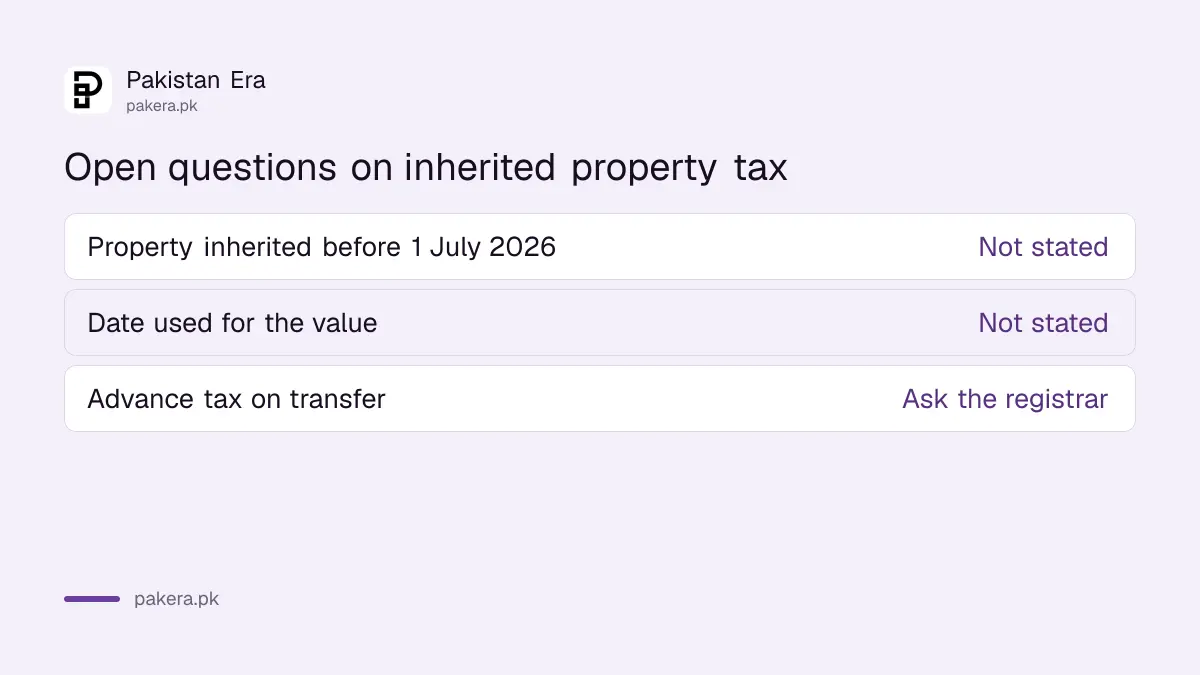
The text of the 2026 changes is short, and some questions are left open. The Finance Act does not say how the rule works for property inherited before 1 July 2026, or whether the market value is read on the date of death or on the date of registration.
The Ordinance also contains advance tax rules for sales and purchases of property, in sections 236C and 236K. We did not find a clause that exempts an inheritance transfer from them. Registration charges and provincial duty are separate. Ask the registrar what will be collected before you pay.
Common questions about tax on inherited property in Pakistan
Do I pay tax when I inherit a house?
Section 79(1)(b) says no gain or loss arises when property is transmitted to a beneficiary on death, so there is no capital gains tax for receiving it.
What is my cost if I sell inherited property?
Under the new sub-section (8A), the cost is the fair market value of the property on transfer to you, as defined by section 68(5).
Does a family settlement count as a sale?
Not if it follows the death. The Finance Act 2026 explanation says a family settlement consequent upon death is a transmission to a beneficiary.
Does the rule apply to land and flats alike?
The new cost rule covers immovable property, which includes both. The explanation also speaks of immovable property.
Where do I find the market value?
First FBR's notified value for the area, if any. If there is none, the stamp duty value fixed by the district revenue officer or provincial authority.
Is this tax advice?
No. It explains the law as published. For a large property, have an adviser read the deed before you sign.
How we verified this
What we checked, where we read it, and what we could not confirm.
Last checked 15 October 2026. The new sub-section and the explanation come from the Finance Act, 2026 (Act XLIII of 2026) in the Gazette of 26 June 2026, on FBR's site. Sections 68 and 79 come from the Income Tax Ordinance, 2001, version dated 24 July 2026. The worked example is our own. We did not check when each Finance Act clause takes effect.
About the author

Senior Writer, Public Services and Technology
Shahid joined us in 2024 as an author. He is a senior contributor to Pakistan's leading technology websites. He writes detailed articles, mostly covering his expertise in the latest tech, mobiles, apps, gadgets, and step-by-step guides. His ideology is to help people understand the latest trends and explain complex methods through very easy-to-understand guides.