Why Children in Pakistan Need Polio Drops in Every Round: OPV, IPV and Repeat Doses
Pakistan's polio programme says some children need more than 10 doses. See how drops (OPV) and the injection (IPV) differ, the heat label and the halal answer.
Short answer: Children under five in Pakistan should get polio drops in every campaign round, even after routine doses, because some children need more than ten doses to be fully protected. The drops (OPV) protect the gut and the injection (IPV) protects the blood. Pakistan's polio programme says children need both.
Parents ask the same question at the door every few months: "But he already had the drops." It is a fair question. The answer is not that the earlier doses failed. It is that one dose rarely finishes the job, and in some children ten are not enough.
We read the frequently asked questions on poliofreepakistan.gov.pk, the official site of the polio eradication programme, on 20 October 2026. We also read its latest release, which confirmed Pakistan's seventh case of the year. Here is what the programme says about the two vaccines, the repeat doses and the common worries.
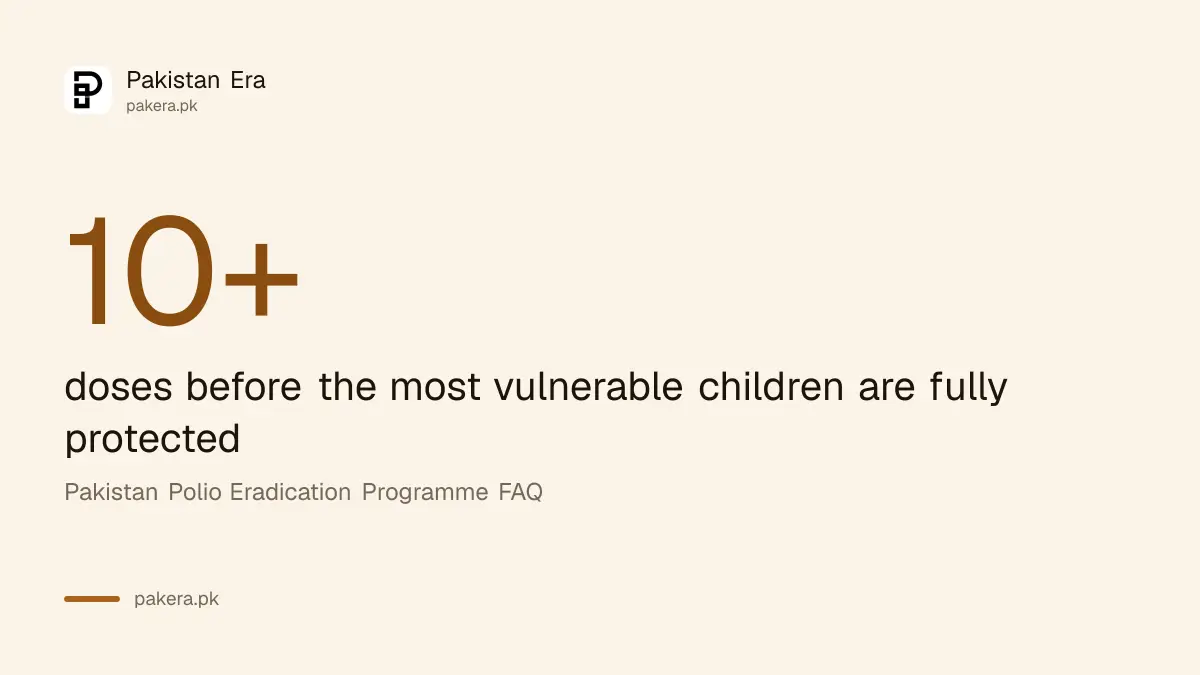
Some children need more than ten doses before they are protected
The programme says a few children build strong immunity after five or six doses, while the most vulnerable need more than ten. Underweight and malnourished children, and children with diarrhoea, respond to the vaccine differently. That is why every round counts.
The number a child needs depends on their health, their nutrition and the other viruses they have met. A parent cannot tell from the outside whether their child is fully protected. So the safe answer is the same for every child under five: take the drops each time.
Extra doses in a campaign are safe, the programme says. The vaccine is designed to be given many times. A child who had routine drops at a clinic still gains extra protection from a campaign dose.
Drops protect the gut and the injection protects the blood
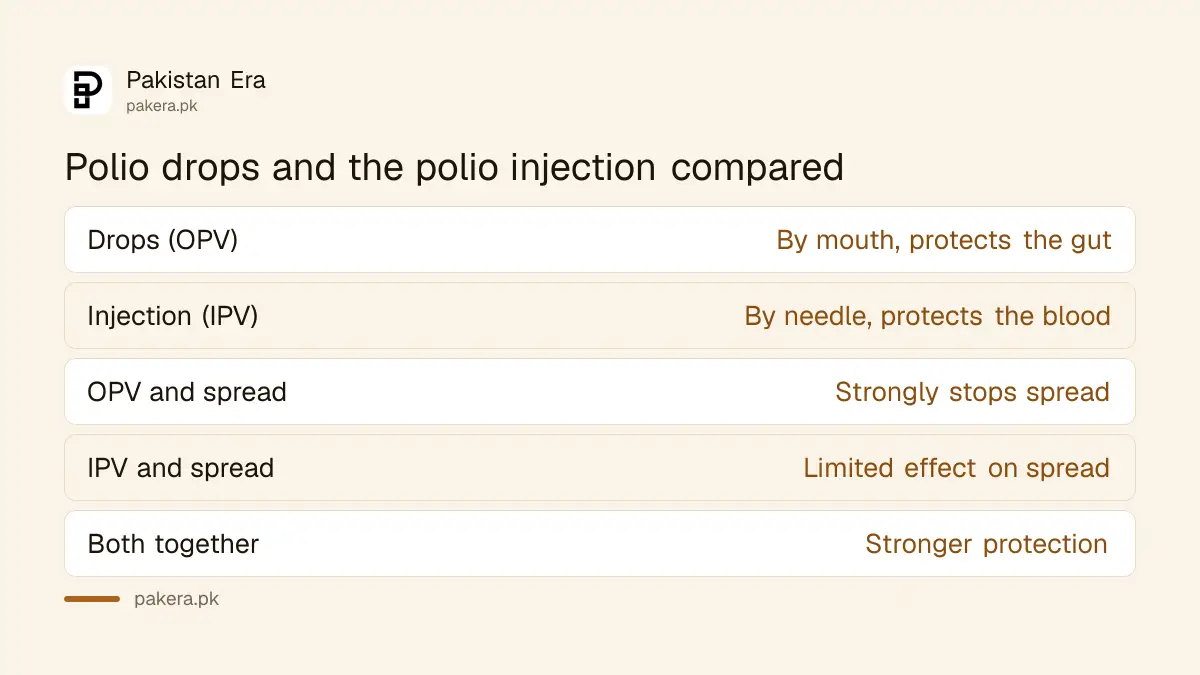
Oral polio vaccine (OPV) is the two drops given by mouth. Inactivated polio vaccine (IPV) is the injection. The programme says combining them gives stronger protection: IPV builds immunity in the blood and OPV builds it in the gut, where the virus multiplies.
| Point | Oral polio vaccine (OPV) | Inactivated polio vaccine (IPV) |
|---|---|---|
| How it is given | Two drops by mouth | An injection |
| Where it builds immunity | The gut | The blood |
| Stops spread in the community | Yes, strongly | Only a little |
| Who can give it | Trained campaign workers, no needle | Trained health workers with sterile equipment |
| Where you get it | Campaigns and routine visits | Routine visits and some targeted rounds |
The gut matters because polio spreads through stool and dirty water. A child protected in the gut is less likely to pass the virus on. That is why the programme says OPV is still the main vaccine in countries where polio is endemic, such as Pakistan.
The routine schedule has drops from birth and at least one injection
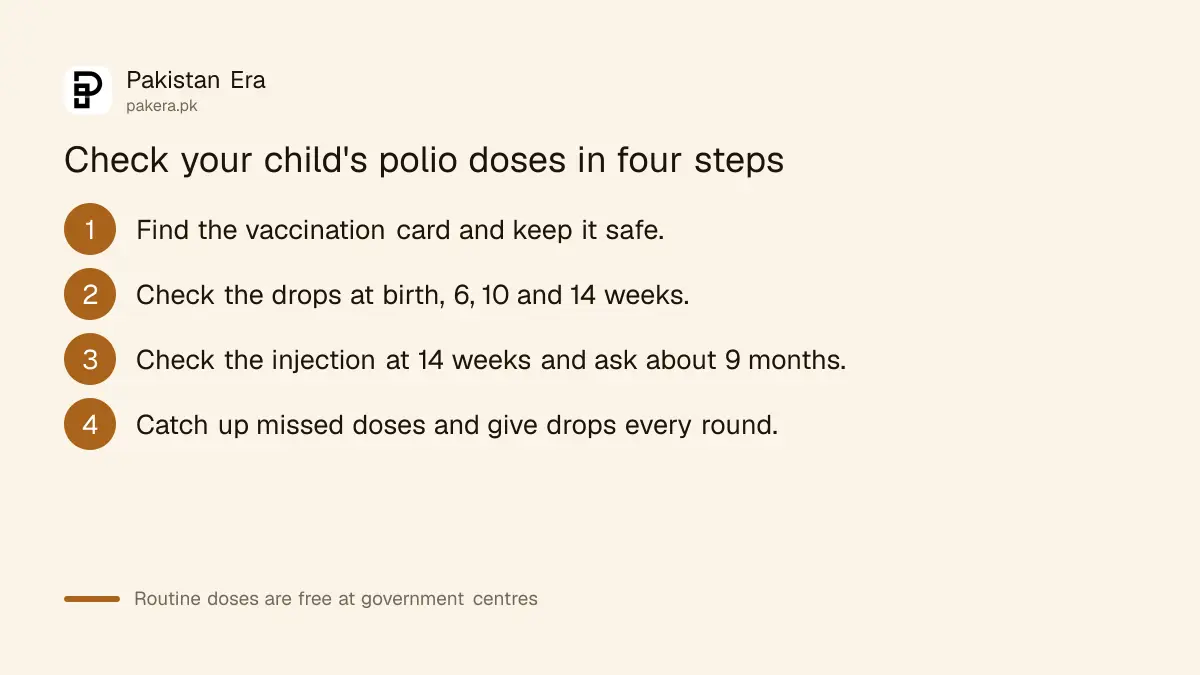
Routine polio doses are free at government vaccination centres. Drops start at birth and continue in the first months, and the injection comes at 14 weeks. Sources differ on whether a second injection follows at 9 months, so check your child's card at the centre.
The polio programme's FAQ says the routine schedule "recommends one dose of IPV and multiple doses of OPV". The WHO schedule data for Pakistan used in our page on the free EPI vaccination schedule lists a second polio injection at 9 months. We could not settle which is current.
- Find your child's vaccination card, and keep it as safely as a birth certificate.
- Check for drops at birth, 6, 10 and 14 weeks, and the injection at 14 weeks.
- Ask the vaccinator whether your child also needs the 9 month injection.
- Catch up any missed dose now, at the nearest government vaccination centre.
- Give the campaign drops as well, every round, until your child turns five.
A heat label on each vial shows whether the drops are still good
OPV loses strength if it gets too hot. Each vial carries a heat-sensitive label called the vaccine vial monitor. The programme says workers use only vials with a valid monitor and a valid expiry date, and the vaccine travels in cold boxes all the way.
The programme also says all OPV used in Pakistan is prequalified by the World Health Organization, and that the vaccine comes from Indonesia. A 2015 test by the National Control Laboratory for Biologicals, run by the Drug Regulatory Authority of Pakistan, found it safe, effective and halal.
You can ask a worker to show you the vial before the drops. Nobody should mind.
The programme answers the side effect and halal worries directly
The programme calls OPV one of the safest vaccines ever made, safe enough for newborns and sick children. It says the only reason not to give it is a severe reaction to an earlier dose or to a vaccine ingredient. It calls claims linking it to cancer false.
It is open about one rare risk. Where too few children are vaccinated, the weakened virus in the drops can circulate and change over 12 to 18 months until it can cause paralysis. The programme says the answer is higher coverage, which is why it wants at least 95 per cent of children under five reached each round.
On religion, the programme lists Al-Azhar, the Grand Mufti of Saudi Arabia, Imam-e-Kaaba and leading Pakistani muftis among those who back the vaccine. Its reasons for vaccinating a sick child are in our page on giving polio drops to a sick child.
Common questions
Why does my child need polio drops again if they already had them?
Because one or two doses are rarely enough. The programme says some children need more than ten doses for full protection.
What is the difference between OPV and IPV?
OPV is the oral drops and builds immunity in the gut. IPV is the injection and builds immunity in the blood. Together they give stronger protection.
Is it safe to give many doses of polio drops?
Yes, according to the programme. The vaccine is designed to be given many times, and each dose adds protection.
Is the polio vaccine halal?
The programme says a 2015 test by DRAP's National Control Laboratory for Biologicals found it halal, and Islamic scholars in Pakistan and abroad endorse it.
Can polio drops cause polio?
Very rarely, where too few children are vaccinated, the vaccine virus can change and cause paralysis. The programme says reaching more children is what prevents this.
When is the next polio campaign?
From 2 to 8 November 2026 in 97 districts, for nearly 24 million children, the programme says. The details are in our report on the November 2026 polio campaign.
How we verified this
What we checked, where we read it, and what we could not confirm.
We read the polio programme's frequently asked questions and its 19 October 2026 release on 20 October 2026. The FAQ is not dated, so some answers may be older than the current schedule. Its "one dose of IPV" differs from the WHO data for Pakistan, and we report both rather than choose.
About the author
Public Services and Education Journalist
Fajr Riaz is a journalist and content writer at Pakistan Era, based in Lahore. She covers the questions people meet in everyday life in Pakistan: how a public service works, what a change in the rules means, and where to find a reliable answer.