How to Prepare Your Home for an Earthquake in Pakistan: NDMA Steps
On the 21st anniversary of the 2005 quake, here is NDMA's advice for Pakistan: what to do during shaking, a home kit list and the doorway myth. Read it today.
When the ground shakes, drop to your knees, get under a sturdy table, cover your head and neck, and hold on until it stops. Do not run outside and do not stand in a doorway. Before that day comes, fix the heavy things in your home and pack one kit.
Today, 8 October, is 21 years since the 2005 earthquake. It hit Balakot in Khyber Pakhtunkhwa and the State of Azad Jammu and Kashmir at magnitude 7.6. The National Disaster Management Authority (NDMA) puts the deaths at more than 80,000 and says over 3 million people were affected.
We read the NDMA Earthquake Guidelines 2026, published on its website on 23 January 2026, on 8 October 2026. Everything below comes from that document unless it says otherwise.
Drop, cover and hold on is the one move to practise
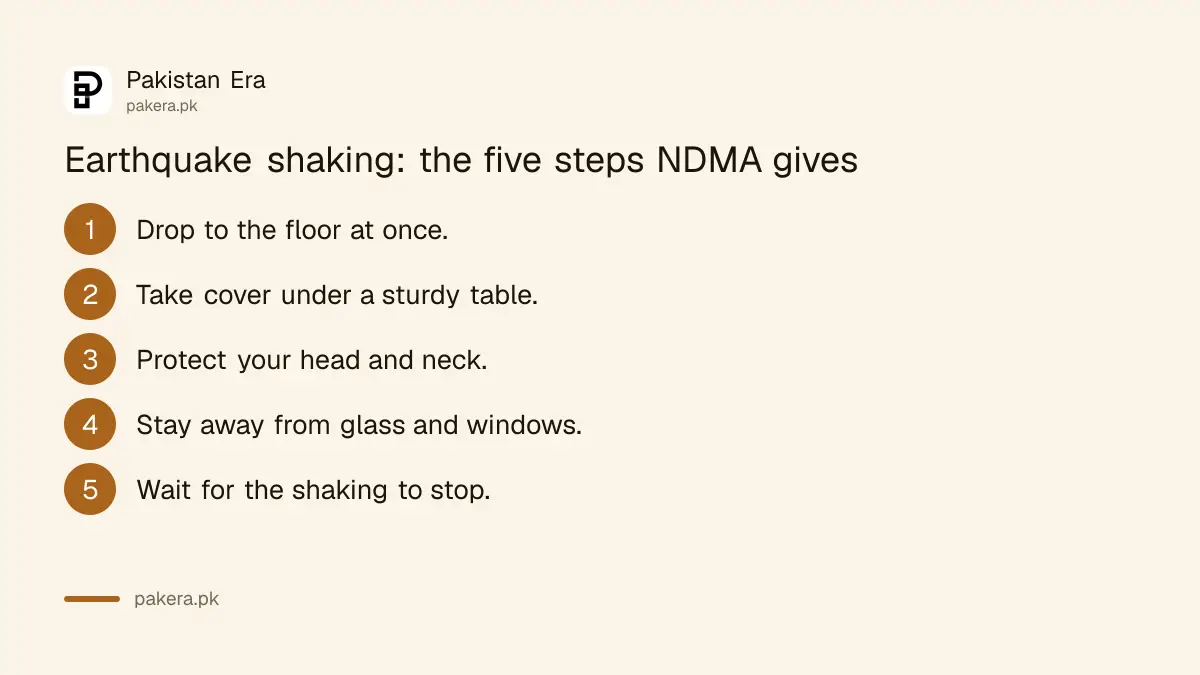
NDMA tells people indoors to take cover under a sturdy desk, table or bench, or against an inside wall, and hold on. If there is no table, cover your face and head with your arms and crouch in an inside corner. Stay put until the shaking stops.
Say it out loud with your family tonight. Children freeze when they have never practised. A two minute drill in the sitting room is worth more than a long talk.
- Drop to the floor the moment you feel shaking.
- Take cover under a sturdy table, or crouch against an inside wall.
- Protect your head and neck with your arms.
- Stay away from glass, windows, outside walls and anything that can fall.
- Wait inside until the shaking stops, then walk out by the stairs, never the lift.
NDMA says most injuries happen when people are hit by falling objects while entering or leaving a building. That is the reason for the last step. Running out in the first seconds puts you under the bricks and glass.
The doorway rule is a myth, so use the table
NDMA lists the doorway rule as outdated advice. In old buildings a door frame was sometimes the only part left standing. Today doorways are no stronger than any other part of a house and do not protect you from falling or flying objects.
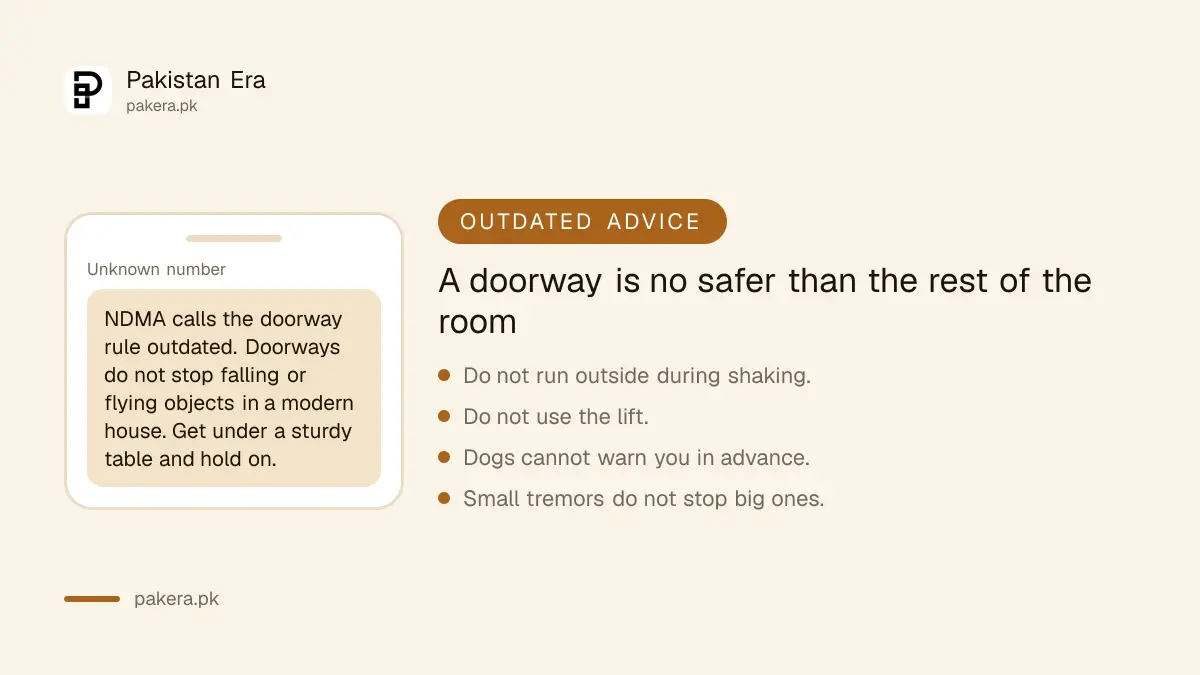
The same list busts three more myths. Dogs and other animals cannot be shown to sense a quake before it comes. There is no "earthquake weather", hot or cold. And small tremors do not use up the stress on a fault, so they do not stop a big one.
If you are in bed, stay there. Hold on and cover your head with a pillow. The one exception is a heavy light fitting right above you, in which case move to the nearest safe spot.
Fix the heavy things in your home first
NDMA's home advice is plain: anchor tall furniture and water heaters to the wall, keep heavy objects on low shelves, and do not hang heavy things over beds or seats. Put beds away from windows. These jobs cost little and stop the most common injuries.
Walk through each room with one question: what falls on a person if this shakes? A steel almirah, a wall mirror above the bed, a loaded top shelf and a ceiling fan are the usual answers.
Also learn where the gas is switched off. NDMA says gas leaks are common after an earthquake and tells you to listen for hissing and smell for gas. If it is safe, turn off gas, water and electrical appliances once the shaking stops. If you use a heater, read how to use a gas heater or geyser safely before winter starts, because both risks arrive in the same season.
On older buildings, NDMA suggests regular checks for weak spots and retrofitting, which means strengthening what already stands. It also says a building made earthquake resistant from the start costs only 5 to 8 per cent more to build. If you are about to build, that is the figure to take to your contractor.
One emergency kit by the door is enough to start
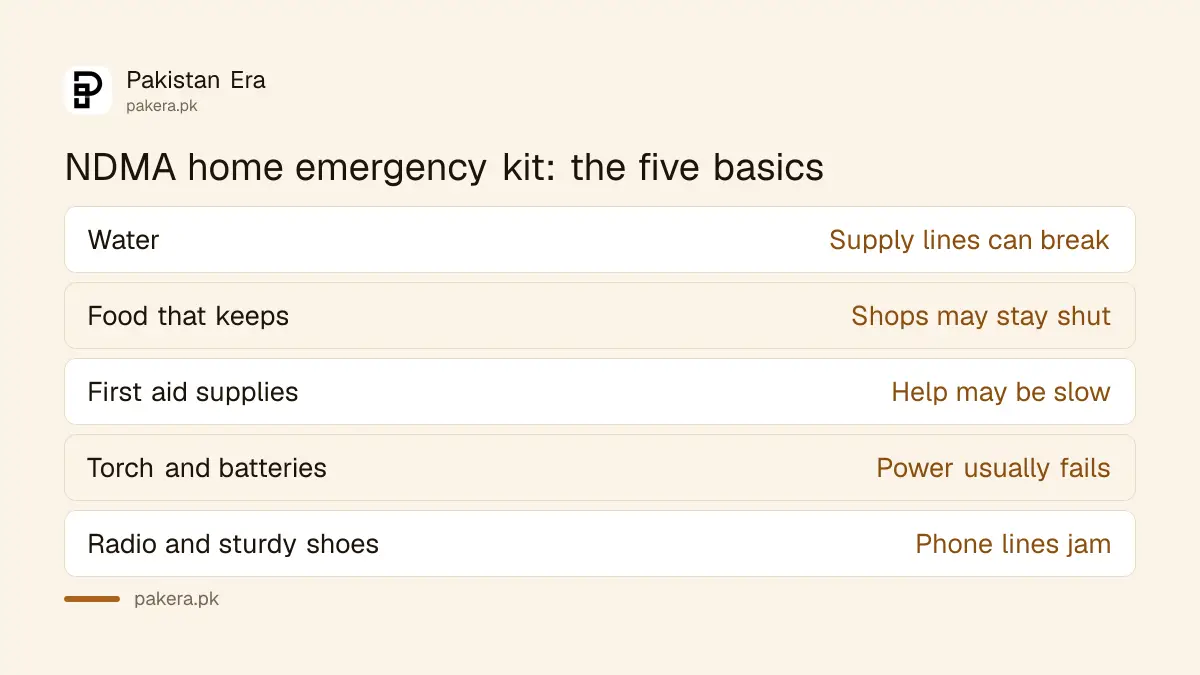
NDMA's list for a home kit is water, food that keeps, first aid supplies, torches, a radio and batteries. It adds sturdy shoes, gloves and blankets. Keep it where you can reach it without going through a bedroom full of fallen furniture.
| Item | Why it is on the list |
|---|---|
| Drinking water | Supply lines can break |
| Food that keeps | Shops may be shut for days |
| First aid supplies | Help may be slow to arrive |
| Torch and spare batteries | Power usually fails |
| Battery or hand-crank radio | Phone networks can be jammed |
| Sturdy shoes, gloves, blankets | Broken glass and cold nights |
We would add a printed list of family phone numbers. That is our own suggestion, not NDMA's. Phones die, and few of us remember a number any more.
Know where you are before the shaking starts
In a car, stop as soon as it is safe, pull to the side and stay inside. Do not stop near buildings, trees, overpasses or wires, and do not cross a damaged bridge. Outdoors, move to an open space away from buildings, trees, streetlights and wires.
If you end up trapped under debris, NDMA's advice is to not light a match, cover your mouth with cloth, and avoid moving about and kicking up dust. Tap on a pipe or wall so rescuers can hear you, or use a whistle. Shout only as a last resort, because shouting makes you breathe in dust.
Pakistan sits where the Indian Subcontinent and Eurasian plates meet. NDMA names the Chaman, Hindukush, Dhurnal and Gabbar faults among the major ones. The Gabbar fault runs under districts in both Khyber Pakhtunkhwa and Punjab, including Rawalpindi, Attock and Jhelum. So this is not only a northern problem. NDMA also flags a tsunami risk on the Balochistan coast from the Makran Subduction Zone.
After the shaking, check yourself, then the building
NDMA tells you to check yourself for injury, expect aftershocks, look for fire, broken glass and other hazards, and stay where you are unless you must leave. Do not enter partly damaged buildings. If you must evacuate, leave a message saying where you went.
Untrained people should not dig in rubble. NDMA says to wait for professional rescue teams, and if you hear someone trapped, call out gently rather than shout. Call Rescue 1122 where it runs, and keep the emergency numbers in your kit.
NDMA's own helpline is 051-111-157-157, shown on its website as open 24 hours. It also lists a WhatsApp number, 0300-0881641. After a shake, you can check the magnitude and epicentre on the PMD site. NDMA also offers a mobile app for early warnings and advisories.
Common questions
What should I do first when an earthquake starts?
Drop, take cover under a sturdy table and hold on, covering your head and neck. Stay inside until the shaking stops.
Is it safe to stand in a doorway?
No. NDMA calls this outdated advice. Doorways are no stronger than the rest of a modern house and do not stop falling objects.
What goes in an earthquake kit?
NDMA lists water, long-life food, first aid supplies, torches, a radio and batteries, plus sturdy shoes, gloves and blankets.
Should I use the lift to get out?
No. NDMA says to use the stairs and to wait until the shaking has stopped before leaving.
Who do I call for help?
NDMA's helpline is 051-111-157-157. For an injury or rescue, call your local ambulance or Rescue 1122 service.
Does a new house cost much more to make earthquake resistant?
NDMA says only 5 to 8 per cent more than an ordinary building, if the seismic features are planned from the start.
How we verified this
What we checked, where we read it, and what we could not confirm.
Last checked 8 October 2026. The figures and advice above come from the NDMA Earthquake Guidelines 2026 (published 23 January 2026) and the NDMA home page at ndma.gov.pk, which lists the helpline 051-111-157-157 and the WhatsApp number 0300-0881641. We did not test the helpline or the NDMA app. The 5 to 8 per cent cost figure and the 2005 death toll are NDMA's own numbers, and other agencies have given different totals for 2005. Confirm local rescue numbers with your district administration.
About the author

Senior Writer, Public Services and Technology
Shahid joined us in 2024 as an author. He is a senior contributor to Pakistan's leading technology websites. He writes detailed articles, mostly covering his expertise in the latest tech, mobiles, apps, gadgets, and step-by-step guides. His ideology is to help people understand the latest trends and explain complex methods through very easy-to-understand guides.