How to Protect Your Seized Goods and Claim the Balance if FBR Auctions Them
FBR's new e-auction rules protect the owner of seized goods: a court stay blocks the sale and the balance after dues goes to you. See the steps to take now.
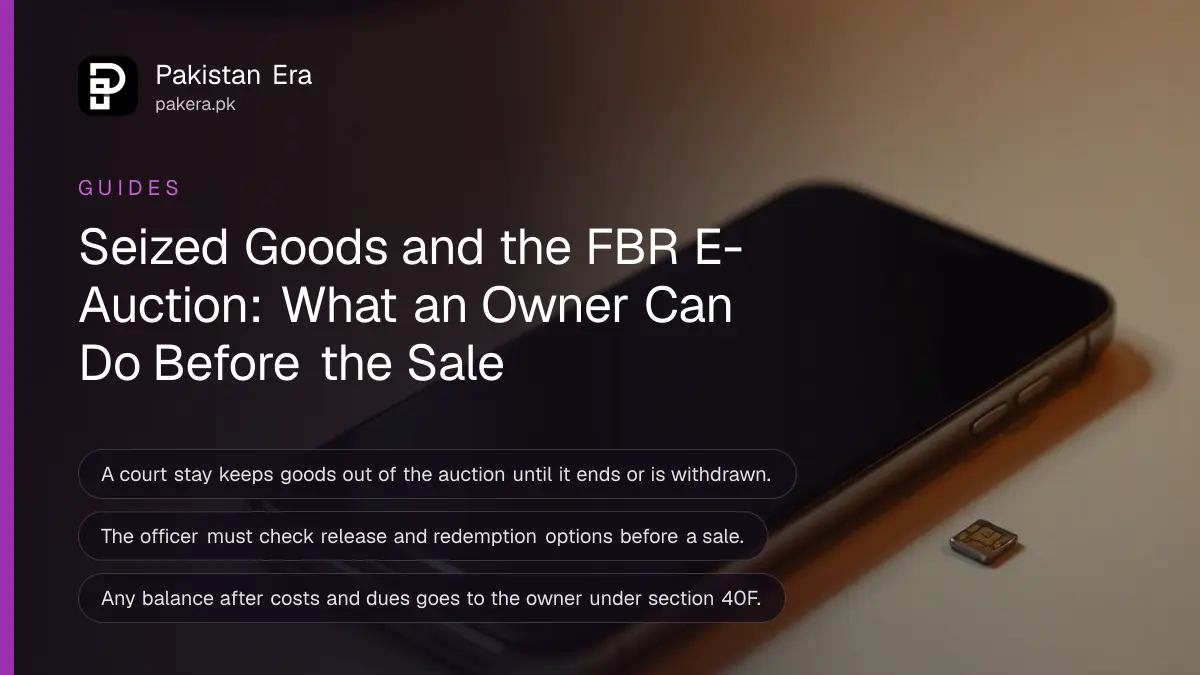
Short answer: If the Federal Board of Revenue (FBR) holds your goods, the new e-auction rules of S.R.O. 1889(I)/2026 give you four points to use: a court stay stops the sale, a release or redemption option must be checked first, the officer may send you a notice, and any balance after costs and dues goes to you. Act before the lot is listed.
We read the 22 October 2026 notification in full. It sets how goods are sold, so it matters most to the owner who still hopes to keep them. This guide is about the owner's side. The bidder's side is in our news note on the FBR e-auction rules and the Rs 25,000 bidder fee. It is not legal advice, so show the text to a tax lawyer.
Only confiscated goods and goods finalised by an adjudication order are sold
The rules name two kinds of goods for the e-auction: confiscated goods, and seized goods finalised for disposal under an adjudication order. Goods that are merely held, with no final order, are not in the list. A final order is the point at which the clock starts running against you.
Adjudication is the process in which a tax officer decides a case about the goods. If you have an order against you, check its date and the appeal period. Our guide to appealing to the Appellate Tribunal Inland Revenue lists the time limit and fee.
A court stay keeps the goods out of the auction
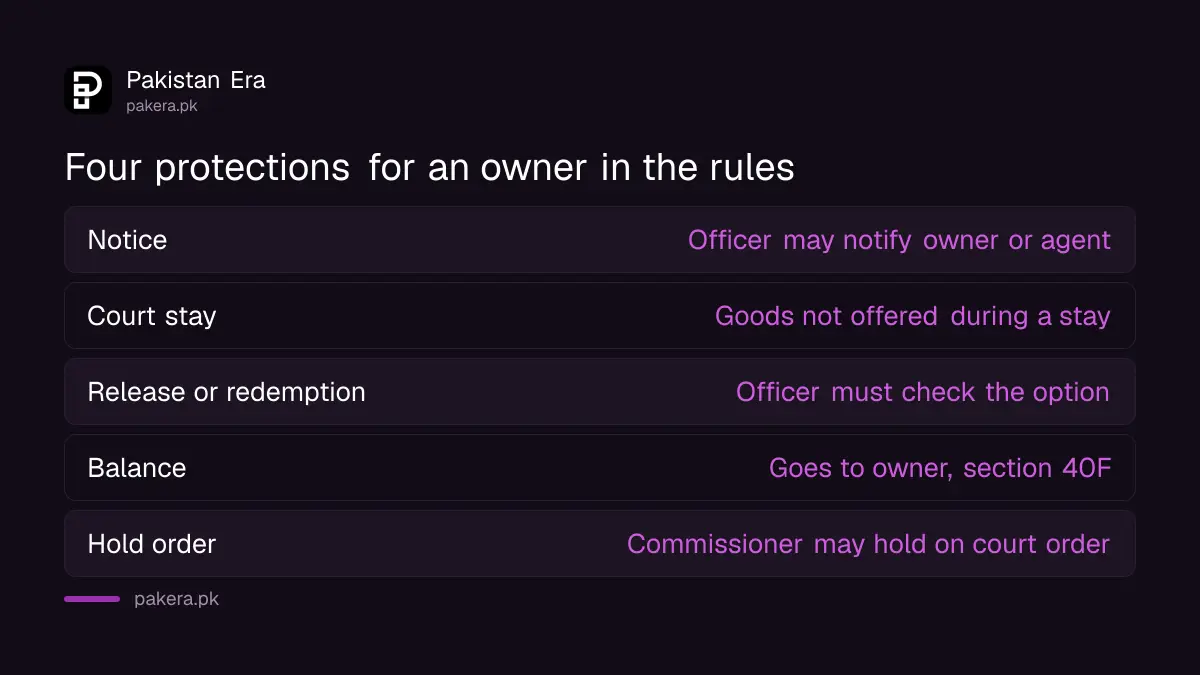
Rule 158P says the authorised officer must check for any stay order from a court or other judicial forum before the auction starts. Goods under a stay are not offered until the stay ends or is withdrawn, whichever is earlier. The Commissioner can also hold a sale on a court order.
So a stay is your strongest tool. The practical risk is paper. The officer can only honour a stay that has reached the office. Send a certified copy to the Commissioner and to the custodian, and keep proof of delivery.
The officer must look at release and redemption options first
The same rule lists what the officer must verify: the order that made the goods available for sale, any stay, any release or redemption option available under the Act, whether the goods are restricted or perishable, and any needed approval. Redemption means paying a fine to get the goods back.
The rules do not say what the option costs. That sits in the Sales Tax Act, which we did not read. For the customs equivalent, see our guide on paying a fine in lieu of confiscation. For goods held by a court, see getting seized property back.
| Rule | What it says for an owner |
|---|---|
| 158O(3) | The authorised officer may issue a notice, electronically or manually, to the owner, claimant or agent before the auction |
| 158P(2) and (3) | Check for stay orders and for release or redemption options; goods under stay are not offered |
| 158U(2) and (3) | Sale money pays sale costs first, then taxes, penalties and dues; any balance goes to the owner under section 40F |
| 158V(1)(f) | The Commissioner may put a sale on hold under a court order |
The notice to the owner is permitted, not guaranteed
Rule 158O(3) says the officer "may issue notice" to the owner, claimant or agent "if required". That is not a promise. Do not wait for a notice. Keep your address and mobile number current with the Inland Revenue office that holds the file.
Check the e-auction listing too, once the module is live. The rules say the auction notice shows the unique auction number, location, reserve price, photographs and closing time. A listing of your goods is your last warning.
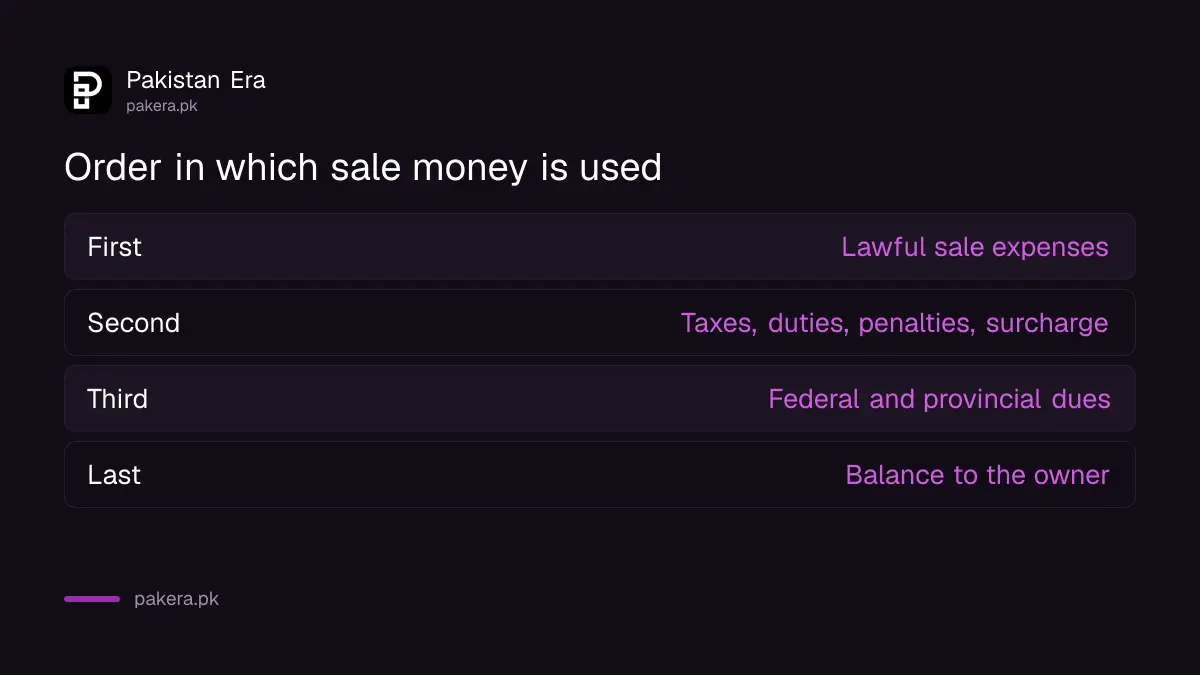
After the sale, costs and dues come out first and the balance is yours
Rule 158U says the proceeds first meet lawful sale expenses, then taxes, duties, penalties, surcharge and federal and provincial dues where they apply. Any balance payable to the owner is dealt with under section 40F of the Sales Tax Act. We did not read section 40F, so we cannot give its time limit.
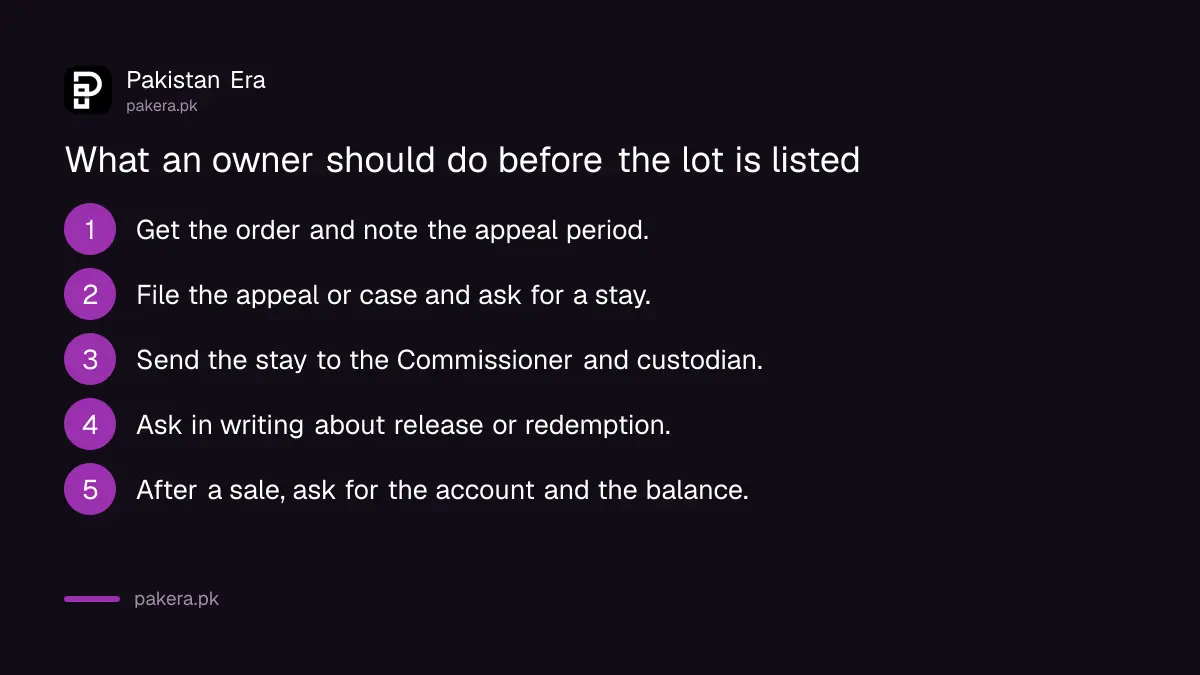
- Get the adjudication or confiscation order and note the appeal period.
- File the appeal or the court case before the lot is listed, and ask for a stay in writing.
- Send a copy of any stay to the Commissioner Inland Revenue and the custodian, and keep proof.
- Ask in writing whether a release or redemption option is open, and what it costs.
- After a sale, write to the office for the account of sale money and the balance due to you.
The Commissioner can recover goods after delivery if fraud is proved
Rule 158V also lets the Commissioner Inland Revenue recover goods after delivery where fraud, misrepresentation or loss of revenue is established. This is aimed at bidders, but it is a reminder that the Commissioner holds wide powers over the whole sale, including cancelling an auction in writing.
If your goods were seized from a factory rather than a warehouse, read what FBR can do under S.R.O. 1662 on sealing and seizure.
Common questions
Can FBR sell my goods without telling me?
The rules say the officer "may" send a notice to the owner, claimant or agent. They do not make it compulsory, so keep your contact details current.
Does a stay order stop the auction?
Yes. Goods under a stay from a judicial forum are not offered until the stay ends or is withdrawn.
Can I buy my own goods back at the auction?
The rules we read do not say. Ask the office, and look first at any redemption option.
What happens to the sale money?
Sale costs are paid first, then taxes, penalties and dues. The balance goes to the owner under section 40F.
Does the e-auction cover goods held by Customs?
No. S.R.O. 1889 amends the Sales Tax Rules and covers goods held by Inland Revenue.
Is the e-auction already running?
The notification gives no start date. We could not confirm that the module is live.
How we verified this
What we checked, where we read it, and what we could not confirm.
Last checked 23 October 2026. We read S.R.O. 1889(I)/2026, dated 22 October 2026, in full on the FBR sales tax SRO list. We did not read section 40F of the Sales Tax Act or the redemption provisions, so we give no time limits or fines from them. We could not confirm when the module starts or how FBR will send notices to owners.
About the author

Tax, Bills and Technology Writer
Ali Akhtar is a young and curious voice here at Pakistan Era. He is currently pursuing his A-Levels and has a growing interest in Pakistan’s changing industrial landscape and educational trends. Ali likes to write in a way that helps him explain and explore the world around him. His writing reflects the perspective of the new generation navigating the evolving trends of Pakistan where technology, youth innovation, and shifting opportunities are reshaping the country’s future.