Protected Electricity Consumers in Pakistan: Limit to Rise From 200 to 250 Units, Power Minister Tells Senate
Pakistan plans to lift the protected electricity limit from 200 to 250 units, the Power Minister told the Senate on 27 October 2026. See who would gain.
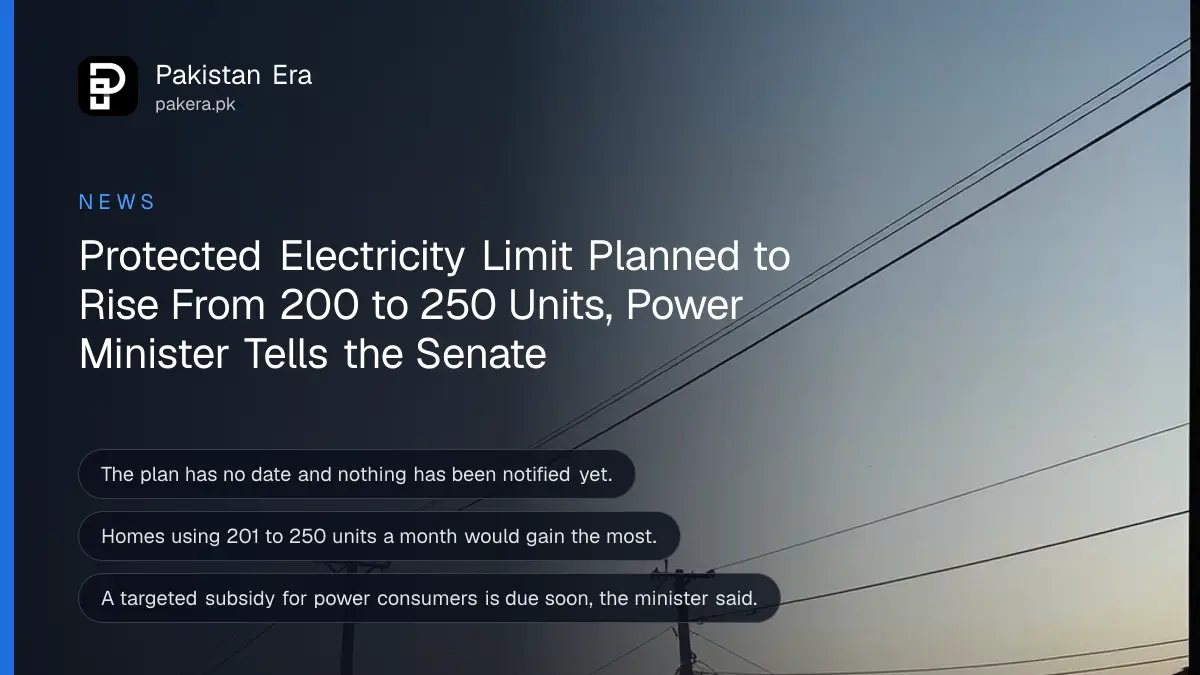
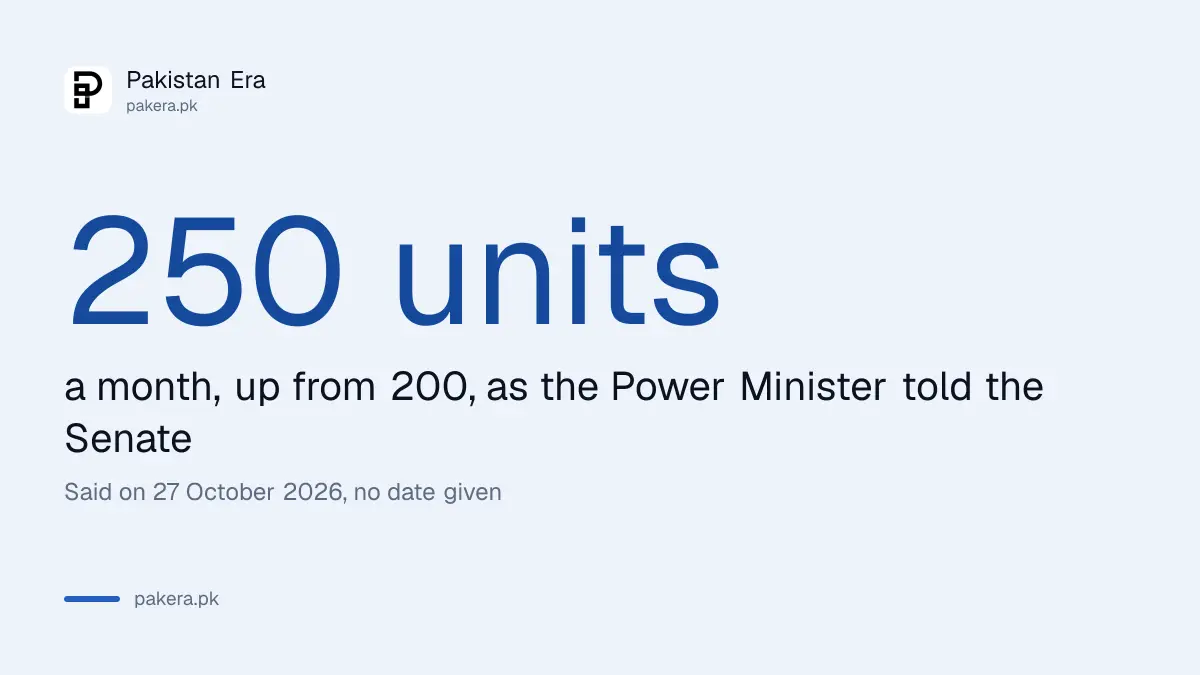
Short answer: the government plans to raise the protected electricity consumer limit from 200 units to 250 units a month, Power Minister Sardar Awais Leghari told the Senate on Tuesday 27 October 2026. He gave no date, and nothing has been notified, so your bill still follows the 200 unit limit.
The minister also said a targeted subsidy system for power consumers is coming "soon". Both points came in his reply to a Senate calling attention notice on slab-based billing. Below is what was said, what it would change for a home using 201 to 250 units, and the steps before it reaches a bill.
The minister said protected status will cover up to 250 units
Awais Leghari told the Senate there is a plan to raise the protected consumer threshold to 250 units. Radio Pakistan reported the words "two hundred and fifty units". He did not say when, and did not link it to a budget, a NEPRA decision or the IMF.
The reply answered a calling attention notice from Senator Abid Sher Ali. The Senate's orders of the day for 27 October describe it as drawing attention to "the slab-based incremental electricity tariff and billing practices of DISCOs, which impose an excessive financial burden on consumers". A calling attention notice lets a member raise an urgent matter and get a minister's answer in the House. It does not change any law or tariff by itself.
| What the minister said on 27 October | Detail given |
|---|---|
| Protected limit to rise to 250 units | Described as a plan, no date |
| Targeted subsidy system for power consumers | To be introduced "soon" |
| Power sector circular debt | Down to around Rs 1.6 trillion over two and a half years |
Today a home loses protection above 200 units
As the rule is applied on bills today, a household is protected only if it used 200 units or less a month, and the status depends on the previous six months. Protected homes pay much lower rates on their first 200 units than everyone else.
The trouble is the cliff at 201. One hot month at 201 units, a few guests, or a late meter reading can push a family out. Under the rule as applied, the higher rates then last for that month and the next five. We set out that six month penalty, and a Power Division idea to soften it, in our September report on the 200 unit rule.
A late reading is not always your loss. NEPRA's Consumer Service Manual pro-rates a billing cycle that runs long, and its own example turns 208 units over 33 days into 189 units for a 30 day month. That is explained in how NEPRA's pro-rata slab rule works.
Homes using 201 to 250 units would gain the most
Raising the limit to 250 units would bring households that sit just above 200 units into the protected group. These are often small families with one fan, a fridge and a water pump in summer. They would pay protected rates instead of unprotected ones.
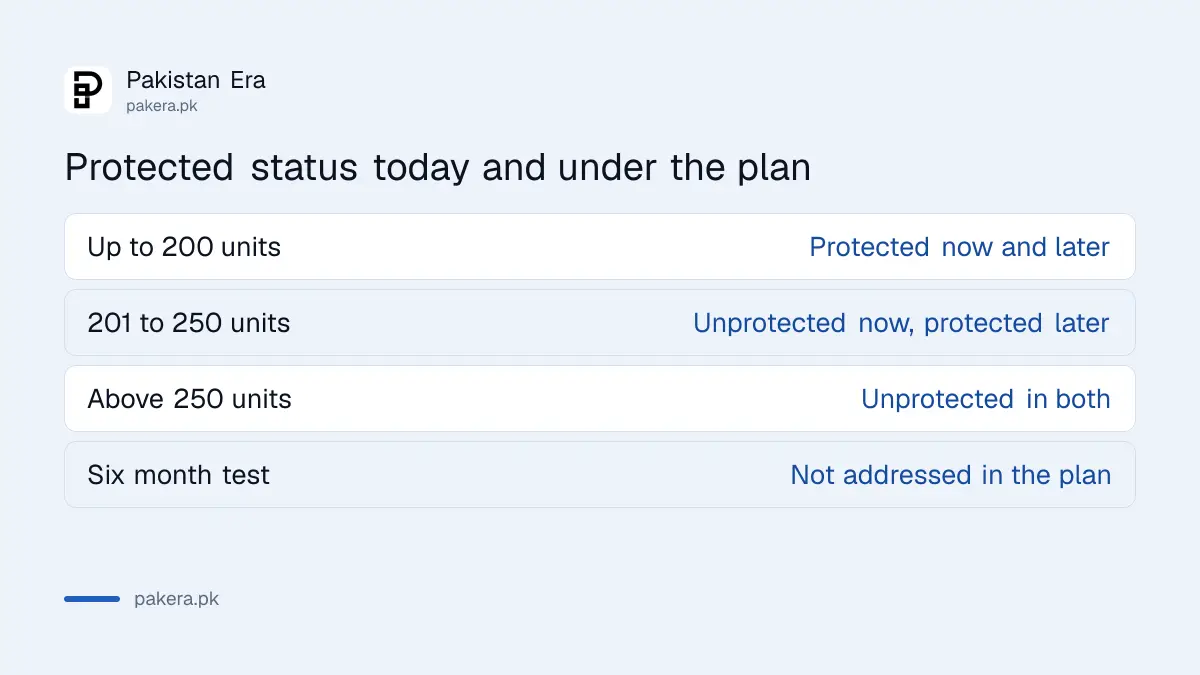
| Monthly use | Today | If the 250 unit plan is notified |
|---|---|---|
| Up to 200 units, six months running | Protected | Protected |
| 201 to 250 units | Not protected | Protected, if the six month test carries over |
| Above 250 units | Not protected | Not protected |
Two things are unknown. The minister did not say whether the six month test stays. And he did not say whether the protected rates for the new 201 to 250 band would match today's protected slabs. Until the Power Division publishes the plan, any rupee saving is a guess, so we have not printed one. Today's slab rates are in electricity unit prices for homes in 2026.
A targeted subsidy is due before the limit changes anything
The minister also said the government will soon introduce a targeted subsidy for power consumers. Under the IMF programme, Pakistan has committed to replace slab subsidies with support paid through BISP by the end of January 2027.
That matters for the 250 unit plan. If the subsidy moves to BISP, protected status may stop being the main way poorer homes get cheaper power. The two plans could work together, or one could replace the other. Officials have not said which. The background is in Pakistan's move to BISP-based electricity subsidy.
The plan still needs approval and a NEPRA notification
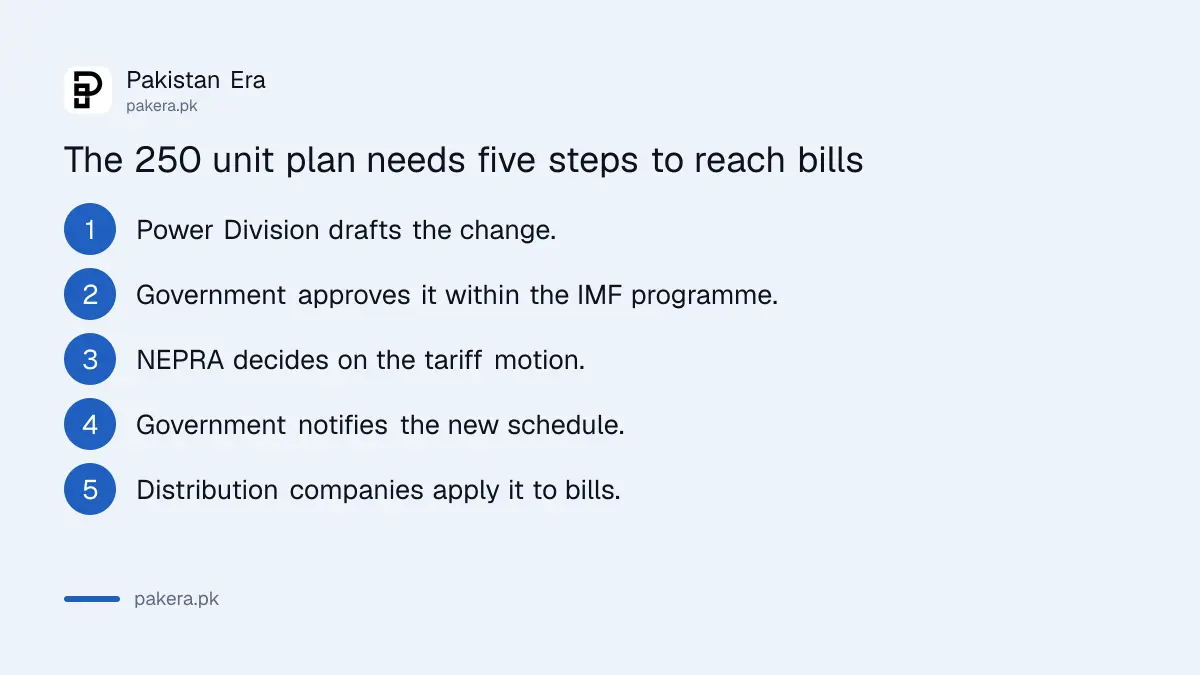
A statement in the Senate is the first stage, not the last. Electricity tariffs reach your bill only after the government's decision, a NEPRA determination and a federal notification. The six month rule proposal from September has not passed those stages either.
- The Power Division drafts the change and its cost.
- The government agrees it, and it has to fit the IMF programme.
- NEPRA decides on the tariff motion.
- The federal government notifies the new schedule.
- Distribution companies apply it to bills.
Until step 5, keep watching your units. If you are near 200, the old limit is the one that counts.
The circular debt figure does not match December's
The minister said power sector circular debt has fallen to around Rs 1.6 trillion over the past two and a half years. The Finance Division's own figure for power circular debt at December 2025 was Rs 1.36 trillion, as we reported in our circular debt report.
The minister gave a round number with no date, so the two may measure different months. We could not find a newer official figure. Circular debt is the unpaid bills that pile up between power companies and the government. It matters to you because it is paid off through surcharges on bills.
Common questions
Has the protected electricity limit changed to 250 units?
No. The Power Minister told the Senate on 27 October 2026 that there is a plan. Nothing has been notified, so 200 units still applies.
Who is a protected electricity consumer now?
A household using 200 units or less a month, with the status based on the previous six months as the rule is applied on bills.
When will the 250 unit limit start?
No date was given. It needs government approval, a NEPRA decision and a notification first.
Will the six month rule stay if the limit rises?
The minister did not say. The Power Division has not published the plan.
What is the targeted electricity subsidy?
Support aimed at low-income homes, which Pakistan has told the IMF it will pay through BISP by the end of January 2027.
What can I do if a long billing cycle pushed me over 200 units?
Ask your company to pro-rate the bill under NEPRA's Consumer Service Manual. If it refuses, complain to NEPRA.
How we verified this
What we checked, where we read it, and what we could not confirm.
We read on 28 October 2026 Radio Pakistan's report of the Senate sitting of 27 October, which carries the minister's words on the 250 unit plan, the targeted subsidy and the circular debt, and the Senate of Pakistan orders of the day for 27 October 2026, which give the calling attention notice. The Senate's written answers for that day are scanned and do not include this reply. The description of today's 200 unit rule, the NEPRA pro-rata example, the BISP commitment and the December 2025 circular debt figure come from our earlier reports, which read NEPRA, the IMF and the Finance Division. We could not verify a date for the 250 unit plan, whether the six month test stays, or the rates that would apply. NEPRA's website refused our requests on 28 October.
About the author

Global Affairs & Political Economy Writer
Muhammad Hatim is a book lover who started writing because he enjoys it. At Pakistan Era he writes about international relations, geopolitics and the global economy, with a particular interest in South Asia and the forces behind current events.