Pakistan’s Circular Debt Is Rs 3.38 Trillion: Power Rs 1.36 Trillion and Gas Rs 2.02 Trillion at December 2025
Pakistan circular debt was Rs 3,381.8 billion at December 2025: power Rs 1,360.9 billion and gas Rs 2,020.9 billion. We read the Finance Division report .
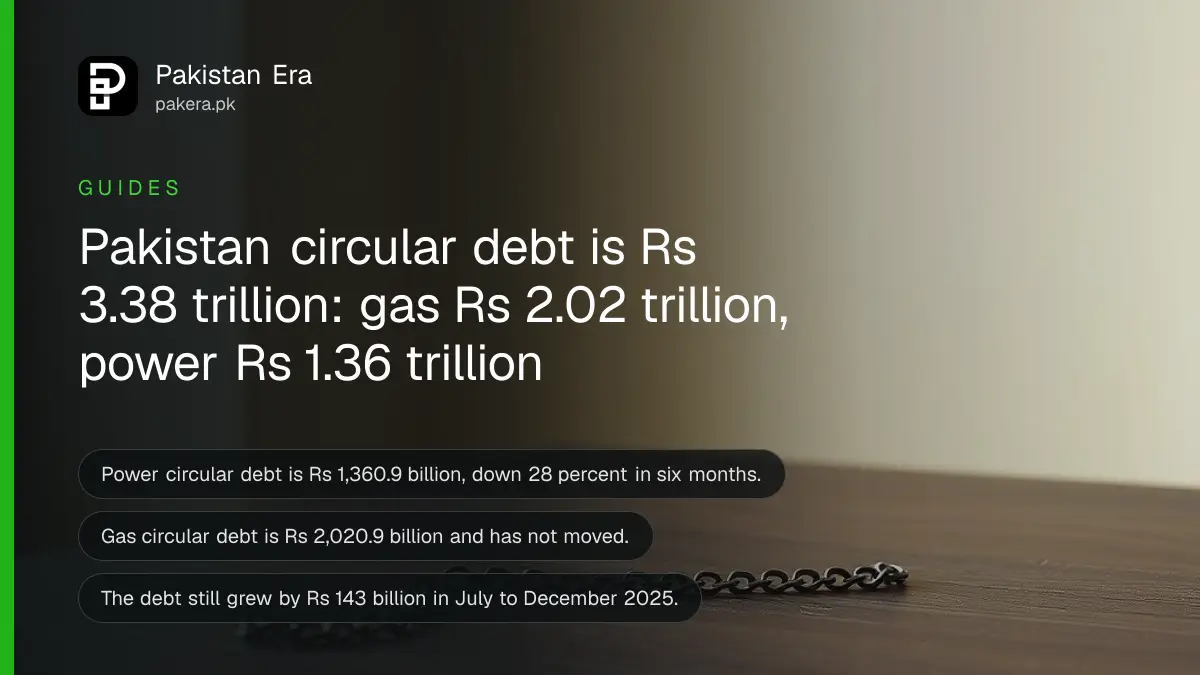
Pakistan's combined circular debt was Rs 3,381.8 billion, about Rs 3.38 trillion, at the end of December 2025. Power accounted for Rs 1,360.9 billion and gas for Rs 2,020.9 billion, says the Finance Division's report on state-owned companies. That is 14 percent lower than the Rs 3,929 billion at June 2025, but the debt kept growing inside the six months.
Circular debt is a chain of unpaid bills. The people who pay late are not the ones who are owed. This page sets out the three totals in the report, why they differ, and what the chain means for a household bill. We downloaded and read the report on 13 October 2026.
The report gives three totals, and each counts something different
The main total is Rs 3,381.8 billion on an accounting basis called IFRS, which leaves out the late payment surcharge on gas. The power part is Rs 1,360.9 billion and the gas part is Rs 2,020.9 billion. A wider "gross" total is about Rs 4,900 billion.
| Measure | Amount, Rs billion | What it counts |
|---|---|---|
| Power sector circular debt | 1,360.9 | Unpaid dues to power producers plus the restructuring loan drawn |
| Gas sector circular debt | 2,020.9 | Gas sector payables of SNGPL and SSGC |
| Total on IFRS basis | 3,381.8 | Power plus gas, without the gas late payment surcharge |
| Gross total (approx.) | 4,900 | Adds about Rs 1,100 billion of late payment surcharge and counts power dues gross |
The gross figure in the report is built from four parts: about Rs 1,100 billion owed to power producers, Rs 694 billion of restructuring loan drawn, Rs 2,000 billion of gas payables and Rs 1,100 billion of late payment surcharge. These are the report's own rounded numbers.
Other offices give other totals, each with its own date and definition. Before comparing two figures, check the date and the definition first. This report uses 31 December 2025.
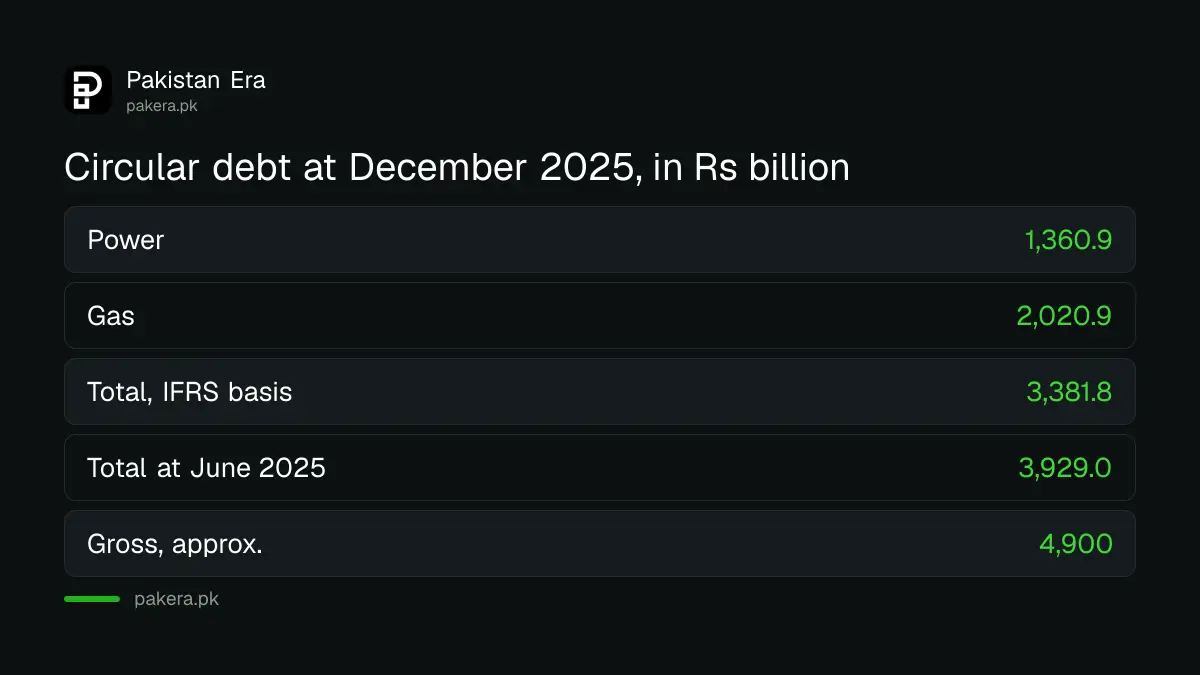
Power circular debt stands at Rs 1.36 trillion
The power figure has two parts. Rs 666.4 billion is owed to power producers and other market participants. Rs 694.5 billion is the part of a Rs 1,200 billion bank facility that has been drawn under the debt restructuring.
The report says the restructured debt is serviced through the Debt Servicing Surcharge (DSS). We understand the DSS to be a charge collected through electricity bills, but the report names it without giving a rate, so check your own bill. To see what else is on your bill, read the electricity slab rates and fixed charges for 2026.
Power circular debt fell 28 percent, from Rs 1,889.9 billion at June 2025. The main reason is the one-off equity injection of Rs 224.6 billion, which the report says went largely to clearing payments to independent power producers.
Gas circular debt is larger than power and has not moved
Gas sector payables are Rs 2,020.9 billion. Of this, SNGPL carries Rs 1,178.3 billion and SSGC carries Rs 842.6 billion. The report describes the gas figure as stable at about Rs 2,000 billion against June 2025.
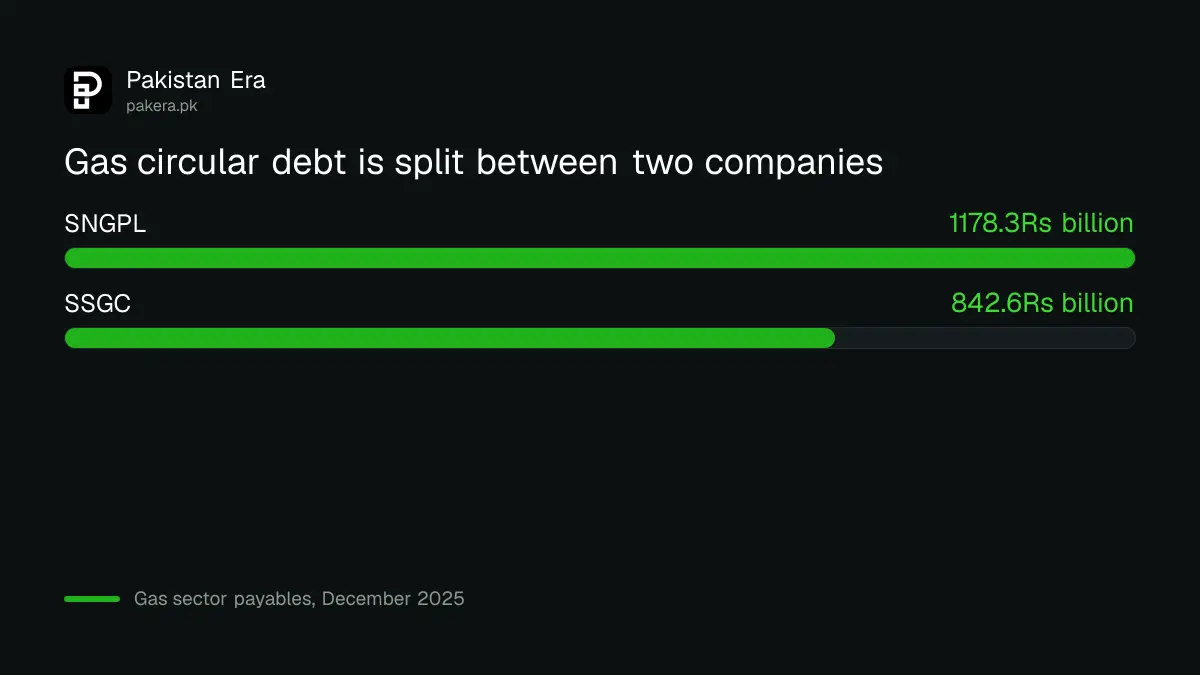
These are amounts that the two gas companies cannot pay on time. A gas bill itself does not show them. If you want to understand your own gas bill, read how to read your SSGC gas bill and the Sui gas winter slabs.
The stock fell on paper, but the debt kept flowing
The report says circular debt still rose by Rs 143 billion in July to December 2025, even with the restructuring. It puts the gross flow at Rs 374 billion on the Power Division's numbers. Rs 112 billion came from distribution company inefficiencies and another Rs 31 billion from under-recoveries.
In plain words, the stock fell because payments were made. The flow did not stop. The report says the continued build-up "signals that the underlying cash flow deficit within the power sector remains unresolved". The IMF makes the same point from outside when it asks for timely tariff changes, in the staff-level agreement on the 1.2 billion dollar tranche.
The wider state-company picture is in what the state companies owe.
How to check the circular debt numbers yourself
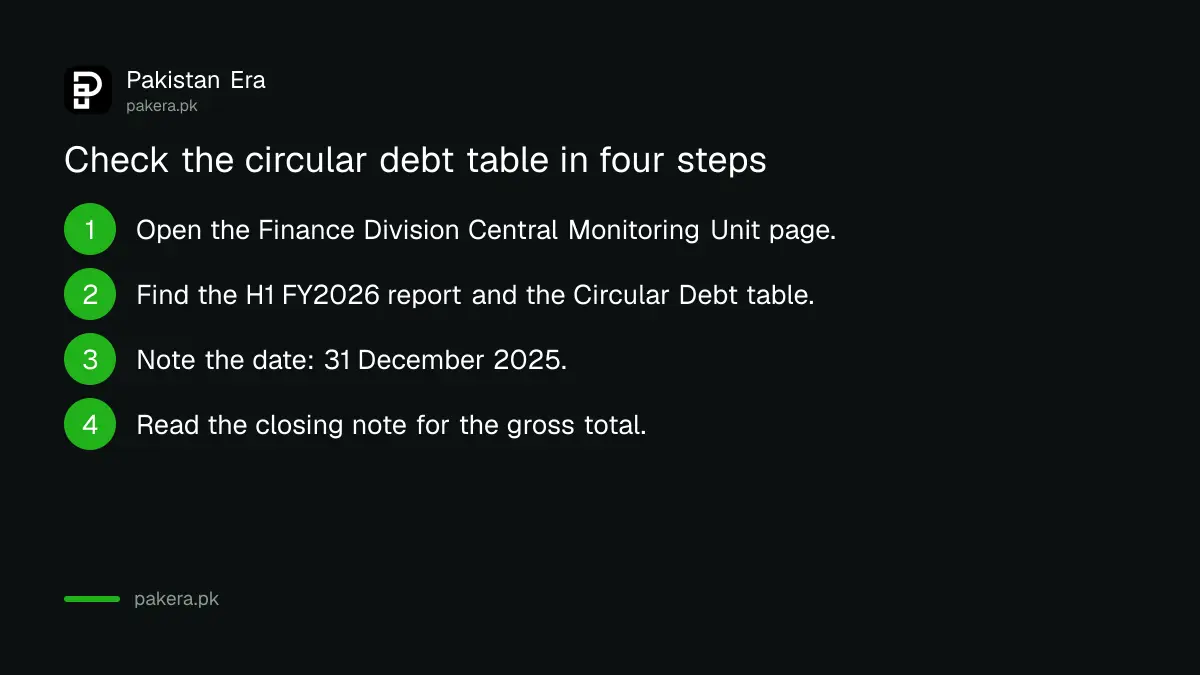
- Open the Finance Division Central Monitoring Unit page and find the bi-annual report for H1 FY2026.
- Go to the "Circular Debt" table in Part II and read the power and gas lines.
- Note the date at the top. This table is at 31 December 2025, not today.
- Read the closing note under the table for the gross total of about Rs 4,900 billion.
Common questions
What is circular debt in Pakistan in simple words?
It is a chain of unpaid dues in the power and gas sectors. Consumers or distribution companies pay late, so producers and fuel suppliers are not paid in full.
How big is Pakistan’s circular debt?
The Finance Division report puts it at Rs 3,381.8 billion at 31 December 2025, with power at Rs 1,360.9 billion and gas at Rs 2,020.9 billion.
Why does the report also say Rs 4,900 billion?
That gross figure adds about Rs 1,100 billion of late payment surcharge and counts power dues without the restructuring offset.
Did circular debt fall in 2025?
The stock fell 14 percent from June to December 2025, but the report says it still grew by Rs 143 billion inside the six months.
Does circular debt affect my electricity bill?
The report names a Debt Servicing Surcharge for restructured power debt. Check your bill for the line and read NEPRA notices for changes.
Is this the latest circular debt figure?
It is the latest in this report, dated 31 December 2025. Later figures may exist elsewhere with a different date and definition.
How we verified this
What we checked, where we read it, and what we could not confirm.
Last checked on 13 October 2026, Pakistan time. We read the Finance Division Central Monitoring Unit's bi-annual report on federal state-owned enterprises for July to December 2025, including the executive summary, the circular debt table and the fiscal risk section. The report is dated 2 June 2026 and was posted in October. We did not compare it with other offices' totals, so we do not say which is right.
About the author

Global Affairs & Political Economy Writer
Muhammad Hatim is a book lover who started writing because he enjoys it. At Pakistan Era he writes about international relations, geopolitics and the global economy, with a particular interest in South Asia and the forces behind current events.