How PSX Circuit Breakers and Trading Halts Work in Pakistan
How PSX circuit breakers and market-wide trading halts work: the percentage limits, which index triggers a halt, and what happens to your pending order.
A circuit breaker at the Pakistan Stock Exchange is a price limit that stops a single stock moving further in one direction for the day. A market-wide trading halt is different and bigger: it freezes every stock at once when the KSE-30 index swings by roughly 5% and holds there for about five minutes. One protects a single scrip. The other protects the whole exchange.
People mix the two up constantly, and reasonably so, because both get called a "circuit breaker" in everyday conversation. We could not pull the exact current percentage figures directly off psx.com.pk's own rule text on 4 October 2026, since the page we found pointed to a live data table rather than the written regulation, and a PDF we tried came back unreadable. What follows is reported, drawn from multiple consistent accounts of PSX's own published rules, and you should treat any exact percentage as something to confirm on the day, since PSX has changed these numbers before.
Here is why it is worth understanding regardless of the exact number. If you have ever placed an order on the Pakistan Stock Exchange and watched it sit unfilled while the whole market froze, a circuit breaker or a trading halt is almost certainly why.
A scrip-level circuit breaker limits one stock, not the market
A scrip-level circuit breaker caps how far a single stock's price can move, up or down, from its previous close in one trading day. Once a stock hits that limit, it stops trading in that direction, but every other stock on the exchange keeps trading normally.
Reported figures put the standard scrip-level limit at around 5%, with PSX allowed to widen it by small steps, about 0.5% every 15 days, up to a reported cap near 7.5%. Exchange-traded funds are reported to carry a separate, slightly wider band of around 7%. We did not confirm these exact figures on PSX's own rule text, so check the live limit shown against any stock you hold before assuming it. When we read PSX's data portal on 8 October 2026, the band shown for UBL, FFC, PSO and Lotte Chemical was exactly 10% either side of the previous close, and a share priced near Rs 5 showed a band of Rs 1 either way. So the live band can be wider than the reported 5%.
What this means in practice: a stock that opens sharply lower on bad news can hit its lower limit within minutes and simply stop trading for the rest of the day. Your sell order sits in the queue, unfilled, until the next session.
| Mechanism | What it affects | Rest of the market |
|---|---|---|
| Scrip-level circuit breaker | One stock's price band for the day | Keeps trading normally |
| Market-wide trading halt | Every listed security at once | Fully paused |
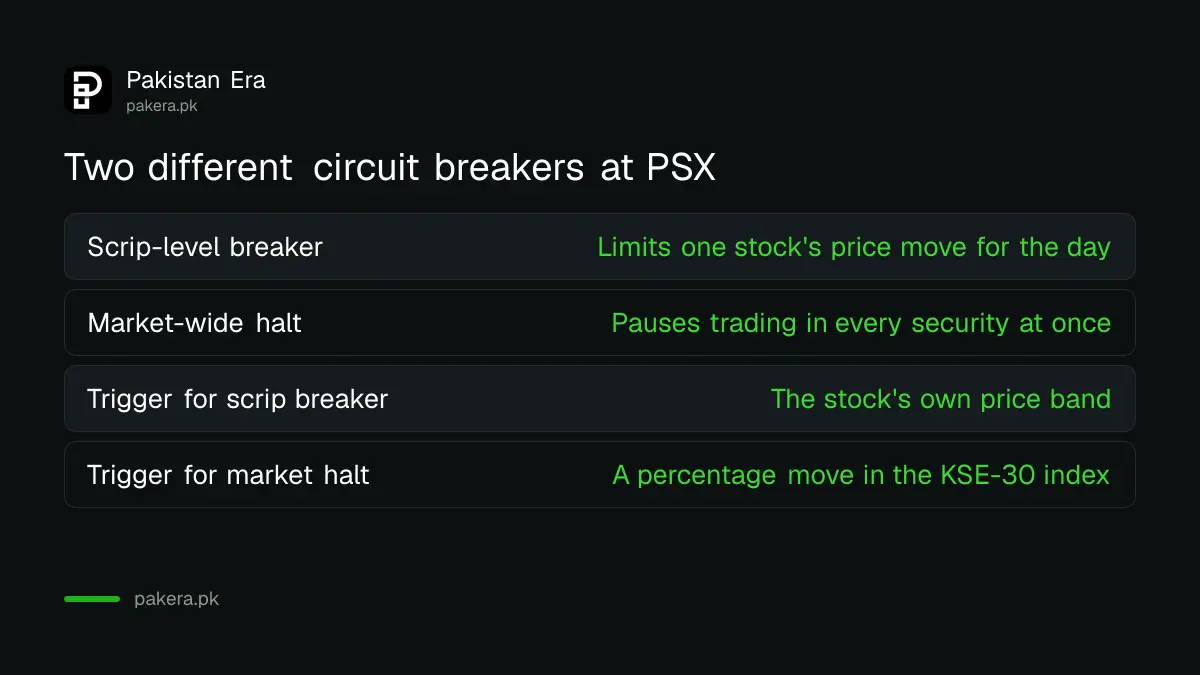
A market-wide halt freezes the entire exchange on an index move
A market-wide trading halt is a single switch that stops trading across every security on PSX at once, triggered when the KSE-30 index moves by a reported threshold of around 5% and the move holds for roughly five consecutive minutes, not just a brief touch.
This mechanism was reported to have been introduced into PSX's regulations around December 2019, after SECP approval, as a direct response to volatile sessions where individual scrip limits were not enough to calm the whole market. The idea is to force a pause so everyone, brokers included, can reassess rather than keep selling into a falling market.
We saw this play out in reported incidents during sharp market swings in 2020, where PSX suspended trading after the KSE-30 opened or fell several percentage points in a single session. The pattern reported each time was the same: a percentage move on KSE-30, a short hold at that level, then a full halt.
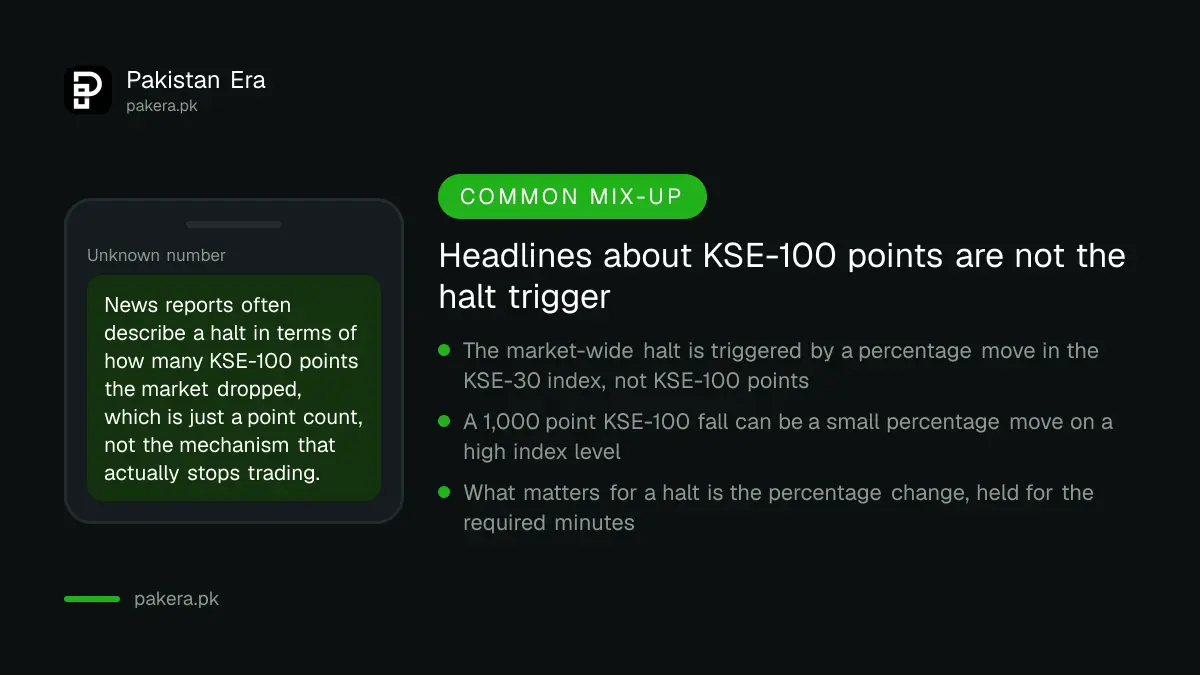
Why the KSE-30, not the KSE-100, decides a halt
PSX's market-wide halt mechanism is reported to run off the KSE-30 index specifically, a smaller index of thirty large, liquid stocks, rather than the more widely quoted KSE-100. This surprises a lot of people, since news coverage almost always leads with KSE-100 point drops.
A KSE-100 point figure on its own does not tell you whether a halt is coming. A 1,500 point fall sounds dramatic, but as a percentage of an index trading above 100,000 points, it may be well under the threshold that actually triggers anything. The KSE-30's percentage move is what the mechanism watches, not the point count on the headline index.
So if you are trying to judge whether trading might pause, watch the percentage change on KSE-30 during a fast-moving session, not the raw point drop reported for KSE-100.
Anyone new to the exchange tends to assume a frozen screen means something is broken. It usually just means the index crossed its threshold, which is worth knowing before you ever place your first order while opening a trading account on PSX.
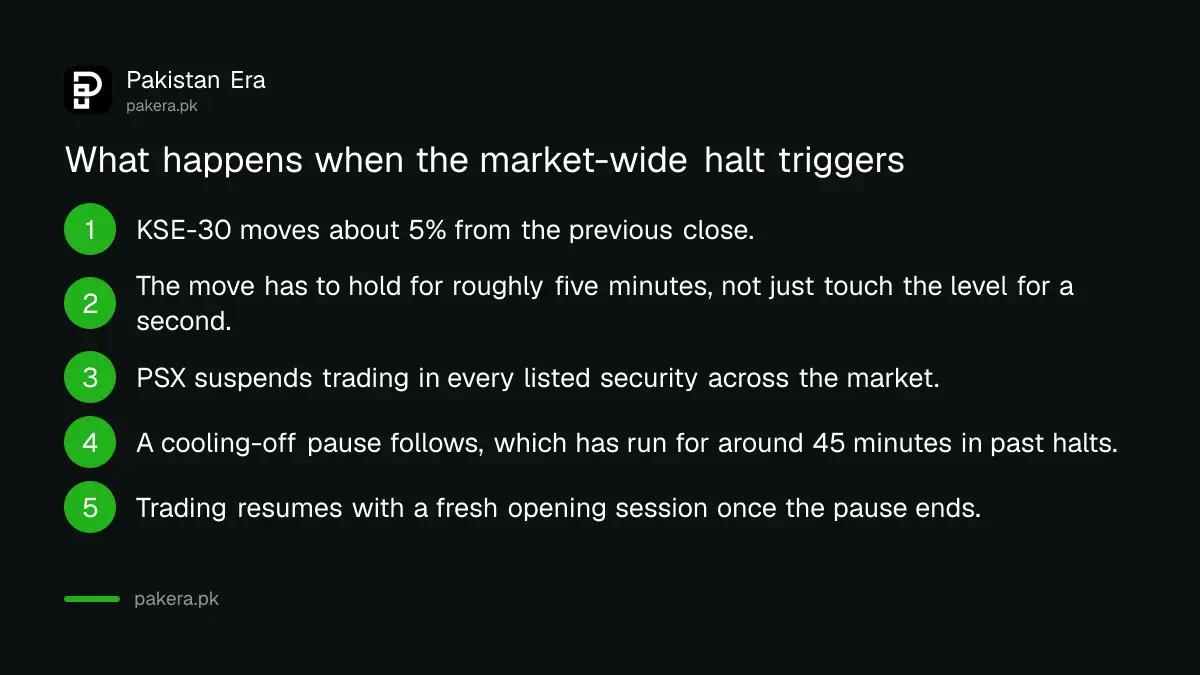
What actually happens once a halt is triggered
Once the market-wide halt triggers, PSX stops matching trades across the board, and reported accounts of past halts describe a cooling-off pause of around 45 minutes before a fresh opening session begins.
- The KSE-30 index crosses the threshold and holds there for the required few minutes rather than briefly touching it.
- PSX suspends all trading across every listed security, not just the stocks that were falling.
- A pause follows, reported at around 45 minutes in several past halts, intended as a cooling-off period.
- Risk teams and brokers use the pause to run mark-to-market checks on client positions.
- Trading resumes with a new opening session, which can itself move sharply as pent-up orders are matched.
Your pending order does not vanish during a halt
A trading halt pauses matching, it does not cancel orders already sitting in the system. An order you placed before the halt is usually still there when trading resumes, unless you cancel it yourself or it was set to expire that same session.
What you cannot do during a halt is place a new trade, cancel an existing one through most broker platforms, or get a live price quote that means anything, since nothing is actually matching. If your broker's app shows a price during a halt, treat it as the last traded price, not a current one.
This is also a moment where a slow or unresponsive broker becomes a real problem rather than an annoyance. If you have ever needed to escalate a dispute with a brokerage over how an order was or was not handled, the process for a stockbroker complaint runs through PSX and SECP, separate from the halt mechanism itself.
The same caution applies around a public offering. If a company's shares are freshly listed and volatile in their first sessions, the circuit breaker is one of the few things standing between a rough opening day and a halted one, which is worth knowing before you ever apply for an IPO on PSX.
Common questions
What triggers a PSX circuit breaker on a single stock?
A single stock hits its circuit breaker when its price moves by its allowed daily band from the previous close, reported at around 5% rising to near 7.5% over time, although PSX's data portal showed 10% bands on several large shares on 8 October 2026. It then cannot trade further in that direction for the day.
What triggers a market-wide trading halt at PSX?
A reported move of around 5% in the KSE-30 index, held for roughly five minutes, which pauses trading in every security at once rather than just one stock.
Does a circuit breaker on one stock affect the rest of the market?
No. A scrip-level circuit breaker only stops that one stock from trading further. Every other listed security keeps trading normally.
How long does a PSX market-wide halt usually last?
Reported accounts of past halts describe a cooling-off pause of around 45 minutes before a fresh opening session starts, though this is not something we confirmed as a fixed rule on PSX's own page.
Is the KSE-100 or the KSE-30 used to trigger a trading halt?
The KSE-30 index is reported to be the trigger for PSX's market-wide halt mechanism, not the more commonly quoted KSE-100.
What happens to my order when trading halts?
An order already placed generally stays in the system through the pause. You cannot place new orders or get a live price while trading is halted.
How we verified this
What we checked, where we read it, and what we could not confirm.
Last checked on 4 October 2026. We attempted to read PSX's own circuit breaker and regulation pages directly on psx.com.pk and dps.psx.com.pk; the live circuit breaker table loaded but did not state the underlying rule text, the regulations page returned a 404, and a PDF attachment came back as unreadable binary data rather than text. The percentages and timings in this article are reported figures, drawn from multiple consistent secondary accounts of PSX's SECP-approved rules, rather than confirmed firsthand on PSX's own written rule book on this date. Readers should check the live limit PSX displays for any stock before trading on it.
About the author

Tax, Bills and Technology Writer
Ali Akhtar is a young and curious voice here at Pakistan Era. He is currently pursuing his A-Levels and has a growing interest in Pakistan’s changing industrial landscape and educational trends. Ali likes to write in a way that helps him explain and explore the world around him. His writing reflects the perspective of the new generation navigating the evolving trends of Pakistan where technology, youth innovation, and shifting opportunities are reshaping the country’s future.