Register Foreign Shareholders' Shares as Repatriable in Pakistan: Your Bank Now Does It, Not the State Bank
Since 25 June 2026 a Pakistani company registers foreign investors' shares as repatriable through its bank. See the documents, the 60 day deadline and steps.

Short answer: Since 25 June 2026, a Pakistani company registers shares held by foreign investors as repatriable through its own bank, not through the State Bank. The company picks a bank to act as its designated authorised dealer, gives it the proceeds certificates and a signed undertaking, and applies within 60 days of issuing the shares. That bank then also sends the dividends abroad.
A software company in Karachi takes equity from a Singapore fund. The fund wants to know one thing: can it send its dividends home later? The answer depends on one piece of paper, the registration of its shares on a repatriable basis. Until this year the State Bank issued that paper. Now a commercial bank does.
We read the State Bank's FE Circular No. 02 of 2026 and its two annexures on sbp.org.pk on 12 October 2026. The rule is written for banks, but the work falls on the company secretary, so this page is written for them.
Banks now register foreign shares, and SBP only gets a copy
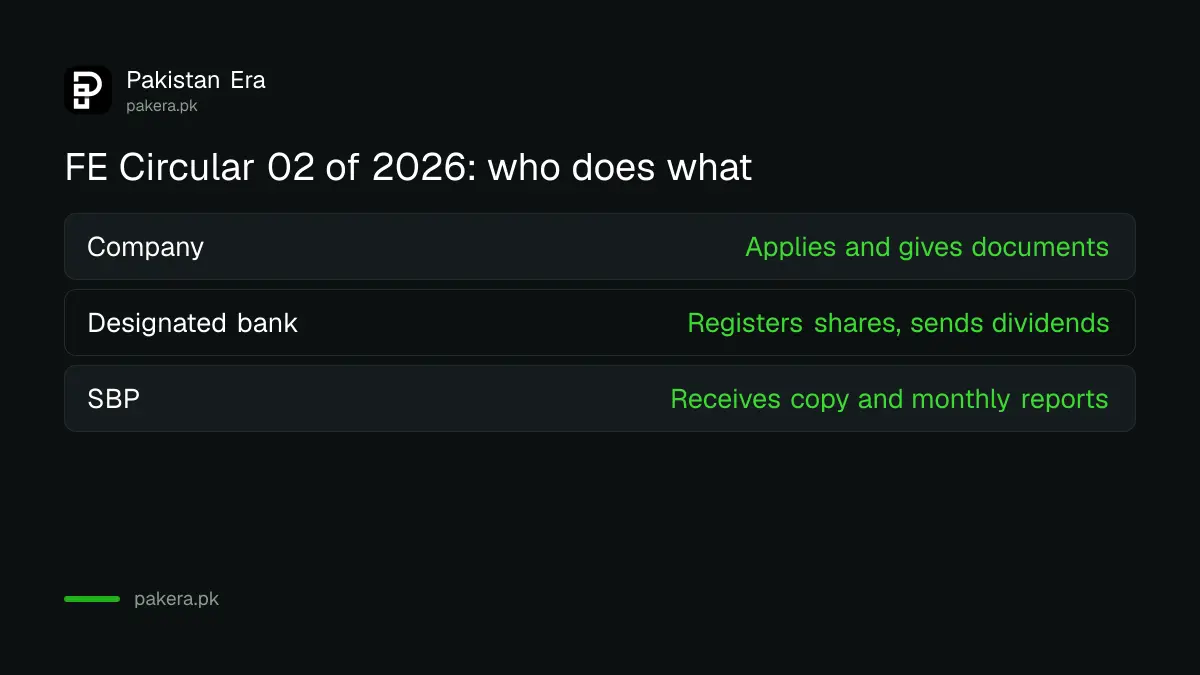
FE Circular No. 02, dated 25 May 2026, delegates two functions to authorised dealers, which are the banks licensed to deal in foreign exchange. One is registering shares and fund units issued or transferred to non-residents on a repatriable basis. The other is designating the bank that will send dividends and sale proceeds abroad.
The circular says the aim is to promote ease of doing business and to facilitate foreign investors. It also simplifies the documents. The instructions took effect one month after issue, which is 25 June 2026.
The company picks one designated bank and that bank handles everything
The company asks an authorised dealer of its choice to act as its designated bank. That bank becomes the only one that can register the company's shares for foreigners and send dividends and disinvestment proceeds abroad.
| Situation | What the company does |
|---|---|
| A bank is already designated by SBP | Nothing new. That bank now also registers the shares. |
| No bank designated yet | Asks a bank of its choice, with a company secretary's undertaking that it has never designated a bank, registered shares on this basis or sent dividends abroad. |
| Wants to change its designated bank | Gives the new bank a board approval, the old designation letter and a no objection certificate from the old bank's registration unit. |
The bank issues a designation letter and sends a copy to the State Bank's Exchange Policy Department within three working days. The registration itself is done by a central unit at the bank's head office, headed by an officer of at least Senior Vice President rank. No branch can do it.
What the company submits for registration
The documents depend on how the shares were issued. The circular's list is a minimum, and the bank may ask for more. Every proceeds realisation certificate, certificate of deposit or exchange entitlement certificate can be used once only.
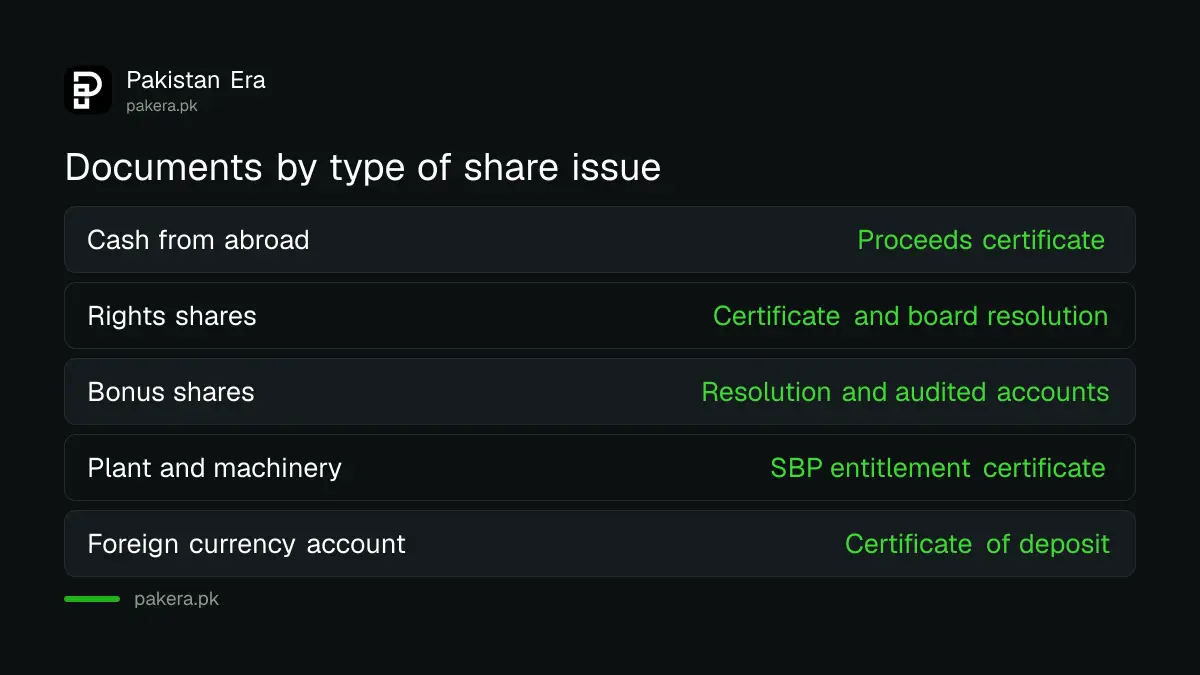
- Public offer, private placement against equity brought in, or fund units: the bank's proceeds realisation certificates.
- Rights shares: the certificates and a board resolution.
- Bonus shares: a board resolution and the audited accounts for the year.
- Shares issued against plant and machinery: an exchange entitlement certificate from the State Bank's Foreign Exchange Operations Department.
- Shares issued against a foreign currency account: a certificate of deposit from the bank holding the account.
- Transfer of unlisted shares: an auditor's certificate of break-up value, accounts, the agreed sale price and certificates for the cost.
For every case the company also gives an undertaking, signed by its company secretary, that no resident Pakistani is included, directly or indirectly, in the beneficial ownership of the foreign investor. Where it applies, it must also give a certificate from the FBR Commissioner under Rule 19H of the Income Tax Rules, as notified in SRO 776(I)/2023.
How to register the shares in six steps
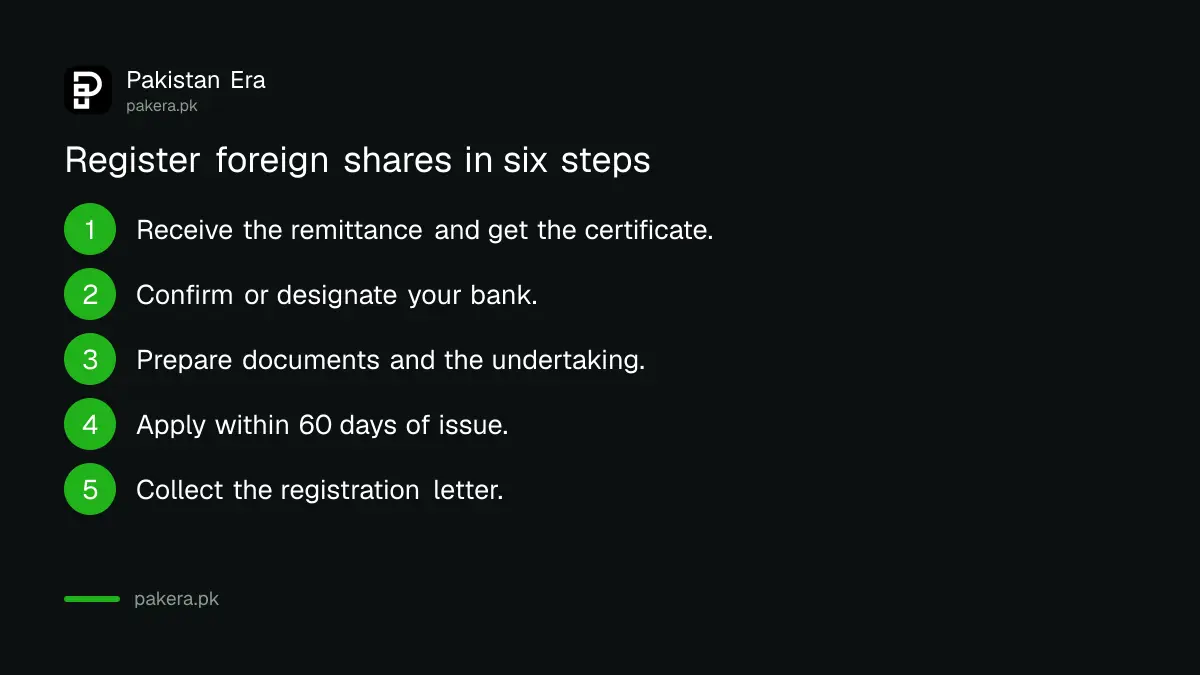
The order matters. The bank advises the company to start registration after it receives the foreign money and issues the certificate. The circular sets 60 days from the issue or transfer of the shares.
- Receive the foreign remittance through a bank and get the proceeds realisation certificate or certificate of deposit.
- Confirm which bank is your designated bank, or designate one.
- Prepare the documents for your type of issue, plus the secretary's undertaking and any FBR certificate.
- Apply to the designated bank's central unit within 60 days of issuing or transferring the shares.
- Collect the registration letter. The shares are recorded at the foreigner's overseas address.
- Send the bank an update of share registrations in favour of non-residents within 30 days of the letter.
The registration letter carries a condition. If it later turns out that a resident Pakistani owns the foreign entity, directly or indirectly, the registration is void and the company must bring back any dividends already sent. Where a person of Pakistani origin or a non-resident Pakistani holds a stake, the bank asks for an undertaking and proof that the stake came from earnings abroad.
Dividends can be sent abroad without asking the State Bank
Once the bank is designated, it can allow dividend remittance to non-resident shareholders without the State Bank's prior approval. The bank must check three things first. Shares are held by non-residents other than Indian nationals under the State Bank's permission and registered at foreign addresses. They were not acquired on an undertaking not to claim dividends. The amount applied for is net of Pakistan tax, supported by an auditor's certificate from a well-known firm.
A company can also ask the bank to release unutilised proceeds. That is money a foreign investor sent for shares but which was not used after allotment. The bank may allow its use for more shares, or its return, on documentary proof that it was not used.
The shares are one side of the picture. A foreign investor also needs an account at home. The value accounts open to non-residents are covered separately. The size of the inflow is in the report on foreign investment in July and August 2026.
Banks must report every registration to the State Bank each month
FE Circular No. 03 of 2026, issued the same day, set up the Non-Resident Shareholding Registration System. Banks must report designations, share registrations, dividend repatriation and disinvestment every month, by the fifth working day of the next month. The first report covered July 2026.
For the company this means a clean paper trail. Anything the bank registers, and every dividend it sends, ends up in a State Bank record, and the national totals appear in the data explained in how to check inflation, reserves and remittances on official pages. The circular also gives banks phased deadlines to report older dividend and disinvestment data back to 2006.
Common questions
Does the State Bank still register foreign shares?
Not directly. FE Circular No. 02 of 2026 delegates registration to authorised dealer banks. The bank sends the State Bank a copy of each designation letter within three working days.
How long does the company have to apply for registration?
The company should start registration with its designated bank within 60 days after the shares are issued or transferred.
Can a company use a different bank for each foreign investor?
No. A company has one designated bank, which is the sole bank authorised to register its shares for non-residents and send dividends abroad.
Can Indian nationals get dividends through this route?
The circular's dividend conditions refer to non-residents other than Indian nationals. Ask the designated bank about any specific case.
What happens if a resident turns out to own the foreign investor?
The registration becomes null and void, and the company must bring back any dividends or proceeds already sent abroad.
Who signs the undertaking about resident owners?
The company secretary signs it. It states that no resident Pakistani is included, directly or indirectly, in the beneficial ownership of the foreign investor.
How we verified this
What we checked, where we read it, and what we could not confirm.
We read the State Bank of Pakistan's FE Circular No. 02 of 25 May 2026 with its Annexure A and Annexure B, and FE Circular No. 03 of 25 May 2026, on 12 October 2026. We did not read any single bank's own procedure, so confirm timelines and fees with your designated bank.
About the author

Global Affairs & Political Economy Writer
Muhammad Hatim is a book lover who started writing because he enjoys it. At Pakistan Era he writes about international relations, geopolitics and the global economy, with a particular interest in South Asia and the forces behind current events.