Open an FCVA or NRVA Account in Pakistan as a Non-Resident: SBP Rules for Foreign Currency and Rupee Value Accounts
SBP widened FCVA and NRVA accounts on 24 March 2026 to all non-residents. See who qualifies, what the accounts can buy and the 3 year rule on property gains.
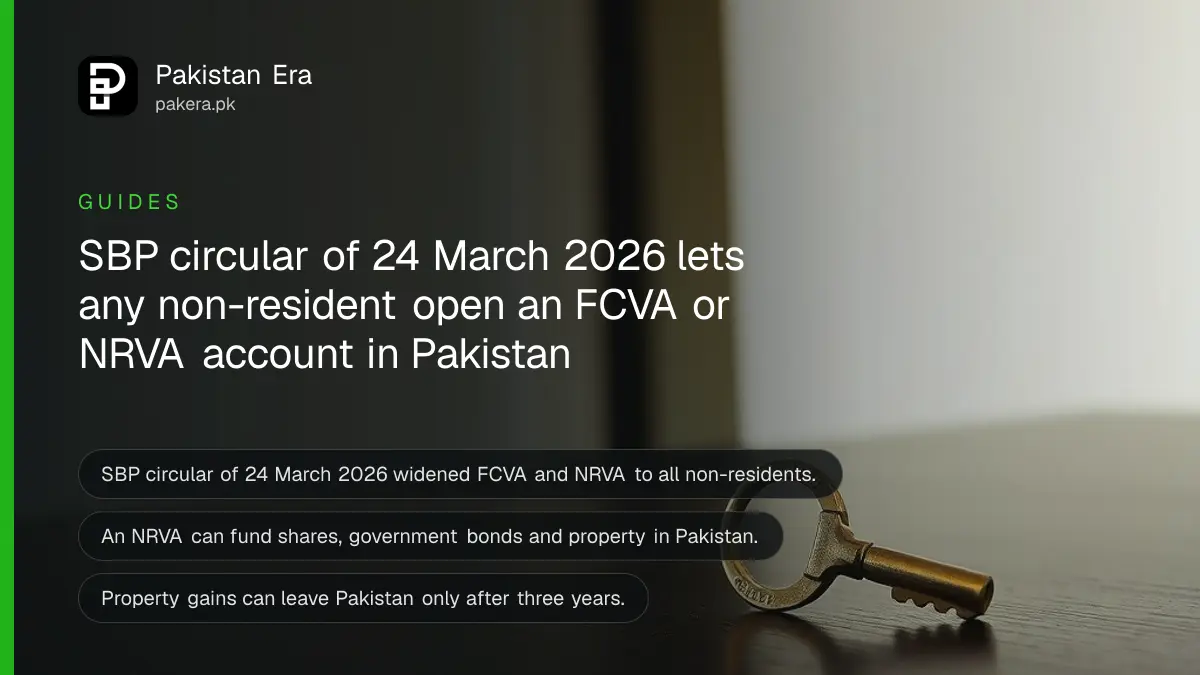
Short answer: Under a State Bank circular dated 24 March 2026, any non-resident person under the Income Tax Ordinance can ask a Pakistani bank for a Foreign Currency Value Account (FCVA) or a Non-Resident Pakistani Rupee Value Account (NRVA). Individuals open FCVA or NRVA. Companies and trusts open the business versions, FCBVA and NRBVA. The circular does not list documents, so ask your bank for its checklist. A resident Pakistani with foreign assets must also show the latest FBR wealth statement.
A Pakistani engineer in Dubai wants one account that takes his salary in dollars and lets him buy a plot in Lahore. A British investor of Pakistani origin wants the same, with a bank card that works on both sides of the border. Until this year the State Bank's rules were narrow on who could open such accounts. EPD Circular Letter No. 05, dated 24 March 2026, widened them.
We read the circular and its two annexures on sbp.org.pk on 12 October 2026. The circular is addressed to banks, so the steps below are what a bank must allow. Each bank decides its own forms, minimum balance and which branch handles the account.
Any non-resident under the Income Tax Ordinance can now open these accounts
The circular says all persons, natural or juridical, who fall within the definition of non-resident under the Income Tax Ordinance, 2001, are eligible. That includes non-resident Pakistanis and non-residents who hold a Pakistan Origin Card. The aim stated in the circular is to facilitate foreign investment in Pakistan.
Whether you count as non-resident is a tax question, not a passport question. A Pakistani citizen living abroad can be a non-resident for tax. A foreign national can open the account too. If you are unsure, the steps in filing a tax return as an overseas Pakistani explain how residency is judged.
The four account types and who each one is for
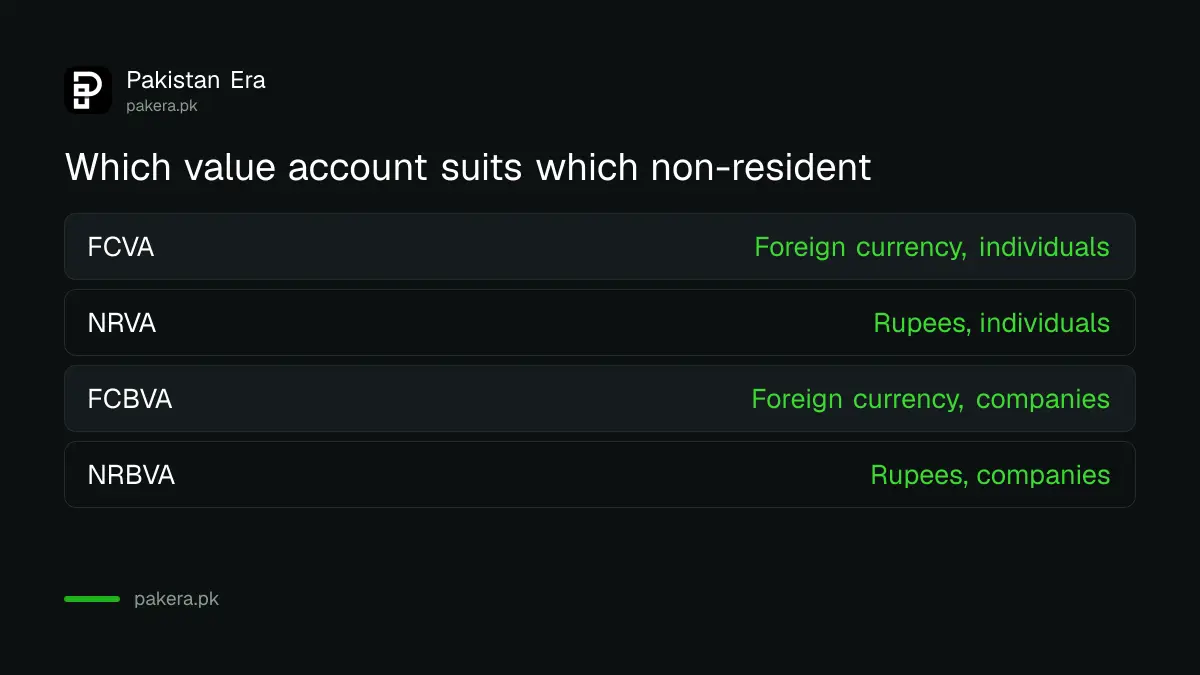
The circular names four accounts. Two are for individuals and two are for companies and similar bodies. The first of each pair is held in foreign currency and the second in Pakistani rupees.
| Account | Currency | Who can open it |
|---|---|---|
| FCVA, Foreign Currency Value Account | Foreign currency | Non-resident individuals, including non-resident Pakistanis and POC holders. Also a resident Pakistani who holds assets abroad declared in the latest FBR wealth statement. |
| NRVA, Non-Resident Pakistani Rupee Value Account | Pakistani rupees | Non-resident individuals |
| FCBVA, Foreign Currency Business Value Account | Foreign currency | Non-resident companies, associations, foundations, LLPs, societies, trusts and waqfs |
| NRBVA, Non-Resident Rupee Business Value Account | Pakistani rupees | The same non-resident bodies |
Sole proprietorships and unregistered partnerships are not eligible for the business versions. A sole trader opens the individual account instead.
What you can put in and take out of an FCVA
Money can enter an FCVA as remittances from abroad through banking channels, as transfers from your own NRVA at the same bank, and as profit or sale proceeds of permitted investments. You can send it back abroad up to the balance without asking the bank or the State Bank first.
The circular also lists what you can do with the money inside Pakistan. You can invest in government debt securities in foreign currency, or in a foreign currency term deposit at the same bank. You can withdraw cash in foreign currency or its rupee equivalent. A rupee payment to a person in Pakistan is allowed, but that money cannot be paid back into the account.
Banks are encouraged to give real-time conversion from foreign currency to rupees on the customer's digital request, and must show the exchange rate used. That makes it worth comparing the bank's rate with the State Bank's own sheet, as shown in the check of the dollar rate you are offered.
An NRVA can buy shares, bonds and property in Pakistan
The rupee account is the investing account. The circular lists the investments an NRVA can fund, provided the relevant law allows them. Each carries its own process in Chapter 20 of the Foreign Exchange Manual.
- Government of Pakistan debt securities such as T-bills, PIBs and sukuk.
- Shares quoted on the Pakistan stock exchange, and units of listed funds or open end mutual funds.
- Shares of unlisted companies and units of private equity or venture funds licensed by the SECP.
- Residential and commercial real estate, paid from your own funds or with bank financing.
- Term deposits of the same bank, and voluntary pension fund contributions.
You can send the proceeds abroad without prior approval, up to the balance in the account. The one exception is the sale of real estate, which follows its own conditions below. For other ways to put overseas savings to work, the Naya Pakistan Certificates for overseas Pakistanis use a separate route.

Property bought through an NRVA has a three year rule on gains
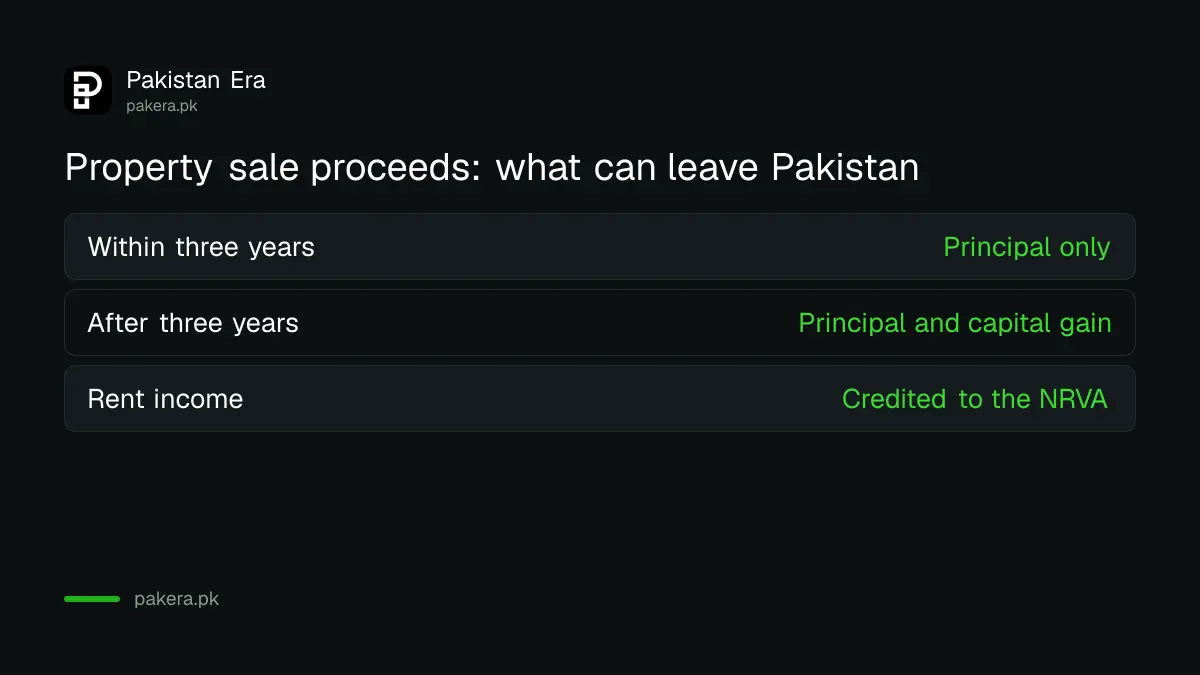
The real estate framework applies to non-resident Pakistanis and non-resident POC holders. If you sell within three years of final payment, only the principal can be sent abroad. The capital gain can leave Pakistan only after three years.
The circular sets these conditions for a purchase.
- Pay from NRVA funds, or from bank financing that you repay out of the NRVA.
- Have the bank pay the seller directly by payment order, banker's cheque or digital transfer.
- Provide the sale agreement, a valuation report from a valuer on the Pakistan Banks' Association panel not older than three months, and the seller's identity documents.
- Accept a price within 10% either side of the valuer's figure.
- Submit the title documents within six months of the final payment.
- Hold the property in your own name or jointly with parents, siblings, spouse, children or lineal ascendants and descendants only.
Rent can be credited straight into the NRVA. The bank needs the tenant's IBAN, a valid rent agreement, the tenant's CNIC and a certificate of benchmark rental value from a panel valuer. For a loan against such a purchase, the Roshan Apna Ghar home finance is the best known scheme, but we have not confirmed from this circular whether it runs through these accounts.
Fees, cards and digital banking are covered too
Banks must allow operation through internet and mobile banking, ATM and debit cards. They may issue a cheque book and supplementary cards. If a debit card is used outside Pakistan, the bank settles it through the interbank market.
On fees, the circular says banks must not charge an NRVA customer a fee for sending remittances through foreign correspondents under the Free Send Model. For money received that way, the bank can charge nothing or a fee no more than the amount the State Bank reimburses under its telegraphic transfer scheme. Banks must tell NRVA holders what fees will be deducted.
A dormant account can be reactivated digitally for non-resident customers. That matters to anyone who goes abroad and does not touch the account for months.
Common questions
Can a foreign national open an FCVA in Pakistan?
Yes, if the person is a non-resident under the Income Tax Ordinance. The circular covers all non-resident individuals, not only Pakistanis.
Can a resident Pakistani open an FCVA?
Yes, but only a resident who holds assets abroad and has declared them in the latest FBR wealth statement. The bank asks for details of those assets and the statement. The account can be joint only with another resident.
Is an NRVA the same as a Roshan Digital Account?
We cannot say from the circular. The Roshan Digital Account is a bank product for overseas Pakistanis. Ask your bank which State Bank account category it falls under.
Can I send money abroad from an NRVA without State Bank approval?
Yes, up to the balance in the account, without prior approval from the bank or the State Bank. Sales of real estate have extra conditions on gains within three years.
Can a company open an FCVA?
No. Companies and similar bodies open the business versions, the FCBVA for foreign currency and the NRBVA for rupees. Sole proprietorships are not eligible for those.
Does the circular set a minimum balance or a profit rate?
No. It does not mention either. Those are decisions for each bank, so ask before you open.
How we verified this
What we checked, where we read it, and what we could not confirm.
We read the State Bank of Pakistan's EPD Circular Letter No. 05 of 24 March 2026 and its Annexure A and Annexure B on 12 October 2026. We did not review any single bank's product terms, so confirm requirements with your bank before you send documents.
About the author

Global Affairs & Political Economy Writer
Muhammad Hatim is a book lover who started writing because he enjoys it. At Pakistan Era he writes about international relations, geopolitics and the global economy, with a particular interest in South Asia and the forces behind current events.