Check the Dollar Rate You Are Offered Against the State Bank's Sheet in Pakistan
Compare the dollar rate a counter offers with the open market closing sheet on the State Bank site: Rs 277.52 buying and Rs 278.69 selling on 9 October 2026.
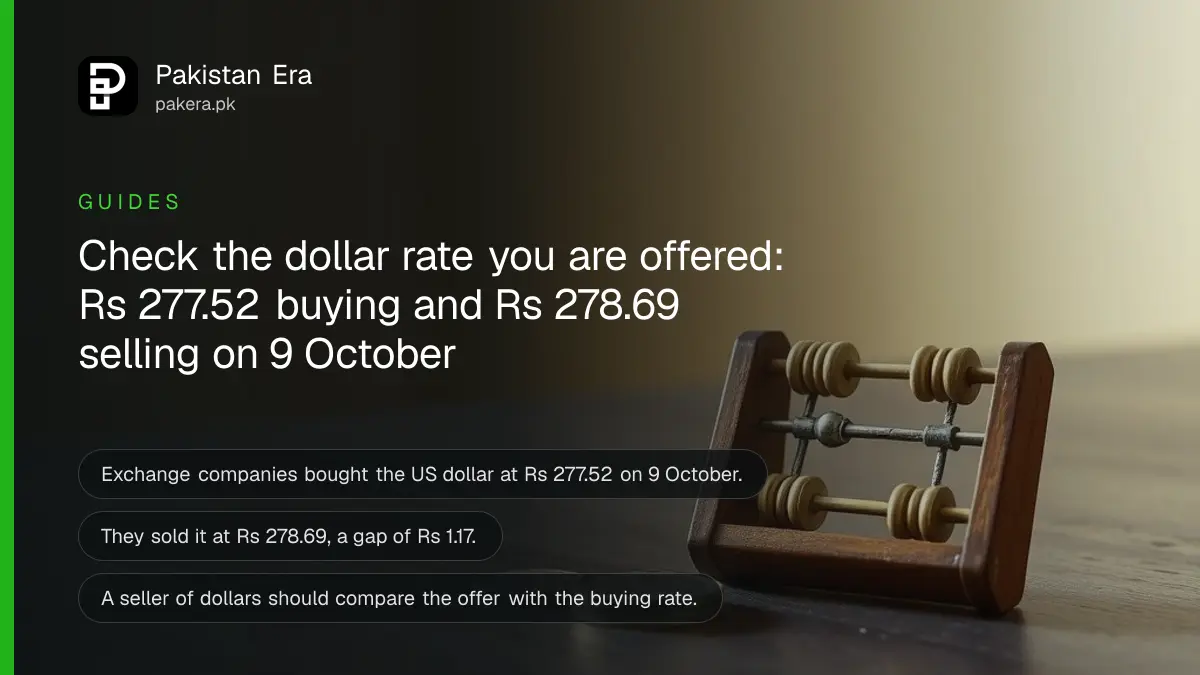
Short answer: Before you sell dollars or collect a remittance in cash, compare the offer with the exchange companies' own closing rate on the State Bank's site. On 9 October 2026 the open market closing rate for the US dollar was Rs 277.52 to buy and Rs 278.69 to sell. You, as a seller of dollars, get the lower one.
Imagine a family receives $1,000 from a brother in Dubai, and the counter offers Rs 276,500. They have no way to know if that is fair. A two minute look at the State Bank's sheet for 9 October would have shown Rs 277,520, which is Rs 1,020 more.
This guide shows the two State Bank pages to open, which line applies to you, and how to turn the rate into rupees. The figures are for Friday 9 October 2026, the latest closing sheets we could read on 12 October.
Two State Bank pages give you a rate to measure against
Open the State Bank's economic data page for the open market closing rates, published by the Exchange Companies Association of Pakistan (ECAP). It shows buying and selling for each currency. A second sheet, the mark to market rate, is the rate banks use to value their dollars.
The open market sheet is the one that matters for cash and remittance counters, because it comes from the exchange companies themselves. The mark to market sheet is a reference point. On 9 October it showed Rs 277.0040 for the dollar. We cover the daily revaluation numbers in our dollar rate report for 9 October.
The open market sheet is a PDF whose name includes the date. It appears late in the day, and at times it is still the previous day's sheet in the evening. Check the date printed at the top before you rely on it.
You get the buying rate, and you pay the selling rate
The buying rate is what the exchange company pays you for your dollars. The selling rate is what it charges you to buy dollars. Always find the line that matches what you are doing, because the gap between them is the company's margin.
| Currency | Company buys from you | Company sells to you | Gap |
|---|---|---|---|
| US dollar | Rs 277.52 | Rs 278.69 | Rs 1.17 |
| Saudi riyal | Rs 73.89 | Rs 74.41 | Rs 0.52 |
| UAE dirham | Rs 75.57 | Rs 76.16 | Rs 0.59 |
| British pound | Rs 366.63 | Rs 370.07 | Rs 3.44 |
| Euro | Rs 310.68 | Rs 313.68 | Rs 3.00 |
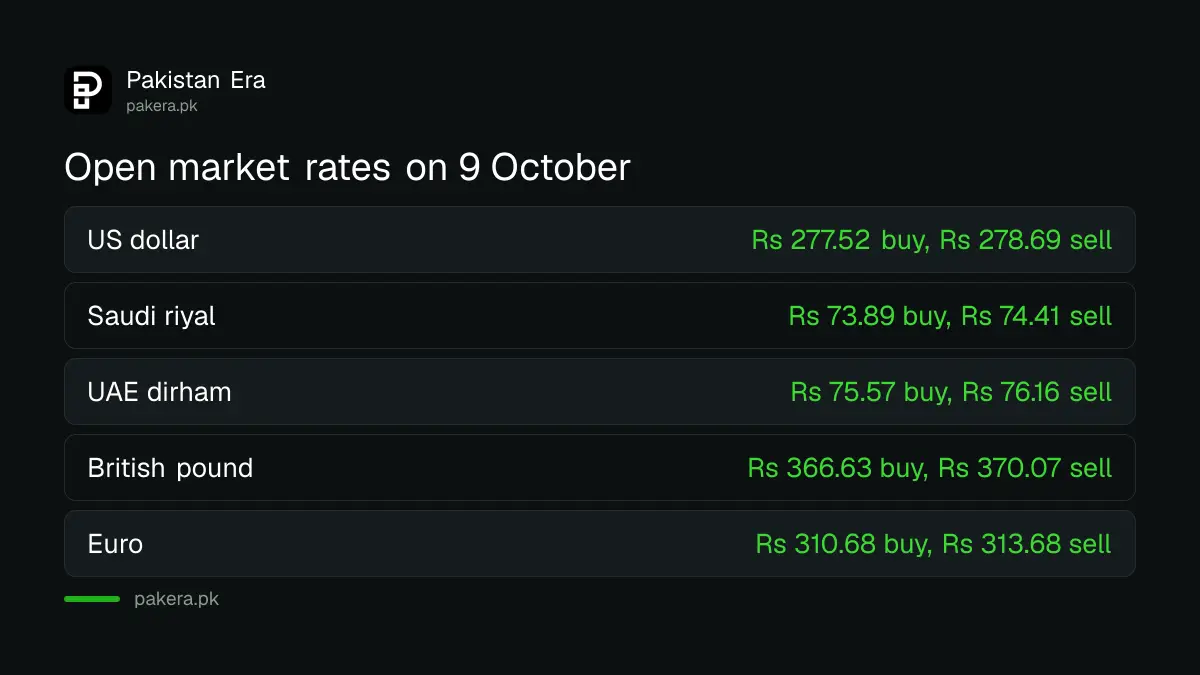
If you are selling dollars, you should be offered the buying figure or close to it. If a counter offers well under the buying rate, ask why. If you are buying dollars, the selling figure is the most you should expect to pay. Our note on buying US dollars legally in Pakistan sets out the limits.
Turn the rate into rupees before you agree
Multiply the amount of foreign currency by the buying rate. For $1,000 on 9 October, that is Rs 277,520. Then subtract any fee the counter states. The result is the least you should accept for that day.
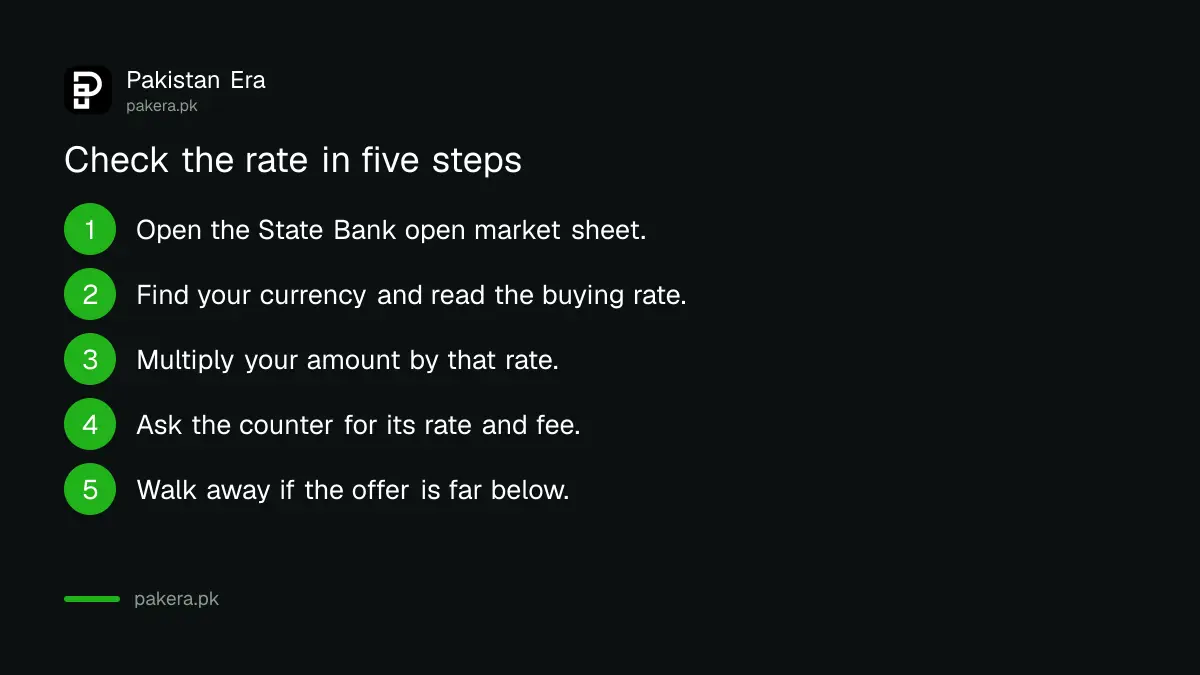
- Open the State Bank's open market closing sheet and check its date.
- Find your currency and read the buying rate.
- Multiply your amount by that rate.
- Ask the counter for its rate and any fee in writing.
- Walk away if the offer is more than a rupee or two below the sheet.
A counter can be a little below the sheet because the sheet is a closing rate and shops quote through the day. The sheet itself shows a gap of Rs 1.17 between the dollar buying and selling rates. Use the sheet as your measure and not as a guarantee.
Check the company is authorised before you hand over cash
A fair rate is no use if the counter is not licensed. The State Bank publishes a list of authorised exchange companies. If a dealer is not on it, do not trade, whatever rate he quotes.
Our guide to checking an exchange company is SBP authorised shows how to read that list. Take a receipt that names the company, the amount, the rate and the date. A receipt matters if a dispute follows.
Banks pay on remittances at their own rates, which are not on the open market sheet. For a remittance that comes into your account, ask the bank for its rate on the day and compare it with the open market buying rate. Our report on Pakistan's September 2026 remittances shows how large these flows are, which is why a few paisa per dollar adds up.
Common questions
Where can I see the open market dollar rate?
On the State Bank's economic data page, in the open market closing exchange rates sheet from the Exchange Companies Association of Pakistan. It lists buying and selling rates for each currency.
What was the open market dollar rate on 9 October 2026?
The sheet showed Rs 277.52 to buy and Rs 278.69 to sell, against a State Bank revaluation rate of Rs 277.0040.
Which rate applies if I am selling dollars?
The buying rate. That is what the exchange company pays you for your dollars.
Why is the open market rate higher than the interbank rate?
The interbank rate is for large trades between banks. The open market handles small cash amounts and prices in its costs and margin. The gap is normal.
Is the sheet rate guaranteed?
No. It is the closing rate reported by the association. Counters quote through the day and may differ slightly.
How we verified this
What we checked, where we read it, and what we could not confirm.
We read the State Bank's open market closing exchange rate sheet and the mark to market revaluation sheet for 9 October 2026 on sbp.org.pk on 12 October 2026. The 12 October sheets were not yet posted at 12:30 PKT. Rates change daily, so read the date on the sheet.
About the author

Public Services and Education Journalist
Fajr Riaz is a journalist and content writer at Pakistan Era, based in Lahore. She covers the questions people meet in everyday life in Pakistan: how a public service works, what a change in the rules means, and where to find a reliable answer.