How to Buy US Dollars Legally in Pakistan: SBP Limits and Rules
Buy dollars legally in Pakistan: SBP limits of $10,000 a day and $100,000 a year, CNIC, biometrics from $500, purpose from $1,000. Check the rules first.
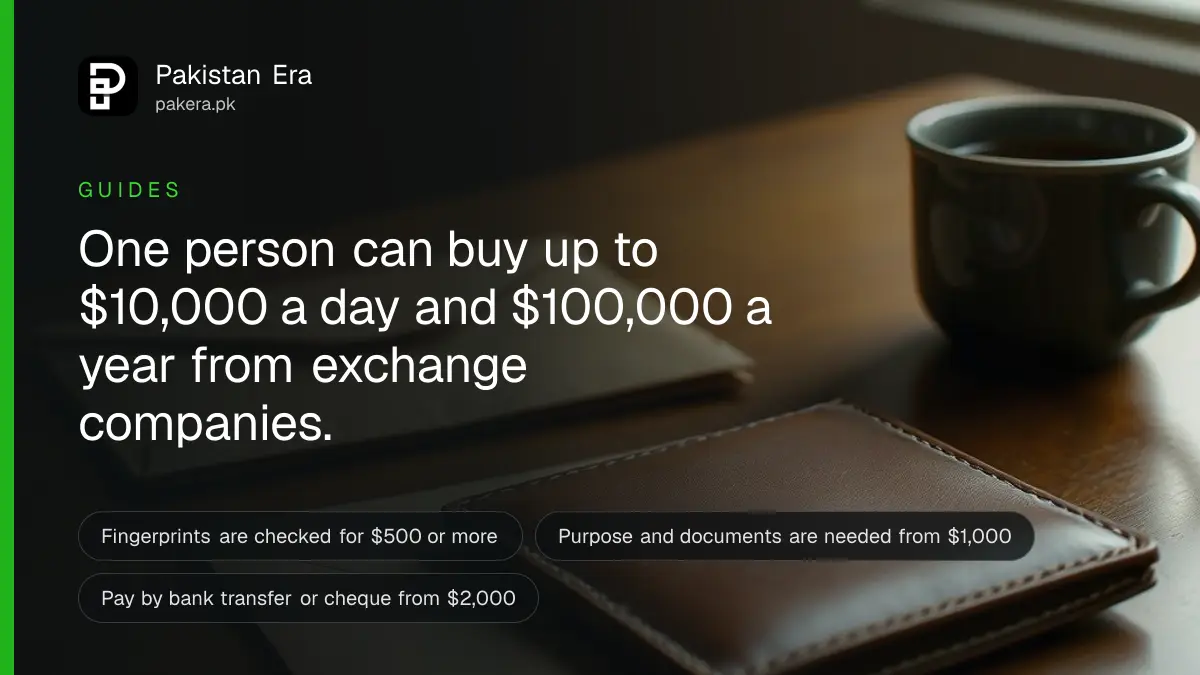
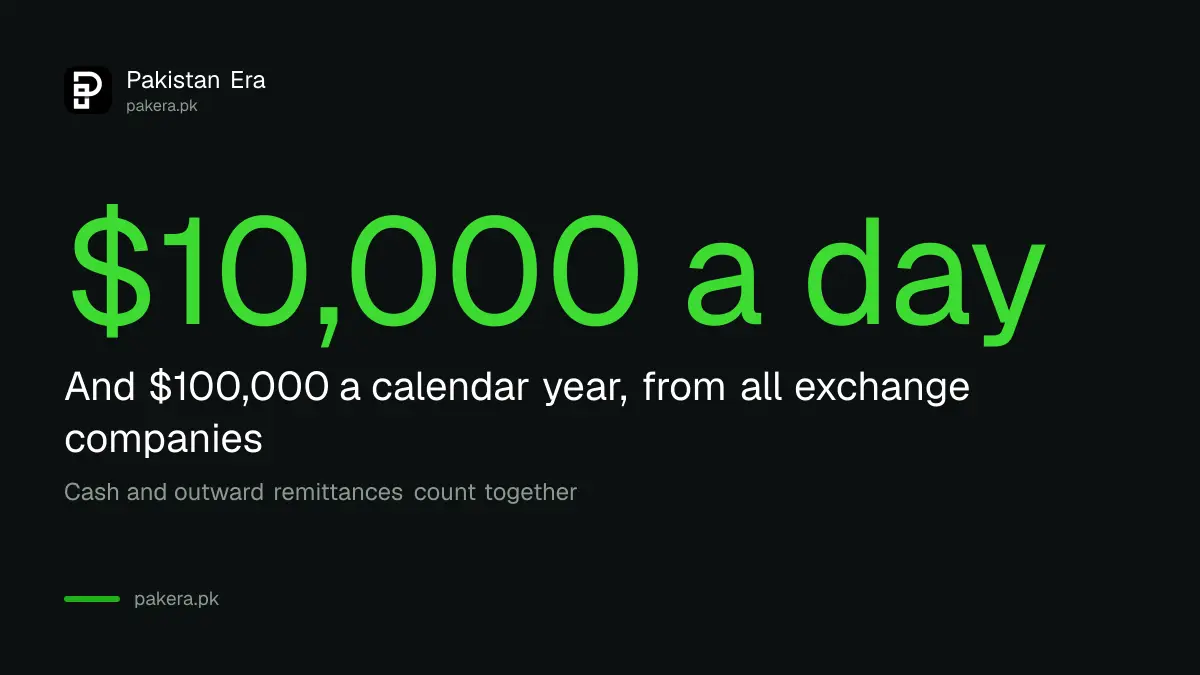
You can buy US dollars legally in Pakistan only from a bank or an exchange company authorised by the State Bank of Pakistan (SBP). Bring your original CNIC. From $500 you give your fingerprints, from $1,000 you state the purpose, and from $2,000 you pay from your own bank account. One person can buy at most $10,000 a day and $100,000 a year from all exchange companies combined.
Those numbers come from SBP's Regulatory Framework for Exchange Companies, which took effect on 1 January 2025. We read the full framework and every SBP exchange policy circular issued since, up to September 2026.
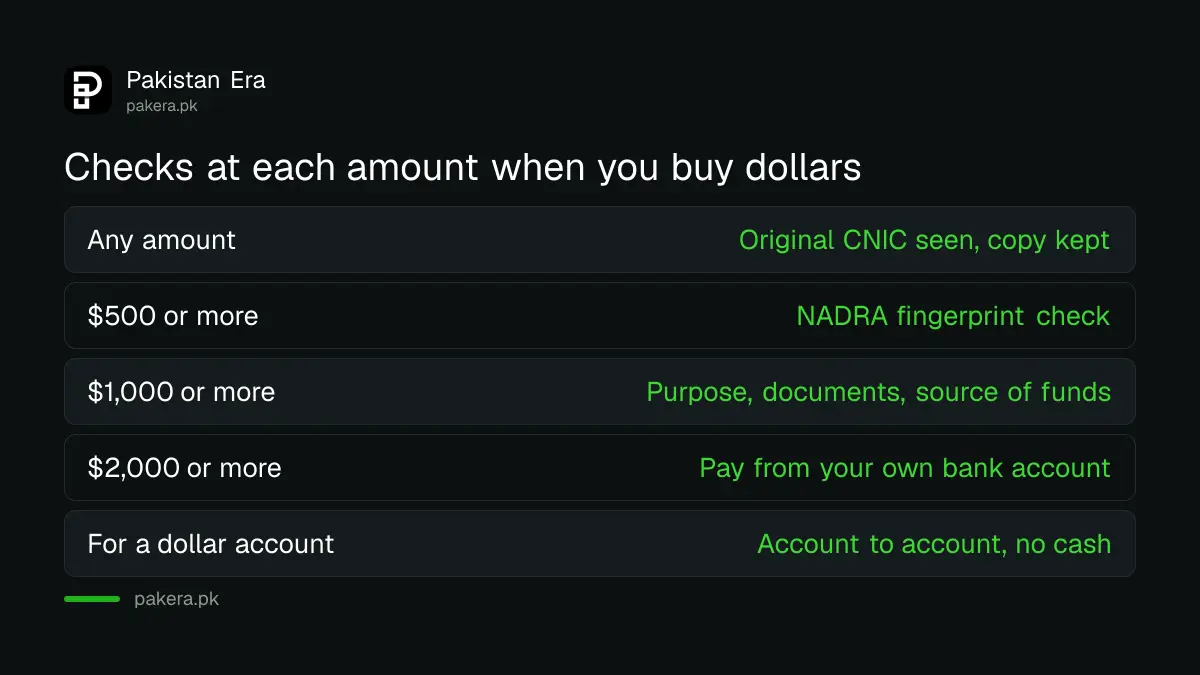
| Amount you buy | What the exchange company must do |
|---|---|
| Any amount | See your original CNIC, NICOP, POC or passport and keep a copy |
| $500 or more | Verify your fingerprints with NADRA (biometric check) |
| $1,000 or more | Record the purpose, take supporting documents and note your source of funds |
| $2,000 or more | Take your rupees by bank transfer or cheque from your personal account, not cash |
| For deposit in a dollar account | Send the dollars account to account, with no cash handed over |
Only banks and SBP authorised exchange companies can sell you dollars
A bank or an exchange company authorised by SBP under the Foreign Exchange Regulation Act 1947 is the only legal seller.
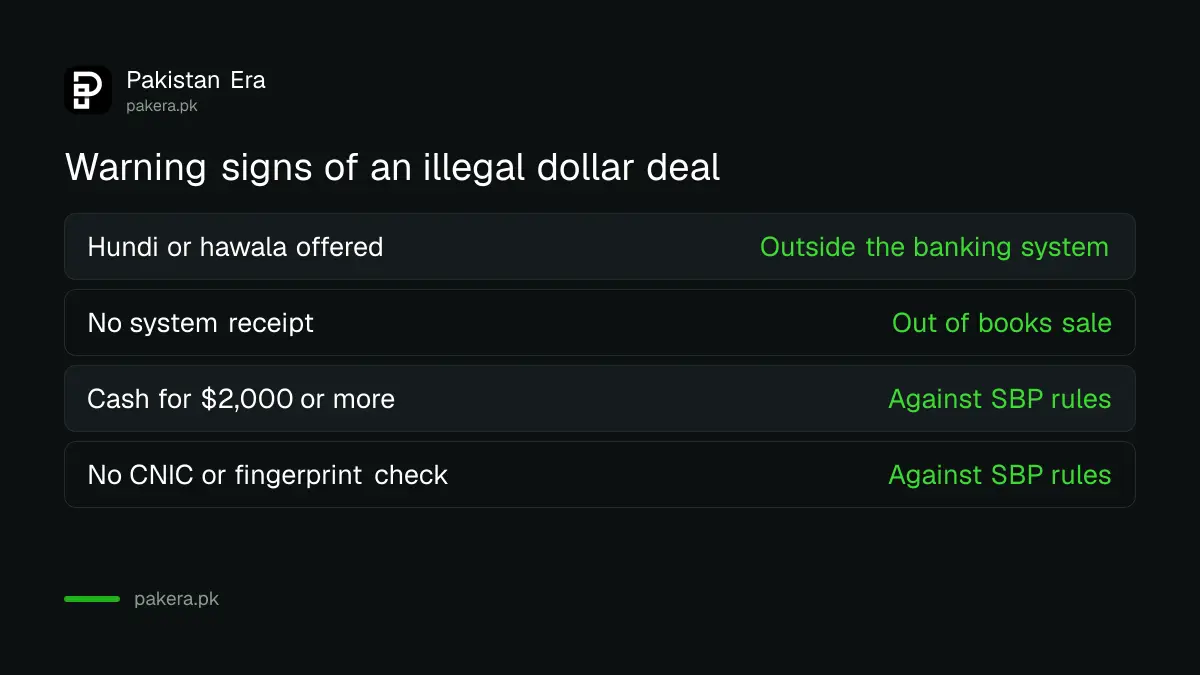
SBP authorises exchange companies under section 3AA of that Act. Its framework lists "conducting or facilitating any unauthorized foreign exchange business" as a violation. That covers the informal hundi and hawala networks too. They move money outside the banking system, so you get no receipt, no record and no way to complain if the money disappears.
A legal sale always ends with a receipt printed by the company's system. SBP says every transaction must be recorded in the company's central software in real time, and that no manual transaction is allowed. If a counter offers you dollars "off the books" for a better rate, walk away.
The daily and yearly limits are $10,000 and $100,000
One person can buy up to $10,000 a day and $100,000 in a calendar year, counting cash and outward remittances from all exchange companies together. The limits are per person, not per company, so splitting purchases across companies does not raise them.
SBP makes you sign an undertaking with every purchase. In it you confirm that you have not already reached the daily or yearly limit and that this purchase will not take you over. Each company must also block sales over the limits in its own system.
The same rule adds that purpose-specific limits under other SBP regulations also apply.
How to buy dollars from an exchange company step by step
Go to an authorised outlet with your original CNIC, know your purpose and amount, and pay from your own bank account for anything at or above $2,000.
- Check the rate board. SBP requires every outlet to show its buying and selling rates for major currencies on a board in a prominent place. Its schedule of charges must also be on display, in English and Urdu.
- Hand over your original CNIC. The company must see the original and keep a copy, on paper or digitally, for every sale.
- Give your fingerprints for $500 or more. The check runs against NADRA's records.
- Explain the purpose for $1,000 or more. Travel or study fees abroad are examples. Bring the proof, such as a ticket, a visa or a fee voucher.
- Pay by transfer or cheque for $2,000 or more. The money must come from your personal account. The bank name and the transfer or cheque number go on your receipt.
- Keep the printed receipt. It is your record that the purchase was legal.
If your fingerprints will not verify, SBP lets the company take an original Verisys slip from NADRA instead. That applies to a permanent disability, worn or unclear prints, a temporary problem such as a bandaged hand or mehndi, or a NADRA system fault. NADRA also has facial and iris verification for people whose prints fail.
Dollars for a foreign currency account now move account to account
Since SBP's EPD Circular Letter No. 10 of 14 November 2025, dollars sold to a resident Pakistani for deposit into a foreign currency account must move by account-to-account transfer. You do not get the cash in hand.
SBP gave one reason: to promote a cashless economy. In practice, ask the exchange company how it will send the money to your bank before you pay. A transfer between two different banks can take longer than one inside the same bank. If you are an overseas Pakistani, a Roshan Digital Account is a separate route that does not involve an exchange counter at all.
Where to check the open market and interbank rate officially
SBP publishes two rates. The open market closing rate comes from the Exchange Companies Association of Pakistan and is posted on SBP's website. The interbank rate is the one banks use when they trade with each other.
The open market page is on SBP's archive site, in its economic data section. SBP's own framework names that page as the source exchange companies must use for their year-end accounts. When we opened it on 1 October 2026, the page loaded but the rate table, which loads separately, was blocked to our automated check. Open it in an ordinary browser.
Exchange companies are free to set their own buying and selling rates. SBP only asks for a "fair, reasonable and competitive" spread between the two. So the counter rate can differ a little from the published closing rate, and from one company to the next. Compare two or three boards before you buy a large amount. For context on the wider currency picture, SBP's own foreign exchange reserves are published every week.
What is not allowed when you buy dollars
Hundi and hawala, buying above the limits by splitting across names, and paying cash for $2,000 or more are all outside SBP's rules. So is using an exchange company to pay a business bill abroad.
- No business payments. SBP lets exchange companies send money abroad only for an individual's personal needs. Trade, commercial and service payments, including commission, are not allowed through them, whether for a person or a company.
- No unrecorded sales. Any sale not entered in the company's system counts as an out-of-books transaction.
- No cash for big amounts. At $2,000 and above your rupees must come from your own bank account.
For paying online in dollars, such as for a subscription, virtual dollar cards from banks and wallets are usually simpler than buying cash.
Common questions
How many dollars can I buy in a day in Pakistan?
Up to $10,000 a day per person, counting all exchange companies together. The yearly cap is $100,000 in a calendar year.
Do I need my CNIC to buy $100?
Yes. SBP's framework says the company must see the original and keep a copy for every sale, whatever the amount.
When is biometric verification needed?
For every purchase of $500 or more. If your fingerprints fail, the company can accept an original NADRA Verisys slip.
Can I pay cash for $3,000?
No. For $2,000 or more, SBP requires payment by bank transfer or cheque from your personal account.
Is hundi or hawala legal in Pakistan?
No. Only banks and SBP authorised exchange companies may deal in foreign exchange. Hundi and hawala work outside that system and leave you with no protection.
Why is the exchange company rate different from the SBP rate?
Each company sets its own buying and selling rates. SBP publishes a closing rate for reference and asks companies to keep a fair spread.
How we verified this
What we checked, where we read it, and what we could not confirm.
Last checked on 1 October 2026. We read SBP's FE Circular No. 02 of 2024 and the Regulatory Framework for Exchange Companies attached to it, in force from 1 January 2025: Chapter 2 on authorisation, Chapter 7 paragraphs 2, 5 and the outward remittance rules, and the rules on rate boards and charges. We read EPD Circular Letter No. 10 of 2025 on account-to-account sales, and checked the titles of every SBP exchange policy circular from January 2025 to September 2026 for later changes; none altered the limits above. We could not read the live open market rate table, which blocked our automated check. Exchange companies may ask for more documents than these minimums.
About the author

Tax, Bills and Technology Writer
Ali Akhtar is a young and curious voice here at Pakistan Era. He is currently pursuing his A-Levels and has a growing interest in Pakistan’s changing industrial landscape and educational trends. Ali likes to write in a way that helps him explain and explore the world around him. His writing reflects the perspective of the new generation navigating the evolving trends of Pakistan where technology, youth innovation, and shifting opportunities are reshaping the country’s future.