SBP Doubles Minimum Capital for Banks in Pakistan to Rs 20 Billion by 2030
SBP raised minimum capital for banks in Pakistan from Rs 10 billion to Rs 20 billion by 31 December 2030. See the foreign bank and DFI levels and what it means.
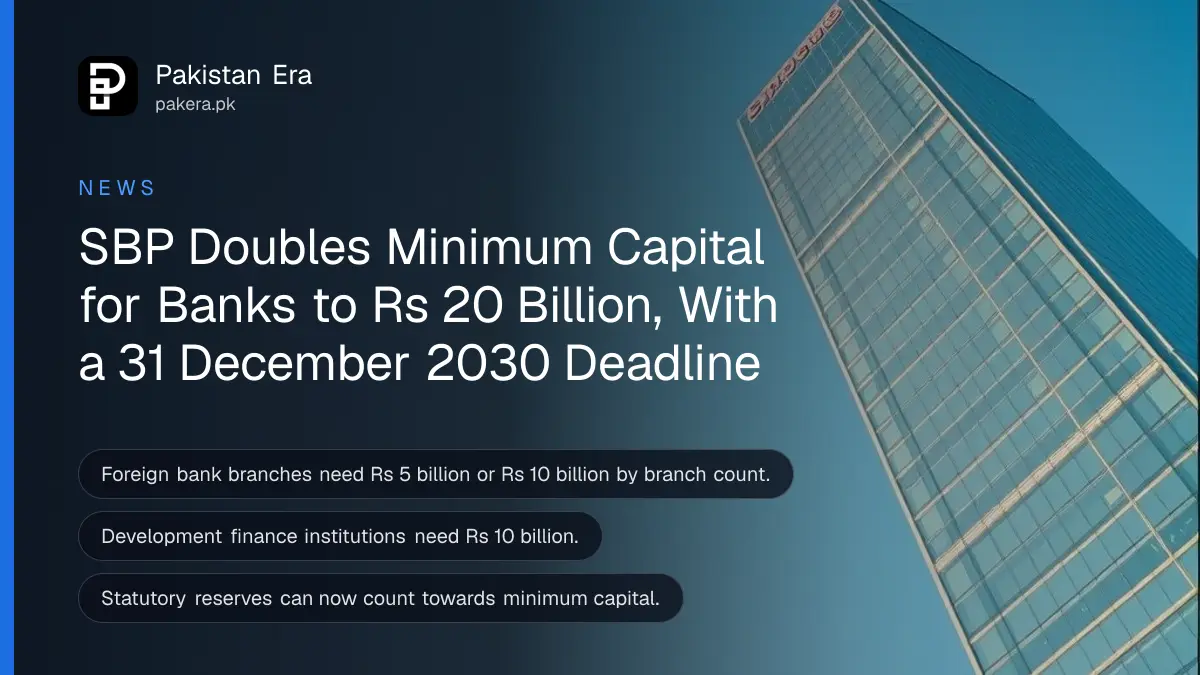
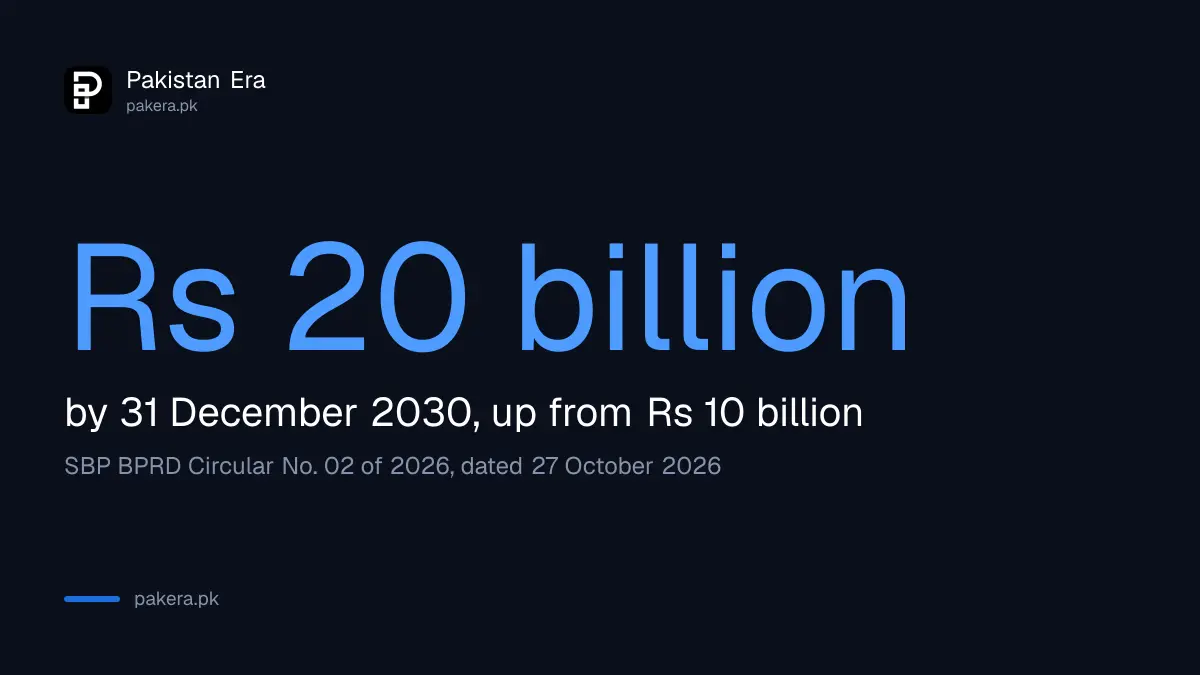
The State Bank of Pakistan (SBP) has doubled the minimum capital a Pakistani bank must hold, from Rs 10 billion to Rs 20 billion, and given existing banks until 31 December 2030 to reach it. The order is BPRD Circular No. 02 of 2026, dated 27 October 2026.
The same circular sets new floors for foreign bank branches (Rs 5 billion or Rs 10 billion, by branch count) and for development finance institutions (Rs 10 billion). If you only hold an account, you do not need to do anything. We read the circular on the SBP website on 28 October and set out below what changed, who must act and by when.
Banks must hold at least Rs 20 billion of capital by 31 December 2030
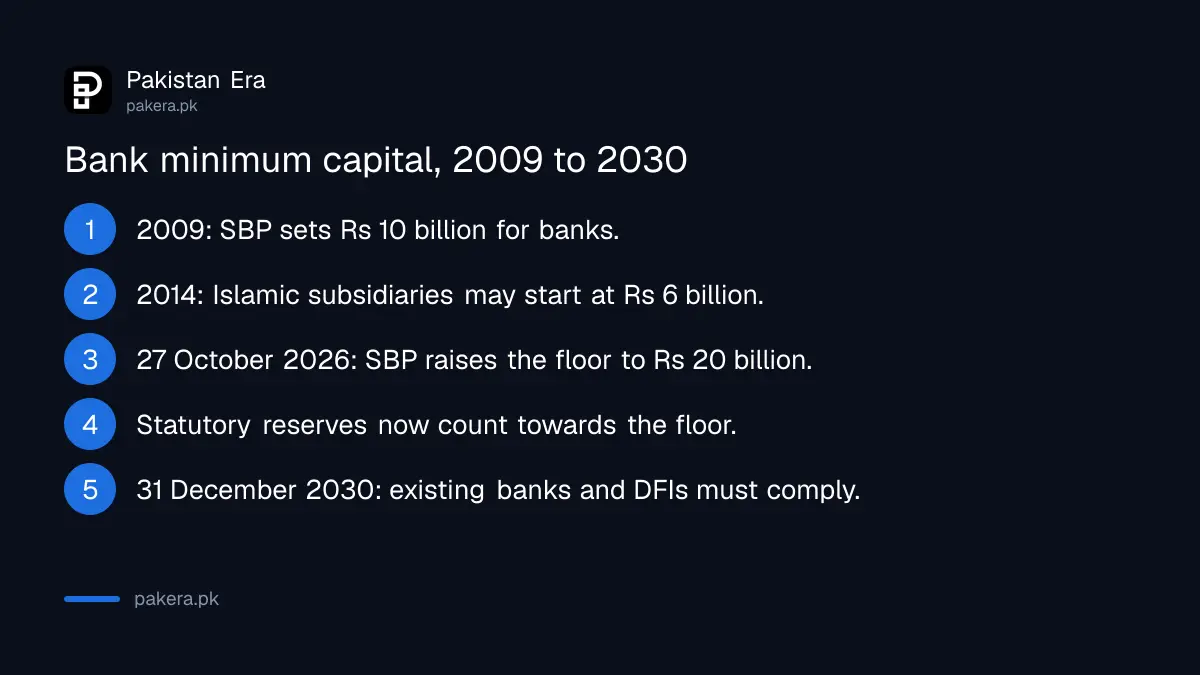
Every bank incorporated in Pakistan, including the Islamic banking subsidiary of a bank, must now hold minimum capital of Rs 20 billion. Existing banks have until 31 December 2030. The previous floor, set in 2009, was Rs 10 billion, so the requirement doubles after 17 years.
The SBP gives one reason in the circular: "increased operating costs to establish and manage financial institutions on sustainable basis". In plain words, running a bank safely now costs more, so the owners must put in more of their own money first.
Minimum capital, often shortened to MCR (minimum capital requirement), is the owners' money that stays in the bank. An earlier SBP circular describes it as paid-up capital net of losses. It is the first buffer that absorbs losses before depositors are touched.
Foreign bank branches need Rs 5 billion or Rs 10 billion
A foreign bank that works in Pakistan through branches, rather than a local company, must keep "assigned capital" net of losses. With up to 5 branches the floor is Rs 5 billion. With 6 to 50 branches it is Rs 10 billion. Assigned capital is the money the parent bank sets aside for its Pakistan branches.
The circular does not mention a foreign bank with more than 50 branches. We could not find a case for that in what we read, so we do not guess at the answer.
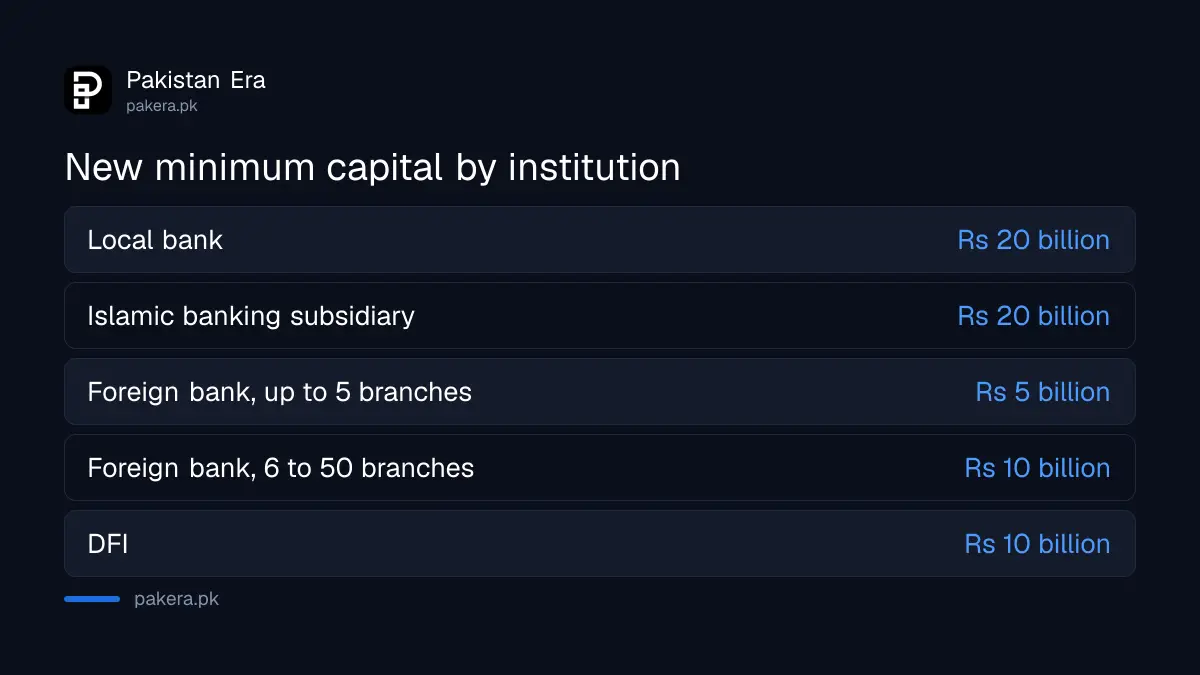
| Institution | Minimum capital now required | Deadline for existing ones |
|---|---|---|
| Bank incorporated in Pakistan | Rs 20 billion (was Rs 10 billion) | 31 December 2030 |
| Islamic banking subsidiary of a bank | Rs 20 billion (was Rs 10 billion) | 31 December 2030 |
| Foreign bank, up to 5 branches | Rs 5 billion assigned capital | Not stated separately |
| Foreign bank, 6 to 50 branches | Rs 10 billion assigned capital | Not stated separately |
| Development finance institution (DFI) | Rs 10 billion | 31 December 2030 |
Paragraph 3 of the circular gives the 2030 date to "existing banks and DFIs". It does not give a separate date for foreign bank branches, which is why the table says so.
Development finance institutions need Rs 10 billion
A development finance institution (DFI) is a lender set up to fund long-term projects such as industry, housing or infrastructure, rather than to take ordinary deposits. Under the new circular each DFI needs minimum capital of Rs 10 billion, and existing DFIs must reach it by 31 December 2030.
The circular does not state the old DFI floor, and the earlier circulars we read deal with banks. So we have not put a "was" figure next to DFIs.
Statutory reserves can now count towards the Rs 20 billion
The circular lets a bank count its statutory reserves towards minimum capital, on top of the items SBP already allowed in 2013. These are the reserves banks build from their profits under section 21 of the Banking Companies Ordinance, 1962. Once counted, a bank cannot take them out without SBP approval.
This matters in practice. A bank that has kept years of profit in its statutory reserve may already be close to Rs 20 billion without raising fresh money. A smaller bank with thin reserves may need new shares, a merger or a richer owner. The circular does not name any bank that falls short, and we have not done that sum for each bank.
Depositors do not need to do anything
The new rule is a duty on banks and their owners, not on customers. Your account, profit rate and cards stay the same. A bank with more capital has a thicker cushion against losses, which is the point of the change for depositors.
This is separate from the extra capital SBP asks of the largest lenders. In the 2026 list of systemically important banks, UBL, HBL and NBP were told to hold more capital by March 2027. That rule measures capital against risk. The new one sets a flat rupee floor for every bank.
If you want a wider picture of how banks are doing, SBP's mid-year banking review for 2026 covers deposits, bad loans and profits. The policy rate rise to 12% came a day before this circular and is a different decision.
What happens between now and 2030
Banks and DFIs have just over four years. The order below is what the circular itself requires; anything beyond it, such as how SBP will check progress year by year, is not in the text we read.
- Each bank and DFI acknowledges the circular to the SBP, as paragraph 6 asks.
- Each one works out its eligible capital, now including statutory reserves.
- Any shortfall is met by 31 December 2030, through profits kept in the bank, new shares or other means.
- Statutory reserves counted towards the floor stay locked unless the SBP agrees otherwise.
- All other SBP capital instructions keep applying, as paragraph 5 says.
Common questions
What is the new minimum capital for banks in Pakistan?
Rs 20 billion for every locally incorporated bank, including Islamic banking subsidiaries, under SBP BPRD Circular No. 02 of 2026.
When must banks meet the Rs 20 billion requirement?
Existing banks and DFIs must meet it by 31 December 2030.
What was the old minimum capital?
Rs 10 billion of paid-up capital net of losses, set by SBP's BSD Circular No. 7 of 2009, as a later SBP circular confirms.
Do foreign banks in Pakistan have to hold Rs 20 billion?
No. Foreign bank branches need assigned capital of Rs 5 billion with up to 5 branches, or Rs 10 billion with 6 to 50 branches.
Is my money at risk if my bank has less than Rs 20 billion today?
The circular gives banks until the end of 2030, so a bank below the new floor today is not breaking the rule. It sets no duty on depositors.
Who signed the circular?
It was issued by the SBP's Banking Policy and Regulations Department (BPRD) to the presidents and chief executives of all banks and DFIs.
How we verified this
What we checked, where we read it, and what we could not confirm.
We read BPRD Circular No. 02 of 2026 on the SBP website on 28 October 2026, and BPRD Circular No. 10 of 2014, which records the earlier Rs 10 billion floor and 10% capital adequacy ratio from BSD Circular No. 7 of 2009. We could not verify the old minimum for DFIs or foreign bank branches, which bank stands where today against the new floor, or what applies to a foreign bank with more than 50 branches.
About the author

Tax, Bills and Technology Writer
Ali Akhtar is a young and curious voice here at Pakistan Era. He is currently pursuing his A-Levels and has a growing interest in Pakistan’s changing industrial landscape and educational trends. Ali likes to write in a way that helps him explain and explore the world around him. His writing reflects the perspective of the new generation navigating the evolving trends of Pakistan where technology, youth innovation, and shifting opportunities are reshaping the country’s future.