SBP Caps Tawarruq at 5% of Islamic Bank Financing in Pakistan: What Changes for Customers
SBP adopted AAOIFI Standard 30 on Tawarruq on 16 October 2026: a 5% cap, a 10% consumer cap, and a duty to show Shariah alternatives. See your rights now.
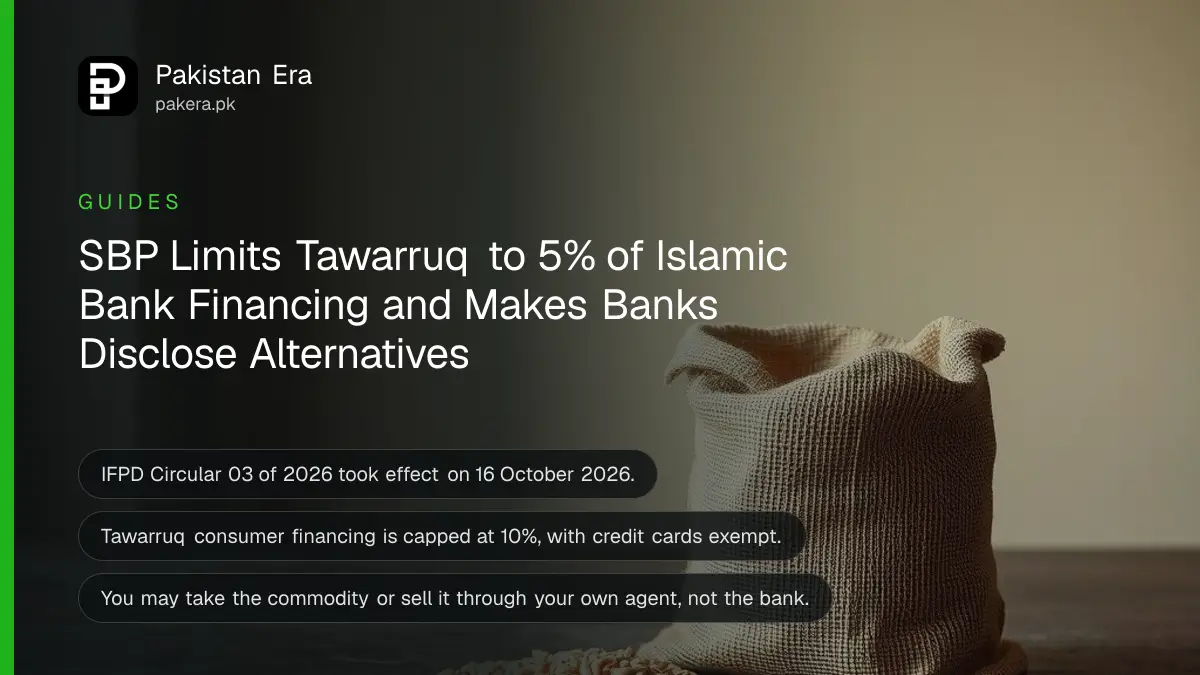
Short answer: From 16 October 2026, Islamic banks in Pakistan may use Tawarruq, also called commodity Murabaha, only for a documented need, and only up to 5 per cent of their total financing. Consumer loans built on Tawarruq are capped at 10 per cent of a bank's consumer financing, with credit cards exempt from that second cap. Your bank must also show you the Shariah compliant alternatives and their cost before offering a Tawarruq product.
The rules come from IFPD Circular No. 03 of 2026, which the State Bank of Pakistan (SBP) issued on 16 October 2026. We read the circular, its Appendix A and its Annexure I on 19 October 2026. The circular adopts AAOIFI Shariah Standard No. 30 on Monetization (Tawarruq) with immediate effect and attaches SBP's own "Guidelines on Application of Hajah (Need) in Tawarruq-based Transactions". Any earlier SBP letters or approvals on Tawarruq stand revoked.
Tawarruq is a cash loan dressed as a commodity sale, and SBP now treats it as an exception
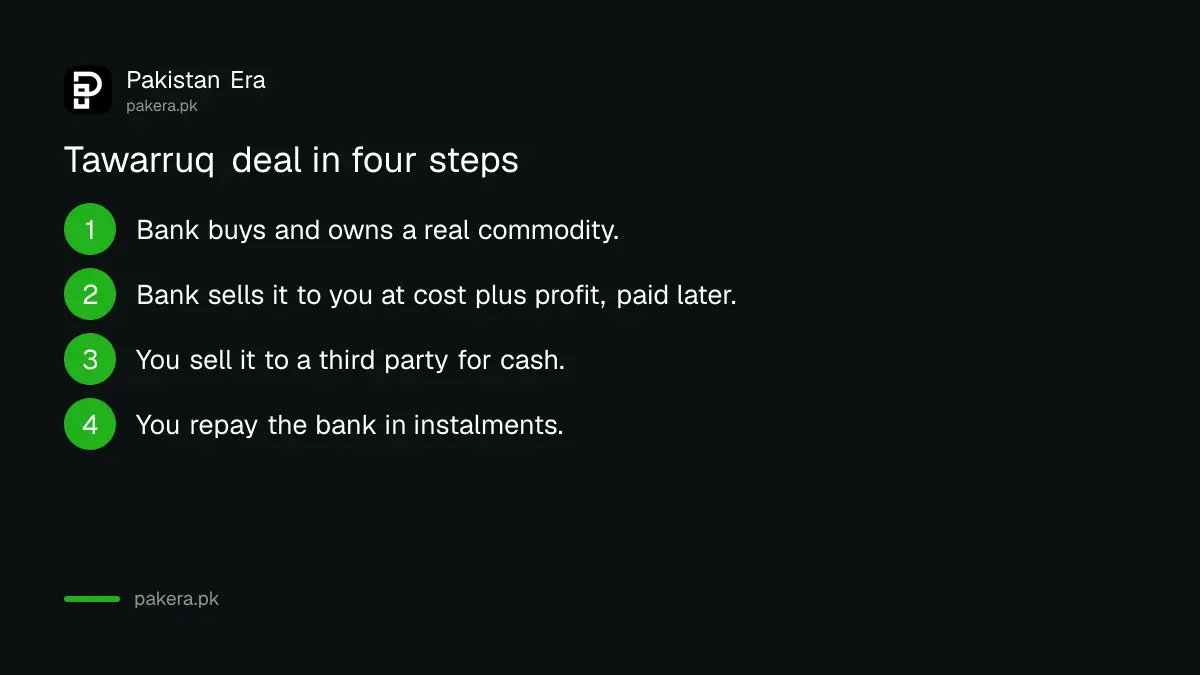
In a Tawarruq deal the bank sells you a commodity on deferred payment at cost plus profit, you sell it to a third party for cash, and you repay the bank in instalments. Appendix A defines it as buying a commodity for a deferred price and selling it to a third party for a spot price to obtain cash.
The appendix also draws the line SBP cares about most. Selling the commodity back to the same party you bought it from, for a lower spot price, is 'Inah, and the standard calls it "strictly prohibited". That is why the new rules say the commodity must go to a genuine third party and must never return to the original seller by agreement, custom or collusion.
SBP's guidelines go further than the standard. They say Tawarruq is "not a mode of investment or financing", that a bank may use it only when "no other practicable alternative Shariah compliant product is available", and that it must not be marketed "as the easiest or default financing solution".
Two caps now apply: 5 per cent of all financing and 10 per cent of consumer financing
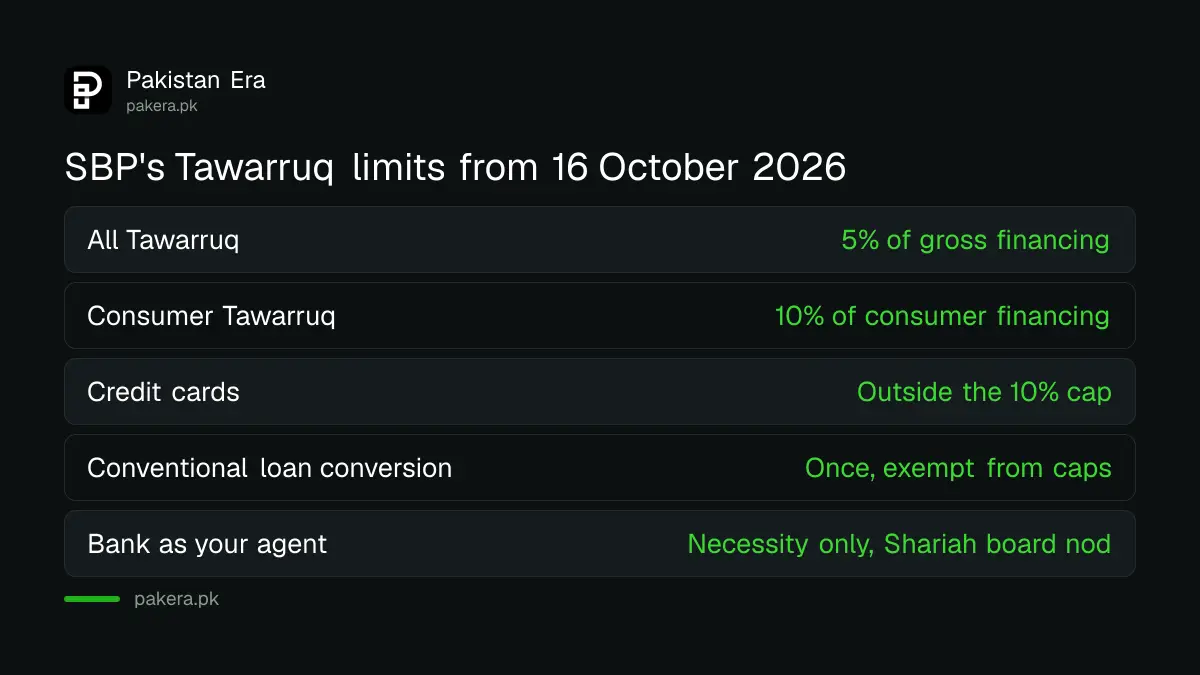
Tawarruq transactions must stay within 5 per cent of a bank's gross financing at all times, counting consumer financing and treasury deals. Consumer financing based on Tawarruq must not exceed 10 per cent of total consumer financing, except for credit cards issued under Tawarruq, which sit outside that 10 per cent.
There is one exemption. A one-time conversion of a bank's conventional loan book into Islamic financing, including commodity financing, does not count towards either limit. That matters for conventional banks that are switching whole branches or portfolios to Islamic banking, and for the Islamic windows of conventional banks.
| Rule in the 16 October 2026 circular | What it says |
|---|---|
| Overall cap | Tawarruq within 5 per cent of gross financing, including consumer and treasury |
| Consumer cap | Tawarruq consumer financing within 10 per cent of total consumer financing |
| Credit cards | Exempt from the 10 per cent consumer cap |
| Conversion of conventional loans | Allowed once, exempt from both caps, needs Shariah board certificate |
| Bank as your selling agent | Only in cases of necessity, with Shariah board approval, never by prior arrangement |
| Placing funds with conventional banks | Not allowed through Tawarruq, directly or indirectly |
| Rollover of an existing facility | Tawarruq may not be used to extend tenure or evergreen a loan |
Who is covered: full Islamic banks, Islamic windows of conventional banks, microfinance banks, development finance institutions and digital banks that offer Islamic products. The circular itself is addressed to Islamic banks, Islamic banking subsidiaries and conventional banks with Islamic branches.
Your bank must show you the alternatives and prove you need the cash
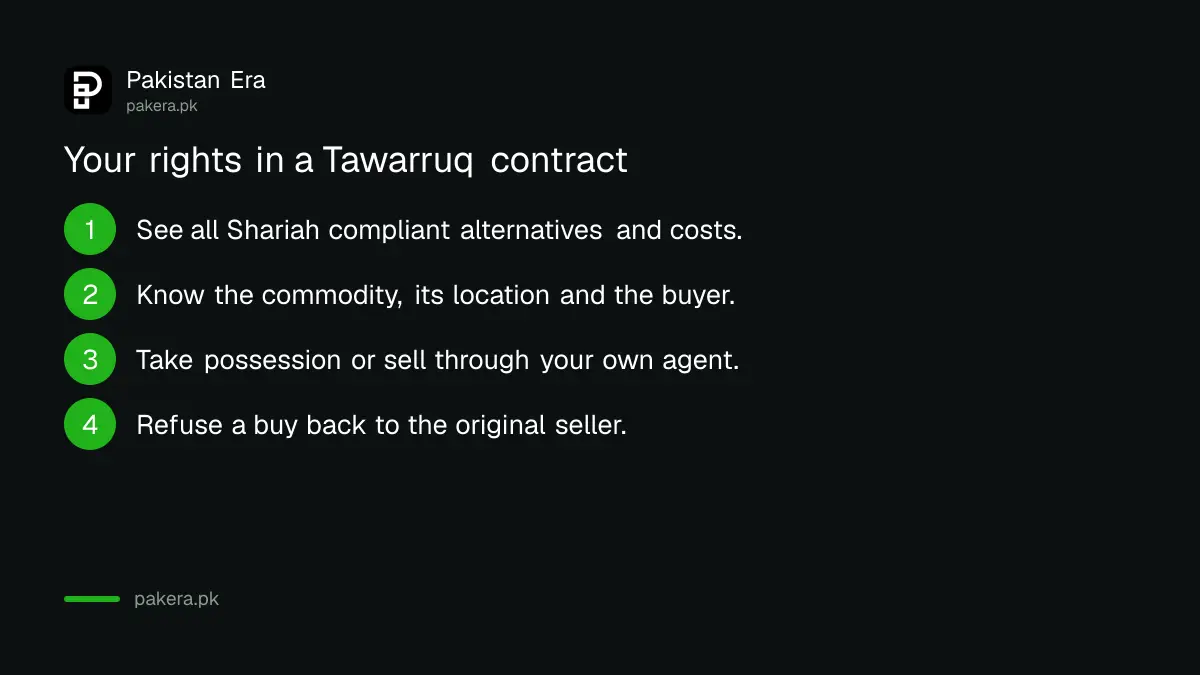
Before a Tawarruq facility, the bank must disclose "all available Shariah-compliant alternatives along with cost implications". It must keep a written eligibility checklist showing why your case meets the threshold of need, and it must specify the purpose of the financing in the application and obtain evidence that you actually used the money for it.
The need test, Hajah, has a definition in the guidelines: a pressing requirement whose non-fulfilment causes distress, hardship or difficulty, short of loss of life or property. The guidelines say the test covers hardship faced by customers and by the banks themselves, and that it must be exception based, not "a general and permanent solution".
Three uses are ruled out in plain words. A bank may not use Tawarruq to meet profit targets, to suit its pricing or convenience, or to cover weak governance. It may not use it to extend the tenure of an existing facility in exchange for more profit. And it may not use it to push money into interest bearing instruments, including placing funds with conventional banks or moving liquidity from an Islamic window to its conventional head office.
You have the right to take the commodity or sell it through your own agent
The guidelines give the customer a choice: take possession of the commodity, sell it yourself, or appoint an independent agent other than the bank to sell it. The bank may act as your selling agent only in cases of necessity and with its Shariah board's approval, and never through a prior arrangement that amounts to a buy back.
Appendix A adds the practical conditions. The commodity must exist and be owned by the bank before sale, it cannot be gold, silver or currency, and it must be identified well enough to separate it from the seller's other goods, for example by warehouse certificate numbers. If the commodity is not present when you sign, you must get a full description or a sample, and local commodities are preferred.
The two contracts, your deferred purchase and your spot sale, may not be linked so that you lose the right to possess the goods. If your bank's paperwork folds the two into one signature with the bank selling on your behalf by default, that is now the pattern SBP has told banks to stop.
Banks must report Tawarruq exposure to their boards twice a year and audit it quarterly
Each bank needs a board approved policy on when Tawarruq is allowed, management must report exposure to the board every six months, the Shariah compliance department must report quarterly to the Shariah board, and internal Shariah audit must review Tawarruq deals and interbank placements every quarter. Records must be available for SBP inspection.
The guidelines also tell banks to develop alternative Shariah compliant products, "especially in consumer financing", to reduce reliance on Tawarruq. For a borrower that is the long term point. Personal finance and some credit cards are where commodity Murabaha has been most used, because there is no asset to lease or sell as there is in Islamic car financing. Expect banks to rework those products.
Failure to comply can bring penal action under the Banking Companies Ordinance 1962. The earlier product approval rules in IBD Circular No. 2 of 2008 and IBD Circular Letter No. 02 of 2013 still apply to Tawarruq product structures.
What to do if you hold or are offered a Tawarruq product
Existing contracts are not cancelled by the circular; it changes how banks structure and approve new deals and how much they may hold. If you are offered one now, use the disclosure rule and ask for the alternatives in writing. The checks every borrower should run on any offer are in our page on the eight things a bank must tell you about a loan.
- Ask the bank to name the contract: Tawarruq, commodity Murabaha, Musawamah or something else.
- Ask for the Shariah compliant alternatives and their cost, which the bank must now disclose.
- Ask which commodity is being sold, where it is stored and who the third party buyer is.
- Read whether you are asked to appoint the bank as your selling agent, and whether you can refuse.
- If the bank refuses to disclose, complain through SBP's Sunwai portal after the bank's own complaint process.
Disputes over Shariah structure go first to the bank, then to the Banking Mohtasib if the bank does not resolve them. The circular does not create a new complaint route.
Common questions about SBP's Tawarruq rules
What is Tawarruq in Islamic banking?
It is buying a commodity from the bank on deferred payment and selling it to a third party for cash, so you end up with money and an instalment debt. SBP's appendix calls it monetization and distinguishes it from the prohibited 'Inah buy back.
When did the new SBP rules take effect?
Immediately on 16 October 2026, the date of IFPD Circular No. 03 of 2026. The guidelines say prior instructions and approvals on Tawarruq stand revoked.
Can my Islamic bank still give me a personal loan?
Yes, but Tawarruq based consumer financing is limited to 10 per cent of the bank's consumer book, and the bank must show you alternatives first. Credit cards under Tawarruq are outside that 10 per cent.
Do the rules apply to Islamic windows of conventional banks?
Yes. The guidelines cover full Islamic banks, Islamic windows, microfinance banks, development finance institutions and digital banks offering Islamic products.
Can the bank sell the commodity on my behalf?
Only in cases of necessity with Shariah board approval. You have the choice to take possession, sell it yourself or use an agent other than the bank.
Does this change my existing contract?
The circular does not say it rewrites signed contracts. It governs how banks structure, approve, limit and audit Tawarruq from 16 October 2026.
How we verified this
What we checked, where we read it, and what we could not confirm.
Last checked 19 October 2026. We read IFPD Circular No. 03 of 2026 on sbp.org.pk, its Appendix A on AAOIFI Shariah Standard No. 30, and its Annexure I guidelines on Hajah, all dated 16 October 2026 and signed by Director Dr. Zahid Ur Rehman Khokher. Every limit, definition and duty above is from those three documents. We did not read the full AAOIFI standard text, only SBP's clarifications to it, and we could not verify how much Tawarruq any bank currently holds or which named products use it.
About the author

Public Services and Education Journalist
Fajr Riaz is a journalist and content writer at Pakistan Era, based in Lahore. She covers the questions people meet in everyday life in Pakistan: how a public service works, what a change in the rules means, and where to find a reliable answer.