Islamic vs Conventional Car Financing in Pakistan: What Really Differs
Islamic car financing in Pakistan often costs the same as a conventional loan. We compare 8 banks on ownership, theft, late payment charity and early exit fees.
Islamic car financing in Pakistan usually costs about the same as a conventional car loan from the same bank. Bank Alfalah and UBL quote the same spread over 1-year KIBOR on both versions. The real differences are who owns the car, what happens after a theft, how late payments are treated and what early settlement costs.
We read the product pages, fact sheets and FAQs of nine banks on 6 October 2026 to compare Islamic and conventional car financing side by side. KIBOR, the interbank rate most car deals are priced on, was 12.68% for 1 year on the State Bank of Pakistan (SBP) home page on 5 October.
The same SBP rules cover both: a 30% down payment, a Rs 3 million cap across all banks, 3 years above 1000cc (5 years up to 1000cc), and all instalments within 40% of net income.
The price is close because both are tied to KIBOR
An Islamic bank charges rent (Ijarah) or rent on its share of the car (Diminishing Musharakah), not interest. Both the rent and a conventional markup are usually set as 1-year KIBOR plus a spread. So the monthly figure moves the same way when rates change.
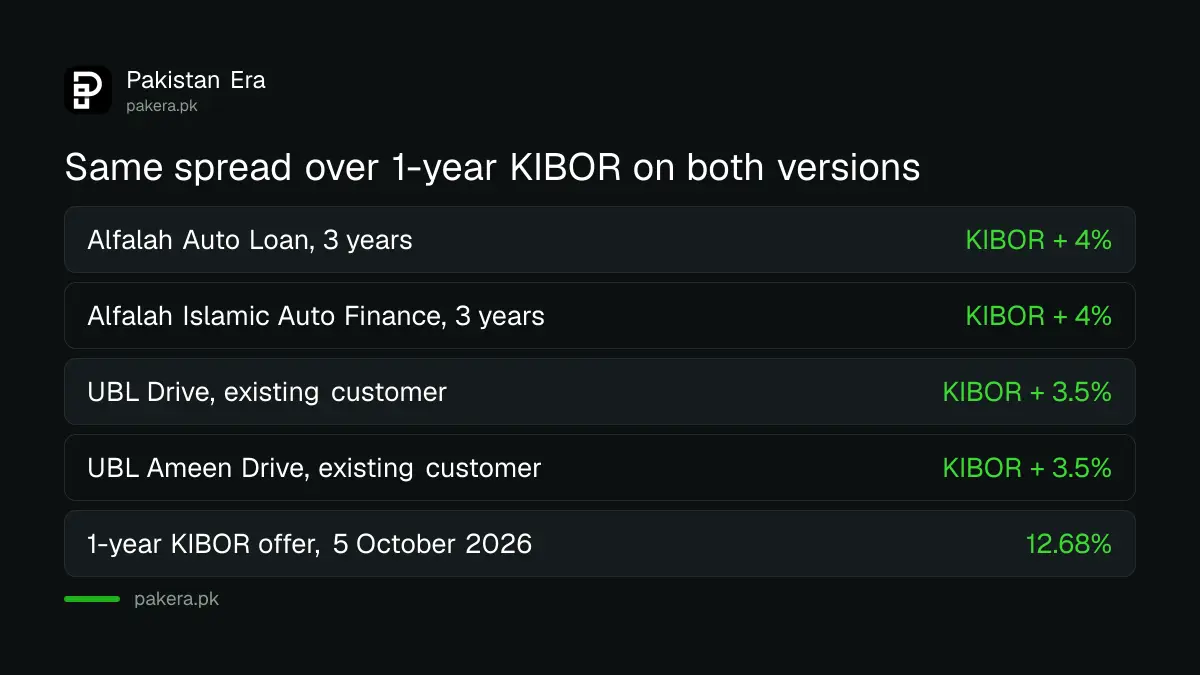
The clearest proof is a bank that sells both. Bank Alfalah's conventional Auto Loan and its Islamic Auto Finance both show 1-year KIBOR plus 3.5% for 1 to 2 years, plus 4% for 3 years and plus 4.5% for 4 to 5 years. UBL Drive and UBL Ameen Drive both show plus 3.5% for existing customers and plus 4% for new ones.
| Bank and product | Type | Pricing read on the bank's page |
|---|---|---|
| Meezan Car Ijarah | Islamic (Ijarah) | Fixed 13.38% to 13.46% by term, 13.41% for 3 years |
| BankIslami AutoFinance | Islamic (Diminishing Musharakah) | 6-month KIBOR plus a spread; spread not published |
| Alfalah Islamic Auto Finance | Islamic (Ijarah) | 1-year KIBOR + 3.5% to 4.5% |
| UBL Ameen Drive | Islamic (Diminishing Musharakah) | 1-year KIBOR + 3.5% (existing) or 4% (new) |
| HBL CarLoan | Conventional | 11.99% fixed for the whole term (promotion, no end date shown) |
| MCB Car4U | Conventional | 1-year KIBOR + 4% (MCB customers) or 4.5% |
| Bank Alfalah Auto Loan | Conventional | 1-year KIBOR + 3.5% to 4.5% |
| UBL Drive | Conventional | Fixed 16.5% (existing) or 17% (new), or KIBOR + 3.5% to 4% |
HBL's 11.99% promotion and Meezan's fixed table both sit below today's KIBOR, so expect them to change.
What a 3-year deal costs on Rs 2 million
We worked out the monthly payment on Rs 2,000,000 financed over 36 months, using the published rates and today's KIBOR. Insurance or takaful, fees and the down payment are extra.
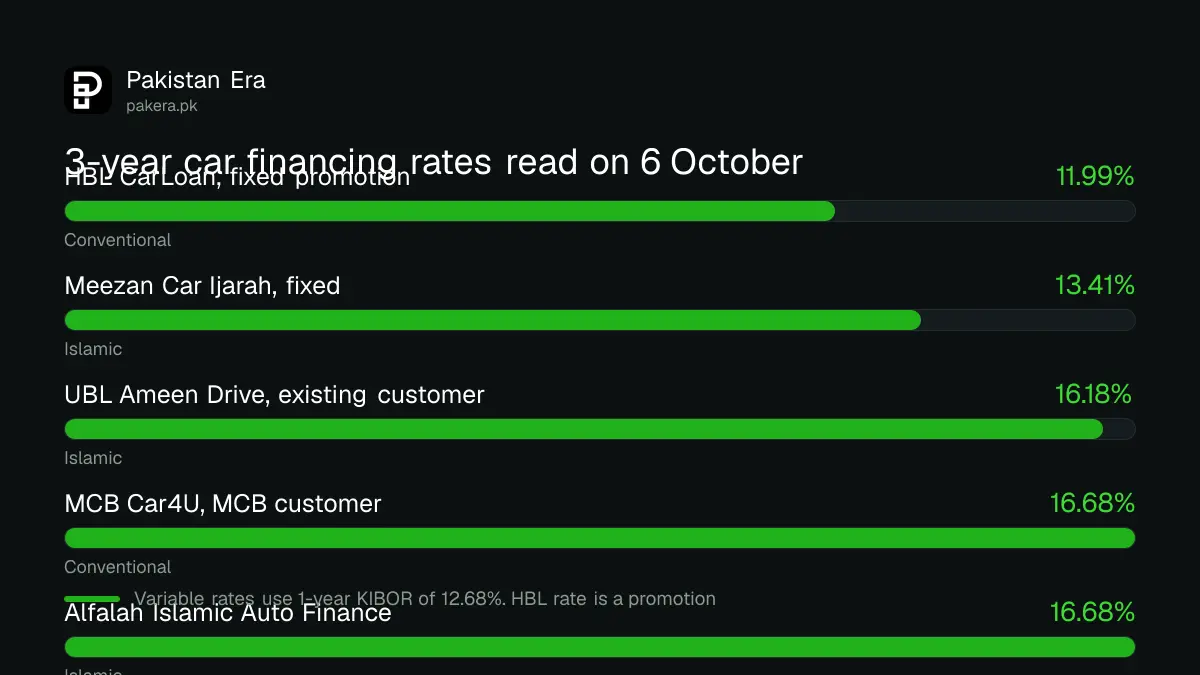
At 16.68%, the KIBOR plus 4% level at Alfalah (both versions) and MCB, the instalment is about Rs 70,990 and the total profit or markup about Rs 555,500. At Meezan's fixed 13.41% it is about Rs 67,780, with Rs 440,200 in total. At HBL's 11.99% it is about Rs 66,420, with Rs 391,100 in total. A three-point gap in rate is worth over Rs 100,000.
Ownership and risk sit in different places
In a conventional loan the car is yours, mortgaged to the bank. In Ijarah the bank owns the car and you rent it. In Diminishing Musharakah you and the bank own it together, and you buy the bank's units over time.
Meezan's page puts it plainly: ownership risks stay with the bank, usage risks stay with you. Bank Alfalah Islamic adds that it pays takaful as an owner's expense. Allied Bank says ownership passes to you at the end by a separate sale or gift.
Takaful versus insurance
Takaful is the Islamic form of insurance, based on a shared fund. On the pages we read, takaful was 1.49% a year at BankIslami (its FAQ says 1.5% to 2.8%) and 1.99% at Meezan. HBL's conventional insurance was 1.4%. On a Rs 2,860,000 car, 1.4% is about Rs 40,000 a year and 1.99% about Rs 56,900. Ask for the exact figure in your quote.
Theft or a total loss is where the contracts differ most
Under Ijarah, rent is paid for use of the car. If the car is stolen or written off, the rent should stop. Under conventional leasing, payments usually continue until the insurance claim settles.
Bank Alfalah Islamic's FAQ says rentals "will be stopped immediately" after theft or total loss. The bank can only charge rent for the days you actually used the car. It contrasts this with conventional leasing, where payments continue. You must report the incident in writing quickly, and the car insurance claim after a theft runs alongside it.
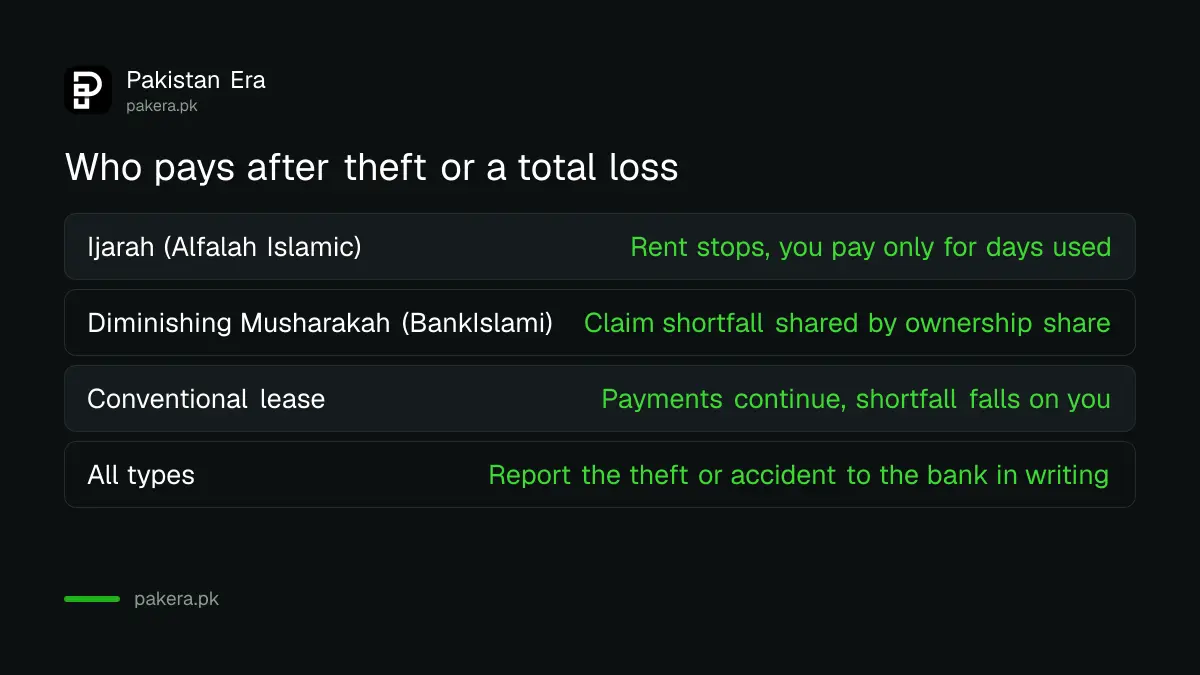
BankIslami's page puts the gap in money terms. Under a conventional lease, any shortfall in the insurance claim falls on the customer. Under its Diminishing Musharakah, the shortfall is shared by ownership share at the time of loss. That can be a real sum on a newer car.
Late payment means charity at an Islamic bank, not a free pass
Islamic banks cannot keep a late payment fee as income, because that would be riba. Instead you promise to pay an amount to a charity fund the bank manages. It still costs you money.
Meezan, Bank Alfalah Islamic and BankIslami all describe this. Alfalah Islamic says the money goes to a charity account under its Shariah Board, and you cannot pay it yourself and bring a receipt. BankIslami's comparison says conventional late charges "are taken as income".
BankIslami's fact sheet adds more. Late payment can bring charity plus additional rental on outstanding units, eCIB reporting and, in the end, repossession and auction. Meezan notes that an overdue record stays on your eCIB credit report for two years after you settle. A missed payment hurts your credit file under both systems.
Early settlement is not cheaper by default
Paying off early costs money at most banks, Islamic or not. Read the early termination table before you sign, because it can cost more than a small rate difference.
- UBL Drive (conventional): 8% of principal outstanding in years 1 to 3, 6% in years 4 to 5, per its FAQ.
- Dubai Islamic Auto Finance: 20% at 6 months, 10% at 12, 8% at 24, 6% at 36, 4% at 48 and 0% at 60 months.
- BankIslami AutoFinance: an early purchase price of 5% to 8% of the outstanding unit price.
- UBL Ameen Drive: an option priced 1% higher from the start, which lets you buy the bank's units early without an extra charge.
- HBL CarLoan: allowed, with charges as per its schedule of charges.
How to compare two quotes properly
Ask both banks for a Key Fact Statement for the same car, down payment and term. Then compare these five things in order.
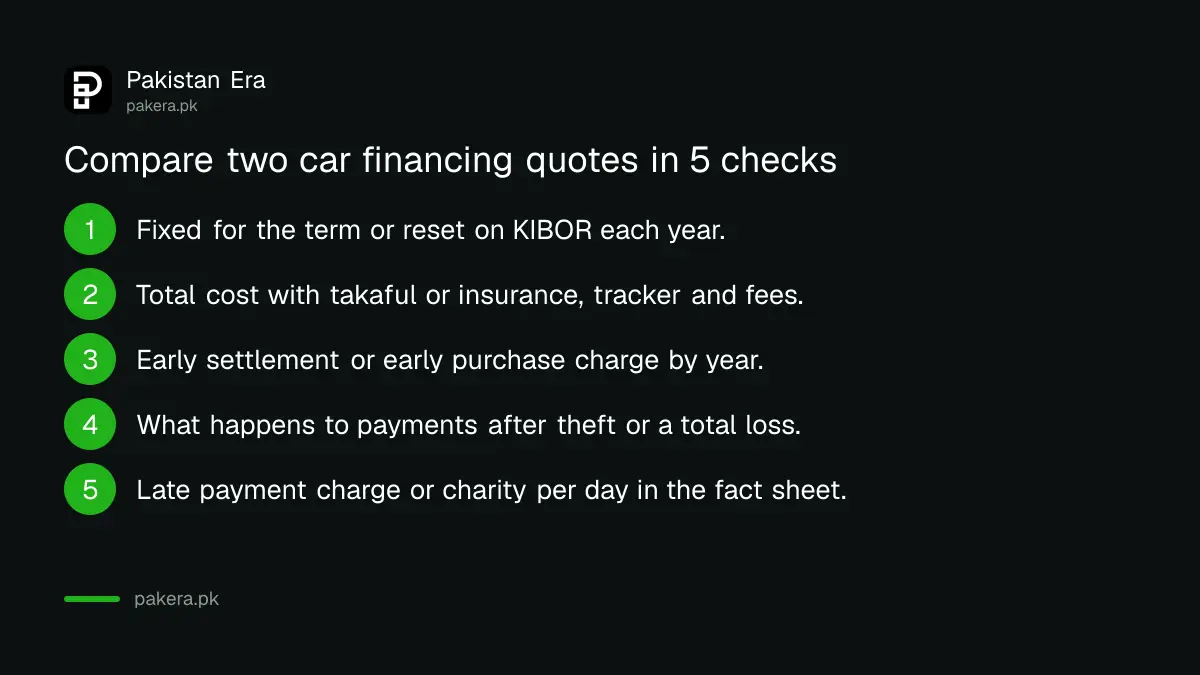
- Rate type: fixed for the term, or KIBOR plus a spread that resets every year or 6 months.
- Total cost over the term, including takaful or insurance, tracker and processing fee.
- Early settlement or early purchase charges by year.
- What happens to payments after theft or a total loss.
- Late payment treatment and the per day charge in the fact sheet.
If a variable rate worries you, read how the SBP policy rate feeds into your EMI before choosing. The down payment, the Rs 3 million cap and the term together decide what a car loan in Pakistan actually costs, whichever system you choose.
The 2027 riba deadline
On 28 April 2022 the Federal Shariat Court ruled that riba is prohibited in all forms. It directed that Pakistan become an interest-free economy by the end of 2027, as SBP's Financial Stability Review 2022 records. That deadline is 31 December 2027. We could not find any SBP instruction on what happens to existing conventional car loans at the deadline.
Try it on your own numbers: use our Car Finance Calculator to compare Islamic and conventional banks on your own car, down payment and tenure.
Common questions
Is Islamic car financing cheaper than a conventional car loan in Pakistan?
Not usually. Bank Alfalah and UBL charge the same spread over 1-year KIBOR on both versions. Price depends on the bank and the offer, not on the system.
Who owns the car during Ijarah?
The bank owns it and you rent it. Ownership passes to you at the end through a separate sale or gift, after the last rental.
Do I keep paying if my leased car is stolen?
Under Ijarah, Bank Alfalah Islamic says rentals stop at once and you pay only for days used. Under conventional leasing, payments usually continue until the claim settles.
What is the late payment charity?
It is an amount you promise to pay into a charity fund the bank manages if you pay late. The bank cannot keep it as income.
Do SBP limits apply to Islamic car financing too?
Yes. The 30% down payment, Rs 3 million cap, 40% debt burden limit and 3 or 5 year terms apply to all banks.
How we verified this
What we checked, where we read it, and what we could not confirm.
Last checked 6 October 2026. Bank terms come from each bank's own product page, FAQ or Key Fact Statement read that day: Meezan Bank, BankIslami, Bank Alfalah, Bank Alfalah Islamic, UBL, HBL, MCB, Allied Bank and Dubai Islamic Bank. KIBOR is from the State Bank of Pakistan home page (as on 5 October 2026). The SBP limits come from BPRD Circular Letter 29 of 2021 and Circular Letter 19 of 2022. The court ruling and deadline come from SBP's Financial Stability Review 2022, Box 3.2. Monthly figures are our own arithmetic, without fees or takaful. Confirm rates with the bank before you sign. This is not financial advice.
Work out your own figure
Switch between Islamic and conventional banks and compare the monthly cost on the same car.
Car Loan Calculator →About the author
Public Services and Education Journalist
Fajr Riaz is a journalist and content writer at Pakistan Era, based in Lahore. She covers the questions people meet in everyday life in Pakistan: how a public service works, what a change in the rules means, and where to find a reliable answer.