SECP Bans Ponzi, Pyramid and Deceptive MLM Schemes in Pakistan: How to Check a Scheme
SECP's 2026 regulations ban Ponzi, pyramid and deceptive MLM schemes in Pakistan. See the signs it lists, what stays legal, the penalties and what to do now.
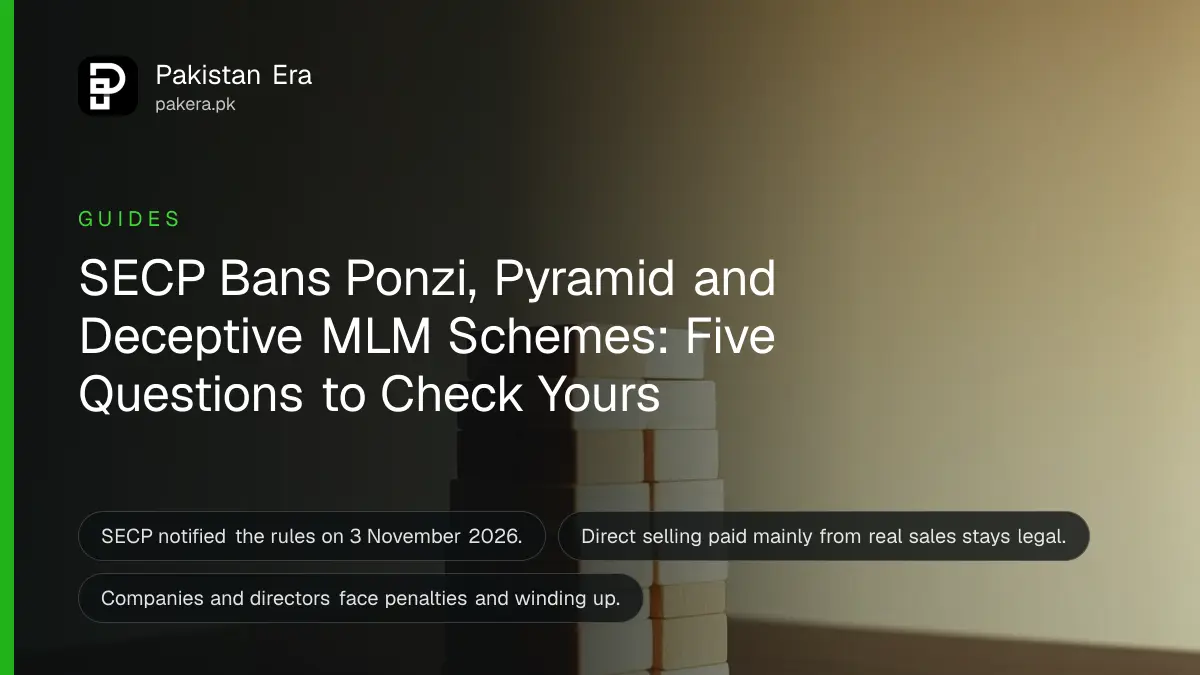
SECP notified the Companies (Prohibition of Unlawful Activities) Regulations, 2026 on 3 November 2026. They bar every company in Pakistan, including foreign ones, from running Ponzi schemes, pyramid schemes, deceptive multi-level marketing (MLM) and recruitment-based referral schemes, online or offline. Genuine direct selling, paid mainly from real sales, stays legal.
A cousin asks you to "join under him" for Rs 10,000 and promises income from everyone you bring in. Until this month, many such schemes argued that no rule named them. The new regulations now spell out the signs, and the test below lets you check any scheme against them in five minutes.
The 2026 regulations ban four kinds of scheme by name
The Securities and Exchange Commission of Pakistan (SECP) made these rules under the Companies Act, 2017. They cover Ponzi schemes, pyramid schemes, deceptive MLM and unlawful referral marketing. They apply to all companies, to schemes already running, and to websites, mobile apps and social media.
SECP first published a draft in December 2025 and finalised the rules after talks with business and professional bodies. The final version also stops any company from promoting, conducting or facilitating such a scheme, so a company that only advertises or collects money for one is covered too.
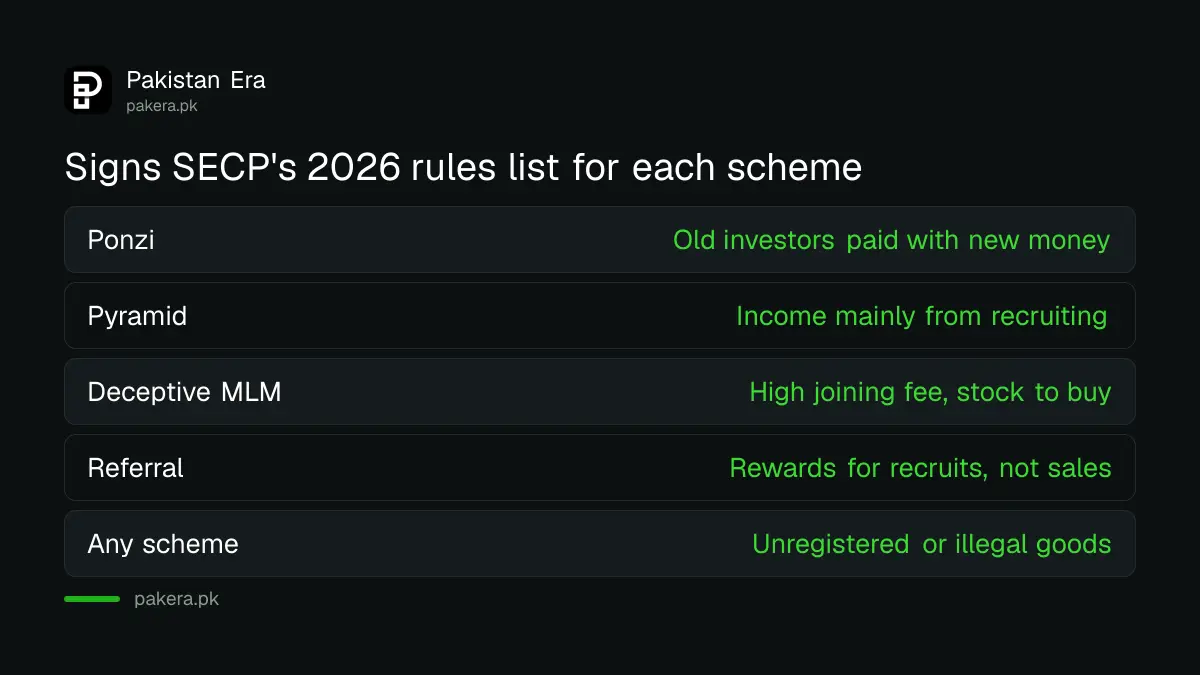
| Scheme | What the regulations treat as the sign |
|---|---|
| Ponzi scheme | Earlier investors paid from new investors' money; unrealistic or guaranteed returns; use of funds hidden |
| Pyramid scheme | Income mainly from recruiting people, not from selling products; unclear contract terms; unreasonable purchase demands; several "positions" per person to earn recruitment rewards |
| Deceptive MLM | Excessive joining fees or stock purchases; products with little real demand; misleading income or product claims; weak refund or buy-back terms |
| Unlawful referral marketing | Rewards that come from recruiting new members rather than real sales |
| Any of the above | Selling unregistered, unapproved or illegal goods |
Genuine direct selling is still allowed
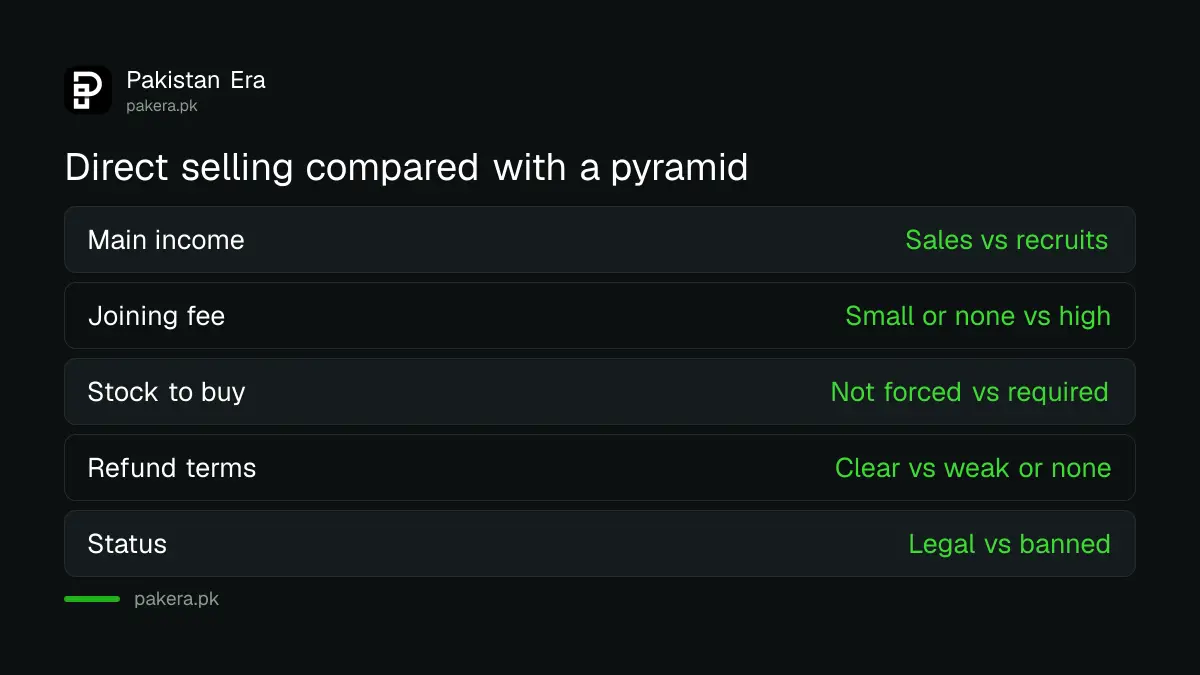
The regulations do not ban selling through people. Bona fide direct selling stays legal where a seller's pay comes mainly from actual sales to end consumers. The question is where the money comes from: real customers buying a product, or new members paying to join.
A person who sells cosmetics door to door and earns a commission on each sale is doing direct selling. A person who must pay Rs 15,000 to join, buy a stock of products nobody outside the network wants, and earns mainly when friends also pay to join, fits the pyramid signs instead.
Check any scheme against the rules in five questions
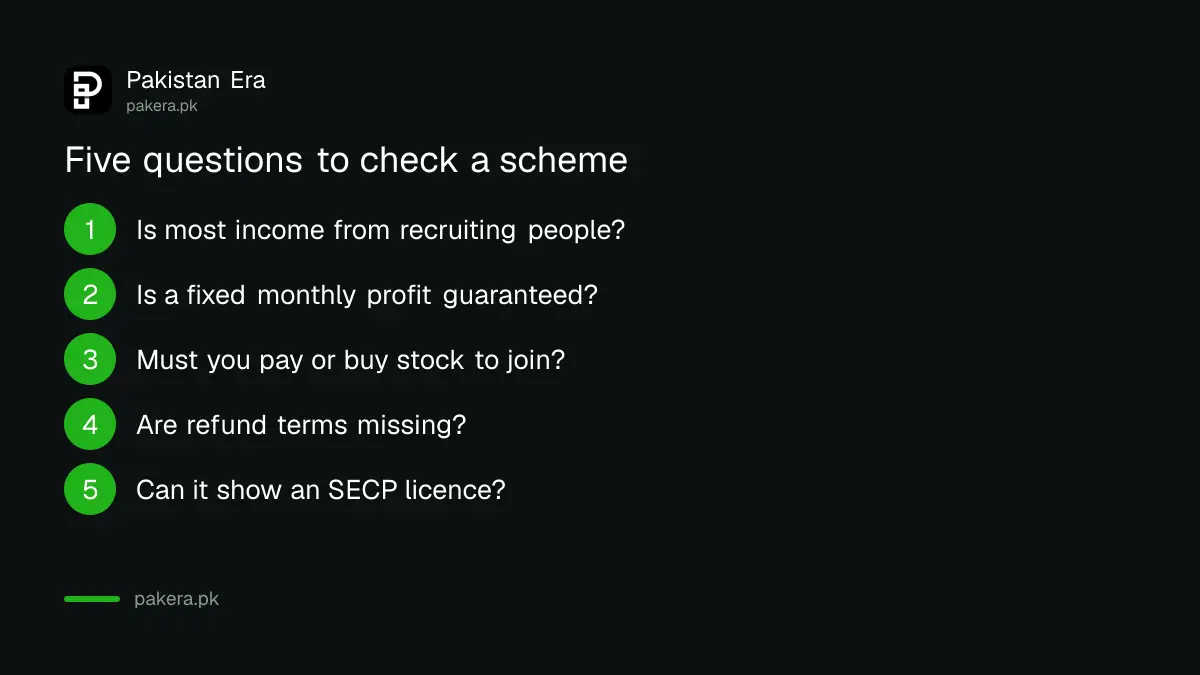
Ask these five questions before you pay a joining fee or deposit. One "yes" to any of the first four is a strong sign the scheme matches what the regulations ban. A "no" to the fifth means you have nothing to check it against.
- Does most of the income come from bringing in new members rather than from customers?
- Is a fixed or "guaranteed" monthly profit promised, with no clear business behind it?
- Must you pay a joining fee or buy stock before you can earn?
- Is there no written refund or buy-back promise for unsold products?
- Can the company show you its SECP registration and, for investments, its SECP licence?
For the fifth question, the steps to check if a company is registered with SECP take one minute. Keep in mind that registration alone does not allow a company to take deposits.
Companies and their directors now face penalties and winding up
A company that breaks the regulations, and its directors and officers, can face penalties under section 512(2) of the Companies Act, 2017. SECP can also take other action, including winding the company up under section 301 of the same Act. These are actions against the company, not a refund scheme.
That last point matters for anyone already inside a scheme. The regulations give SECP power to act against the company. They do not promise that members get their money back. Winding up can lead to a payout from whatever assets remain, but in a Ponzi collapse that is often little.
| Action | Legal basis | Against whom |
|---|---|---|
| Penalty | Section 512(2), Companies Act 2017 | Company, directors and officers |
| Winding up | Section 301, Companies Act 2017 | The company |
| Ban on promoting or facilitating | The 2026 regulations | Any company that helps run the scheme |
If you are already in a scheme, act this week
Stop paying in, and do not recruit anyone else. Collect your proof: receipts, bank or wallet transfers, screenshots of the offer, the names of the people who signed you up, and any app or group links. Then report it to SECP, and to NCCIA if you paid online.
- Report the company to SECP through its complaint channels. The steps are in the guide to file a complaint with SECP.
- If the money went through a bank, wallet or app, file with the National Cyber Crime Investigation Agency using the NCCIA complaint form.
- Write down the date you joined and every payment. A complete list helps if the company is wound up later.
The Blink Capital case shows how one Pakistani scheme looked from the inside before it fell, and why a high fixed return was the first warning.
Common questions
Is MLM banned in Pakistan?
Deceptive MLM is banned under the 2026 regulations. Genuine direct selling, where pay comes mainly from real sales to customers, is still allowed. The test is where the income comes from.
When did the SECP regulations come into force?
SECP notified the Companies (Prohibition of Unlawful Activities) Regulations, 2026 on 3 November 2026, after a draft in December 2025.
Do the rules apply to online earning apps and WhatsApp schemes?
Yes. They cover schemes run through websites, mobile apps and social media, as well as offline. They also apply to foreign companies.
Will I get my money back from a banned scheme?
The regulations allow penalties and winding up against the company. They do not promise refunds to members. Report early and keep every payment record.
Is a referral bonus on an app illegal?
Not by itself. A referral reward becomes a problem when the main way to earn is recruiting people who pay to join, rather than real sales or real use of a service.
Where can I read the official text?
SECP publishes its notified regulations and press releases on its own website under Laws and Media Centre.
How we verified this
What we checked and where we read it.
Checked on 25 November 2026. The name of the regulations, the 3 November 2026 notification date, the scheme criteria, the direct selling exception, the coverage of foreign companies, existing schemes and digital channels, and the penalty sections (512(2) and 301 of the Companies Act, 2017) are consistent across reports of SECP's announcement on 3 November 2026. The December 2025 draft is recorded in reports of SECP's draft notice. The company check in step five uses SECP's Company Name Search, which we used on 25 November 2026.
Free on WhatsApp
Get last dates and rule changes on WhatsApp
We post new last dates, fee changes and fixes for common problems, a few short posts a day.
Follow Pakera on WhatsAppOther followers cannot see your number.
Pakera Solves It
Which online process wasted your time this week?
A portal that will not load, a form nobody explains, a complaint that went nowhere. Tell us. Every week we pick one, solve it step by step and publish the answer.
About the author

Senior Writer, Public Services and Technology
Shahid joined us in 2024 as an author. He is a senior contributor to Pakistan's leading technology websites. He writes detailed articles, mostly covering his expertise in the latest tech, mobiles, apps, gadgets, and step-by-step guides. His ideology is to help people understand the latest trends and explain complex methods through very easy-to-understand guides.