How to File a Consumer Court Complaint in Sindh: 15 Day Notice and 30 Day Limit
Send a written notice, wait 15 days, then file within 30 days. See each step of a Sindh consumer court claim under the 2014 Act, with limits, orders and appeal.
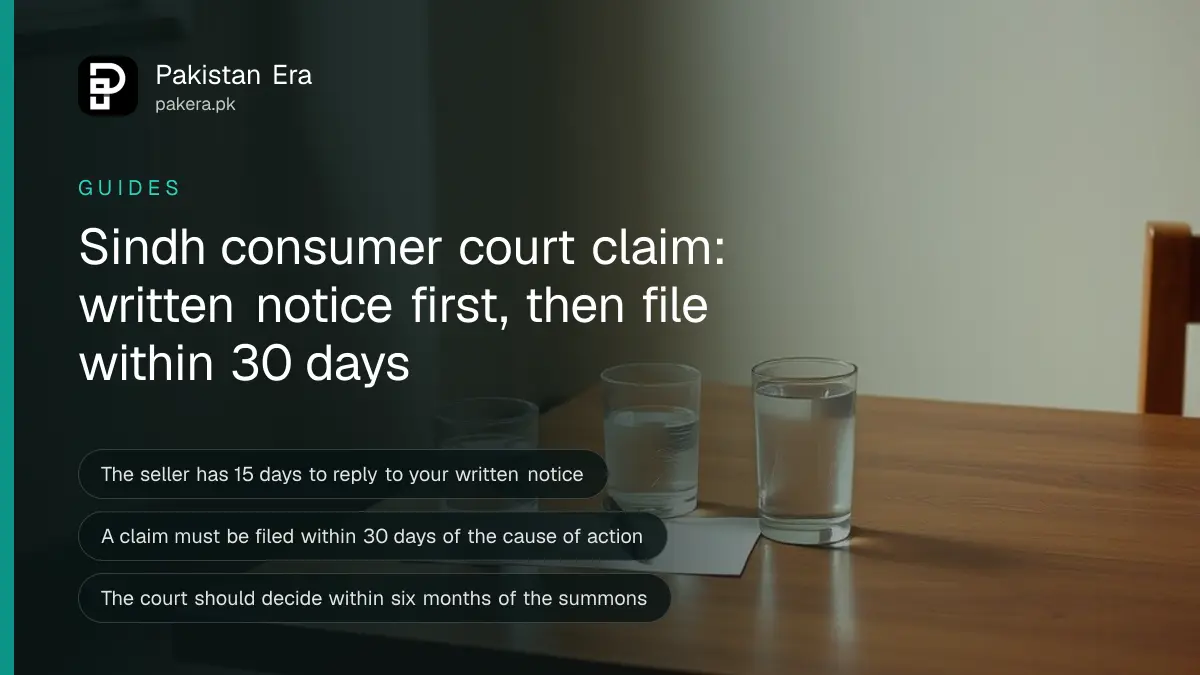
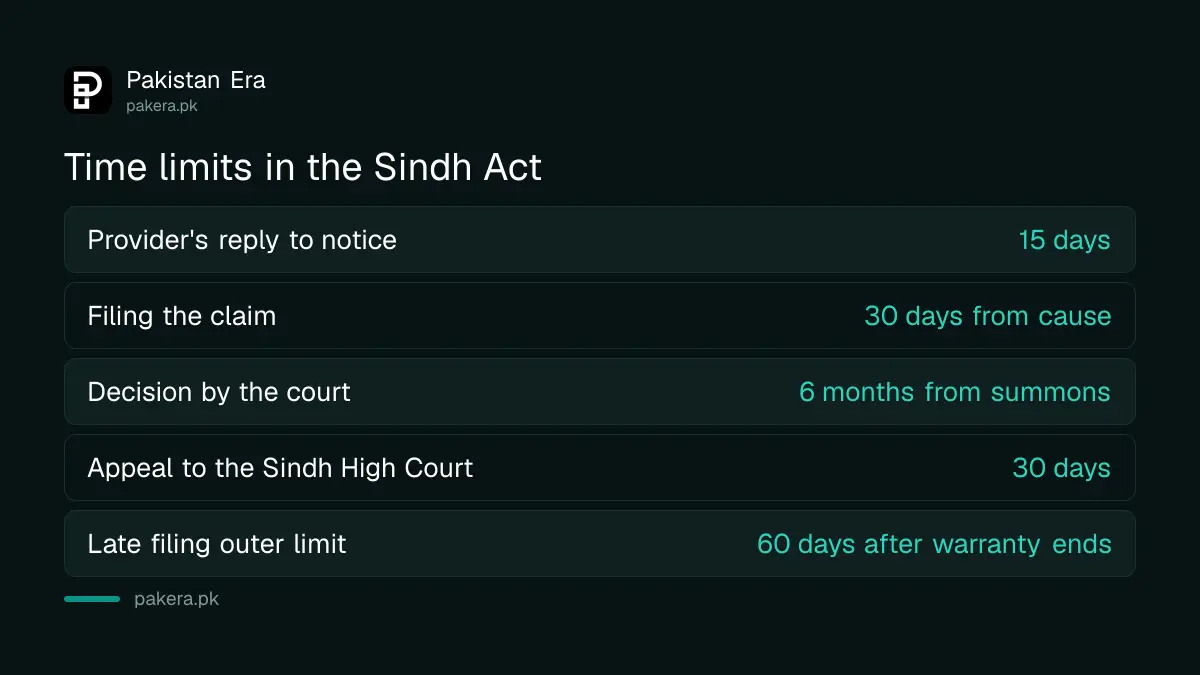
To take a seller or service provider to a Sindh consumer court, first send a written notice and wait 15 days for a reply. Then file the claim within 30 days of the problem arising. The Sindh Consumer Protection Act, 2014 sets both clocks, and the court will not hear a claim without proof that the notice was delivered.
Most people lose time here, not on the merits. A phone call to the shop starts no clock. A letter does. This guide follows the Act's own wording, so you can check each step against the law.
Send a written notice before anything else
Section 29 says no consumer court will entertain a claim unless you first gave written notice and can prove it was delivered. The provider then has 15 days from receiving it to reply. No reply, or an unfair one, opens the way to court.
Your notice should say four things: what you bought or hired, what is wrong, what you want (repair, replacement, refund or damages), and that you will go to the consumer court if there is no answer. Keep it short and dated.
Send it in a way that leaves proof, such as a courier receipt, a registered post slip or a signed acknowledgement copy. Keep the receipt, the bill and the product with you. Our guide to claiming an electronics warranty shows what a good paper trail looks like.
File within 30 days of the cause of action
Section 29(4) says a claim must be filed within 30 days of the cause of action arising. The court may allow a late claim if you show a sufficient reason, but the Act caps that extension in two ways, shown in the table below.
| Point | What the Act says |
|---|---|
| Written notice | Required first, with proof of delivery |
| Provider's time to reply | 15 days from receiving the notice |
| Filing time | 30 days from the cause of action |
| Late filing | Only with sufficient cause |
| Outer limit for late filing | 60 days after the warranty ends, or one year from purchase if no warranty period is stated |
The two clocks overlap. If you wait a week before sending the notice, then wait 15 days for the reply, little of the 30 days is left. Send the notice the day you find the fault. This is our reading of the Act, and a lawyer can confirm how a court counts the days in your case.
File in the district where the seller works or the problem arose
Each district is to have one or more consumer courts, each led by a Judicial Magistrate. You can file where the seller or provider lives, runs a business or works, or where the cause of action wholly or partly arose.
That last option helps online buyers. If the problem happened where you received the goods, that district can be a place to file. Ask the district courts office which court is notified for consumer claims, because we did not find a public list.
The Act does not make a lawyer compulsory. It also does not state a court fee. We could not confirm the filing fee from the Act, so ask the court office before you go.
Know what the court can order
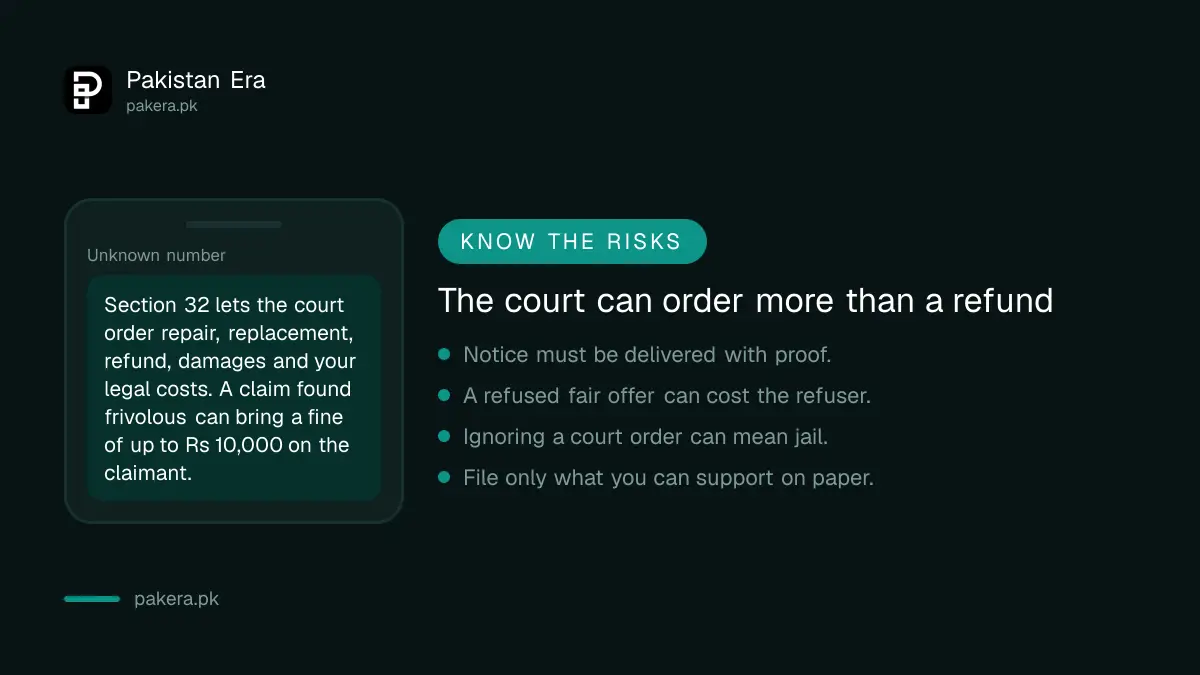
If the court agrees, section 32 lets it order the seller to repair the defect, replace the product, refund the price, pay reasonable compensation and damages, and pay your actual legal costs including lawyer fees. It can also order a recall or destruction of a defective product.
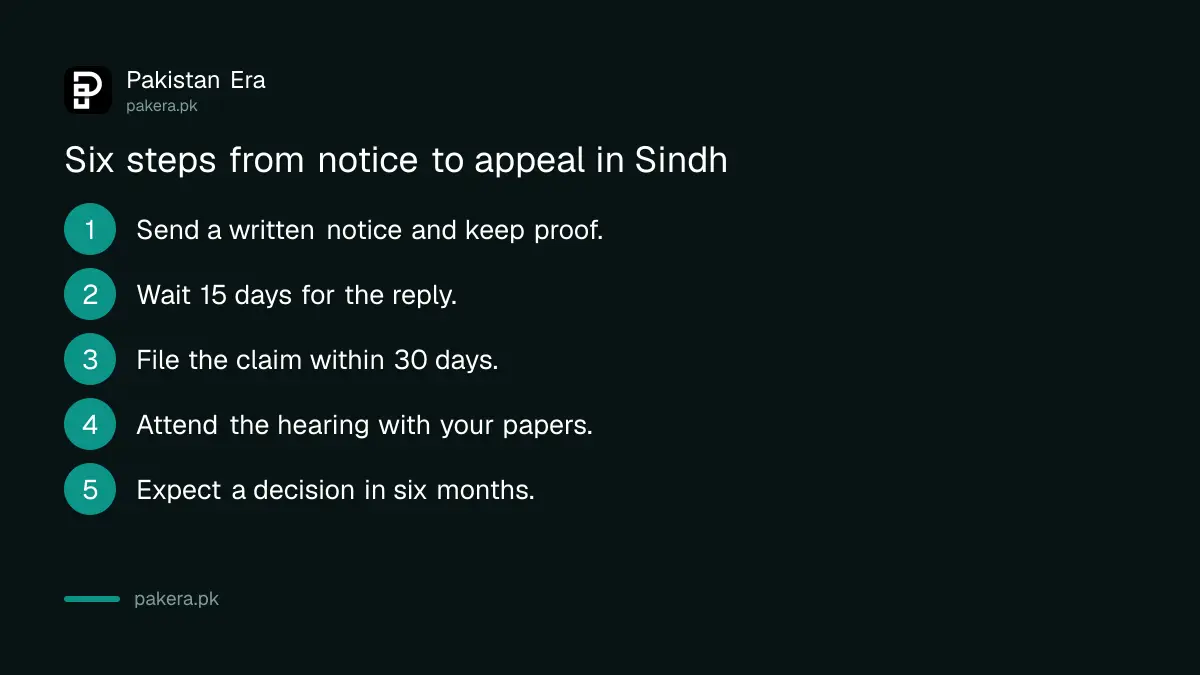
- Send the written notice and keep proof of delivery.
- Wait 15 days for the reply.
- File the claim within 30 days of the cause of action.
- Attend the hearing with the bill, notice, proof and photos.
- Expect a decision within six months of the summons being served.
- Appeal to the Sindh High Court within 30 days if you disagree.
Section 31 says the court should decide a claim within six months after the summons reaches the other side. The defendant gets 15 days, extendable by up to 15 more, to file a written reply.
Make a written settlement offer to protect your costs
Section 30 lets either side make a firm written settlement offer before trial. If the other side refuses and the final order goes against them, they must pay the actual costs of the case, including lawyer fees. A fair written offer can protect you.
Be careful with the opposite risk. Section 36 says a claim found frivolous or vexatious is dismissed, with a fine of up to Rs 10,000 on the claimant. File only a claim you can support with papers.
Orders are also enforceable. Section 33(2) says a party who fails to comply with a court order can face one month to three years in prison, or a fine of Rs 50,000 to Rs 200,000, or both.
Use the other routes if a court is too much
You do not always need a court. For missing price displays, no receipt or no disclosure, section 23 lets any person complain to the Authority, which is the Secretary or Director General of the Supply and Prices Department, who can fine the violator up to Rs 50,000.
For overcharging in Karachi and Sindh, see how to report overcharging by calling 1299 or online. For the general route in other provinces, read the guide to taking a shop to consumer court and the one for a KP consumer court complaint. For online orders, see your return and refund rights.
Common questions about Sindh consumer courts
Can I go straight to the consumer court without a notice?
No. Section 29(3) says the court cannot entertain a claim unless you gave written notice and can show it was delivered and not answered. Skipping the notice is the most common reason a claim fails.
Who counts as a consumer under the Act?
A person who buys a product or hires a service for a price, including its user. Someone who buys for resale or a commercial purpose is not a consumer, though goods bought for your own livelihood are treated differently, so ask a lawyer if unsure.
What if the 30 days have already passed?
The court may allow a late claim if you show sufficient cause, but not beyond 60 days after the warranty ends, or one year from purchase when no warranty period is given. Explain the delay in writing.
Can I appeal if I lose?
Yes. Section 34 allows an appeal to the Sindh High Court within 30 days of the final order. Otherwise the order becomes final under section 35.
Does a lawyer cost me more than I can win?
It can. That is why a settlement offer under section 30 matters, since the side that refuses a fair offer and then loses pays actual costs. Ask for a fee quote before you decide.
How we verified this
What we checked, where we read it, and what we could not confirm.
Last checked 8 October 2026. We read the Sindh Consumer Protection Act, 2014 (Sindh Act No. XVII of 2015) as published on the Sindh Laws website, covering sections 2, 18 to 23 and 25 to 36. We have not seen any amendment since, but laws can change, so check the current text. The Act does not state a court fee, and we did not find a public list of notified consumer courts, so confirm both with the district courts office. This guide is general information, not legal advice.
About the author

Public Services and Education Journalist
Fajr Riaz is a journalist and content writer at Pakistan Era, based in Lahore. She covers the questions people meet in everyday life in Pakistan: how a public service works, what a change in the rules means, and where to find a reliable answer.