What to Do After a Snakebite in Pakistan: First Aid, Antivenom and What Not to Do
WHO and NIH say go to hospital after a snakebite, stay still and take off tight items. See the first aid steps, what not to do and where the two sources differ.
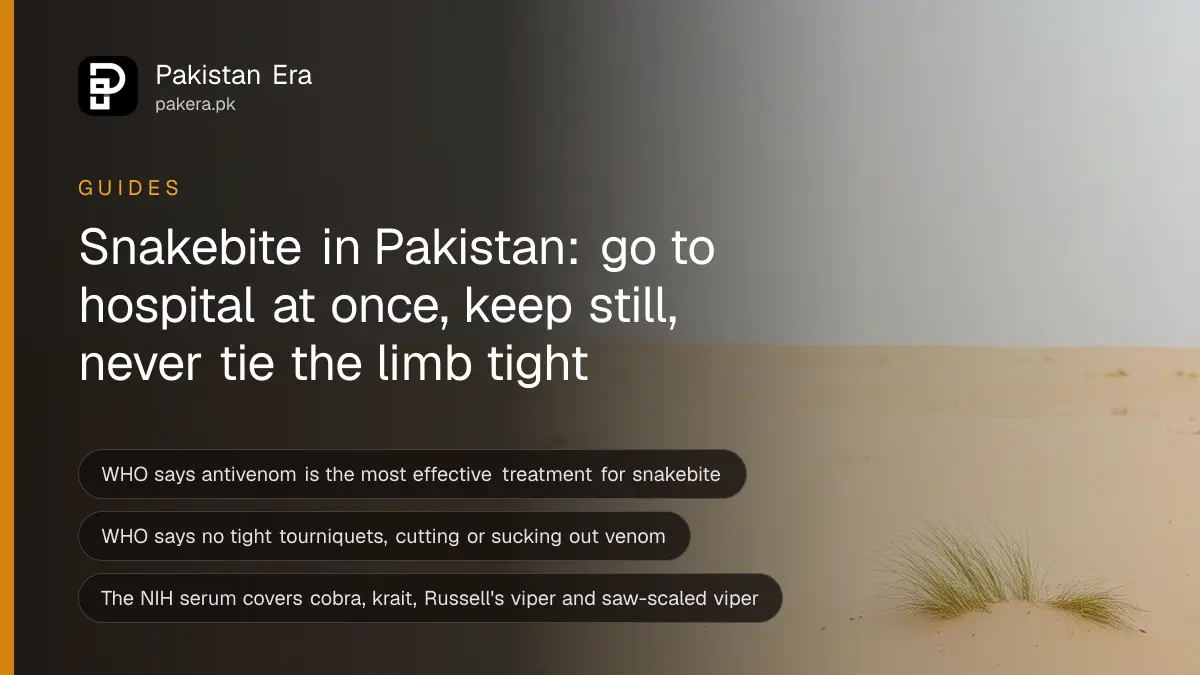
Short answer: After a snakebite in Pakistan, move away from the snake, keep the person calm and still, take off rings and tight items, and get to a hospital at once. Antivenom is given only at a health facility. Do not cut the wound, suck it, use a tight tourniquet or try herbal remedies. The World Health Organization (WHO) and the National Institute of Health (NIH) both say so.
A snakebite is a medical emergency, and the first hour often goes to the wrong things: a rope tied tight, a blade, a visit to a healer. Those steps lose time. The only treatment that neutralises venom is antivenom, and it is given in a hospital.
We read the WHO snakebite fact sheet and first aid guidance, and the NIH Islamabad leaflet on anti-snake venom serum, on 12 October 2026. We are not doctors. This page repeats what those bodies say and gives no treatment advice of our own.
Go to a hospital first, because only antivenom neutralises the venom
WHO says high-quality antivenoms are the most effective treatment to prevent or reverse most of the effects of a snakebite. The NIH leaflet says that once venom is in the blood, it is the anti-snake venom serum that can neutralise it. Nothing you do at home replaces it.
WHO estimates that around 81,410 to 137,880 people die each year worldwide from snakebites. It says most deaths and serious harm are preventable. Speed to a facility with antivenom is the point of everything below.
Call an ambulance if you can, but do not wait for one if a vehicle is faster. Our guide to Edhi and Chhipa ambulance numbers lists the lines, and in Punjab you can read how to request Rescue 1122.
First aid: what WHO says to do
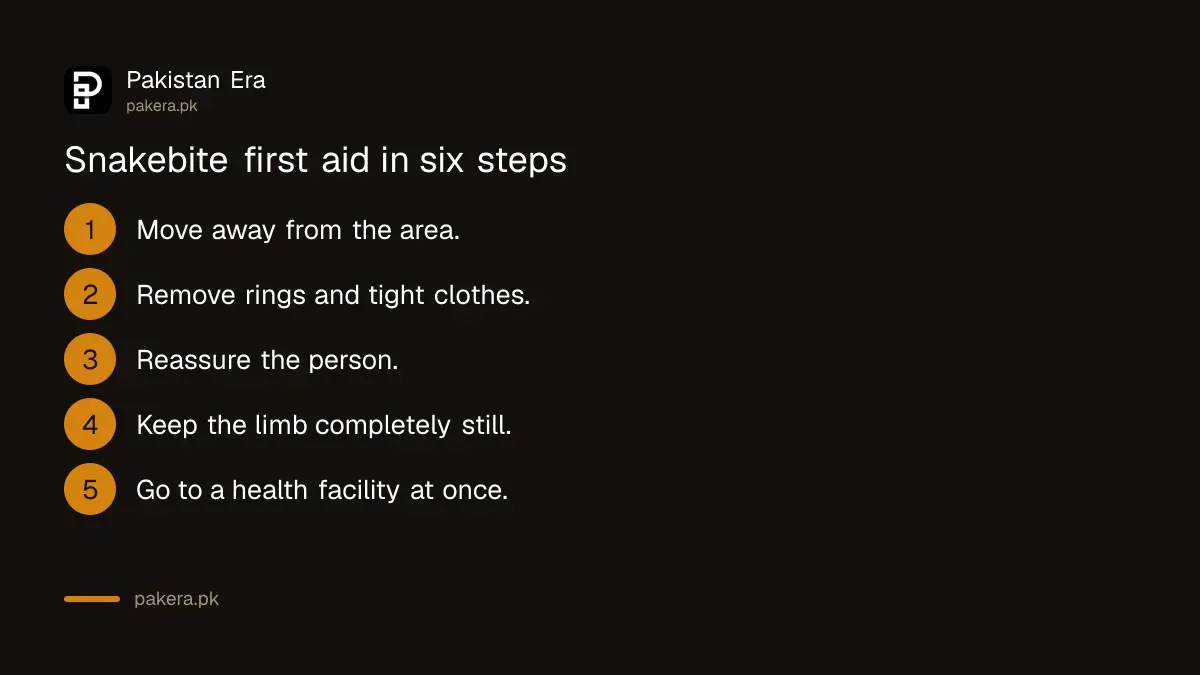
WHO's list is short. Move away from where the bite happened, take off anything tight from the bitten limb before it swells, reassure the person, keep them completely still, and move them to a health facility as soon as possible.
- Move away from the area. If the snake is still attached, use a tool, not your hand.
- Remove rings, bracelets, anklets and tight clothes from the bitten part.
- Reassure the person. WHO notes most venomous bites do not cause immediate death.
- Keep the person completely still. Splint the limb and use a makeshift stretcher.
- Take the person to a health facility as soon as possible.
- If they vomit, place them on their left side in the recovery position.
WHO says paracetamol may be given for local pain, which can be severe. It also says to watch the airway and breathing closely, and to be ready to resuscitate.
What not to do after a snakebite
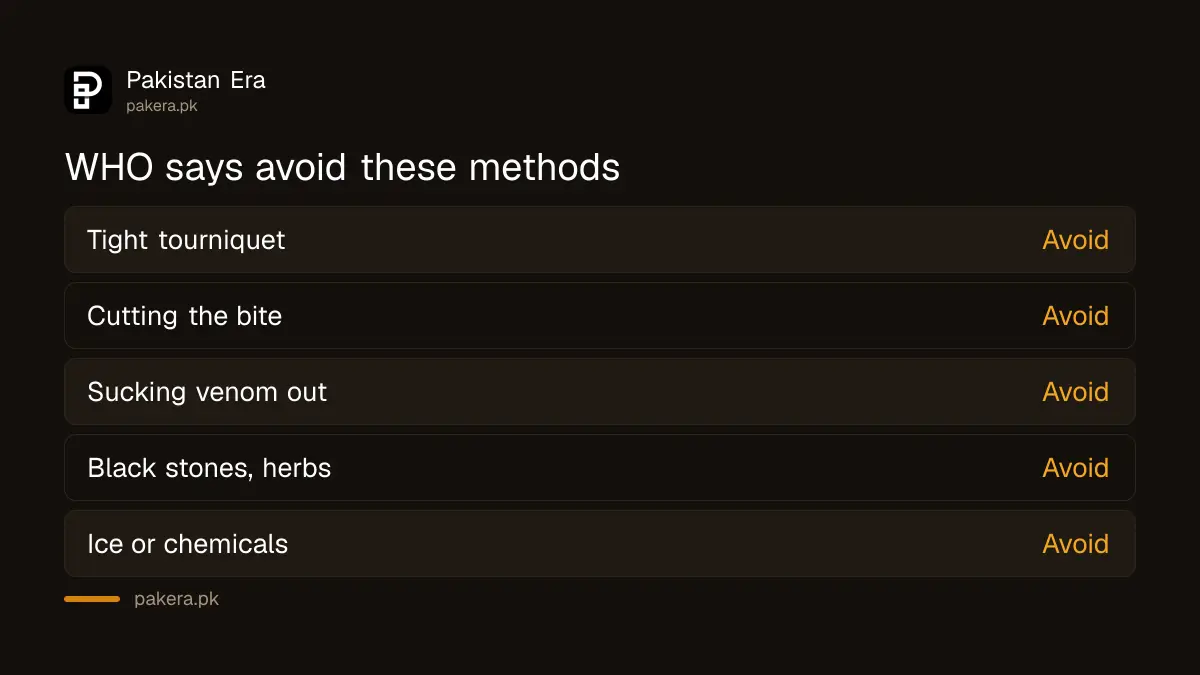
WHO says to avoid traditional first aid methods, herbal medicines and other unproven or unsafe methods. Its list names tight arterial tourniquets, cutting or pricking the bite, sucking out venom, black stones, electric shock and chemicals or ice on the wound.
| Do not | Source |
|---|---|
| Tie a tight tourniquet | WHO |
| Cut or prick the wound | WHO |
| Suck the venom out | WHO |
| Use black stones or herbal remedies | WHO |
| Use ice, freezing agents or chemicals | WHO and NIH |
| Burn the wound or give electric shock | WHO and NIH |
Bandage advice differs between NIH and WHO, so tell the doctor what was done
The NIH leaflet says to apply a pressure bandage on a limb bite and to ease it every 10 minutes. WHO says pressure immobilisation suits only some bites, from snakes with nerve venom and no local swelling, and that a pressure pad may be suitable in some cases.
The NIH leaflet we read is a printed insert for doctors, and its code shows a 2007 print run. We cannot say which version NIH's current training uses. The safe common ground is this: nothing tight, keep the limb still, and go. Whatever was applied, tell the doctor.
Note down the time of the bite. If you can do it safely, tell staff what the snake looked like. Do not try to catch it or carry it in.
Antivenom in Pakistan covers four common snakes and must be kept cold
The NIH leaflet says its serum is made from horse immunoglobulins against four common poisonous snakes of Pakistan: cobra, krait, Russell's viper and saw-scaled viper. It says the serum must be stored at 2 to 8 degrees Celsius and that room temperature damages it.
That is why antivenom sits in hospital fridges and not in a village shop or a home. The leaflet says doses and repeats are decided by the doctor according to symptoms. It says adrenaline should be kept ready in case of an allergic reaction, so the patient should be in a facility that can manage that.
We could not confirm which hospitals in your district hold stock at the moment. Ask the ambulance service or call the nearest government hospital before you set out, if you can do that without delay.
Common questions
Should I tie a cloth above a snakebite?
Not tightly. WHO says never to use a tight arterial tourniquet. Remove tight items, keep the limb still and go to a hospital.
Can I suck the venom out?
No. WHO lists sucking out venom among methods to avoid, along with cutting the wound.
Is antivenom free in government hospitals?
We could not confirm a current free-of-charge policy on an official page, so we do not state one. Ask the hospital. Do not delay treatment over cost.
Is every snake in Pakistan dangerous?
No. WHO notes that many bites are not venomous. But you cannot tell at home, so treat every bite as an emergency until a doctor says otherwise.
Should I bring the dead snake to the hospital?
Do not risk another bite to catch or carry it. A photo from a safe distance, or a description, is enough for staff.
What if the bite is from a dog and not a snake?
Our guide on what to do after a dog bite in Pakistan covers rabies shots and the first steps.
How we verified this
What we checked, where we read it, and what we could not confirm.
We read the WHO snakebite envenoming fact sheet and its first aid and treatment pages, and the NIH Islamabad leaflet for anti-snake venom serum, on 12 October 2026. We did not find a current NIH advisory on snakebite among its published advisories. This page is general information, not medical advice.
About the author

Public Services and Education Journalist
Fajr Riaz is a journalist and content writer at Pakistan Era, based in Lahore. She covers the questions people meet in everyday life in Pakistan: how a public service works, what a change in the rules means, and where to find a reliable answer.