Pakistan’s State Companies Score 46% in Power and 75% in Oil and Gas Against Their Own Plans
Finance Division scores for July to December 2025: Pakistan state power companies met 46% of their plans, oil and gas 75%. Return on equity was only 1.26%.
Pakistan's power sector state companies scored only 46 percent against their own business plans in July to December 2025. Oil and gas scored 75 percent, financial companies 66 percent and infrastructure 55 percent, says the Finance Division. The report also says the state company portfolio earns a return on equity of 1.26 percent.
A business plan is the target a state company sets for itself: how much it will earn, spend and fix. The Finance Division's report checks the actual results against those plans. This page explains the scorecard in plain words and what it says about where public money is working and where it is not. We downloaded and read the report on 13 October 2026.
Oil and gas met 75 percent of its plan and power only 46 percent
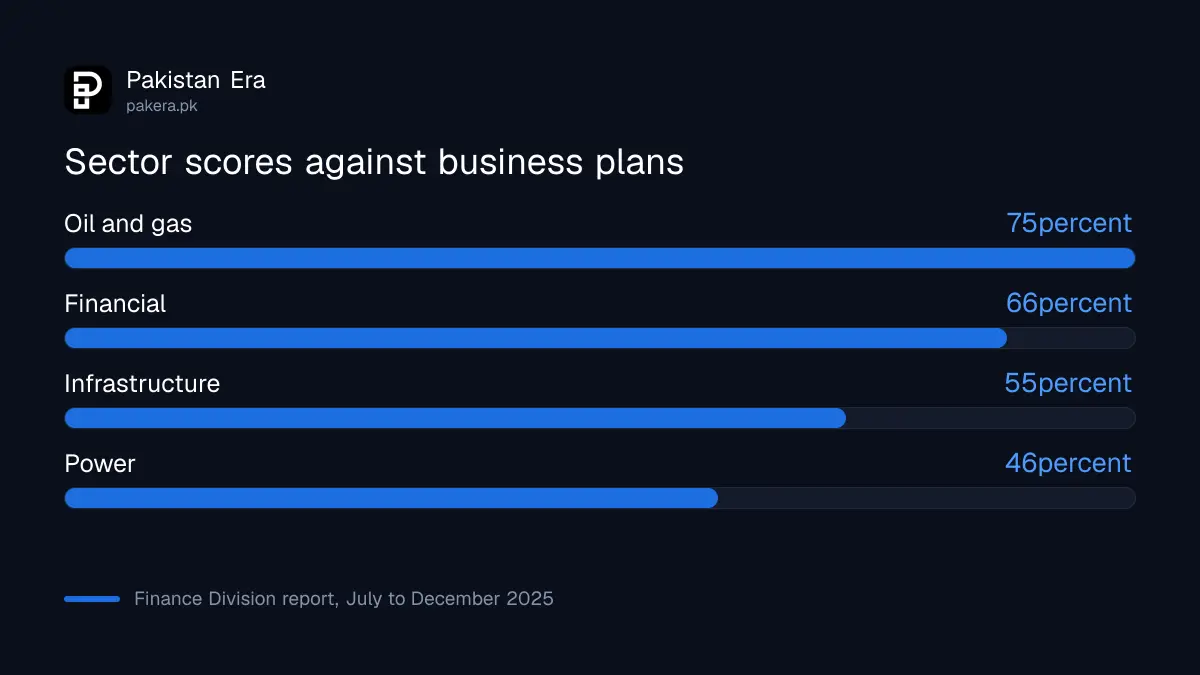
The report ranks the four main sectors by a cumulative scorecard. Oil and gas leads at 75 percent. Financial companies follow at 66 percent and infrastructure at 55 percent. Power is last at 46 percent, which the report calls a concerning result.
| Sector | Score against business plans | What the report says |
|---|---|---|
| Oil and gas | 75% | Strong target delivery, financially grounded exploration plans |
| Financial | 66% | Good planning, risk-adjusted capital use |
| Infrastructure | 55% | Railways, telecom and the NHA pull the score down |
| Power | 46% | High technical losses in DISCOs largely unaddressed |
The report says recovery targets in high-loss electricity companies were either missed or improved only slightly, and that targets were often too weak. It adds that circular debt will keep growing until the plans reflect these issues.
A few companies earn the profit and many lose it
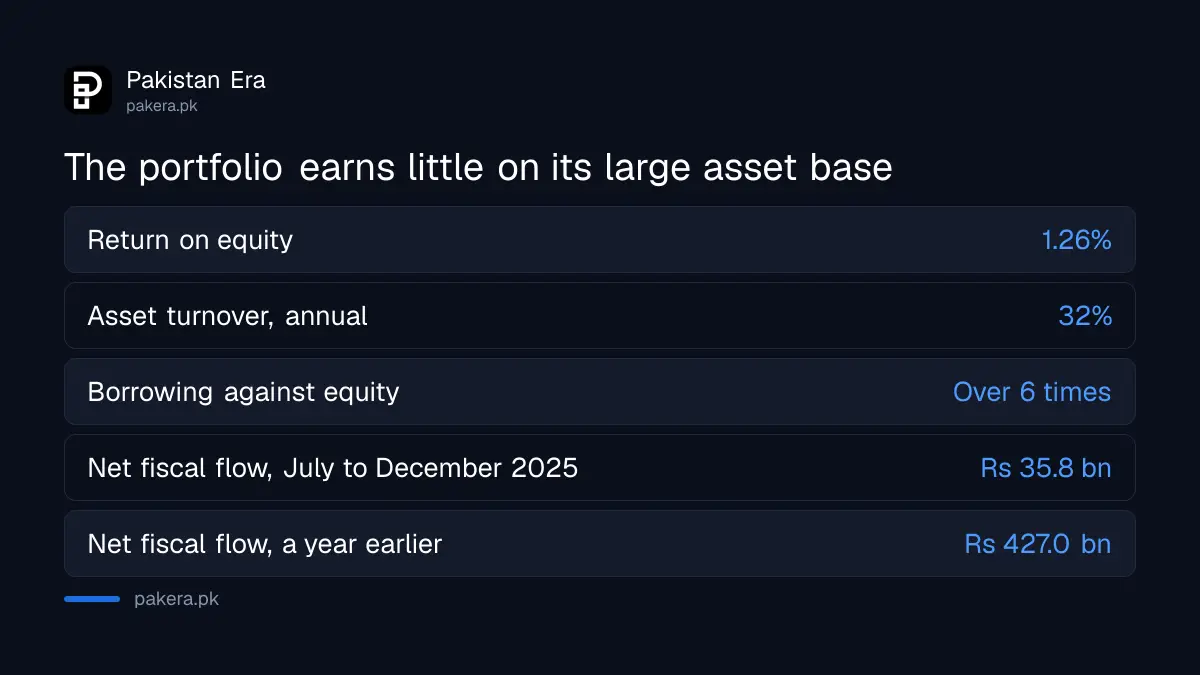
Return on equity for the whole portfolio is 1.26 percent. Asset turnover is 32 percent on an annual basis, and borrowing is more than six times equity. The report says these figures keep the portfolio exposed to shocks.
Profit is concentrated in oil, gas and financial companies. The debt that these companies carry is set out in what Pakistan’s state companies owe.
One rupee in nine of federal tax goes back to state companies
Government support to state companies was Rs 804 billion in six months. The report compares it with Rs 7,065 billion of federal tax revenue in FY2025 and says about 11 percent, or roughly one rupee in nine, goes back to these companies.
The report also says its net fiscal flow, the money state companies send to the government minus support received, fell from Rs 427.0 billion to Rs 35.8 billion. If the trend goes on, state companies could cost the budget more than they give.
The IMF lists better state company governance and transparency among Pakistan's duties. See the staff-level agreement on the 1.2 billion dollar tranche for the money behind it.
Two risks the report flags for the next year
The first risk is a new accounting rule. The report says state companies must move to full IFRS reporting, including a test for expected credit losses. It warns that this could force oil and gas companies to set aside provisions close to Rs 500 billion, which would cut profit and dividends to the government.
The second is contingent liabilities. Sovereign guarantees stand at Rs 2,123 billion and unfunded pensions near Rs 1.98 trillion. These are promises that could become direct government debt under stress.
- Open the Finance Division Central Monitoring Unit page and download the H1 FY2026 report.
- Read the executive summary on pages 7 to 13 for the sector scores.
- Check the "Key Risks" section in Part III for the IFRS and fiscal risk warnings.
- Compare the sector score of your interest, for example power or railways, with the others.
What the scorecard does not tell you
The score measures results against a company's own plan, not against the public's needs. A high score can mean a good plan or an easy plan. The report itself says some targets were too weak.
The report also covers July to December 2025 only. It was dated 2 June 2026 and posted on 5 October 2026, so later results are not in it. For current economy numbers, see the Finance Division economy update for September 2026.
Common questions
What does a score of 46 percent for power mean?
It means the power sector companies met less than half of the targets in their own business plans in July to December 2025.
Which sector did best against its plan?
Oil and gas scored 75 percent, the highest of the four sectors in the Finance Division report.
What is the return on equity of Pakistan’s state companies?
The report puts it at 1.26 percent for the portfolio, down from 1.67 percent a year earlier.
How much do state companies cost the budget?
Government support was Rs 804 billion in six months, about 11 percent of federal tax receipts, or roughly one rupee in nine.
What is the IFRS risk in the report?
A new accounting test for expected credit losses could force oil and gas companies to book provisions near Rs 500 billion.
Is this about all state companies?
It covers federal state-owned enterprises only. Provincial companies are not in this report.
How we verified this
What we checked, where we read it, and what we could not confirm.
Last checked on 13 October 2026, Pakistan time. We read the Finance Division Central Monitoring Unit's bi-annual report on federal state-owned enterprises for July to December 2025: the executive summary, the integrated snapshot and the fiscal risk section. We did not read the individual business plans and we do not judge whether the targets were fair.
About the author

Global Affairs & Political Economy Writer
Muhammad Hatim is a book lover who started writing because he enjoys it. At Pakistan Era he writes about international relations, geopolitics and the global economy, with a particular interest in South Asia and the forces behind current events.