State Companies in Pakistan Owe Rs 1.98 Trillion in Unfunded Pensions, 74% of It in the Power Sector
Pakistan state companies carry Rs 1,982.4 billion in unfunded pension promises, 74% in power. MEPCO, LESCO and PESCO lead. We read the Finance Division report.
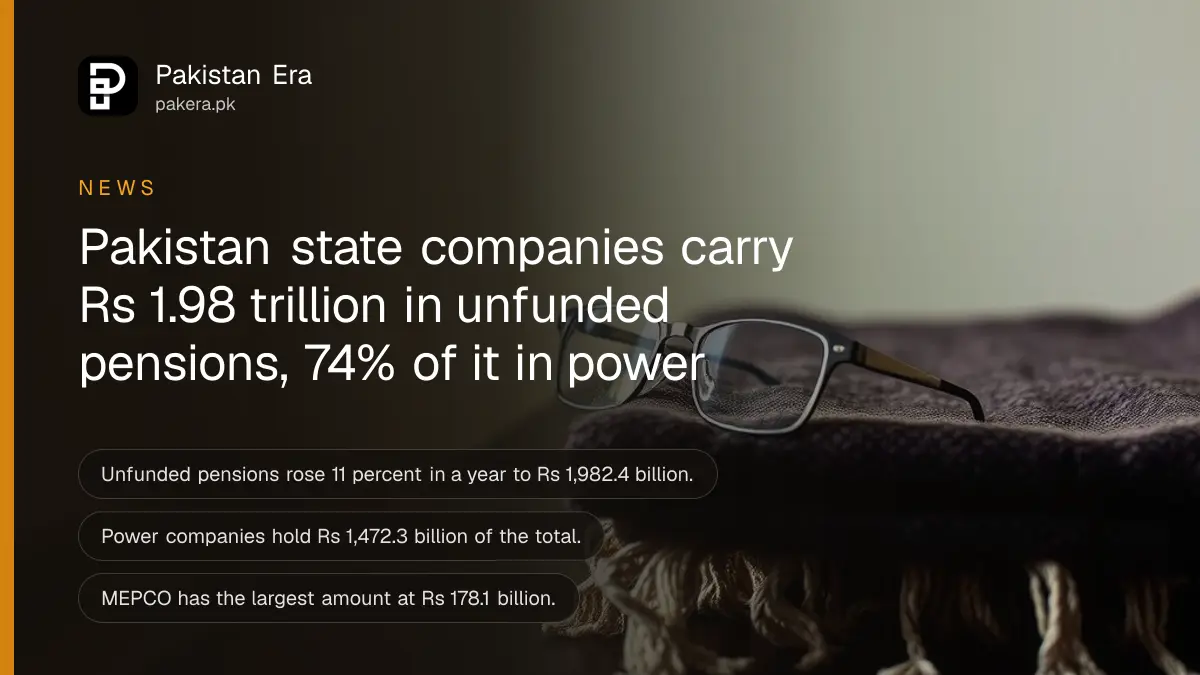
Pakistan's federal state-owned companies had Rs 1,982.4 billion, about Rs 1.98 trillion, in unfunded pension promises at the end of December 2025. Power sector companies hold Rs 1,472.3 billion of it, 74 percent. The total is 11 percent higher than a year earlier. MEPCO, LESCO and PESCO carry the largest amounts.
An unfunded pension is a promise to pay retired staff that has no pot of money set aside. It is paid each year from current income, or from the budget when the company cannot. The report does not say pensions are in danger. It says the promise is a growing claim on the state. We downloaded and read the Finance Division report on 13 October 2026.
Unfunded pension promises reached Rs 1.98 trillion
The Finance Division's bi-annual report lists unfunded pension liabilities by sector and by company as of December 2025. The total is Rs 1,982,429 million, up from Rs 1,791,630 million a year earlier, a rise of 11 percent.
The report's own GDP figure is Rs 114 trillion, so the pension promise equals about 1.7 percent of that figure. The report calls these amounts latent obligations that could become direct federal liabilities in a stressed economy.
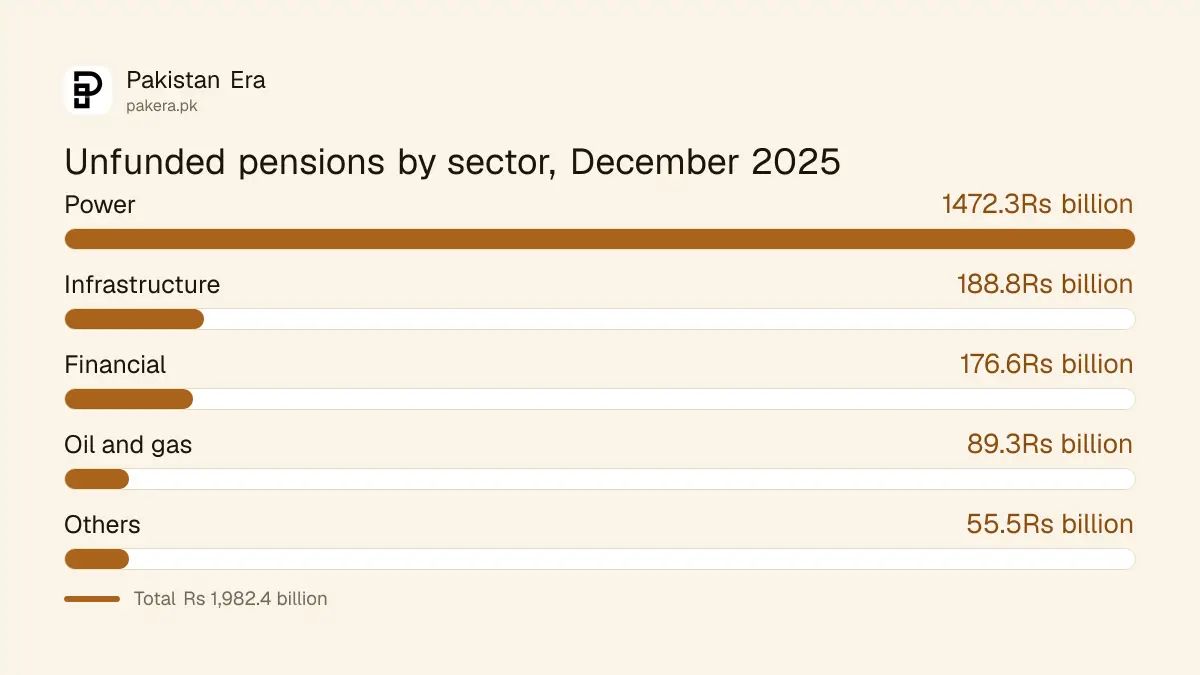
Power sector companies hold 74 percent of the promise
Power sector companies hold Rs 1,472.3 billion. Infrastructure, transport and IT companies hold Rs 188.8 billion, financial companies Rs 176.6 billion and oil and gas companies Rs 89.3 billion.
| Sector | Unfunded pension, Rs billion | Share of total |
|---|---|---|
| Power | 1,472.3 | 74.3% |
| Infrastructure, transport and IT | 188.8 | 9.5% |
| Financial | 176.6 | 8.9% |
| Oil and gas | 89.3 | 4.5% |
| Miscellaneous | 48.1 | 2.4% |
| Others | 7.4 | 0.4% |
| Total | 1,982.4 | 100% |
The shares are our own arithmetic on the report's sector table. "Others" combines manufacturing and mining, industrial estates, and trading.
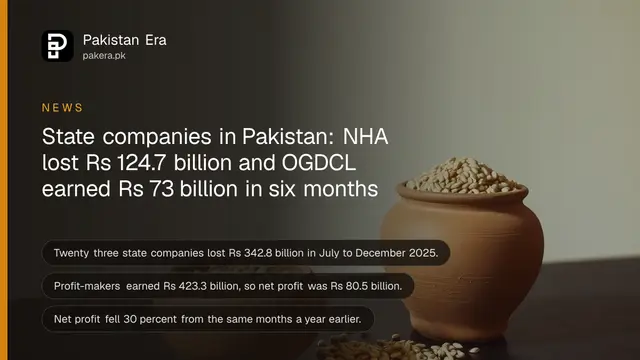
The power total is large because the distribution companies employ many people and have long histories. The report links this to the state of the sector. Weak finances at these companies were also behind the losses set out in what Pakistan’s state companies owe.
MEPCO, LESCO and PESCO carry the largest company amounts
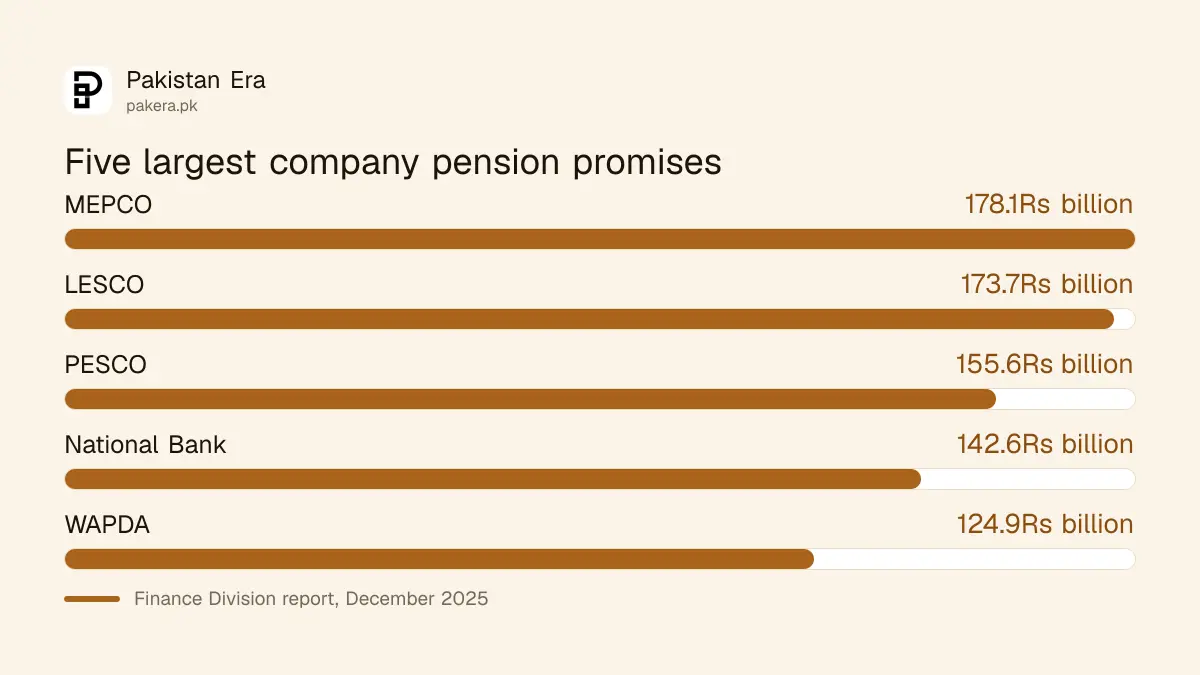
Five companies carry more than Rs 120 billion each. Four are electricity companies or the power authority and one is a bank.
| Company | Unfunded pension, Rs billion |
|---|---|
| Multan Electric Power Company (MEPCO) | 178.1 |
| Lahore Electric Supply Company (LESCO) | 173.7 |
| Peshawar Electric Supply Company (PESCO) | 155.6 |
| National Bank of Pakistan | 142.6 |
| Water and Power Development Authority (WAPDA) | 124.9 |
| Hyderabad Electric Supply Company (HESCO) | 123.3 |
| Faisalabad Electric Supply Company (FESCO) | 118.1 |
| Islamabad Electric Supply Company (IESCO) | 111.7 |
FESCO and IESCO are among the companies being offered for sale. The pages we read from the Privatisation Commission do not say who will carry these pension amounts after a sale. We do not guess. See the sale news at the Privatisation Commission website.
What it means for retired staff and for taxpayers
For a pensioner of one of these companies, the report gives no sign that payments will stop. It does not discuss individual pensions. Pension payments continue as before and the report is about the size of the promise.
For a taxpayer, an unfunded pension is a future bill. If a company cannot meet it from its own income, the federal budget may have to. The report notes that Pakistan Railways, for example, needs yearly grants near Rs 60 billion and has pension obligations that are not fully funded.
The same report shows government support to state companies of Rs 804 billion in six months. The pension amount adds to that load, but is not part of the Rs 804 billion. For household budget effects of the wider fiscal squeeze, see the public debt review for FY26.
The last time we can compare is one year earlier, so we cannot say how fast the promise grew over a longer period.
How to look up your own employer or a company
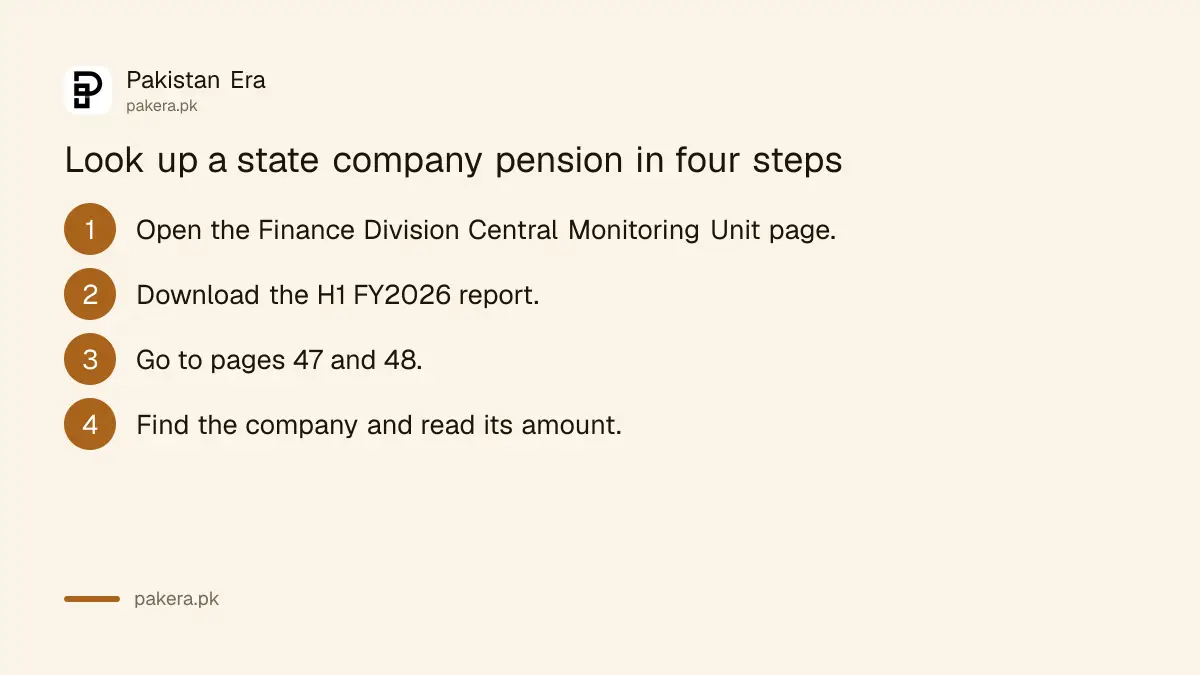
- Open the Finance Division Central Monitoring Unit page and download the H1 FY2026 report.
- Go to "Unfunded Pension Status SOE Wise" on pages 47 and 48.
- Find the company by name. There are 53 entities listed.
- Read the amount in Rs million and divide by 1,000 for Rs billion.
Common questions
What is an unfunded pension?
It is a pension promise with no fund set aside. The employer pays it from current income or, if needed, from the government budget.
How large are the unfunded pensions of Pakistan’s state companies?
Rs 1,982.4 billion at December 2025, up 11 percent from Rs 1,791.6 billion a year earlier, says the Finance Division report.
Which sector has the most?
Power. Its companies hold Rs 1,472.3 billion, about 74 percent of the total.
Will pensions stop being paid?
The report does not say that. It describes the size of the promise as a risk for public finances, not a stop in payments.
Which company has the largest unfunded pension?
MEPCO, with Rs 178.1 billion, followed by LESCO with Rs 173.7 billion and PESCO with Rs 155.6 billion.
Does this include federal government employees?
No. It covers state-owned enterprises only. The report does not cover pensions of civil servants.
How we verified this
What we checked, where we read it, and what we could not confirm.
Last checked on 13 October 2026, Pakistan time. We read the Finance Division Central Monitoring Unit's bi-annual report on federal state-owned enterprises for July to December 2025, the unfunded pension tables and the fiscal risk section. The sector shares are our own arithmetic. We did not read any company's own pension accounts, and the report does not explain how each liability was calculated.
About the author

Global Affairs & Political Economy Writer
Muhammad Hatim is a book lover who started writing because he enjoys it. At Pakistan Era he writes about international relations, geopolitics and the global economy, with a particular interest in South Asia and the forces behind current events.