Transporters Say the Strike Continues, Sindh CM Says It Is Nearly Over
The goods transport strike is in its seventh day. Transporters put the cost at Rs 50 billion and say it goes on. Sindh's CM says almost resolved.
Resolved, and the Chief Minister's reading was the closer one. On 16 August the All Pakistan Goods Transport Ittehad postponed the strike for 40 days, after talks at Karachi's Governor House. Its president, Malik Shehbaz Awan, said some issues were settled immediately and that 15 to 20 days had been given for those needing cabinet approval.
What is not settled is the part that started it. The government has been given 15 days on the daily fuel pricing mechanism, a committee is to be formed on withholding tax relief, truck stand relocation in Sindh is promised within a year, and two of eight Punjab demands remain open. So this is a pause with a deadline, not an ending.
The same daily pricing rule also drove the petrol dealers' strike threat a day earlier, which we set out in the rule that has now produced two disputes in a month.
The article as published on day seven follows.
Pakistan's goods transport strike has entered its seventh day. On the same day, two people close to it described the situation in ways that do not fit together.
We are giving you both, because we cannot tell you which is right.
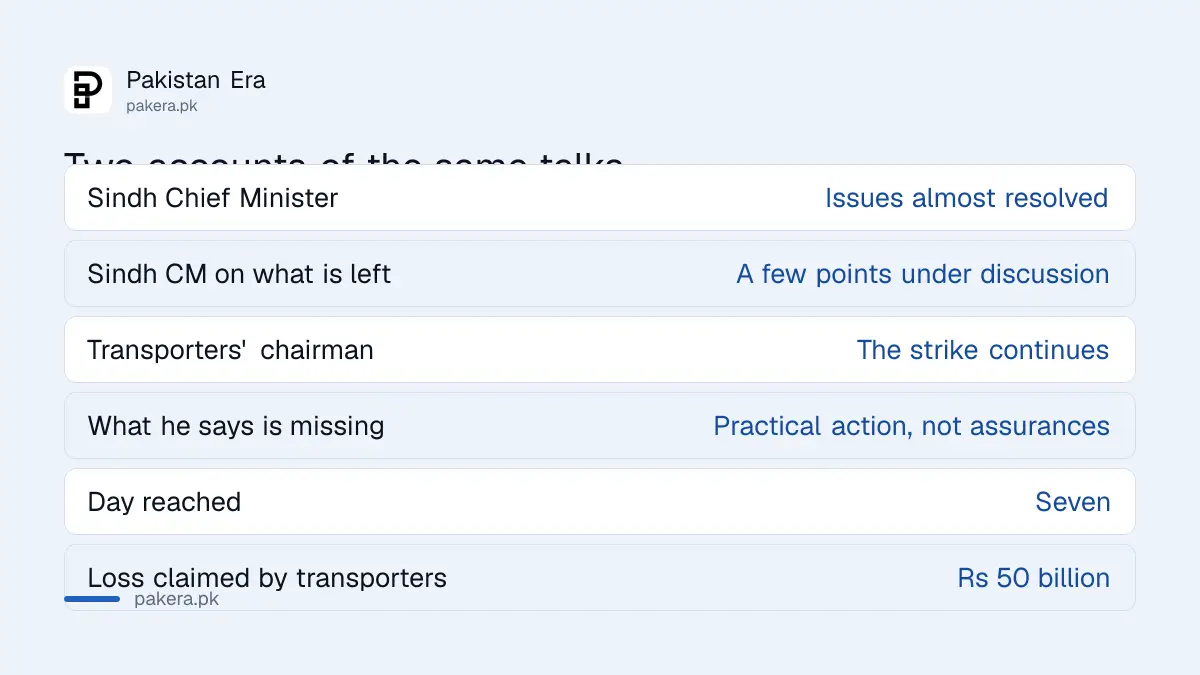
Two accounts of the same talks
| Who | What they said |
|---|---|
| Sindh Chief Minister | Transporters' issues are almost resolved |
| On what remains | Only a few points under discussion |
| Transporters' chairman | The strike continues |
| What he says is missing | Practical action, not assurances |
Muhammad Owais Chaudhry, the transporters' chairman, was specific about the condition. The strike goes on until the government accepts the demands and takes practical action to implement them. He rejected assurances on their own.
That is not quite a contradiction. A negotiation can be nearly finished and still not finished, and the two men are measuring different things. One is counting unresolved points, the other is counting what has actually been done.
But the practical effect for anyone waiting on a delivery is that you cannot plan on this ending today, whatever the more encouraging headline says.
About that Rs 50 billion
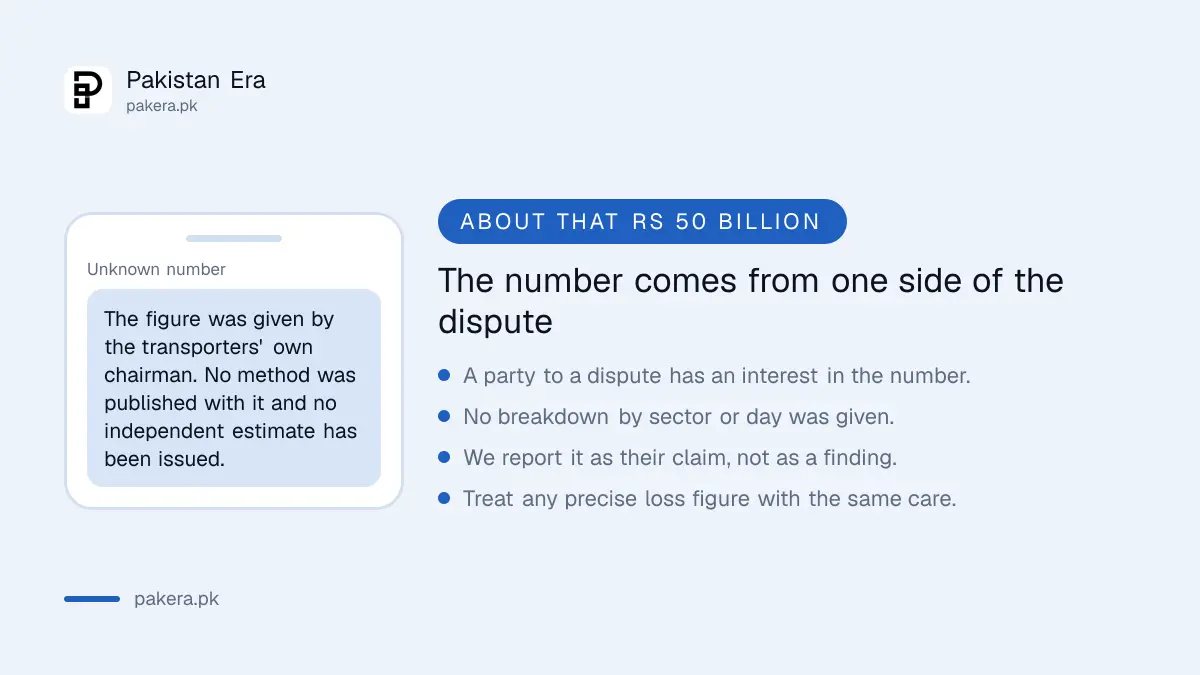
The figure being reported for the economic loss is Rs 50 billion. It is worth knowing where it came from.
It was given by the transporters' own chairman. No method was published alongside it, there is no breakdown by sector or by day, and we found no independent estimate to compare it against.
That is not a suggestion that anyone is being dishonest. It is the ordinary care an unaudited number deserves when it is produced by a party in the middle of a negotiation, where the size of the disruption is itself an argument. We would treat a figure from the other side the same way.
So we report it as the transporters' claim. If a precise loss figure matters to your decision, wait for one with a method attached.
How a freight stoppage reaches an ordinary household
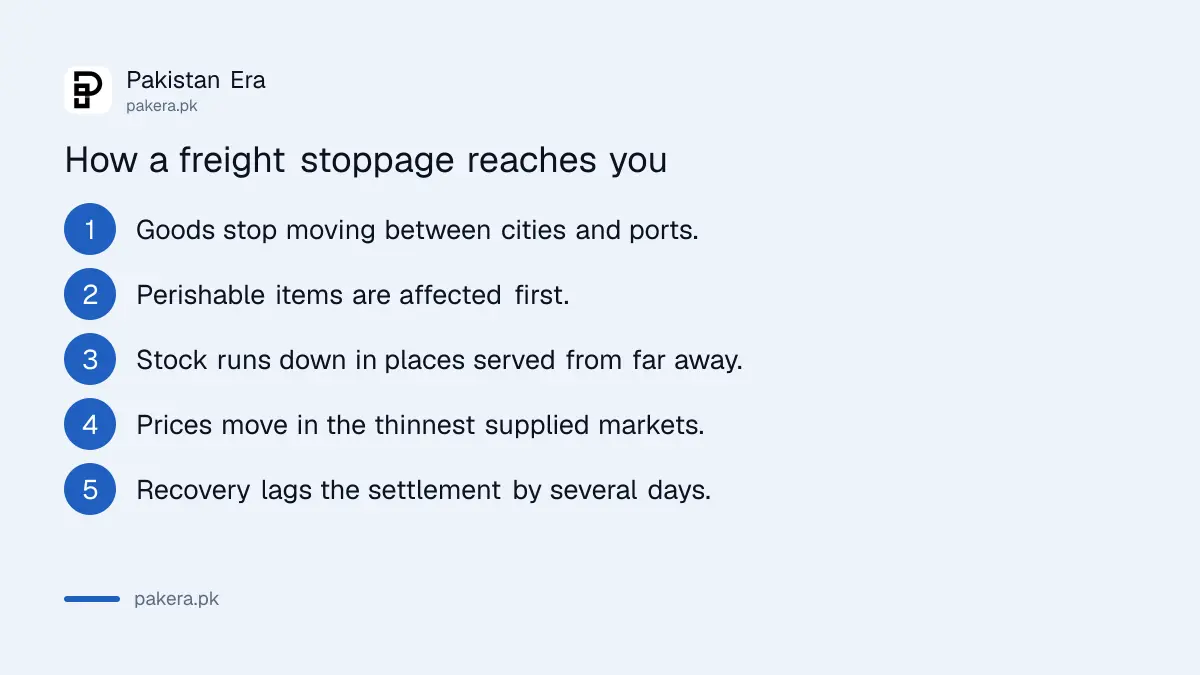
Most people never see a strike like this directly. It arrives as something else.
- Goods stop moving between cities, and between ports and inland markets.
- Perishables go first. Anything with a short life either does not arrive or arrives in worse condition.
- Stock runs down where distance is greatest. A city supplied from far away feels it before one supplied locally.
- Prices move in the thinnest markets, not evenly across the country.
- Recovery lags the settlement. Even when trucks move again, backlogs take days to clear.
That last point is the one people misjudge. A strike ending is not supply returning. It is the beginning of supply returning.
Why this week is worse than a normal week
This is not the only stoppage in progress.
Petrol dealers have announced a nationwide shutdown from 6am on 15 August, though at the time of writing that remained subject to a decision by their executive committee. We are following it in our strike article, and the reason it is not about the pump price is in the margin explainer.
A freight stoppage and a possible fuel stoppage in the same week compound each other. Freight that resumes still needs fuel to move, and a backlog cleared slowly is a backlog that lasts longer.
We are not predicting a shortage of anything. We are pointing out that the two are connected, and that recovery from one depends on the other.
What we are not telling you
We are not listing the transporters' demands. The reporting we read did not set them out in a form we could state accurately, and a half remembered list would misrepresent both sides of a live negotiation.
We are not predicting when this ends. One side says nearly, the other says not yet, and both have been in the room.
We are not apportioning blame between the transporters and any government, provincial or federal. There is a negotiation happening and we are reporting its state.
And we are not publishing a figure for what it has cost the country, beyond attributing the one that exists to the person who gave it.
If you are waiting on goods
Three practical notes.
Ask your supplier for a specific reason, not a general one. Whether your consignment is stuck at a port, at a warehouse, or simply not booked makes a difference to when it moves.
Do not assume a settlement means immediate delivery. Build in the backlog.
If you are importing, watch your clearance dates. Separately from this strike, new customs penalties for late filing and late removal are reported to begin on 1 October, and a disrupted month is exactly when consignments slip. We set those out in the new customs penalties.
Questions readers are asking
Is the transport strike over?
No. It has entered its seventh day. The Sindh Chief Minister says issues are almost resolved, while the transporters' chairman says it continues.
What do transporters want before they stop?
Their chairman says acceptance of the demands and practical action to implement them, rather than assurances alone.
How much has the strike cost?
Rs 50 billion, according to the transporters' chairman. That figure comes from one side of the dispute and was published without a method.
Will prices go up?
Effects show first in perishables and in markets furthest from supply. We are not forecasting a specific price move.
Does this affect the petrol pump strike?
They are separate disputes, but they compound. Freight needs fuel, so a fuel stoppage would slow any recovery from this one.
When will deliveries return to normal?
Later than the settlement, whenever that comes. Backlogs take days to clear after trucks start moving.
Who is negotiating?
Talks involving transporters and government have been running, with the Sindh Chief Minister among those describing their progress.
About the author

Tax, Bills and Technology Writer
Ali Akhtar is a young and curious voice here at Pakistan Era. He is currently pursuing his A-Levels and has a growing interest in Pakistan’s changing industrial landscape and educational trends. Ali likes to write in a way that helps him explain and explore the world around him. His writing reflects the perspective of the new generation navigating the evolving trends of Pakistan where technology, youth innovation, and shifting opportunities are reshaping the country’s future.