Daily Fuel Pricing Has Triggered Two Strike Threats in a Month
Petrol dealers and goods transporters both demanded the daily fuel price rule be changed. One was refused outright. The other got 15 days.
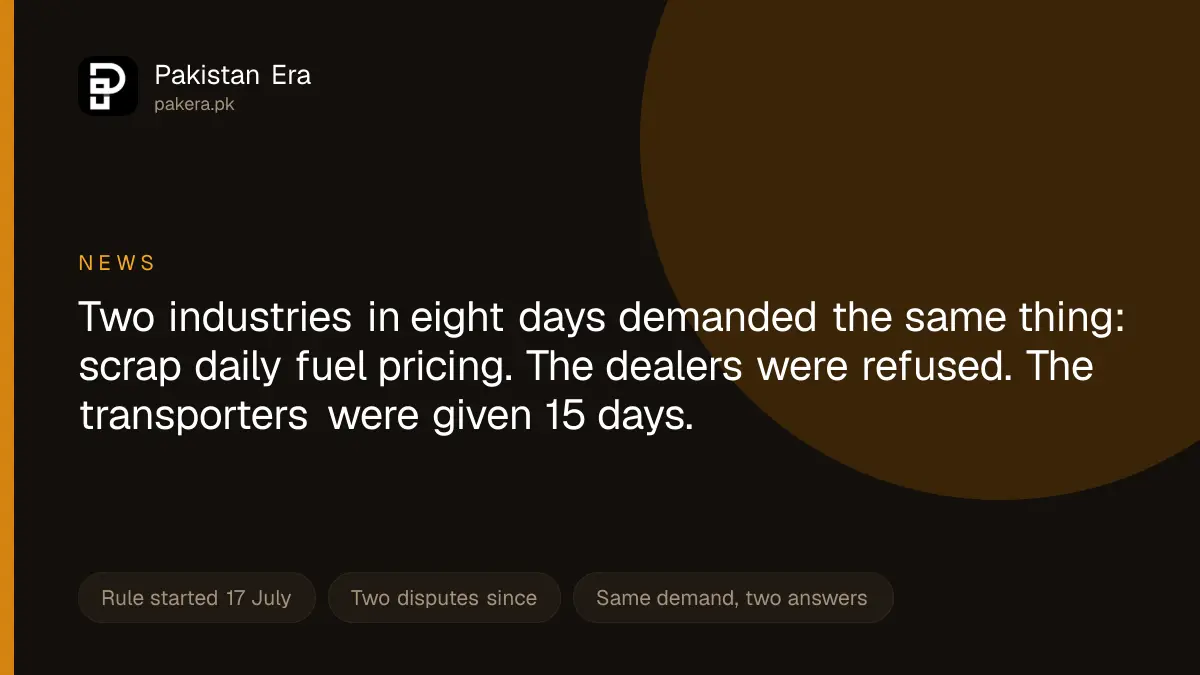
In eight days, two industries threatened to shut down over the same rule. Both wanted Pakistan to stop changing fuel prices every 24 hours.
They were given different answers, and that is the part worth looking at.
Same demand, two answers
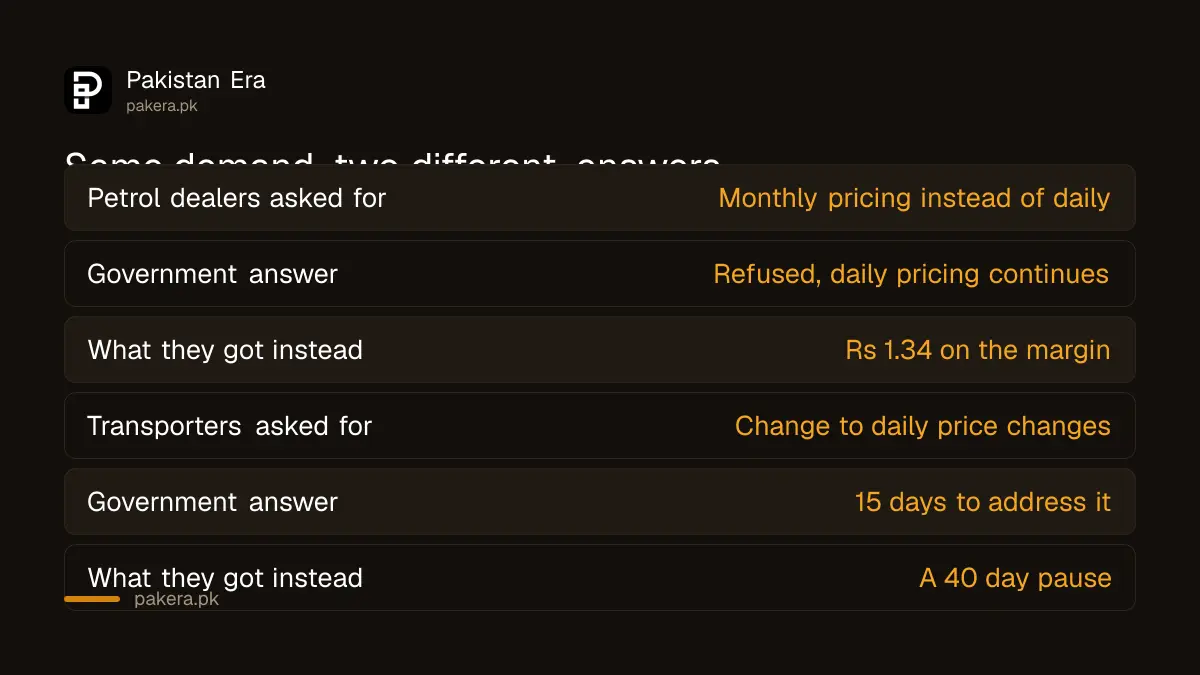
| Petrol dealers | Goods transporters | |
|---|---|---|
| Asked for | Monthly pricing instead of daily | Change to daily price changes |
| Answer | Refused outright | 15 days to address it |
| Got instead | Rs 1.34 on the margin | A 40 day pause |
| Action | Suspended | Postponed |
The dealers were told plainly that the daily mechanism continues. The Petroleum Minister said so, and they settled for a margin increase instead, which we covered in who pays for the dealer margin rise.
The transporters raised the same objection two days later and were given a fifteen day window on it, inside a forty day pause. Nothing was conceded, but nothing was refused either.
What actually happened with the transporters
The All Pakistan Goods Transport Ittehad postponed its strike on 16 August after talks at Karachi's Governor House. Its president, Malik Shehbaz Awan, said some issues were resolved immediately and that fifteen to twenty days had been given for those needing cabinet approval.
The rest of the list is worth knowing, because it shows how much is still open.
- Daily fuel price changes. Fifteen days given to the government.
- Withholding tax relief. A committee is to be formed.
- Truck stand relocation in Sindh. Promised within a year.
- Punjab demands. Six of eight acknowledged, two outstanding.
- Axle load and overloading. Partial agreement, specifics unstated.
Sindh Governor Nihal Hashmi, Federal Communications Minister Abdul Aleem Khan and Karachi Mayor Murtaza Wahab were present at the talks.
Why one rule bites two different trades
This is our explanation rather than either side's, but the logic is not complicated.
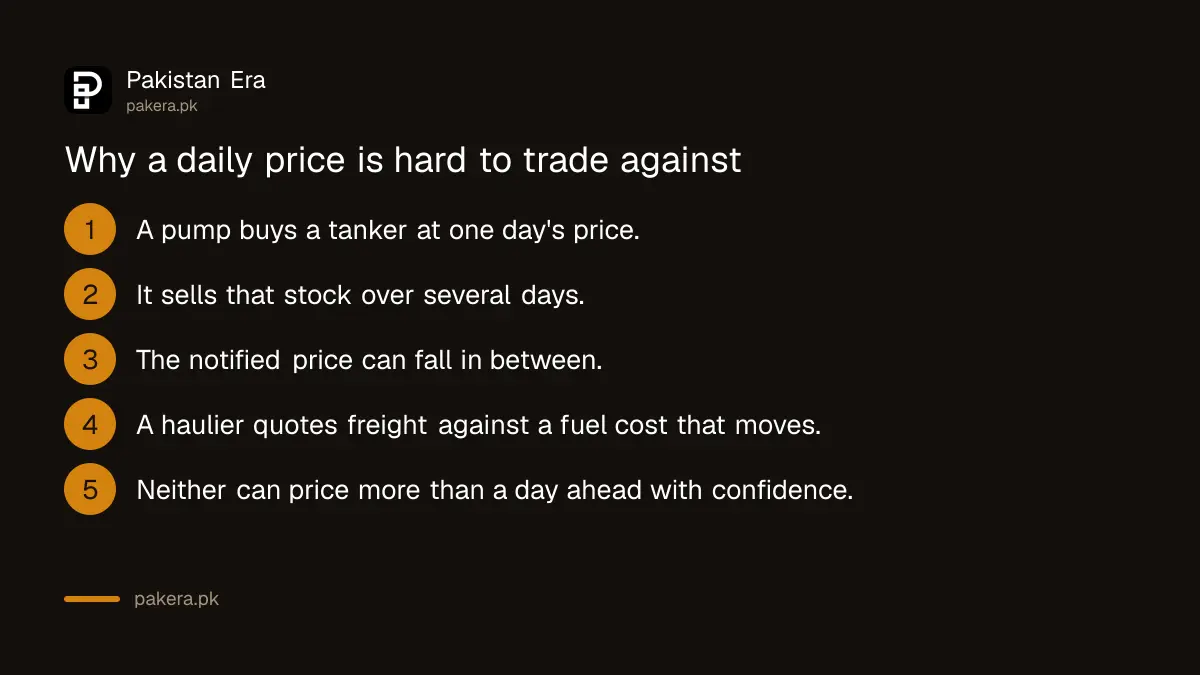
A price that moves every day is difficult to trade against if there is any gap between buying and selling.
A pump buys a tanker at one day's price and sells that stock over several days. If the notified price falls in between, it sells at the lower rate what it bought at the higher one. A fixed margin per litre does not cover that swing.
A haulier quotes a freight rate for a journey that has not happened yet, against a fuel cost that will have changed by the time the truck runs. Quote for a month and you are guessing.
Neither trade is complaining about the level of prices. They are complaining about not being able to price their own work more than a day ahead. That is a different objection from wanting fuel to be cheaper, and it explains why a margin increase satisfied the dealers on paper without touching what they actually raised.
Two clocks are now running
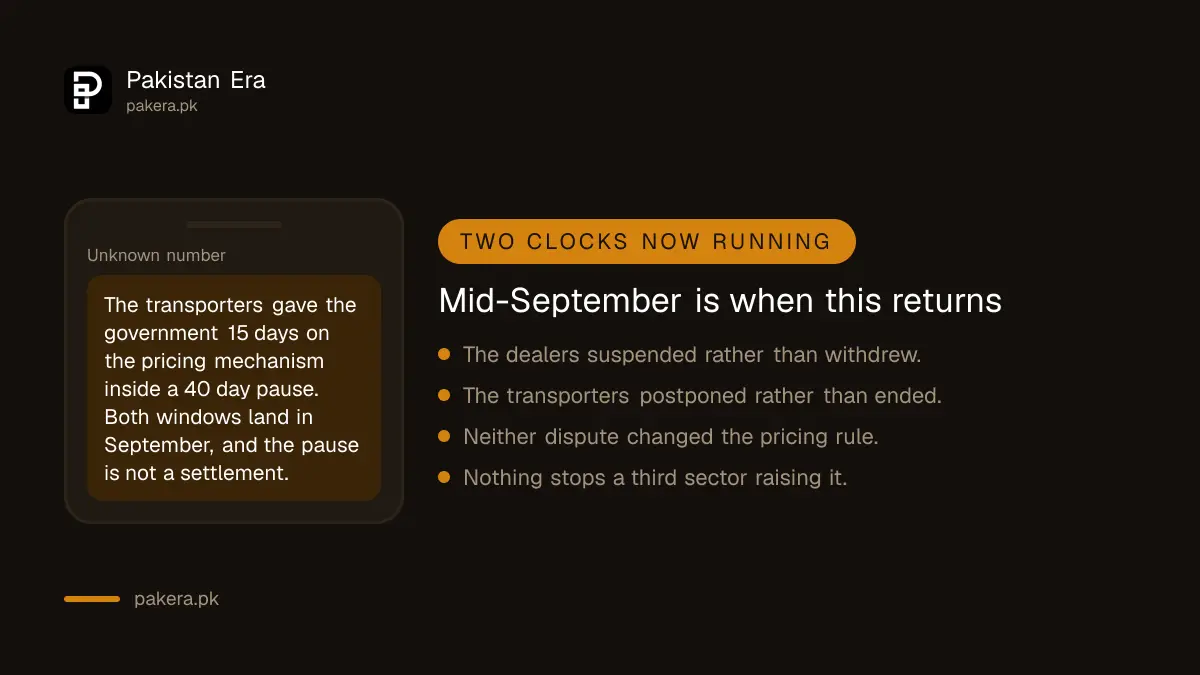
Neither dispute is over, and the language both sides used says so.
The dealers suspended their strike. They did not withdraw it, and the structure they objected to is unchanged. The transporters postponed for forty days, with fifteen of those days attached specifically to the pricing question.
Both windows land in September. If nothing moves on the mechanism by then, the same demand returns with the same leverage behind it.
The daily rule itself began on 17 July, so it has produced two national strike threats within a month of starting. Nothing prevents a third sector raising it.
What we are not saying
We are not saying daily pricing is bad policy. It exists for reasons connected to the fiscal position and to how the levy is collected, which we set out in the flexible petroleum levy.
We are not saying the government handled the two disputes inconsistently. A refusal and a fifteen day review are different responses, but they were given to different parties with different leverage in different negotiations, and we have not seen the reasoning behind either.
We are not predicting that either strike resumes. Both were called off, and Pakistani strike threats are frequently resolved quietly before a deadline.
What we are doing is pointing out that one rule, one month old, has now been the central demand in two separate national disputes. That is a fact about the rule rather than an opinion about it.
What it means for you
Nothing changes at the pump today. Prices continue to be set every 24 hours on a seven day average of international rates, and today's figure is on our daily petrol price page.
For freight, the forty day pause means goods move normally through most of September. If you are pricing anything that depends on haulage over a longer horizon, that deadline is worth noting.
The strike that was running, and what it cost, is covered in the transport strike at day seven.
Questions readers are asking
Is the goods transport strike over?
Postponed for 40 days from 16 August, not ended. Several demands remain open.
What did the transporters want changed?
Among other things, the daily fuel price mechanism. The government was given 15 days to address it.
Did the petrol dealers get the same thing?
No. They asked for monthly pricing and were refused. They accepted a margin increase instead and suspended their strike.
Why does daily pricing bother these businesses?
Both buy or commit at one price and deliver later, so a price that moves daily makes their own pricing a guess. It is about predictability rather than the level.
When does this come back?
The 15 day window and the 40 day pause both fall in September.
Will fuel prices change?
Prices continue to be revised every 24 hours. Nothing about either settlement changed that.
Should I expect goods shortages?
Not during the pause. Freight is moving, and the deadline is the thing to watch rather than the present.
About the author

Tax, Bills and Technology Writer
Ali Akhtar is a young and curious voice here at Pakistan Era. He is currently pursuing his A-Levels and has a growing interest in Pakistan’s changing industrial landscape and educational trends. Ali likes to write in a way that helps him explain and explore the world around him. His writing reflects the perspective of the new generation navigating the evolving trends of Pakistan where technology, youth innovation, and shifting opportunities are reshaping the country’s future.