Do Not Rely on Widal or Typhidot for Typhoid in Pakistan: NIH Says Ask for a Blood Culture
NIH says Widal and Typhidot have no diagnostic value for typhoid in Pakistan. See why a blood culture is preferred, when to take it and how XDR alters care.
Short answer: A Widal or Typhidot test is not a reliable way to confirm typhoid in Pakistan. The National Institute of Health (NIH) says both tests have no diagnostic value and that labs should stop using them. It says the test to ask for is a blood culture, ideally taken before the first antibiotic.
You get a fever that will not go away. You walk into a lab near home, pay a few hundred rupees, and the slip says "Widal positive" or "Typhidot positive". The doctor writes an antibiotic. Three days later you are no better, and nobody knows whether you ever had typhoid at all.
We read NIH's advisory on typhoid fever including XDR typhoid, No. F.1-22/Advisory/CDC/2024, dated 22 May 2024, in full on 13 October 2026. Everything attributed to NIH below comes from that document. It is an advisory to health departments, not a law, and it is written for doctors and labs. We have turned it into steps a patient can use.
NIH says Widal and Typhidot must be stopped
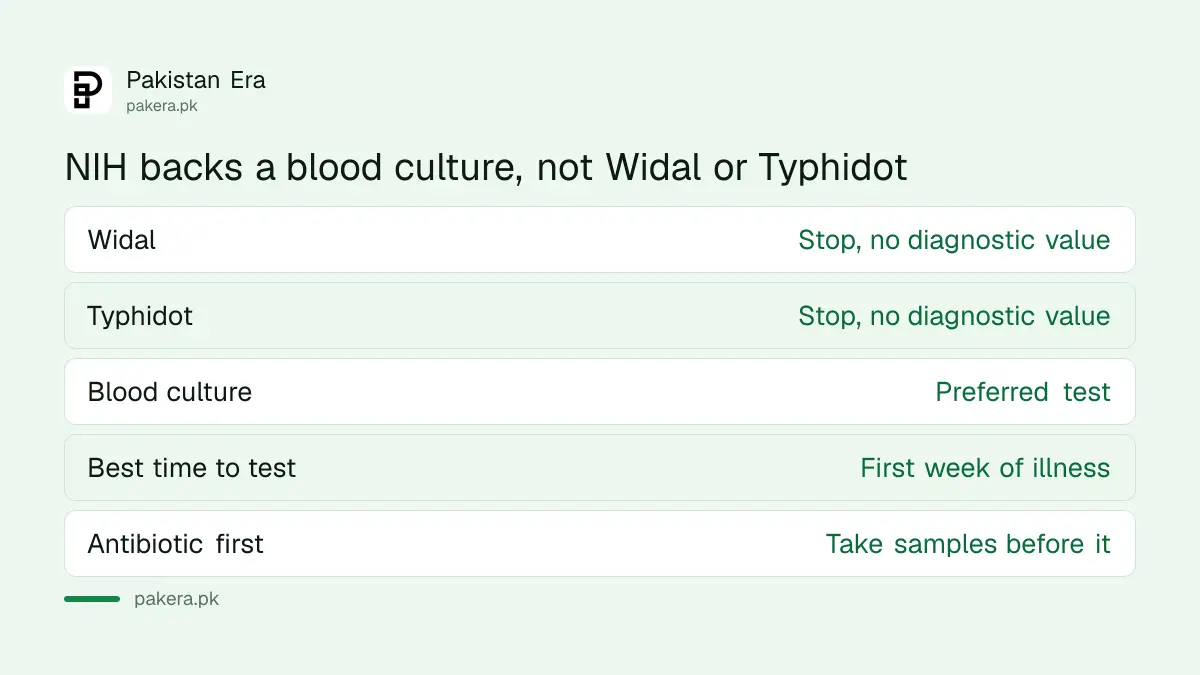
NIH's advisory states that Widal and Typhidot have no diagnostic value because of limited sensitivity, specificity and cross reactivity. It says they must be stopped immediately by all labs. In plain words, they miss real cases and flag people who do not have typhoid.
Cross reactivity means the test reacts to other germs or to an old infection, so a positive result may not mean typhoid now. That is why two labs can give two different answers on the same blood.
The word "stopped" is NIH's own. We did not find a law or a notification that bans the test, so some labs still run it. You can decline it and ask for a culture instead.
Ask for a blood culture, and ask early
NIH says blood culture is the preferred test because typhoid patients usually have the bacteria in the blood. The germ is easiest to find in blood during the first week of illness. After that, stool and urine tests become more useful.
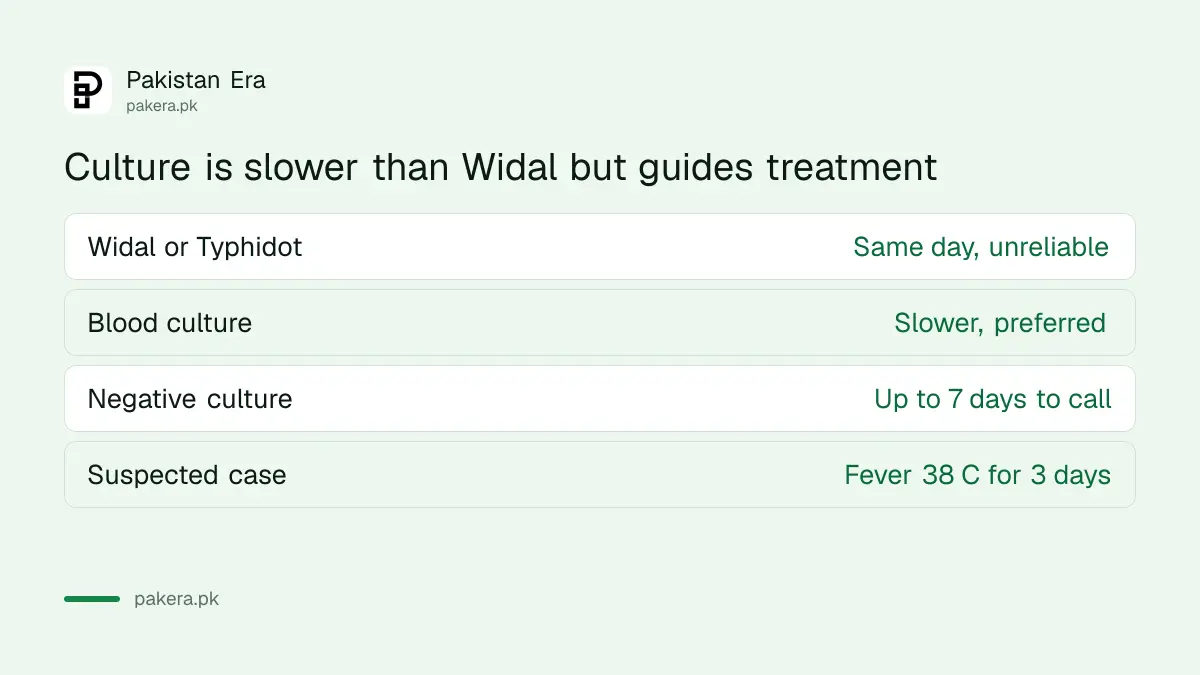
A blood culture is slow. NIH notes that, depending on the lab system, a culture may have to be held and watched for up to 7 days before a negative result is given. Do not expect an answer the same afternoon.
NIH also says the samples should be taken before antibiotics start, and that the antibiotic should be chosen from the culture report. A pill taken first can make the culture come back clear when the infection is still there.
Know when a fever counts as suspected typhoid
NIH defines a suspected case as a person with fever of at least 38 degrees Celsius for 3 or more days, plus abdominal symptoms such as diarrhoea or constipation, tenderness in the belly and extreme tiredness. A confirmed case needs the germ found in blood, stool or urine.
Typhoid usually builds slowly. NIH lists a long fever, headache, constipation or diarrhoea, body aches, belly pain, loss of appetite and vomiting. A faint rash of rose coloured spots can appear on the trunk.
The same advisory warns that severe cases can bring confusion, bleeding in the gut or a hole in the bowel, usually after two to three weeks of illness. That is the reason to see a doctor early rather than waiting out a long fever at home.
The steps to follow when you have a long fever
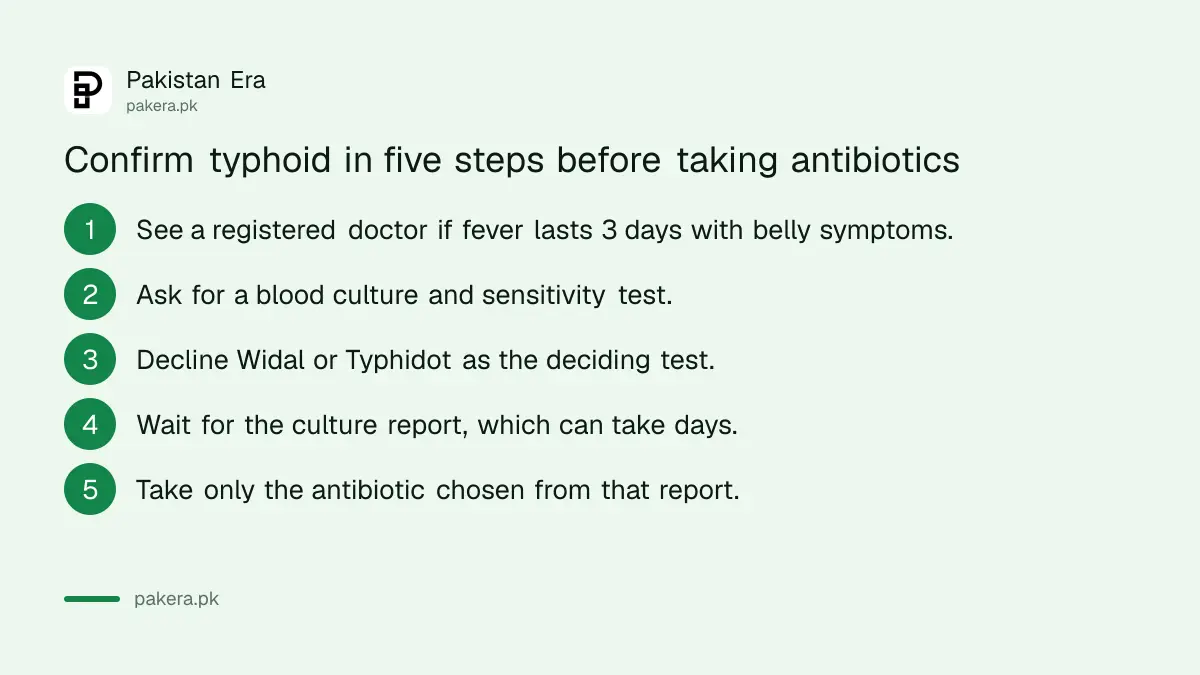
Go to a registered doctor first, because NIH tells suspected patients to seek advice from registered medical practitioners. Then follow the order below so the test result can actually guide treatment.
- See a registered doctor if fever has lasted 3 days or more with belly symptoms.
- Ask for a blood culture and sensitivity test before taking any antibiotic.
- Refuse Widal or Typhidot as the deciding test.
- Wait for the culture report, which can take several days.
- Take only the antibiotic the doctor chooses from that report, and finish the course.
If you cannot find a lab that runs a culture, ask the doctor where one is done. Ask the price before the sample is taken, as you would for a dengue test, because lab prices vary a lot.
Why the antibiotic choice matters for XDR typhoid
XDR means extensively drug resistant. NIH says XDR Salmonella Typhi has been reported in Pakistan since 2016, mainly in summer and the monsoon. It resists ampicillin, chloramphenicol, co-trimoxazole, fluoroquinolones and third generation cephalosporins.
NIH says it is sensitive only to carbapenems such as meropenem and to azithromycin. It asks that azithromycin and meropenem be kept for confirmed XDR cases on a registered doctor's prescription, and that azithromycin not be used for ordinary chest infections.
| Question | Widal or Typhidot | Blood culture |
|---|---|---|
| NIH's view | No diagnostic value, labs should stop | Preferred method |
| Best time | Not advised at any stage | First week of illness |
| Speed | Same day | Up to 7 days to call a negative |
| Guides antibiotic choice | No | Yes, with sensitivity |
Prevention still works better than any test
NIH's prevention advice is plain. Wash hands with soap and water after the toilet, after changing a baby's nappy, before cooking and before eating. Drink treated, boiled or bottled water, and use ice made from clean water.
It also advises eating freshly cooked hot food, avoiding street food and leftovers, washing fruit and vegetables, and using pasteurised milk. The advisory recommends typhoid vaccination for all age groups, especially people at high risk, and names the conjugate vaccine as longer lasting. It adds that no typhoid vaccine gives full protection, but it reduces the severity of illness. The doses and where to get them are set out in the adult typhoid and hepatitis vaccine schedule.
The scale is large. NIH's weekly bulletin for week 38 recorded 2,458 suspected typhoid cases in one week.
Common questions
Is a positive Widal test proof of typhoid?
No. NIH says Widal has no diagnostic value because it can react to other causes. A positive slip alone should not decide your treatment.
Which test does NIH prefer for typhoid?
Blood culture. NIH calls it the preferred method because the bacteria are usually in the blood, mainly in the first week of illness.
How long does a blood culture take?
It can take several days. NIH notes that a culture may need to be observed for up to 7 days before a negative result is reported.
Should I take an antibiotic before the test?
No, if it can be avoided. NIH says samples should be collected before antibiotics, and the drug should be chosen from the culture and sensitivity report.
Is azithromycin safe to take for any fever?
NIH asks doctors to keep azithromycin for lab confirmed XDR typhoid and other serious conditions, and not to use it for ordinary chest infections. Take it only if a registered doctor prescribes it.
How we verified this
What we checked, where we read it, and what we could not confirm.
Last checked on 13 October 2026, Pakistan time. We read NIH's advisories page and the full advisory PDF on typhoid fever including XDR typhoid dated 22 May 2024. The advisories list showed no newer typhoid advisory. We could not check which labs still run Widal or Typhidot today, or what a culture costs, so we give no price. This page is general information and does not replace a doctor.
About the author

Public Services and Education Journalist
Fajr Riaz is a journalist and content writer at Pakistan Era, based in Lahore. She covers the questions people meet in everyday life in Pakistan: how a public service works, what a change in the rules means, and where to find a reliable answer.