Check If Your US Visa Needs Public Social Media Accounts: Pakistan Applicant List
The US Embassy in Islamabad tells F, J, M, H-1B, H-4, K, I, TN and TD applicants to set social media to public. See the 21 categories and how to prepare.
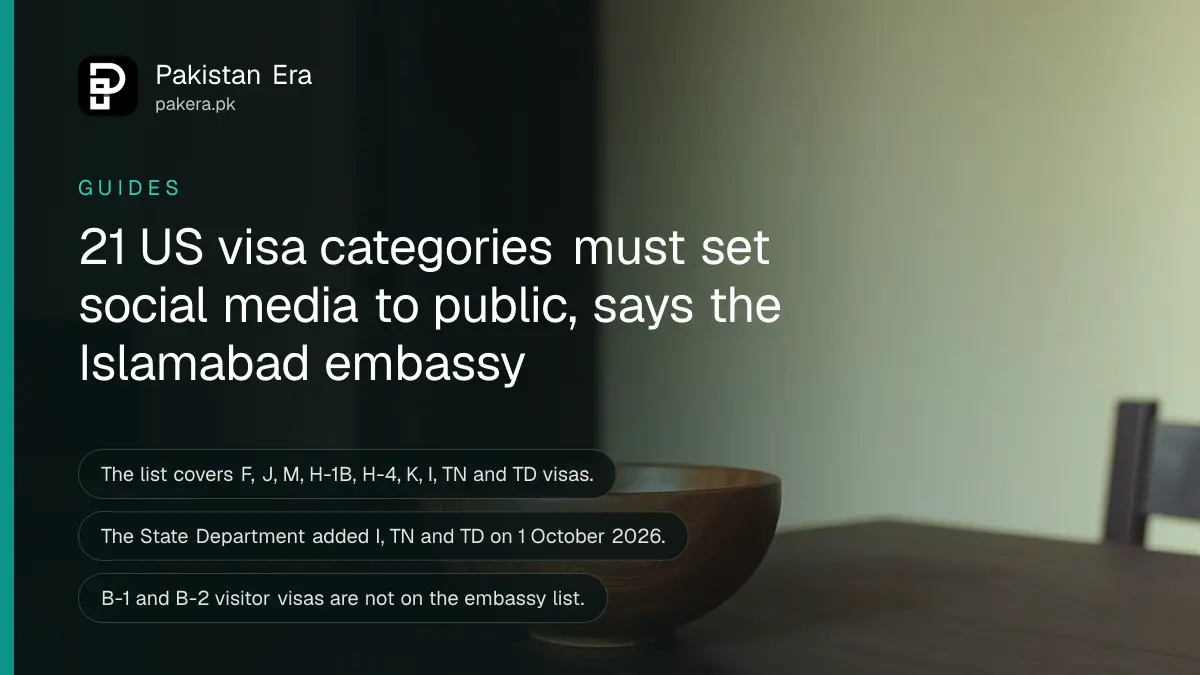
Short answer: If you apply for a US student (F, M), exchange (J), H-1B, H-4, fiance (K), media (I), TN or TD visa, the US Embassy in Islamabad tells you to set every social media account to "public" or "open". Tourist and business visas, B-1 and B-2, are not on the embassy's list.
A Pakistani student with a private Instagram account is the classic case. The profile looks harmless to the owner. For a US visa officer it is a locked door. The embassy's wording is an instruction, so check your category before your interview.
We read the US Embassy Islamabad visa services page on 12 October 2026, and the State Department announcement of expanded screening and vetting. Below is what each says, in plain words.
The embassy lists 21 visa categories that must set accounts to public
The Islamabad embassy page says everyone applying for an A-3, C-3 (domestic worker), G-5, H-1B, H-3, H-4, F, I, J, M, K-1, K-2, K-3, Q, R-1, R-2, S, T, TN, TD or U nonimmigrant visa is instructed to set social media privacy to "public" or "open".
The purpose, the page says, is the vetting needed to establish identity and admissibility to the United States. "Admissibility" means whether you may enter the country under US law. The list covers more than the student visas that were named in earlier rules.
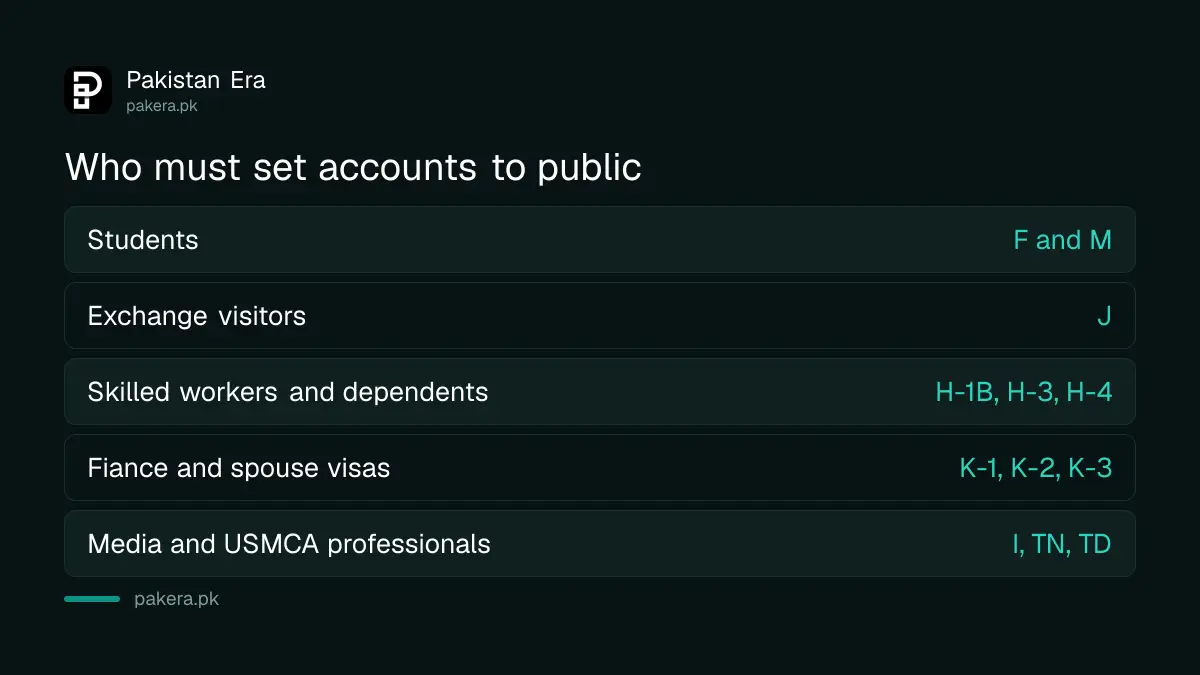
| Who you are | Visa category on the embassy list |
|---|---|
| Student | F and M |
| Exchange visitor, such as a researcher or intern | J |
| Skilled worker or trainee, and their spouse and children | H-1B, H-3 and H-4 |
| Fiance or spouse of a US citizen, on a K visa | K-1, K-2 and K-3 |
| Journalist or media professional | I |
| Trade professional under USMCA, and dependents | TN and TD |
| Other listed categories | A-3, C-3, G-5, Q, R-1, R-2, S, T and U |
The 1 October change added media and USMCA professionals
The State Department announcement is dated 18 September 2026 and took effect on 1 October. It extends the public setting to three more categories: I for foreign media, and TN and TD for USMCA professionals and their dependents. The rest were already covered.
That announcement does not say what happens if you keep a profile private. It says that every visa decision is a national security decision and that vetting uses every available source. So we cannot tell you the exact result of a private profile. We can tell you it is the one thing you control.
For most Pakistani applicants the earlier rule is the one that matters. Our report on the US student visa rules for Pakistanis covered the first round for F, M and J.
B-1 and B-2 visitor visas are not on the embassy's list
The embassy list does not include B-1 or B-2. That is the business and tourist visa. So the instruction on that page does not name you if you are visiting family or going on a short trip. The page is silent on B visas, so it does not say they are exempt from vetting.
Interview rules are separate, and our note on renewing a visitor visa without an interview covers that route. Do not read the silence as permission to hide anything. Officers can look at public information in any case. What we can confirm is narrow: the instruction to set accounts public is listed for the categories above and not for B-1 or B-2.
How to prepare your accounts before the interview
Check each account you use, switch it to public, and review what is visible. Do this before you submit your form and well before the interview date, so you are not changing things in the waiting room.
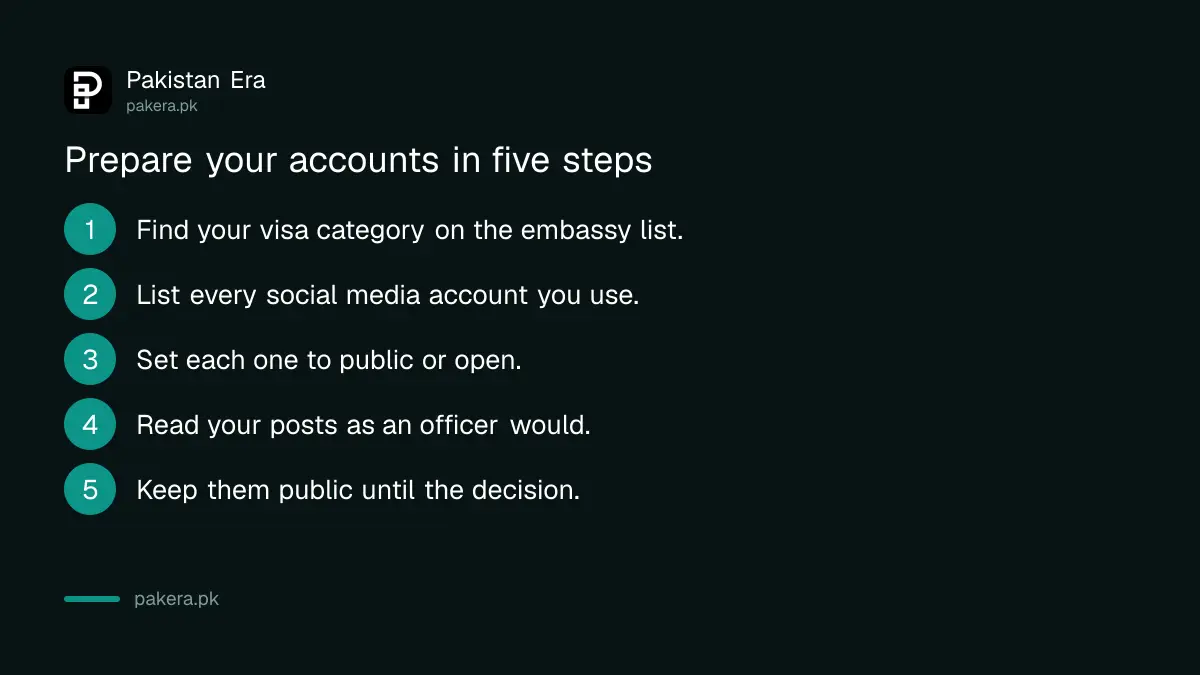
- Find your visa category on your appointment or on the embassy list above.
- Make a list of every social media account you use, including old ones.
- Open the privacy settings on each and choose "public" or "open".
- Read your own posts, bios and photos as an officer would see them.
- Keep your accounts public until your visa decision is made.
If you are unsure whether your category is covered, ask the embassy through its official channel and not through an agent.
Where Pakistani applicants interview
The Islamabad embassy page says it prioritises student and exchange visitor visas, F and J. The Karachi consulate prioritises F and J and temporary employee categories, H, L, O, P, E, I, R, Q, TD and TN, and C1D. Both work by appointment only.
Pakistan is also not on the US 39 country suspension list, which is a separate matter. Beware of agents who say they can pass the vetting for a fee. Our checklist on checking a study abroad agent shows how to verify one. The vetting is done by the US government, not by a person you pay.
Common questions
Do I need to make my social media public for a US student visa?
Yes, if you apply for an F or M student visa, or a J exchange visa. The US Embassy Islamabad page instructs applicants in those categories to set accounts to public or open.
Does the rule apply to a US tourist visa?
The embassy list does not include B-1 or B-2 visas. The page does not say B visas are exempt from vetting, so keep that distinction in mind.
What does "public" or "open" mean?
It means anyone can see your posts and profile without being your friend or follower. On most apps this is a privacy setting you can change in a minute.
What if my account stays private?
The announcement does not state the consequence. It does say vetting relies on every available source. A private account removes one source you could have controlled.
Are my family members covered?
Dependents in listed categories are covered. The embassy list names H-4 dependents of H-1B and H-3, and the new rules cover TD dependents of TN holders. F-2 and J-2 dependents are mentioned in the earlier State Department rules.
When did the rule expand?
The State Department announced the latest expansion on 18 September 2026, and it took effect on 1 October 2026. It added I, TN and TD.
How we verified this
What we checked, where we read it, and what we could not confirm.
We read the US Embassy Islamabad visa services page and the State Department announcement of expanded screening and vetting for visa applicants on 12 October 2026. Rules change by notice. Check both pages again before your interview.
About the author

Global Affairs & Political Economy Writer
Muhammad Hatim is a book lover who started writing because he enjoys it. At Pakistan Era he writes about international relations, geopolitics and the global economy, with a particular interest in South Asia and the forces behind current events.