Use the SSGC Domestic Bill Calculator: Protected and Non-Protected Gas Bills in Sindh
SSGC's calculator needs your previous and current meter readings, pressure and GCV. See each field, the protected and non-protected slabs and the charges added.
To estimate your SSGC gas bill, open the Domestic Bill Calculator on ssgc.com.pk, choose Protected or Non-Protected, then enter your previous reading, current reading, gas pressure and GCV from your last bill. The result is only an estimate, and the real bill adds meter rent, fixed charges and 18 per cent GST.
A gas bill in Karachi, Hyderabad or Quetta can double in January with no warning. The calculator lets you test a reading before the bill arrives. We opened SSGC's Domestic Bill Calculator and its domestic rates page on 22 October 2026. We read the fields and the instructions. We did not enter a reading, so we cannot vouch for the figure it returns.
The calculator asks for five things, and four of them are on your bill
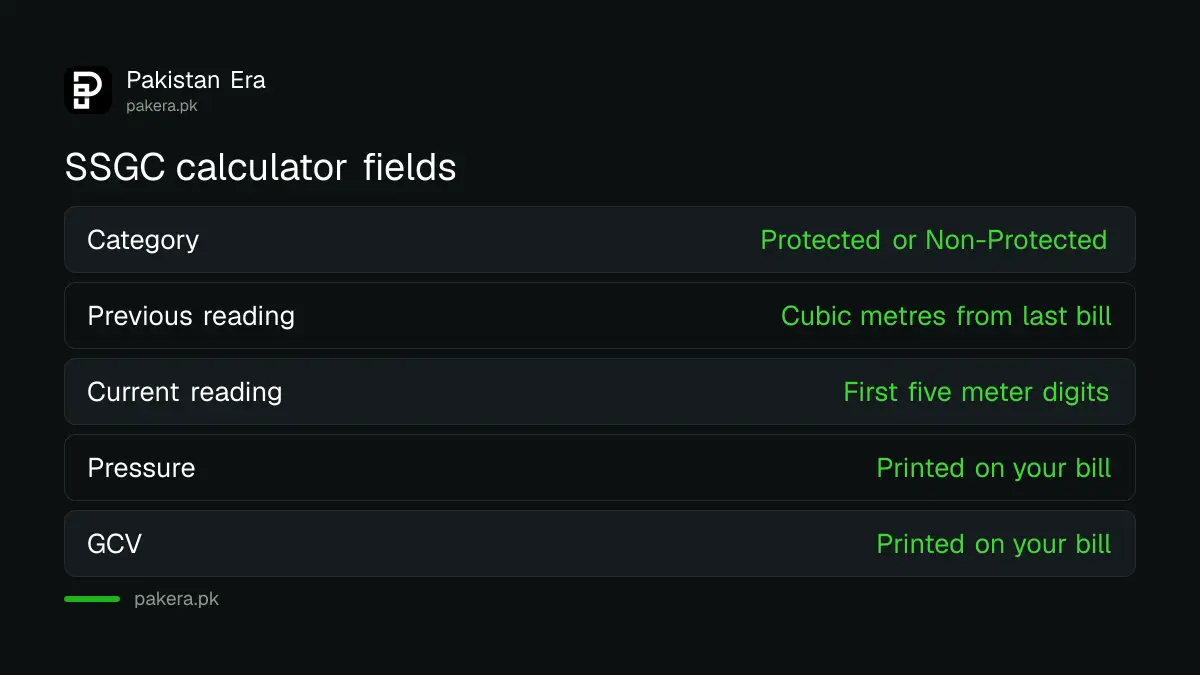
You must pick a category, then fill four mandatory boxes: previous reading, current reading, pressure and GCV. Readings are in cubic metres. SSGC's page tells you to use the first five digits from the left on the meter, which show the cubic metre reading.
GCV is the gas calorific value, a measure of how much heat the gas gives. It is printed on your bill. Pressure is also printed there. If a number is missing from your bill, call 1199 rather than guess it, because a wrong GCV shifts the result.
| Field | Where to find it | Required |
|---|---|---|
| Category (Protected or Non-Protected) | Your bill or SSGC tariff category | Yes |
| Previous reading | Last month's bill, in cubic metres | Yes |
| Current reading | First five digits on the meter, left side | Yes |
| Pressure | Printed on your bill | Yes |
| GCV | Printed on your bill | Yes |
Protected homes get four slabs and non-protected homes get eight
SSGC's calculator shows four monthly slabs for protected homes, up to 0.25, 0.5, 0.6 and 0.9 hm3. Non-protected homes get eight: up to 0.25, 0.6, 1, 1.5, 2, 3 and 4 hm3, and a final one above 4 hm3.
The unit hm3 is hundred cubic metres. So a monthly use of 0.9 hm3 is 90 cubic metres. Our guide to Sui gas winter bill slabs shows the full rate for each slab as OGRA notified it. On SSGC's rates page, the protected slabs run from Rs 200 to Rs 350 per MMBTU and the non-protected from Rs 500 to Rs 4,200.
SSGC's rates page says it shows prices effective 1 July 2025 under an OGRA notification of 29 June 2025, and that the page itself was last updated in August 2025. We found no newer domestic notice when we last looked at OGRA, but check the date before you rely on the rate.
The result has three charges beyond the gas itself
After the gas charge, the calculator adds meter rent, fixed charges and GST at 18 per cent. It then shows an "Est. Total Gas Bill for the Month". The page lists the intermediate steps as units, PCF, standard cubic metres, MMBTU, rate per MMBTU, gas charges and minimum gas charges.
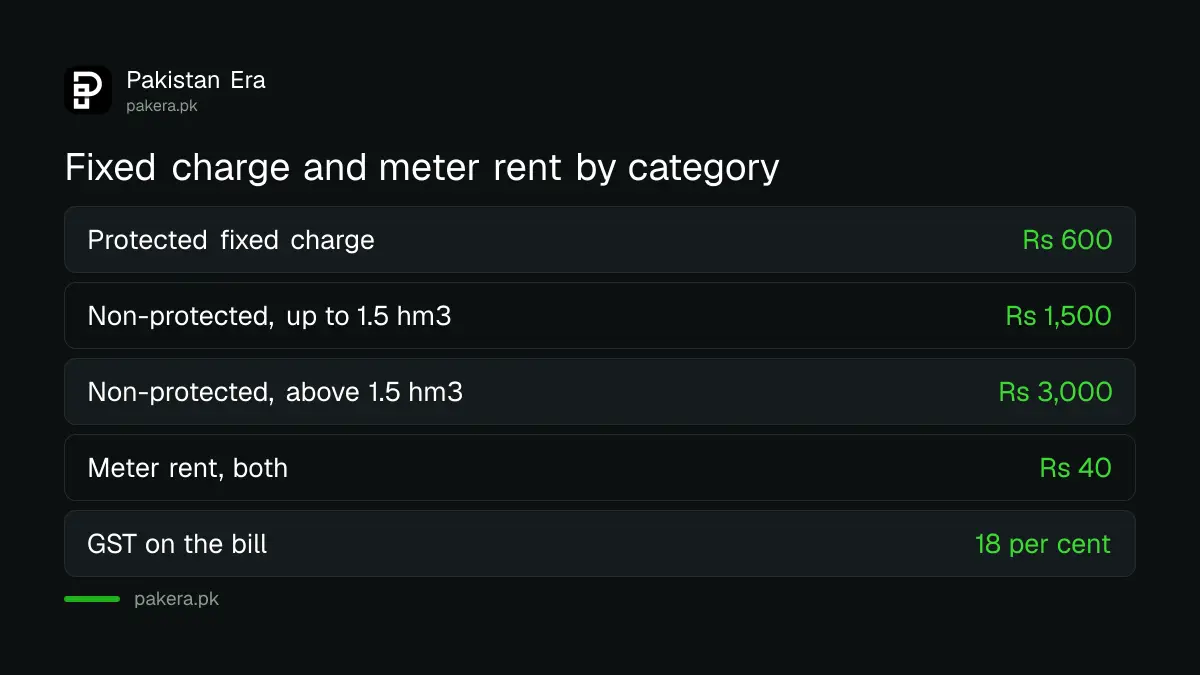
On SSGC's rates page, protected homes pay a fixed charge of Rs 600 and meter rent of Rs 40. Non-protected homes pay Rs 1,500 up to 1.5 hm3, or Rs 3,000 above it, plus Rs 40 meter rent. The page says the minimum bill is calculated at the first slab of each category.
The calculator does not show a worked example, and it does not say how it applies slabs when use crosses a boundary. We did not test that, and we do not state how it is done. Read your own bill's slab lines against the result.
A simple check: work out your use in hm3 before you open the page
Subtract the previous reading from the current reading, then divide by 100. A previous reading of 01250 and a current reading of 01360 is 110 cubic metres, or 1.1 hm3. That sits in the "up to 1.5" band, so a non-protected home would carry the Rs 1,500 fixed charge.
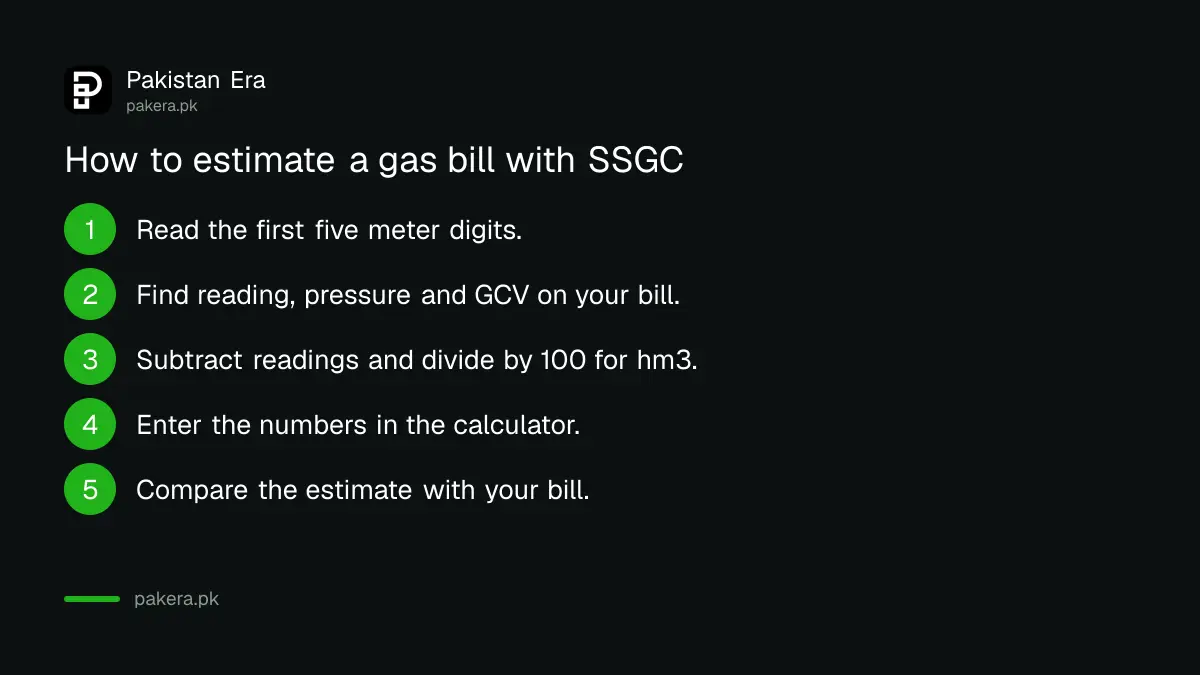
- Read the first five digits on your meter and write them down.
- Find last month's reading, pressure and GCV on your latest bill.
- Subtract the previous reading from the current one, then divide by 100 to get hm3.
- Choose your category in the calculator and enter the four numbers.
- Compare the estimate with your bill and ask SSGC about any gap.
Keep a note of your reading on the same day each month. That is our advice, not SSGC's. It lets you spot an estimated bill early. Our guide to SSGC minimum charges and provisional bills explains why a bill can differ from the meter.
Protected status depends on last winter's use
SSGC says a home is protected if its average use over the four winter months, November to February, is 0.9 hm3 or less. Every other domestic home is non-protected. Because winter use drives the status, a heater left on can change your category.
Ask SSGC which category your account is in before you use the calculator. If you believe it is wrong, take your bills to a facilitation centre. The list of offices is in SSGC Customer Facilitation Centres.
Common questions about the SSGC bill calculator
Is the SSGC bill calculator accurate?
SSGC labels the result an estimate. Use it to plan, not to dispute a bill.
What is GCV on a gas bill?
It is the gas calorific value, which measures the heat in the gas. The number is printed on your bill and the calculator asks for it.
Does the calculator include GST?
Yes. The page lists GST at 18 per cent in its final outputs, next to meter rent and fixed charges.
What is the difference between protected and non-protected?
Protected homes average 0.9 hm3 or less over November to February and pay lower slab rates. Everyone else is non-protected.
Which digits of the meter do I enter?
SSGC says to use the first five digits from the left, which show cubic metres.
Can I use it for an SNGPL bill?
No. It is SSGC's tool. For SNGPL customers, see the SNGPL bill estimator guide.
How we verified this
What we checked, where we read it, and what we could not confirm.
Last checked 22 October 2026. The fields, slab limits, GST rate and instructions come from SSGC's Domestic Bill Calculator page, and the rates, fixed charges, meter rent and protected-status rule come from SSGC's domestic rates page, both read that day. We did not run the calculator, so we cannot confirm its output. The 110 cubic metre example is our own subtraction, not SSGC's. SSGC's rates page is dated August 2025, so a newer OGRA notice could change the rates.
About the author

Senior Writer, Public Services and Technology
Shahid joined us in 2024 as an author. He is a senior contributor to Pakistan's leading technology websites. He writes detailed articles, mostly covering his expertise in the latest tech, mobiles, apps, gadgets, and step-by-step guides. His ideology is to help people understand the latest trends and explain complex methods through very easy-to-understand guides.