How to Use Talaq-e-Tafweez in Pakistan: Delegated Divorce Under Nikah Nama Column 18
If column 18 of your nikah nama gives you the right of divorce, here is how to use talaq-e-tafweez in Pakistan: the notice, the union council and the 90 days.
If column 18 of your nikah nama says your husband gave you the right of divorce, you can use it without going to court. You write a talaq notice using that delegated right, deliver it to the Chairman of your union council, and send a copy to your husband. The divorce takes effect 90 days after the Chairman receives the notice.
This right is called talaq-e-tafweez, or delegated divorce. Section 8 of the Muslim Family Laws Ordinance 1961 says that when the right of divorce "has been duly delegated to the wife", the same notice and 90 day rules used for a husband's talaq apply to her. Many women do not know their nikah nama gave them this right, because column 18 is often filled in quickly on the wedding day.
This page explains the process and the papers. It is not legal advice. If your husband disputes the delegation, see a family lawyer before you act.
Column 18 of the nikah nama decides whether you have this right
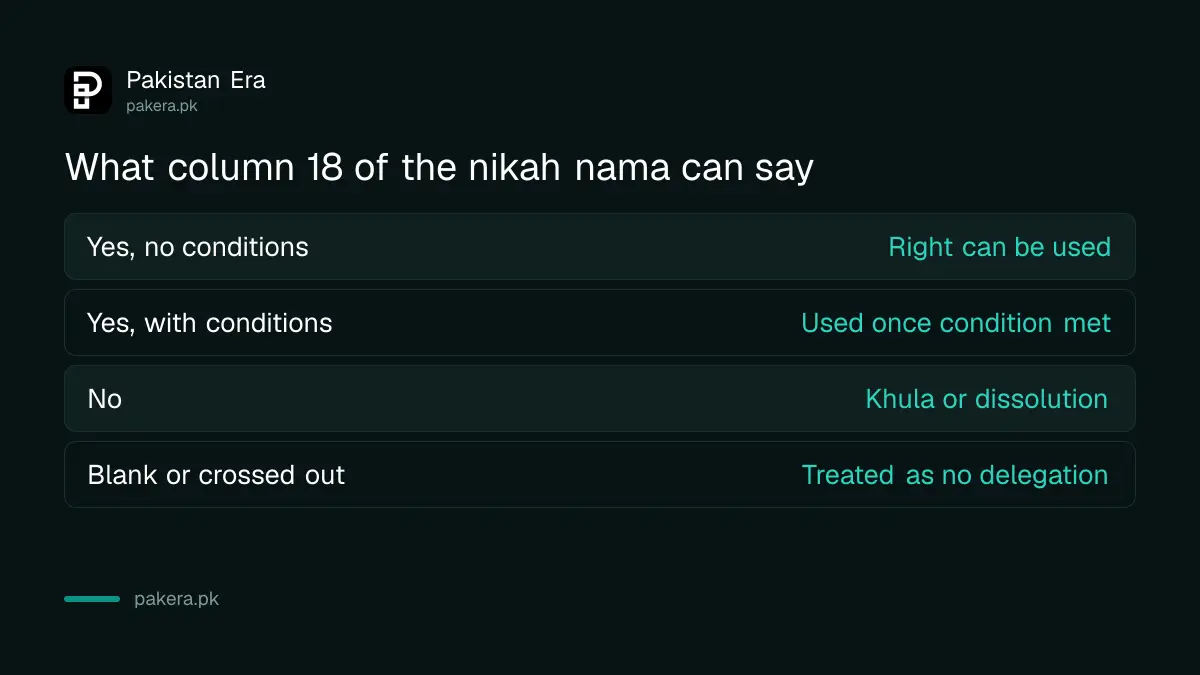
Column 18 asks whether the husband has delegated the power of divorce to the wife, and on what conditions. If it says yes, you can use the right. If it says no or is blank, you cannot, and your route is khula or dissolution in the Family Court.
Start by getting a clear copy of the nikah nama. If you do not have one, the Nikah Registrar or the union council that registered the marriage keeps the record, and the steps to get a copy of a nikah nama from the union council apply.
Read the exact words in column 18. They fall into three kinds.
| What column 18 says | What it means for you |
|---|---|
| Yes, with no conditions | You can use the delegated right at any time |
| Yes, with conditions (for example, if he marries again without permission) | You can use it once that condition has happened, and you should keep proof of it |
| No | No delegated right. Use khula or a dissolution suit instead |
| Blank or crossed out | Treated as no delegation. Speak to a lawyer, as a blank column can itself be a breach of the law in Punjab |
In Punjab, a 2015 amendment made it compulsory for the Nikah Registrar to fill every column with the actual answers of the bride and groom. The fines for leaving columns blank are set out in the page on nikah nama columns and the Rs 25,000 fine in Punjab.
The wife sends a written notice to the union council Chairman
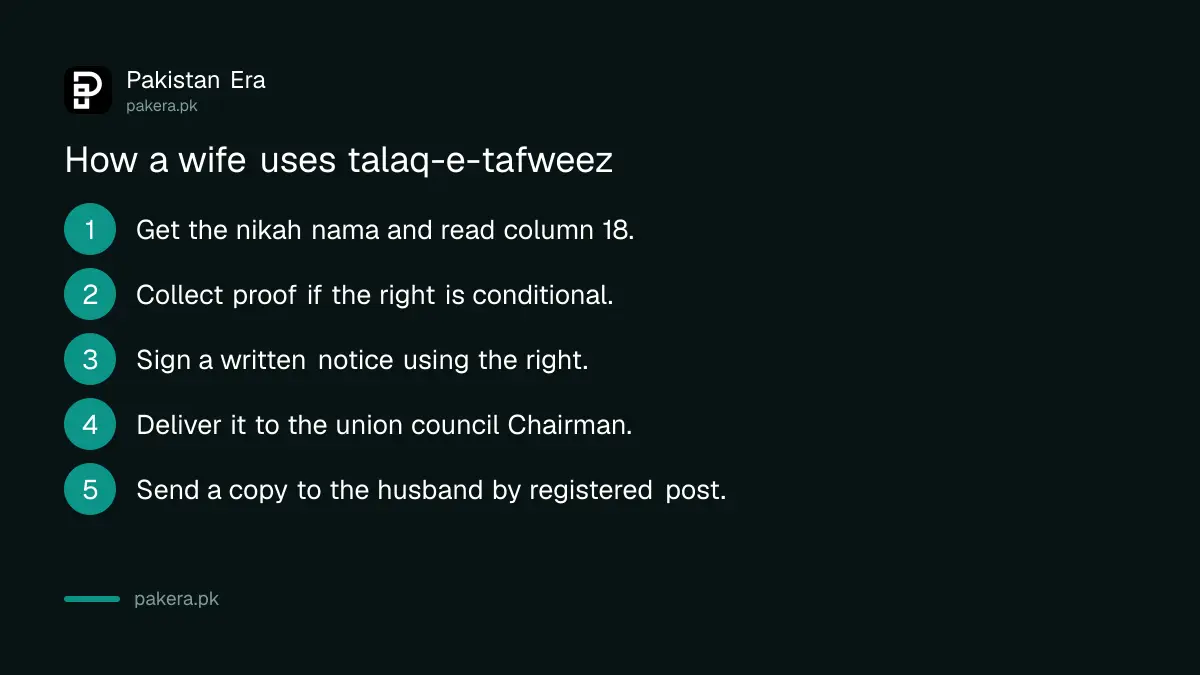
Section 8 applies the talaq rules of section 7 to the wife. So she gives written notice of the divorce to the Chairman of the union council and supplies a copy to the husband. No court case or court fee is needed for this route.
The notice is a short signed letter. It should name both spouses, give their CNIC numbers, give the date and place of the nikah, quote what column 18 says, and state clearly that you are exercising the right of talaq delegated to you. Attach a copy of the nikah nama and your CNIC. If the delegation had a condition, attach proof that it has been met.
- Get a copy of the nikah nama and read column 18.
- If the right is conditional, collect proof that the condition has happened.
- Write and sign the notice stating that you are using the delegated right of talaq.
- Deliver the notice to the Chairman of the union council and get a receipt or a diary number.
- Send a copy to your husband by registered post with acknowledgement due, and keep the receipt.
- Attend the Arbitration Council meetings the Chairman calls.
- After 90 days, collect the certificate that the divorce has taken effect.
In cities, the "union council" may be a municipal committee, a cantonment board or another local body. Ask its secretary which office handles family cases for your address.
The divorce takes effect after 90 days, not on the day you sign
Under section 7(3), applied by section 8, the divorce is not effective until 90 days after the Chairman receives the notice. If the wife is pregnant, it takes effect after 90 days or the end of the pregnancy, whichever is later.
Within 30 days of the notice, the Chairman must form an Arbitration Council. It has the Chairman and one representative of each side, and its job is to try to bring the couple together. You are not forced to agree. If no reconciliation happens, the 90 days run out and the divorce becomes effective. The same timing for a husband's talaq is set out in the page on why talaq takes effect after 90 days.
Once it is effective, the union council issues its certificate and the divorce can be registered with NADRA. The steps for the computerised record are in the page on the NADRA divorce certificate.
Talaq-e-tafweez and khula are different routes
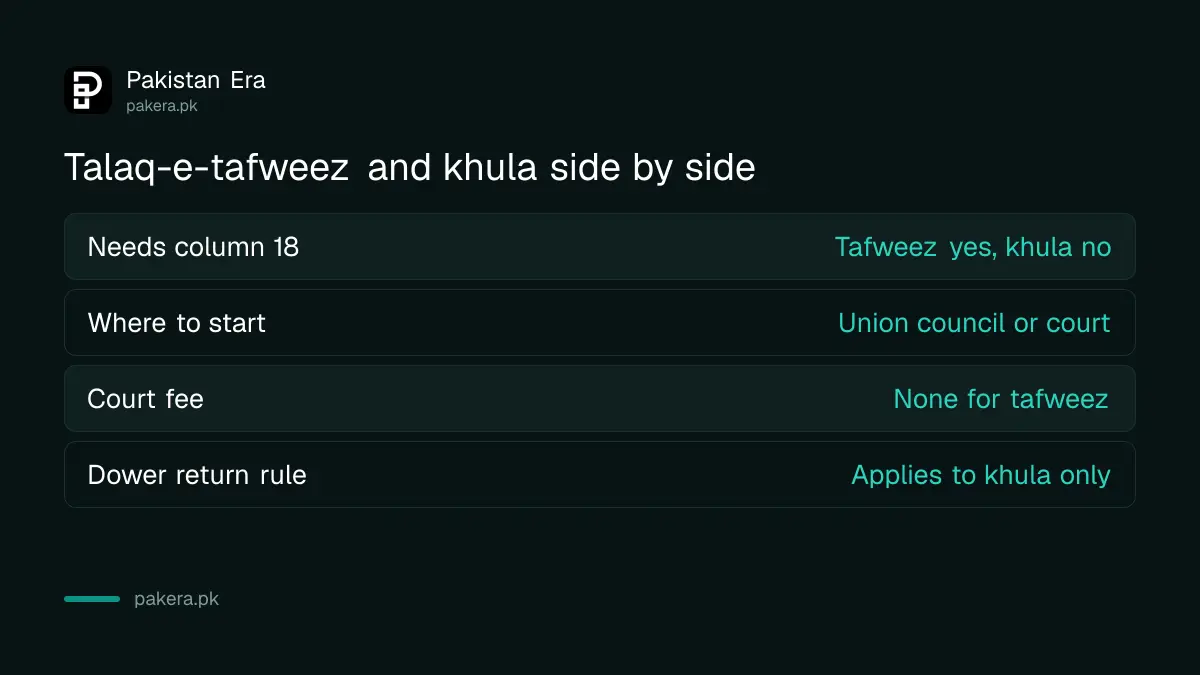
Talaq-e-tafweez goes through the union council and needs a delegation in column 18. Khula goes through the Family Court and needs no delegation. In Punjab, a khula decree can order the wife to give back part of her dower, while a tafweez divorce is not a khula decree.
| Point | Talaq-e-tafweez | Khula |
|---|---|---|
| Needs column 18 delegation | Yes | No |
| Where you start | Union council Chairman | Family Court |
| Court fee | None, as no suit is filed | Family Court fee |
| Law | Section 8, Muslim Family Laws Ordinance 1961 | Family Courts Act 1964 and the Dissolution of Muslim Marriages Act 1939 |
| Dower | No khula surrender rule applies | In Punjab, the court may order up to 50% of deferred or 25% of prompt dower returned |
If column 18 gives you nothing, read how khula works in the Family Court before deciding.
Problems that stop a tafweez divorce, and what to do
Most problems come from the nikah nama itself or from the husband disputing it. A clear certified copy, proof of any condition and proof of delivery solve most of them. A genuine dispute over the column goes to the Family Court.
- The husband says column 18 was changed or forged. Ask the union council for the copy held in its own register. A dispute about the nikah nama is a Family Court matter, so take legal advice.
- The Chairman's office will not accept the notice. Send it by registered post with acknowledgement due to the Chairman and keep the receipt. The 90 days run from delivery.
- The husband refuses to accept his copy. Keep the returned envelope and the post office receipt as proof that you sent it.
- The condition in column 18 is unclear. Wording such as "if he does not maintain her" can be argued about. Get a lawyer's view before you send the notice.
- You need maintenance or your dower too. The union council route ends the marriage only. Claims for dower, dowry or maintenance still go to the Family Court.
Free legal help is available. In Punjab, the district legal empowerment committees can give a lawyer to a woman who cannot pay, and the process is in the page on getting a free lawyer in Punjab.
Common questions
Does talaq-e-tafweez need my husband's consent at the time I use it?
No. His consent was given when he delegated the right in column 18 at the nikah. If the right is conditional, the condition must have happened.
Is delegated divorce valid in Islam and in Pakistani law?
Pakistani law recognises it in section 8 of the Muslim Family Laws Ordinance 1961. In 2013 the Federal Shariat Court dismissed a petition against it, noting that schools of thought differ and treating it as personal law. Ask a scholar of your own school about the religious side.
Can my husband cancel the right he gave in column 18?
The column is part of the registered marriage contract. If he claims to have withdrawn it, that is a dispute for the Family Court, and you should take legal advice.
How long does the whole process take?
At least 90 days from the day the Chairman receives the notice. Add the time to get the certificate and the NADRA record.
Do I lose my haq mehr if I use talaq-e-tafweez?
The Punjab rule on returning part of the dower applies to khula decrees. A tafweez divorce is a different route. If the husband refuses to pay unpaid dower, the claim goes to the Family Court.
Can I remarry the same man later?
Section 7(6) lets a couple remarry after an effective divorce without an intervening marriage, unless it is the third such divorce. Ask a scholar or a lawyer about your own case.
How we verified this
What we checked and where we read it.
Last checked 24 November 2026. We read sections 7 and 8 of the Muslim Family Laws Ordinance 1961 on the Pakistan Code, the Punjab Muslim Family Laws (Amendment) Act 2015 on the Punjab Code, and section 10(5) of the Family Courts Act 1964 as amended in Punjab. We also read the Federal Shariat Court judgment in Shariat Petition 5/I of 2011, dated 24 April 2013, which discusses column 18 and section 8. Union council practice, such as receipts and office names, differs from district to district.
Free on WhatsApp
Get last dates and rule changes on WhatsApp
We post new last dates, fee changes and fixes for common problems, a few short posts a day.
Follow Pakera on WhatsAppOther followers cannot see your number.
Pakera Solves It
Which online process wasted your time this week?
A portal that will not load, a form nobody explains, a complaint that went nowhere. Tell us. Every week we pick one, solve it step by step and publish the answer.
About the author

Global Affairs & Political Economy Writer
Muhammad Hatim is a book lover who started writing because he enjoys it. At Pakistan Era he writes about international relations, geopolitics and the global economy, with a particular interest in South Asia and the forces behind current events.