Who Can Attest a NADRA CNIC Form in Pakistan: Blood Relatives First, Then Grade 16 Officers
Who can verify or attest a NADRA CNIC form: parents and siblings by fingerprint, then grade 16 officers, MNAs, lambardars under Regulation 9. Pak ID steps too.
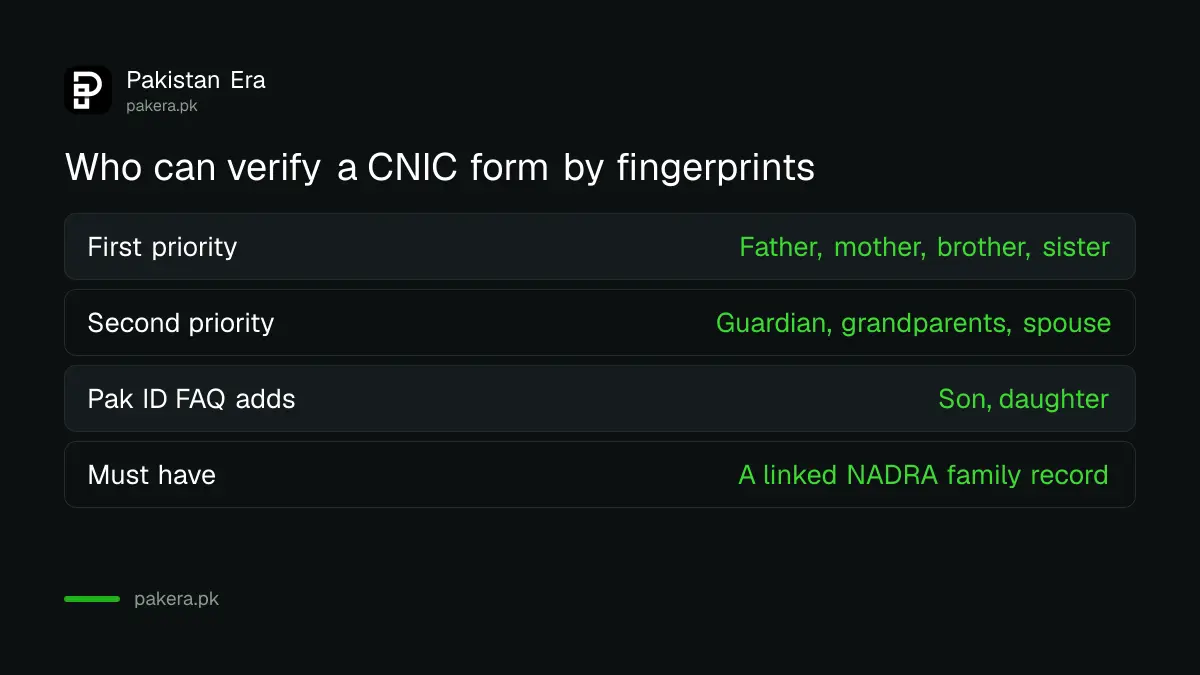
A NADRA CNIC form is verified in one of two ways. A blood relative gives fingerprints: father, mother, brother or sister first, then a guardian, grandparent or spouse. Or, on the paper form, an attester under Regulation 9 signs and stamps it: an MNA, MPA, senator, local body or Zakat committee member, a government officer in grade 16 or above, a commissioned armed forces officer, or the village lambardar. In the Pak ID app only the fingerprint route works.
This step trips up two groups more than anyone: young people with no parent able to come, and families where the only relatives live abroad. Knowing the order NADRA follows saves a second visit.
NADRA prefers a relative's fingerprints over a signature
NADRA calls fingerprint checking by a relative "verification" and treats it as first choice. Its attestation sheet sets two priority levels. Blood relatives come first. Immediate relatives come second. A paper attestation is the older method, used when no relative can give fingerprints.
| Priority | Who can verify by fingerprints |
|---|---|
| First | Father, mother, brother, sister |
| Second | Guardian, paternal or maternal grandfather or grandmother, spouse |
| Pak ID FAQ also lists | Son and daughter |
The relative's own NADRA record must already be linked to yours. If your brother's card does not show you in the family tree, his fingerprints will not verify your form. Check the links on your Family Registration Certificate before the visit.
Twelve kinds of people can attest the paper form
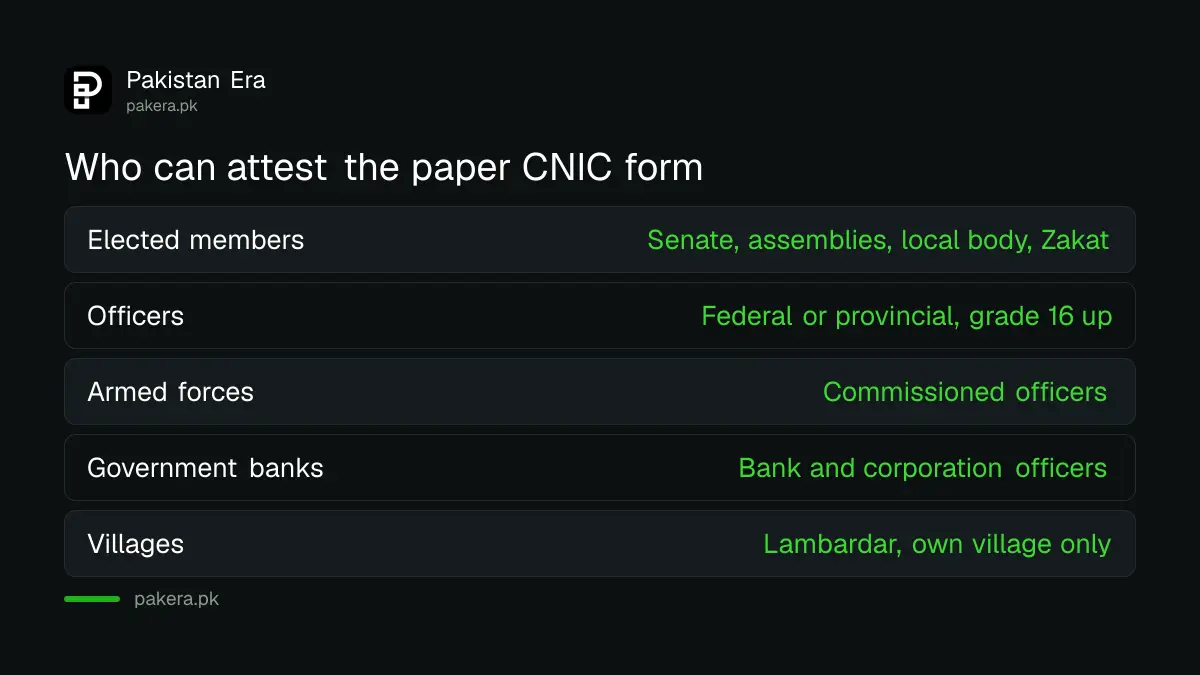
When no relative can give fingerprints, NADRA prints the form and you take it to an attester. NADRA's sheet lists these people under Regulation 9. Each must know you personally, sign, write their full name, citizen number and office stamp.
- A member of the Senate, National Assembly, Provincial Assembly, a local body or a Zakat committee.
- Federal or provincial government officers in Basic Pay Scale 16 or above.
- Commissioned officers of the armed forces and civil armed forces.
- Local body officers of a status equal to grade 16 or above.
- Officers of autonomous and semi-autonomous bodies.
- Officers of the Levies in grade 16 or above.
- Officers of government banks and government corporations.
- The headman (lambardar), for people living in his village.
- Any other person or officer the federal government or NADRA authorises.
- NADRA officers in grade 16 or above, regular or contract.
- A head of family in grade 16 or above, for family members, but not for his or her own form.
- A political agent or assistant political agent.
A government school headteacher in grade 16 or above qualifies, and so does an officer at a government bank. So does a councillor. A private company manager does not, however senior.
What the attester must write on the form
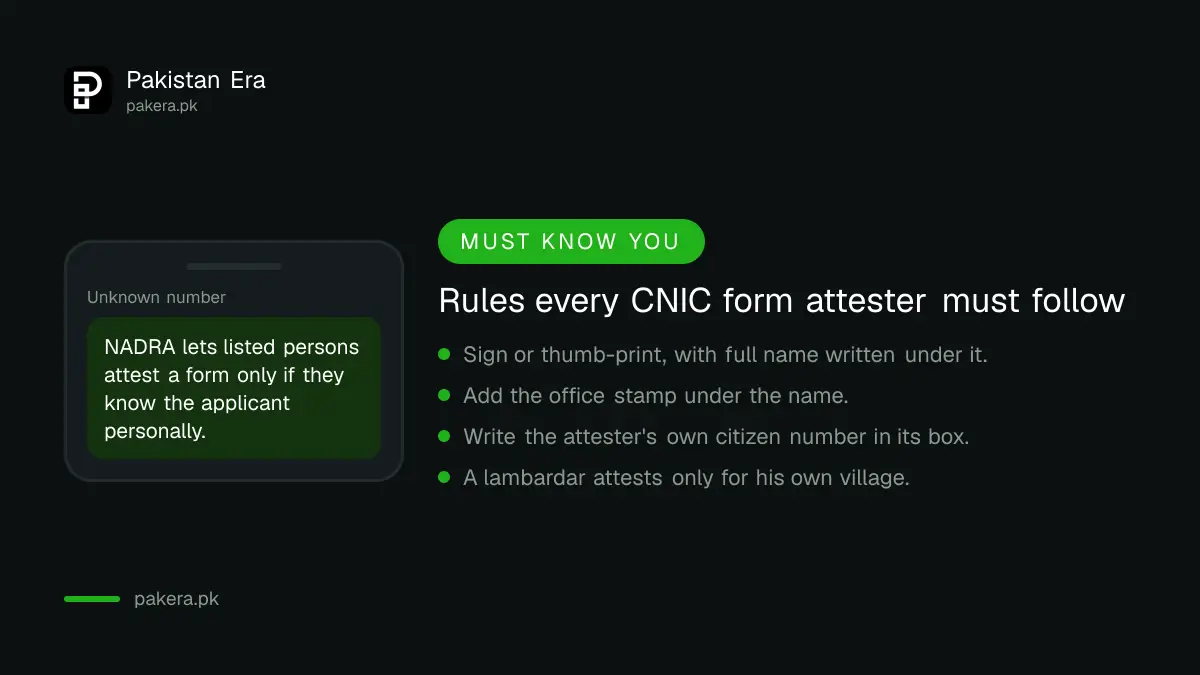
An attestation that misses a detail can send you back. NADRA asks the attester to sign or thumb-print, write his or her full name clearly under it, add the office stamp, and write their own citizen number in the box for it. The stamp may show a designation rather than a name.
- Signature or left thumb impression.
- Full name, written clearly under the signature.
- Office stamp under the name.
- The attester's 13-digit citizen number in the space provided.
NADRA may contact the attester if a question comes up, so a working phone number on the stamp helps. The attester must know you personally. Attesting a stranger's form is exactly what the rule is written to stop.
In the Pak ID app, only fingerprints count
Pak ID has no upload box for a gazetted officer's stamp. NADRA's FAQ says only biometric verification by a relative is available in the app. At the attestation stage the app lists your linked relatives and spouse. You pick one who is with you, and that person's fingers are scanned.
The relative does not have to be in the same room. Send them your application's Tracking ID and PIN. They log in to their own Pak ID account, tap the Attestation icon on the home screen, enter the Tracking ID and PIN, and give their fingerprints. NADRA improved this witness step in Pak ID app version 5.8.5, released on 11 and 12 November 2026.
- Keep the whole hand inside the frame on the screen.
- Hold the phone far enough away that every finger shows.
- Rest the hand on a table so neither hand nor phone moves.
- Follow the on-screen prompts for finger position.
Fingerprints keep failing? NADRA also matches faces, and how NADRA facial and iris verification works is worth knowing before a centre visit.
No relative available: the centre route
If no relative is alive, linked or reachable, apply at a NADRA centre. The staff print your form. You take it to an attester from the Regulation 9 list, then return it to the same centre. For people with no birth record or unregistered parents, NADRA also asks for an undertaking.
For a first CNIC with no blood relative at all, NADRA's requirements allow a biometric witness by any ID holder, with an "Undertaking B" form, in system independent cases. This is the route for orphans and others with no family record. The wider steps for a first CNIC when parents are not registered walk through the documents.
Children's B-Forms follow the same idea. At a centre, a parent, spouse, guardian or gazetted officer attests. The fee for a NADRA B-Form is Rs 50 normal or Rs 500 executive, according to NADRA.
Common questions
Can my uncle verify my CNIC form?
Not by fingerprints. NADRA's list stops at parents, siblings, children, grandparents, a guardian and a spouse. An uncle can attest the paper form only if he is on the Regulation 9 list, for example a grade 16 government officer.
Who is a gazetted officer for NADRA attestation?
NADRA's list means a federal or provincial government officer in grade 16 or above, plus the other office holders under Regulation 9, such as commissioned armed forces officers.
Can I get my form attested in the Pak ID app?
Only by a linked relative's fingerprints. The app does not accept a gazetted officer's attestation.
Can my relative attest from another city?
Yes, in Pak ID. Share your Tracking ID and PIN. They log in to their own account, tap Attestation, enter both, and give fingerprints.
Does the attester need to know me?
Yes. NADRA says the listed persons may attest or verify forms only if they know the applicant personally.
Can a lambardar attest a CNIC form in a city?
NADRA allows a lambardar to attest only for people living in his own village.
How we verified this
What we checked and where we read it.
Last checked 14 November 2026. The two priority levels and the twelve attester categories come from NADRA's attestation sheet, Attestation/Verification of CNICF, linked from the requirements on NADRA's identity documents page. The Pak ID attestation steps, the fingerprint tips and the son and daughter wording come from the Pak ID FAQ on NADRA's site. The Undertaking B route and the B-Form fees come from the CNIC and CRC requirements on the same pages. The 5.8.5 release note is on NADRA's app listings on Google Play and the App Store. The sheet calls the list "Regulation 9 (a-h)" but runs to twelve items, a to l.
About the author

Public Services and Education Journalist
Fajr Riaz is a journalist and content writer at Pakistan Era, based in Lahore. She covers the questions people meet in everyday life in Pakistan: how a public service works, what a change in the rules means, and where to find a reliable answer.