How to File a Workplace Harassment Complaint in Khyber Pakhtunkhwa
File a workplace harassment complaint in Khyber Pakhtunkhwa with the provincial Ombudsperson or your Inquiry Committee. Steps, time limits and penalties.
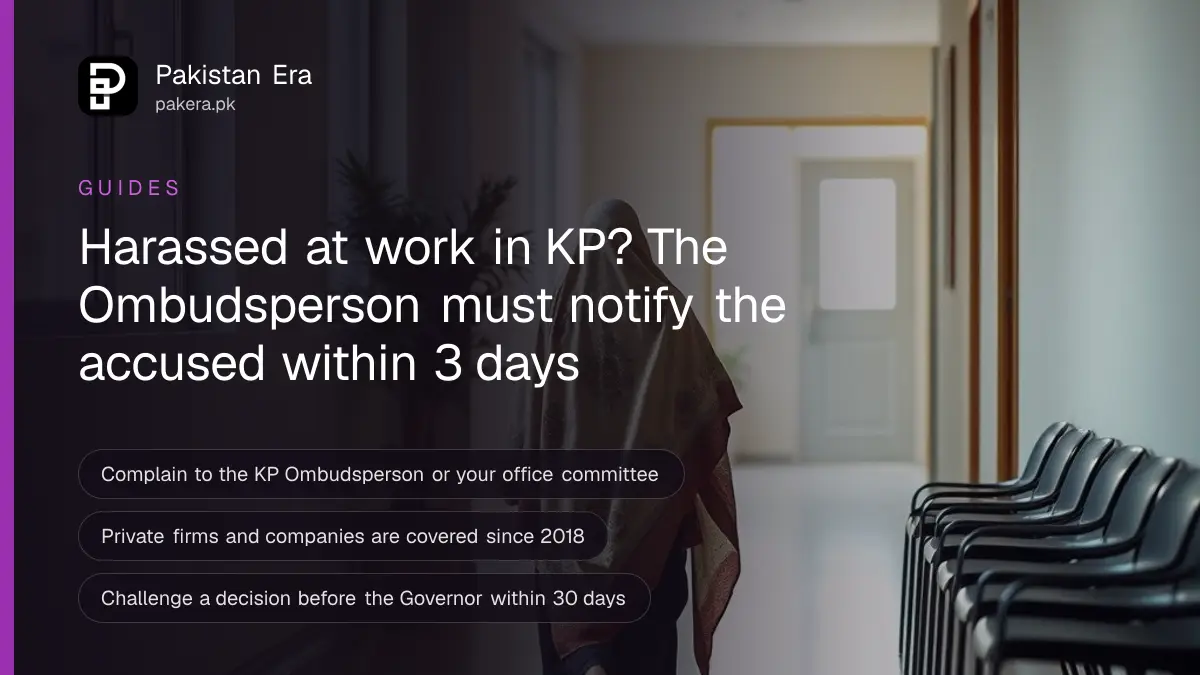
To file a workplace harassment complaint in Khyber Pakhtunkhwa, write to the Provincial Ombudsperson for Protection against Harassment in Peshawar, or to the Inquiry Committee at your workplace. You choose which one. The Ombudsperson's listed number is 091 9212308. Once your complaint arrives, the law gives the Ombudsperson 3 days to send the accused a show cause notice.
Many women in KP do not know this office exists. Plenty assume the only option is the federal forum in Islamabad. Since 2018, though, KP law has provided its own Ombudsperson for harassment at work, under a provincial version of the 2010 law.
On 3 October 2026 we read the 2010 Act, the 2018 KP amendment in the KP Gazette, the Ombudsperson's official page and a 2026 amendment bill. We did not file a complaint.
KP has its own harassment Ombudsperson since 2018
The Khyber Pakhtunkhwa Protection against Harassment of Women at the Workplace (Amendment) Act, 2018 applied the 2010 law to the province and created a provincial Ombudsperson. It was published in the KP Gazette on 2 March 2018 and came into force at once.
The 2018 Act changed "Ombudsman" to "Ombudsperson" throughout. It made the law apply to "the Province of the Khyber Pakhtunkhwa" instead of all Pakistan. The Ombudsperson must be a serving or former High Court judge, someone qualified to be one, or a retired civil servant with a law background and 15 years' service. The term is three years.
If you work for a federal body, such as a federal ministry office in Peshawar, the federal harassment Ombudsperson is usually the right forum instead.
Who can complain and what counts as harassment
Any employee, woman or man, can complain. Harassment means an unwelcome sexual advance, a request for sexual favours, or sexual words, messages or touching that disturb your work or make the workplace hostile. Punishing you for saying no also counts.
The 2010 Act defines an employee widely. It includes regular and contract staff, people paid daily, weekly, monthly or by the hour, interns and apprentices. The 2018 KP amendment widened "organisation" to cover:
- government departments, corporations and autonomous bodies;
- government schools, colleges and hospitals;
- registered civil society associations;
- private shops, factories and commercial firms, and registered companies.
That last point matters. You do not need a government job to use the KP Ombudsperson. A nurse in a private hospital or a sales assistant in a Peshawar mall is covered. Online abuse from strangers is different, and goes to the federal agency that handles cybercrime complaints.
Choose the Ombudsperson or your Inquiry Committee
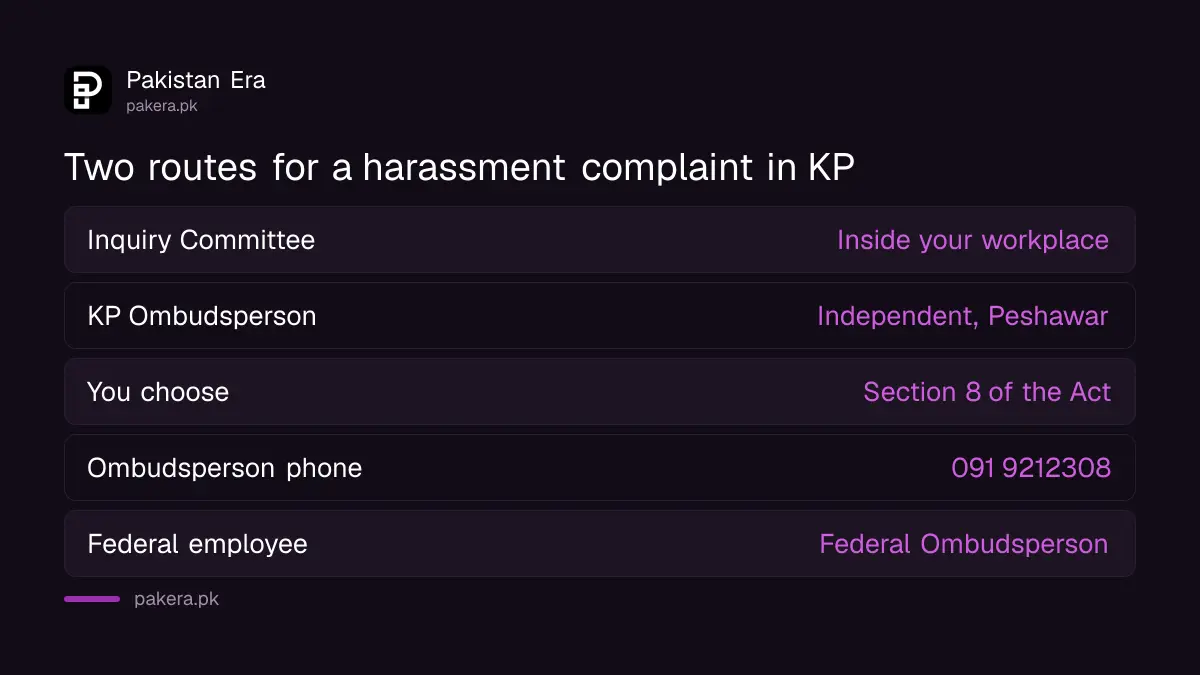
Section 8 of the Act lets you complain either to the Ombudsperson or to the Inquiry Committee at your workplace. You do not have to try the committee first. Going straight to the Ombudsperson makes sense when the accused is senior or the committee does not exist.
| Point | Inquiry Committee | KP Ombudsperson |
|---|---|---|
| Where it sits | Inside your organisation | Independent office, Peshawar |
| First step | Charges sent to accused within 3 days | Show cause notice within 3 days |
| Accused's reply | Within 7 days | Within 5 days |
| Result | Findings within 30 days, then the employer decides | Ombudsperson decides and can impose penalties |
| If unhappy | Appeal to the Ombudsperson within 30 days | Representation to the KP Governor within 30 days |
Every organisation must have an Inquiry Committee of three people, and at least one must be a woman. The employer must also display the Code of Conduct in English and in a language most staff understand. If it does not, any employee can petition the District Court, and the employer faces a fine of Rs 25,000 to Rs 100,000.
How to file the complaint with the KP Ombudsperson
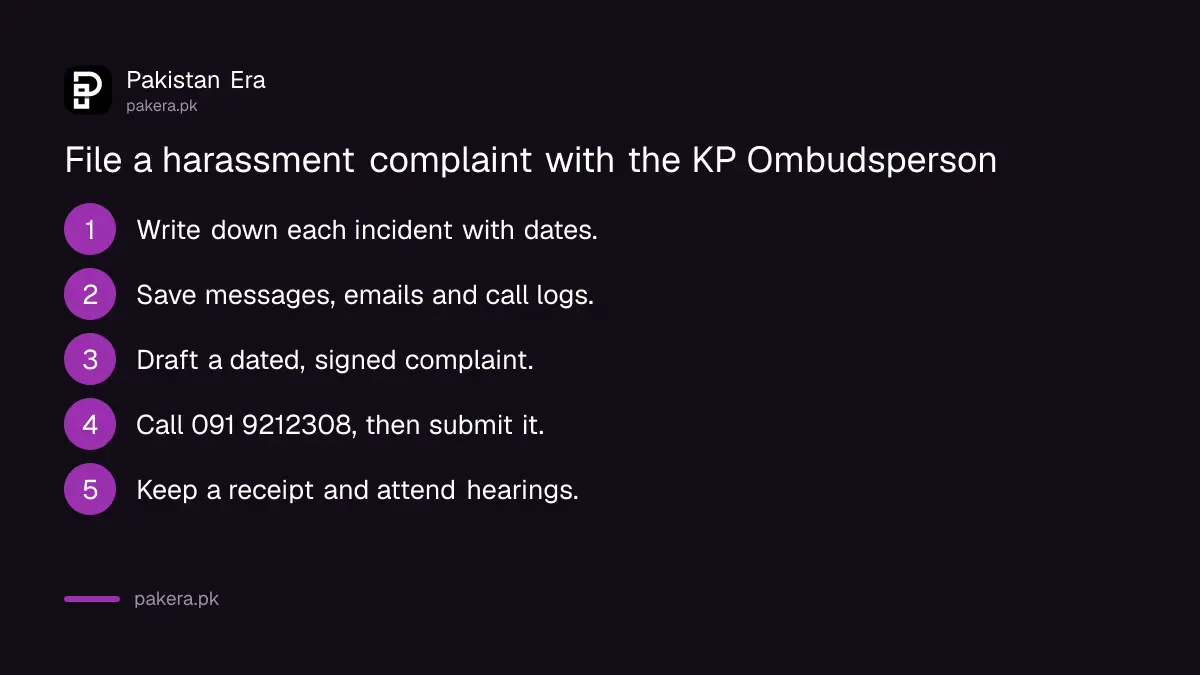
Write a dated complaint that names the accused, says what happened, where and when, and lists witnesses and evidence. Send or deliver it to the Ombudsperson Secretariat in Peshawar, keep a copy, and call 091 9212308 to confirm the address before you go.
- Write it down now. Note every incident with the date, place, words used and who saw it. Notes made at the time carry more weight.
- Keep the proof. Save messages, emails, call logs and voice notes. Do not delete chats, even upsetting ones.
- Draft the complaint. Give your name, job, employer, the accused's name and post, the facts, and what you want done.
- Submit it. Call the Secretariat on 091 9212308 to confirm how to submit, then deliver or post it. Ask for a receipt.
- Attend hearings. You can speak for yourself. The Act lets both sides represent themselves before the Ombudsperson.
We could not find a street address or an online complaint form on the Ombudsperson's official page, which lists only the phone number. That is why the call comes first. If you cannot pay a lawyer, KP's free legal aid system may help you draft and argue the case.
What the Ombudsperson can do after a complaint
The Ombudsperson has civil court powers to summon witnesses and demand documents, and can punish contempt like a High Court. After the inquiry, the Ombudsperson can impose minor or major penalties, from censure up to dismissal and a fine.
| Minor penalties | Major penalties |
|---|---|
| Censure | Demotion to a lower post or scale |
| Withholding promotion or increment for a period | Compulsory retirement |
| Stopping at an efficiency bar for a period | Removal from service |
| Recovering compensation for the complainant from the accused's pay | Dismissal, and a fine, part of which can go to the complainant |
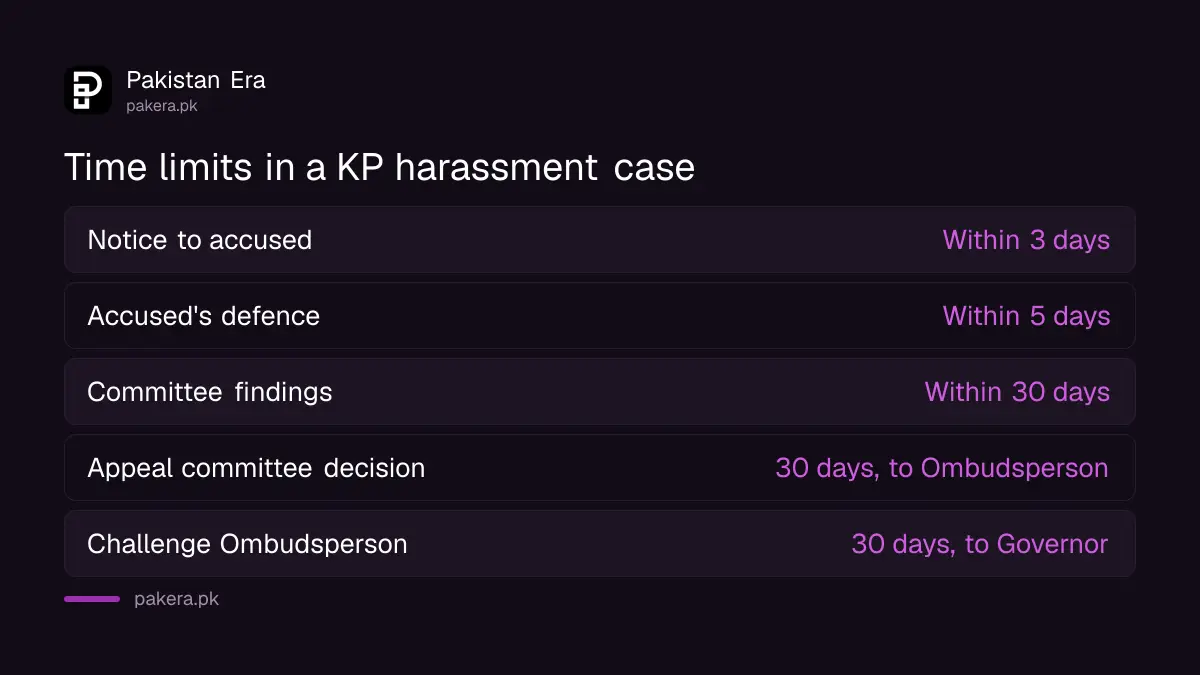
The law also protects you during the case. An Inquiry Committee must not let adverse action be taken against the complainant or witnesses. If the decision goes against you, section 9 as amended in KP lets you make a representation to the Governor of Khyber Pakhtunkhwa within 30 days.
The Act also allows action against a complainant whose allegations are false and made in bad faith. A truthful complaint that cannot be fully proved is not a false one.
A 2026 bill would change the rules, but it is not law yet
A KP amendment bill introduced on 6 April 2026 would add students, gig workers and freelancers, set a 90-day limit for complaints, and let the Ombudsperson fine private offenders up to Rs 2 million. The Assembly website still shows its status as introduced.
The bill is Bill No. 86 on the Provincial Assembly's website. Its statement of reasons says it follows directions of the Supreme Court in Civil Petition No. 2298 of 2025. Its other proposals:
- complaints screened within 10 days, and no anonymous complaints;
- workplaces would include online platforms, homes used for work, transport and tuition centres;
- appeals would go to the Chief Minister instead of the Governor;
- the office would run a free 24-hour helpline;
- a public employer could not punish a complainant or witness while the case is open.
None of this applies until the bill is passed, signed and published. Until then, the 2010 Act as amended for KP is the law. We will update this page if the bill passes. There is also a 2020 KP amendment on the Assembly site, but its copy is a scanned image we could not read, so it is not used here. If the harassment comes with violence at home, a protection order in KP is a separate and faster remedy.
Common questions
Where do I file a harassment complaint in KP?
With the Provincial Ombudsperson for Protection against Harassment in Peshawar, or the Inquiry Committee at your workplace. The Ombudsperson's official number is 091 9212308.
Can a man file a workplace harassment complaint in KP?
Yes. The 2010 Act defines a complainant as a woman or man who is aggrieved by harassment at work.
Do I have to complain to my office committee first?
No. Section 8 lets any employee choose the Ombudsperson or the Inquiry Committee. You can go straight to the Ombudsperson.
Does the KP Ombudsperson cover private companies?
Yes. The 2018 KP amendment includes private commercial and industrial firms, registered companies, and private institutions in the definition of an organisation.
Is there a time limit to file a harassment complaint in KP?
The 2010 Act sets none for the first complaint, though we could not read the 2020 KP amendment. A 2026 bill proposes 90 days from the last incident, but it is not law yet. File as soon as you can.
Can I appeal the Ombudsperson's decision?
Yes. Under section 9 as amended in KP, you can make a representation to the Governor of Khyber Pakhtunkhwa within 30 days of the decision.
How we verified this
What we checked, where we read it, and what we could not confirm.
Last checked on 3 October 2026. The provincial Ombudsperson, the rename, the provincial scope, the wider meaning of organisation, the qualifications, the three-year term and the representation to the Governor are read in the KP amendment Act of 2018, KP Gazette, 2 March 2018. The definitions, the Inquiry Committee rules, the 3, 5, 7 and 30 day limits, the penalties, the Ombudsperson's powers and the District Court fine are read in the Protection against Harassment of Women at the Workplace Act, 2010. The phone number 091 9212308 is read on the Ombudsperson's page on the KP portal. The 2026 bill, its introduction date and its status are read on the Provincial Assembly website. We did not file a complaint, could not find an official street address, and could not read the 2020 amendment.
About the author

Public Services and Education Journalist
Fajr Riaz is a journalist and content writer at Pakistan Era, based in Lahore. She covers the questions people meet in everyday life in Pakistan: how a public service works, what a change in the rules means, and where to find a reliable answer.