How to Get a Protection Order Against Domestic Violence in Khyber Pakhtunkhwa
Get a protection order in Khyber Pakhtunkhwa under the 2021 domestic violence law: file within 15 days at the sessions court, a decision in 60 days, and help.
A woman facing violence at home in Khyber Pakhtunkhwa can ask a District and Sessions Judge for a protection order under the Khyber Pakhtunkhwa Domestic Violence against Women (Prevention and Protection) Act, 2021. File within 15 days of the incident. The court must decide within 60 days. For help right now, call the Bolo Helpline on 0800-22227 or the police on 15.
The KP law is not the same as the Sindh or Punjab laws. It sends the case to a sessions court, not a magistrate. It also gives every district a District Protection Committee, chaired by the Deputy Commissioner, that can file the case for you.
We read the full Act on the KP Code, the official law portal of the KP Law Department, on 3 October 2026. We also read the Social Welfare Department's pages on the Bolo Helpline and the Dar-ul-Aman shelters. Everything below comes from those pages.
Who can ask for a protection order in KP
Any woman facing violence from someone she is related to by blood, marriage or family ties can apply. That includes a husband, in-laws, a father, a brother or a son. She can apply herself, through her guardian, or through the Secretary of the District Protection Committee.
The Act's idea of violence is wide. It is not only beating. Section 2 covers physical, psychological, emotional and economic abuse. It also covers threats, harassment, sexual abuse and locking someone in.
- Economic abuse: denying a woman food, clothing or shelter that the abuser is legally bound to give, in line with his income.
- Psychological abuse: harm that leads to depression, an eating disorder or a suicide attempt, caused by oppressive behaviour or by limiting where she can go.
- Physical acts: assault, hurt, criminal force and wrongful confinement, as the criminal law defines them.
Domestic violence is also a crime under section 3. The punishment is at least one year and up to five years in prison, plus a fine. So a protection order and a criminal case can run side by side.
File within 15 days at the sessions court
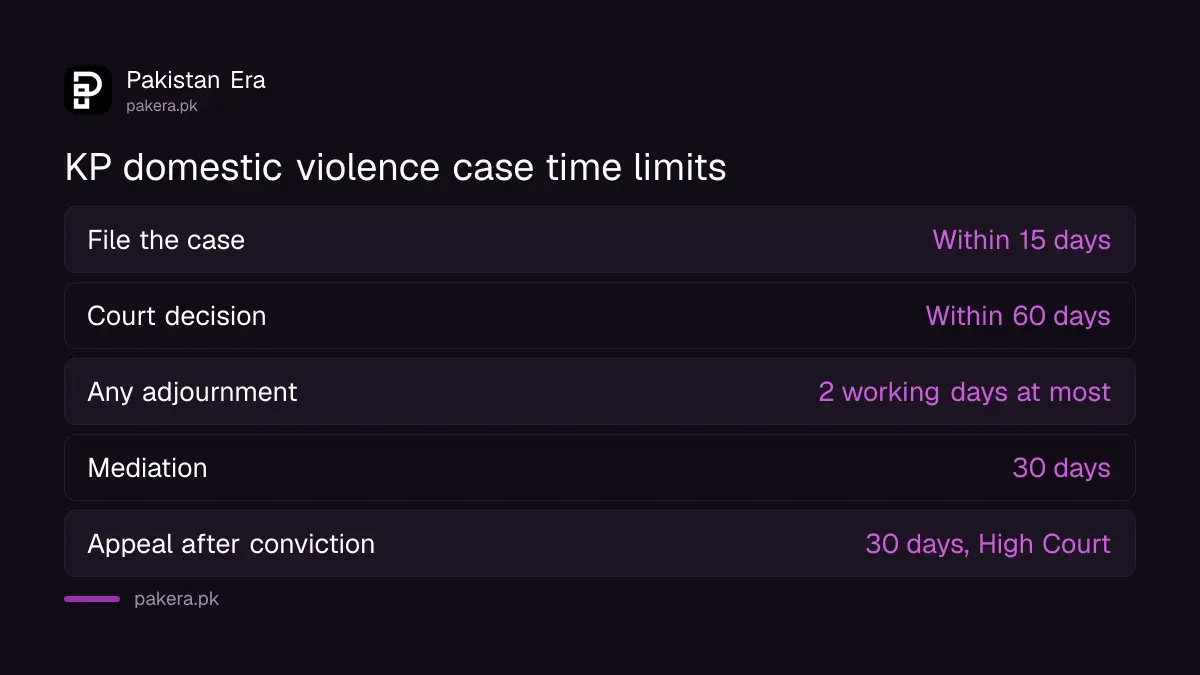
Section 12 says the application goes to the court with local jurisdiction within fifteen days of the incident. The court is the District and Sessions Judge, or an Additional District and Sessions Judge notified by the Peshawar High Court. It must hear the case day to day and decide within 60 days.
The 15 days is the part people miss. Count from the day of the incident, not the day you decide to act. If more time has passed, speak to a lawyer straight away about a late application or other routes, such as a police case for hurt or a family court case for maintenance.
| Step | Time limit in the Act | Section |
|---|---|---|
| File the application | Within 15 days of the incident | 12(1) |
| Court decides the case | Within 60 days of taking it up | 12(2) |
| Any adjournment | No more than 2 working days | 12(2) |
| Mediation, if the committee refers it | 30 days | 8(2) |
| Appeal by a convicted person | 30 days, to the High Court | 18 |
An interim order is possible at any stage under section 13. Ask for it on the first day if you are still in danger. You do not have to wait for the final decision.
How to get a protection order, step by step
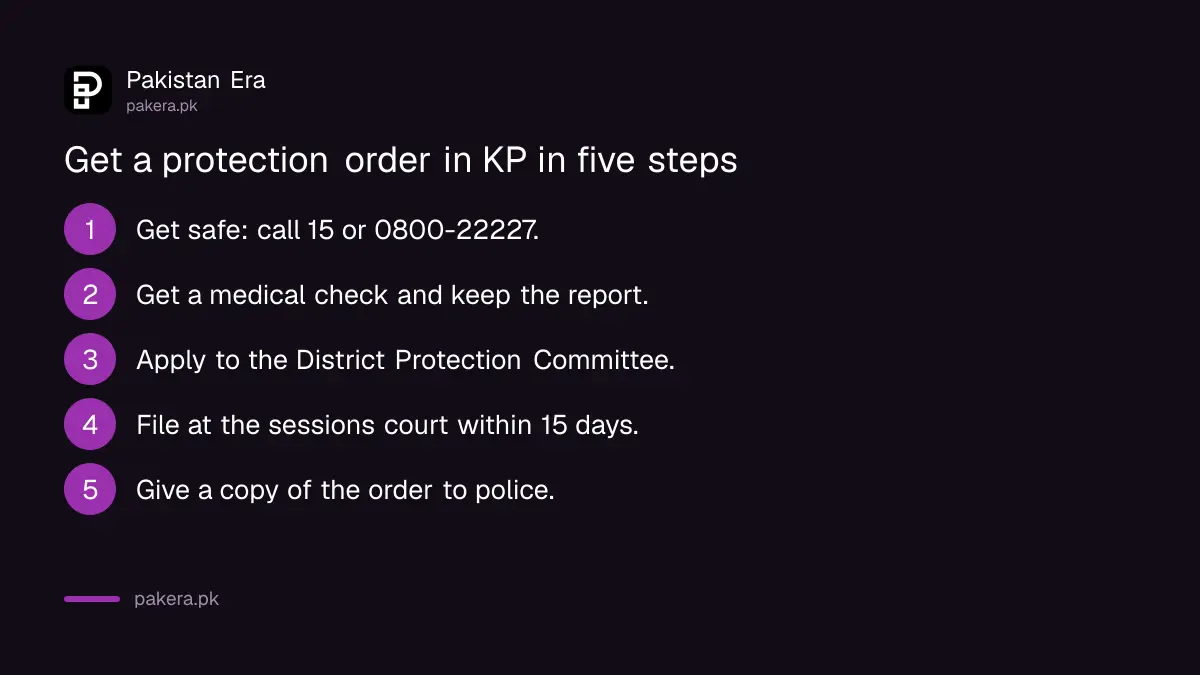
Get safe first, then record what happened, then file. The District Protection Committee can help with each step, and its Secretary can file the application for you with your consent. A lawyer is still worth having, and the Act tells the committee to arrange legal aid.
- Get safe. Call 15 in an emergency. Call the Bolo Helpline on 0800-22227 for advice, shelter, police help and a referral.
- Get a medical check. Go to a government hospital and keep the medical report. The Act tells service providers to arrange this and send a copy to the committee.
- Apply to the District Protection Committee. Write to it through the District Social Welfare Office and ask for assistance under section 8.
- File at the sessions court. You, your guardian or the committee's Secretary files within 15 days. Ask for an interim order.
- Keep copies. Keep the order, the medical report and the application. Give a copy of the order to your local police station.
The committee may suggest mediation, with one mediator from each family and one neutral person. Section 8(3) says mediation does not stop the committee from protecting you. You can refuse a settlement that leaves you unsafe.
What the District Protection Committee does for you
Every district must have a District Protection Committee under section 4. The Deputy Commissioner chairs it. Its Secretary is the chair of the District Committee on the Status of Women, or the District Social Welfare Officer. It meets at least once a month and keeps a record of every case.
The committee includes a woman member of the Provincial Assembly, the district health officer, the District Public Prosecutor, a police representative, a gynaecologist and a psychologist. That mix matters. One application can reach medical, legal and police help together.
Under sections 6 and 9, the committee and its Secretary must:
- help you get medical treatment;
- help you move to a safer place, including a government shelter;
- make sure you get legal aid;
- apply to the court for a protection order with your consent;
- make sure any money the court orders is actually paid.
We could not find a list of committee contacts for each district on an official page. The Social Welfare Department's district office is the practical place to start. The Bolo Helpline also says it follows up cases with the committees.
What the court can order
Once satisfied that violence took place, the court can stop the abuser from hurting you, contacting you or coming near your work or school. It can keep you in the house, return your property, and order money for losses and maintenance. Breaking the order is a crime.
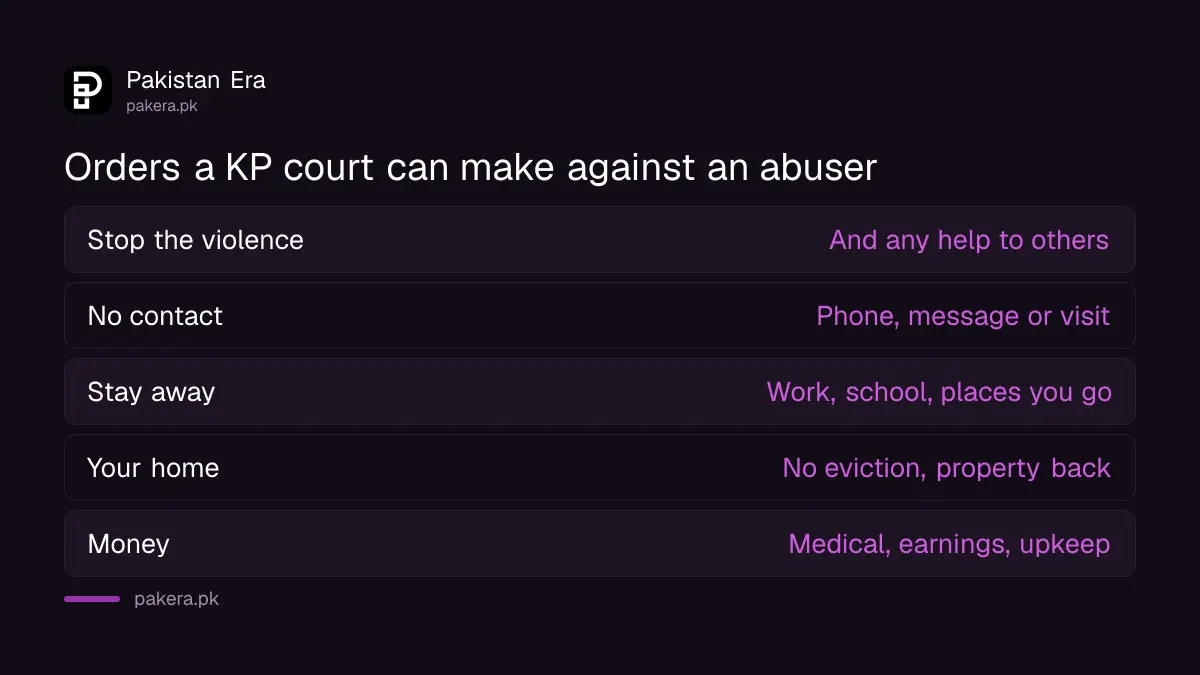
Section 14 lists the protection orders. The abuser can be barred from more violence, from helping others commit it, from your workplace, school or places you often visit, and from any contact by phone, message or in person. The order can also protect your children, relatives and anyone helping you.
The court can also stop him from putting you out of the house, put you back in property you are entitled to, and make him sign a bond to keep the peace. Section 15 adds money relief: medical costs, lost earnings, damaged or taken property, and maintenance for you and your children under family law. A claim to recover dowry or haq mehr is a separate case in the family court.
Orders last until the court cancels them. Under section 17, breaching one can mean up to one year in prison, a fine of up to Rs 300,000, or both.
Helplines and shelters in Khyber Pakhtunkhwa
The Bolo Helpline, 0800-22227, is run by the KP Social Welfare and Women Empowerment Department. It offers counselling, legal advice, shelter, police protection and medical referrals. For a place to stay, the department runs Dar-ul-Aman women's shelters in 15 districts.
The department's page lists Dar-ul-Aman shelters in Abbottabad, Swat, Mardan, Haripur, Mansehra, Kohat, Chitral, Bannu, Dir Lower, Shangla, Swabi, Nowshera, Dera Ismail Khan and Buner, plus the Women Crisis Centre in Peshawar. It says shelter is free, with counselling and skills training. It also says the centres have no in-house legal advisor, and volunteer advocates take court cases.
Save these numbers on your phone under a name only you will know. Police 15 works in every district, like the other emergency helpline numbers across Pakistan. A woman in Karachi or Hyderabad should follow the different process in getting a protection order in Sindh, and in Punjab the Punjab protection order process applies.
Common questions
Which court hears domestic violence cases in KP?
The Court of the District and Sessions Judge, or an Additional District and Sessions Judge notified by the Peshawar High Court. It is not a magistrate's court, unlike Sindh.
How long do I have to file?
Fifteen days from the incident, under section 12(1) of the 2021 Act. If more time has passed, see a lawyer quickly about your options.
Can someone else file for me?
Yes. Your guardian can file, or the Secretary of the District Protection Committee can apply to the court with your consent.
Is domestic violence a crime in KP?
Yes. Section 3 sets one to five years in prison plus a fine. Breaking a protection order is a separate offence with up to one year or Rs 300,000, or both.
Do I have to agree to mediation?
No. The committee can refer a case to mediation for 30 days, but the Act says this does not stop it from protecting you. Do not accept a deal that leaves you unsafe.
Does the law cover a husband who stops giving money for food?
Yes. Denying food, clothing or shelter that he must legally provide is economic abuse under section 2. The court can order maintenance and other money relief.
How we verified this
What we checked, where we read it, and what we could not confirm.
Last checked on 3 October 2026. The definitions, the 15 day filing limit, the sessions court, the 60 day decision rule, interim orders, the District Protection Committee's members and duties, mediation, the orders the court can make, money relief, the one to five year sentence and the penalty for breach are read in the Khyber Pakhtunkhwa Domestic Violence against Women (Prevention and Protection) Act, 2021 on the KP Code. The Bolo Helpline number and services are read on the Social Welfare Department's Bolo Helpline page, and the shelter list on its Dar-ul-Aman page. We did not call the helpline or visit a committee.
About the author

Public Services and Education Journalist
Fajr Riaz is a journalist and content writer at Pakistan Era, based in Lahore. She covers the questions people meet in everyday life in Pakistan: how a public service works, what a change in the rules means, and where to find a reliable answer.