Is the Viral Yalda Hakim Video About a Pakistani TV Channel Real? No, She Says It Is an AI Fake
Yalda Hakim said on 15 November 2026 that the viral video of her reporting a Pakistani TV channel scandal is an AI fake. Check clips like this and report them.
یہ صفحہ اردو میں پڑھیں
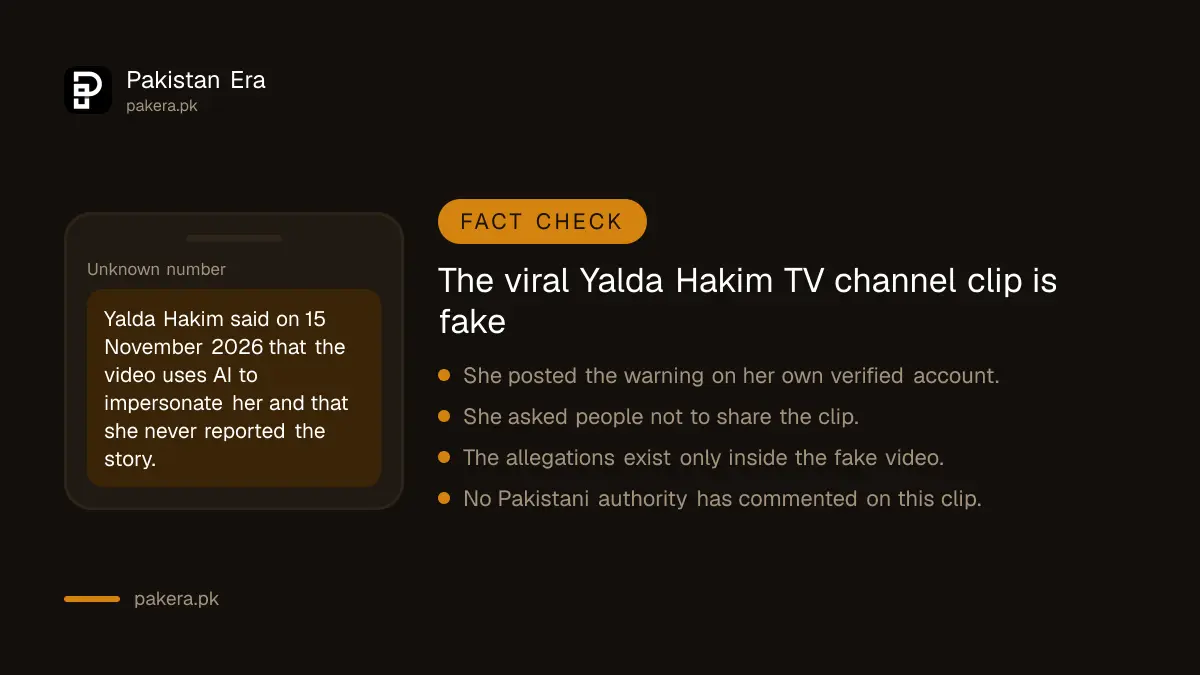
Short answer: No. The viral video in which journalist Yalda Hakim appears to report a money scandal at a Pakistani entertainment TV channel is fake. On 15 November 2026 she wrote on her own X account: "This video is fake. It uses AI to impersonate me." She added: "I never reported this story. Please don't share the clip."
Yalda Hakim is an Afghan-born Australian journalist who presents international news on British television. Her face and voice are well known in Pakistan, which is why clips that copy her keep spreading here. This is at least the third fake clip of her aimed at Pakistani viewers in a year.
The viral Yalda Hakim video is an AI fake
The clip uses artificial intelligence (AI) to copy Yalda Hakim's face and voice. It is made to look like a real news report. She has said in her own words that she never reported the story, and she has asked people to stop sharing it.
The video presents itself as a news bulletin. In it, a figure that looks and sounds like Hakim describes alleged financial wrongdoing at a Pakistani entertainment channel. It was being shared on social media in Pakistan when Hakim spoke up on 15 November.
| What the clip shows | What is true |
|---|---|
| Yalda Hakim reporting a scandal at a Pakistani TV channel | She says she never reported this story |
| A real news bulletin | An AI video that impersonates her |
| Her own face and voice | Copied by software, she says |
| Something to forward to others | She asked people not to share it |
We are not naming the channel in the clip. The allegations exist only inside a fake video, so repeating them would spread the same false claim.
What Yalda Hakim said on 15 November 2026
Hakim posted a short warning on X on Saturday 15 November 2026. She called the video fake, said it used AI to impersonate her, said she never reported the story and asked people not to share the clip. Her words were widely reported in Pakistan the next day.
Her full message was short. These are the two lines that matter:
- "This video is fake. It uses AI to impersonate me."
- "I never reported this story. Please don't share the clip."
She did not say who made the video. No Pakistani authority has said anything about this clip in public so far.
This is not the first fake Yalda Hakim clip in Pakistan
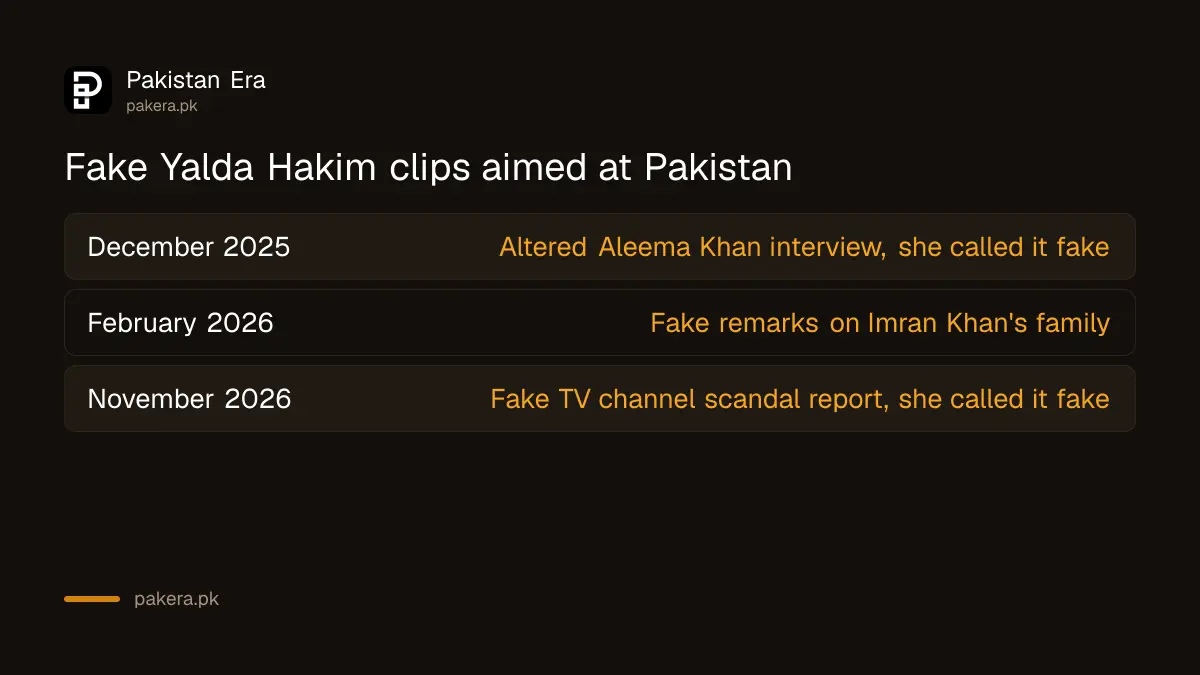
Fake clips of Hakim have targeted Pakistani audiences before. In December 2025 she said a clip of her interview with Aleema Khan, the sister of former prime minister Imran Khan, had been altered. In February 2026 fact-checkers found another fake clip about Imran Khan's family.
| When | What the fake clip claimed | Who said it was fake |
|---|---|---|
| December 2025 | Her interview with Aleema Khan discussed the Pakistan and India conflict | Yalda Hakim herself, on X |
| February 2026 | She made remarks about Imran Khan's family | Pakistani fact-checkers |
| November 2026 | She reported a money scandal at a Pakistani TV channel | Yalda Hakim herself, on X |
The pattern is the same each time. A trusted face is used to give a false story weight. The aim is to make people believe it and pass it on before anyone checks.
How to check a news video before you forward it
Check the presenter's own account and the channel's own pages before you share any shocking news clip. If the story appears nowhere official, treat the video as fake. Look for lips that do not match the words, a flat voice and blurry edges around the face.
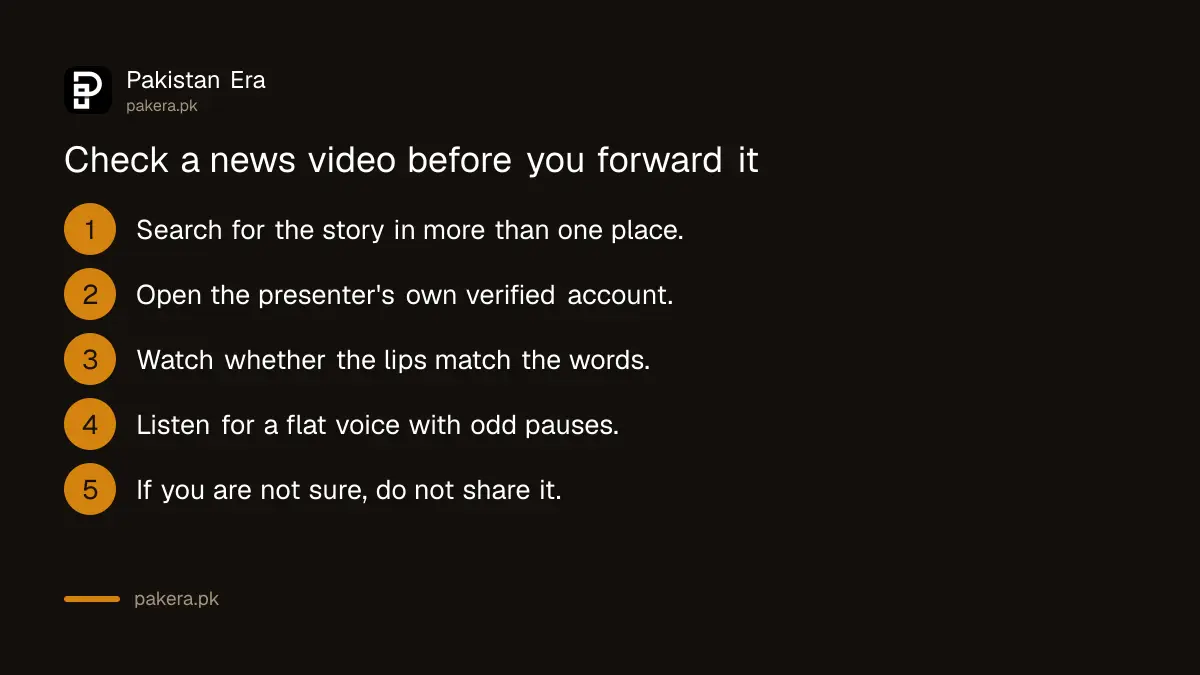
- Search for the story. A real scandal at a TV channel would be reported in many places. If only one clip exists, be careful.
- Open the presenter's verified account. Hakim's own post settled this case in one line.
- Watch the mouth. In many AI videos the lips are slightly out of time with the words.
- Listen to the voice. Cloned voices often sound flat, with odd pauses and no breathing.
- Look at the edges. Hair, ears and glasses often blur or flicker when the head turns.
- Do not forward it. If you are not sure, simply do not share it.
More signs, and the free tools that can check a clip for an AI watermark, are in the steps to spot a deepfake scam video or cloned voice call.
Sharing a fake video can be a crime in Pakistan
Section 26A of the Prevention of Electronic Crimes Act (PECA) punishes knowingly sharing false information that is likely to cause fear, panic or unrest. The penalty is up to 3 years in prison, a fine up to Rs 2 million, or both. A video that falsely accuses a named company can also lead to a defamation case.
The law looks at intention. A person who shares a clip they know, or have reason to believe, is fake is in a weaker position than someone who was fooled. Now that Hakim has said in public that this clip is fake, forwarding it is harder to explain. Each part of the offence is set out in the explainer on PECA section 26A and false information.
How to report a fake video in Pakistan
Report the post on the app where you saw it, using its fake news or impersonation option. If a fake video targets you, your business or your family, complain to the National Cyber Crime Investigation Agency (NCCIA) on its 24 hour helpline, 1799, or through its online complaint form.
- On Facebook, Instagram, TikTok or X: tap the three dots on the post, choose Report, then pick false information or impersonation.
- On WhatsApp: you cannot remove a forwarded clip from other phones, but you can reply in the group that the person shown has called it fake.
- To NCCIA: call 1799 or file online. Keep the link, a screen recording and the date you saw it.
The NCCIA complaint form page lists the fields and documents you need. For a fake profile pretending to be you, follow the steps for reporting a fake social media account.
Common questions
Is the Yalda Hakim video about a Pakistani TV channel real?
No. Yalda Hakim said on 15 November 2026 that the video is fake, that it uses AI to impersonate her, and that she never reported the story.
Who is Yalda Hakim?
She is an Afghan-born Australian journalist who presents international news on British television. She often covers Pakistan and Afghanistan.
Who made the fake video?
No one has said so far. Hakim did not name anyone, and no Pakistani authority has commented on this clip in public.
Can I get in trouble for forwarding it?
Possibly. PECA section 26A punishes knowingly sharing false information likely to cause fear or unrest, with up to 3 years in prison or a Rs 2 million fine.
How do I report a deepfake video in Pakistan?
Report it on the app first. If it targets you or your business, complain to NCCIA on 1799 or through its online complaint form.
Has she been faked before?
Yes. She called out a fake clip of her Aleema Khan interview in December 2025, and fact-checkers flagged another fake clip in February 2026.
How we verified this
What we checked and where we read it.
We checked this on 17 November 2026. Yalda Hakim's statement was posted on X on 15 November 2026, and its wording was reported the same way in several Pakistani reports on 15 and 16 November. The NCCIA helpline number is as listed on the NCCIA website. The PECA penalty is from the text of the Prevention of Electronic Crimes Act as amended in 2025, published by the National Assembly of Pakistan. The earlier fake clips are dated from her own December 2025 post and from fact-checks published in February 2026.
About the author

Fashion & Style Writer
Ayesha Mir is a fashion and style writer at Pakistan Era, joining the new lifestyle desk in November 2026.