PECA Section 26A in Pakistan: 3 Years or Rs 2 Million for Sharing False Information
PECA section 26A punishes knowingly sharing false information likely to cause panic with up to 3 years or Rs 2 million. What it covers, bail and how to check.
Short answer: Section 26A of the Prevention of Electronic Crimes Act (PECA) punishes anyone who intentionally shares information that they know or have reason to believe is false and likely to cause fear, panic or unrest. The penalty is up to 3 years in prison, or a fine up to Rs 2 million, or both. The offence is cognizable, non-bailable and non-compoundable.
A forwarded voice note says a bridge has collapsed. Ten groups get it in a minute. Nobody checked. This law is about that moment, and it asks one thing of you: look before you forward.
We read the Prevention of Electronic Crimes (Amendment) Act, 2025, as published in the Gazette of Pakistan on 29 January 2025, and the 2016 Act on the Pakistan Code website, on 12 October 2026. We are not lawyers. This explains the text, not a case. We did not check whether any court challenge to the amendments is pending.
Section 26A needs a false post, a likely panic and an intention
The text asks for three things together: you intentionally share information through an information system, you know or have reason to believe it is false or fake, and it is likely to cause fear, panic, disorder or unrest in the public. A mistaken post is not the same as a knowing one.
An "information system" covers social media, messaging apps and websites. "Intentionally" matters, because the section does not say that every wrong post is a crime. It also says "has reason to believe", which is wider than certain knowledge. That is where most worry sits. A court would weigh what a reasonable person in your place could have known.
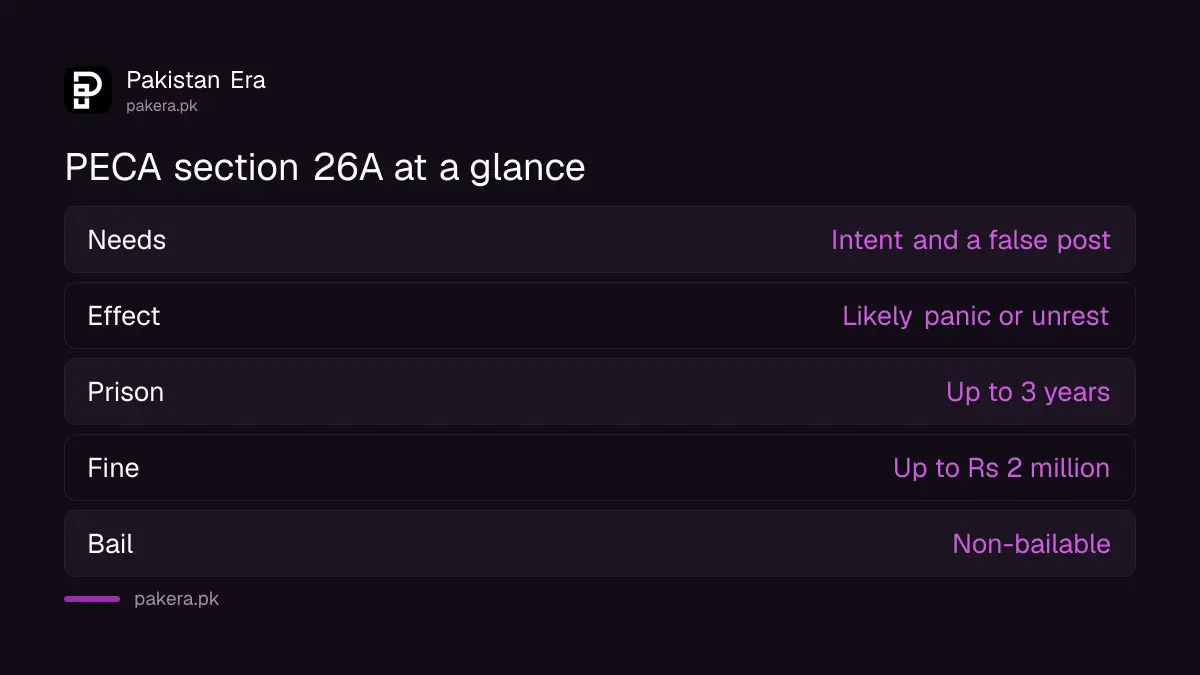
| Question | What section 26A says |
|---|---|
| What is covered | Disseminating, publicly exhibiting or transmitting information through any information system |
| What state of mind | Knows, or has reason to believe, it is false or fake |
| What effect | Likely to cause fear, panic, disorder or unrest in the public or society |
| Prison | Up to 3 years |
| Fine | Up to Rs 2 million, or both prison and fine |
The offence is cognizable and non-bailable
As amended, section 43 treats offences under section 26A as non-bailable, non-compoundable and cognizable by the investigation agency. Cognizable means the agency can start a case without a court order. Non-bailable means bail is not a right and a court decides.
That is different from most PECA offences, which the Act leaves bailable and compoundable. Compoundable means the two sides can settle and end the case. Under 26A, that route is not open. Our guide on getting bail in Pakistan explains the difference in plain terms.
The NCCIA investigates and an Authority can order content removed
The 2025 amendment names the National Cyber Crime Investigation Agency (NCCIA) as the investigation agency under the Act. It also creates a Social Media Protection and Regulatory Authority. Under section 2C, anyone harmed by fake and false information may apply to it for removal or blocking.
The Act says the Authority must pass its orders on such an application forthwith, and not later than 24 hours. We could not verify from the Act whether the Authority is working today. Section 50A says the PTA and the old investigation agency continue until the new bodies are set up, so ask which body handles your complaint.
The same Act, in section 20, separately punishes a knowingly false post that intimidates a person or harms their reputation or privacy: up to 3 years or a fine up to Rs 1 million. Our guide on sending a defamation notice over a false post covers that side.
How to check a post before you share it
Look for the original source, check the date and look for an official statement. If you cannot find any of these, do not forward it. A post that makes you feel panic is the one to slow down on.
- Find who first posted it. A screenshot with no account name is a warning sign.
- Check the date. Old videos return as new events.
- Look for the same news on an official page, such as the relevant ministry, district administration or police.
- If it is a video or voice note, see our guide to spotting a deepfake scam video or cloned voice.
- If you cannot confirm it, do not forward it. Say nothing, or say it is unconfirmed.

What to do if a false post harms you, or if you are accused
If a false post is about you, take screenshots with the link and date, apply for removal under section 2C and report it to the NCCIA. If you are accused, do not delete messages before you speak to a lawyer, and do not sign anything you have not read.
Our guide on reporting a cybercrime to the NCCIA sets out the complaint steps. For harassment with private images, see how to report online blackmail. A free lawyer is an option: free legal aid in Punjab and the 1818 helpline in Supreme Court free legal aid.
Common questions
What is the punishment under PECA section 26A?
Imprisonment up to 3 years, a fine up to Rs 2 million, or both. The text is in the Prevention of Electronic Crimes (Amendment) Act, 2025.
Is it a crime to share something false by mistake?
The section requires that you act intentionally and that you know or have reason to believe the information is false. A genuine mistake is not the same, but a court decides the facts.
Can I get bail?
The offence is non-bailable under section 43, which means bail is not a right. A court decides on bail after hearing both sides.
Does deleting the post make me safe?
No. Deleting may reduce harm, but the Act punishes the sharing. Talk to a lawyer before you delete evidence that matters.
Who can apply to remove a false post about me?
Any person aggrieved by fake and false information may apply to the Authority under section 2C. The Act says it should decide within 24 hours.
Which agency investigates these cases?
The amended Act names the National Cyber Crime Investigation Agency. The Act also keeps the old agency working until the new body is set up.
How we verified this
What we checked, where we read it, and what we could not confirm.
We read the Prevention of Electronic Crimes (Amendment) Act, 2025 on the National Assembly website and the Prevention of Electronic Crimes Act, 2016 on Pakistan Code on 12 October 2026. We did not read any court judgment on section 26A, and we did not check the status of the new Authority. Laws change, so check the current text.
About the author

Senior Writer, Public Services and Technology
Shahid joined us in 2024 as an author. He is a senior contributor to Pakistan's leading technology websites. He writes detailed articles, mostly covering his expertise in the latest tech, mobiles, apps, gadgets, and step-by-step guides. His ideology is to help people understand the latest trends and explain complex methods through very easy-to-understand guides.